New card? The sign-up offers in Singapore right now, and the conditions behind each one
Singapore credit card sign-up offers as at 25 Nov 2026: cash back, miles with no fee and 30,000-mile deals, with the minimum spend and end date for each.

Last Sunday, after dinner at my parents' place, my mum was cutting oranges and my sister had her phone out under the table, the way she does when she's about to ask me something she has already half decided.
"Brandon. This one says 30,000 miles if I sign up. If I sign up now, the miles come before Da Nang or not?"
She's going to Da Nang in December with two friends from the hospital, and someone in their group chat had sent round a card offer. My dad, reaching for an orange slice, asked the more important question: "Thirty thousand miles for what?"
That's the whole post, really. Every sign-up offer is a trade. The bank gives you cash or miles, and in return you open a card, sometimes pay a fee, and spend a set amount within a set number of days, before a set date. The gift is real. So are the conditions, and they're printed in a size that suggests nobody expects you to read them.
Part of my job at Sum is reading card terms when they change, so I sat with her phone and went through it. This week's carousel lists the sign-up offers I could confirm on each bank's own page on 25 November 2026. I'll go through it slide by slide, with the conditions the slides only have room to hint at, and some arithmetic.
A sign-up offer is a reward for a condition
A sign-up offer (banks also call it a welcome gift) is a one-off reward for opening a new card. In Singapore it usually comes in one of two forms: cash credited to the card, or miles (or points that convert to miles) credited to your rewards account.
Almost every one has the same four conditions:
- You're a new customer, by that bank's definition.
- You spend a minimum amount, such as $800.
- You do it within a window, such as 60 days from approval.
- You apply before the offer ends, such as 31 December.
Some add a fifth: a promo code at application, an app you need to have, or a fee you must pay. Miss any one and the gift doesn't come.
So when the cover says "get paid to sign up", that's true in the way a cashback card is "paying you": only after you've done what the terms ask.
What this means for you: before comparing gifts, it's worth knowing roughly what you put on cards in a normal month. A $365 gift that needs $800 in 60 days is easy for some people and a stretch for others, and the only number that decides which you are is your own.
Cash back for signing up
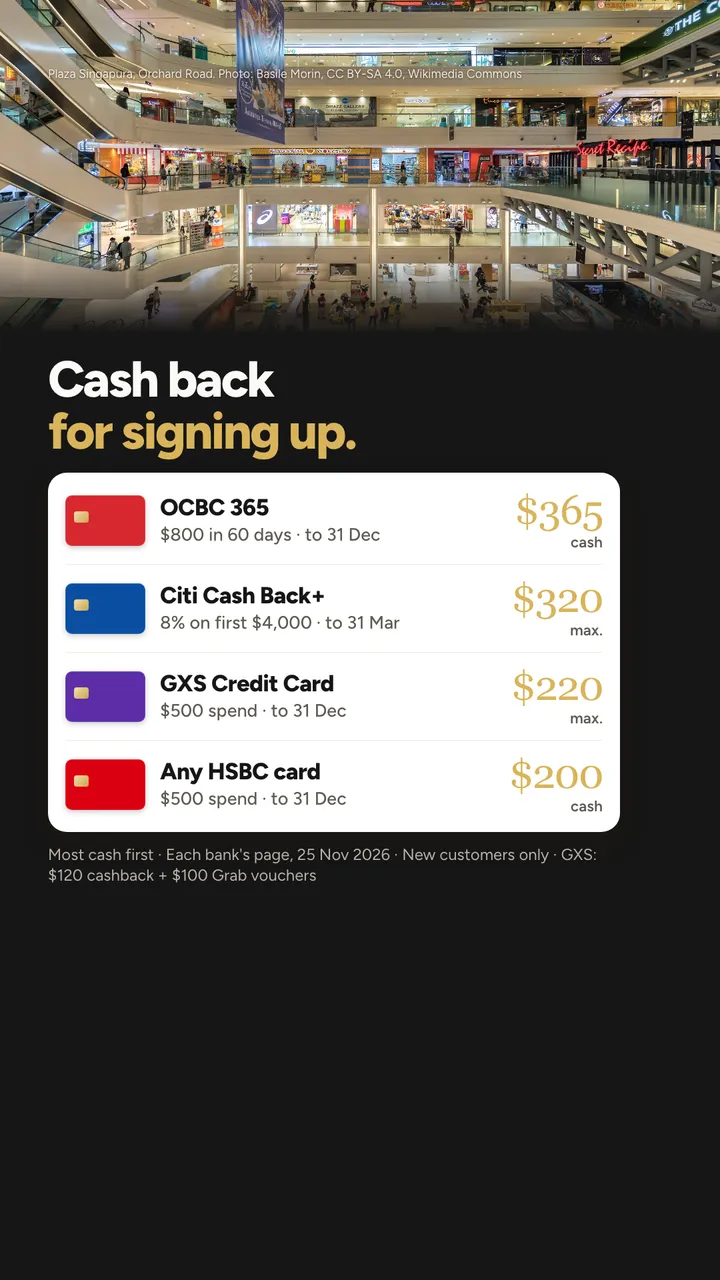
Four cash offers, ranked by the most cash you can get:
| Card | Gift | Condition | Ends |
|---|---|---|---|
| OCBC 365 | $365 cash | $800 in 60 days | 31 Dec 2026 |
| Citi Cash Back+ | up to $320 | 8% on the first $4,000 | 31 Mar 2027 |
| GXS Credit Card | up to $220 | $500 spend | 31 Dec 2026 |
| Any HSBC card | $200 cash | $500 spend | 31 Dec 2026 |
They aren't quite the same kind of gift, and the differences matter more than the headline.
A flat gift (OCBC 365, HSBC) is all or nothing. Spend $800 within 60 days on the OCBC card and you get $365. Spend $790 and you get nothing. Put the other way, $365 back on $800 of spending is about 46% back on that $800 ($365 divided by $800), which is why banks can only offer it once.
A percentage gift (Citi Cash Back+) scales with what you spend. It's 8% on your first $4,000, so the $320 is the most you can get: 8% of $4,000. Say Marcus spends $1,500 in the window. This is made up, but it's a fairly ordinary month and a bit. He'd get 8% of $1,500, which is $120, not $320. To get the full $320 he'd need the whole $4,000.
A mixed gift (GXS) is part cash and part vouchers. The slide's footnote says the $220 is $120 cashback plus $100 in Grab vouchers. If you use Grab anyway, the vouchers are close to cash. If you don't, the gift is really $120.
What this means for you: for a flat gift, check you can hit the minimum in the window without changing how you spend. For a percentage gift, work out the gift on your likely spend, not the maximum. For vouchers, value them at what you'd actually use.
Miles, with no fee to pay
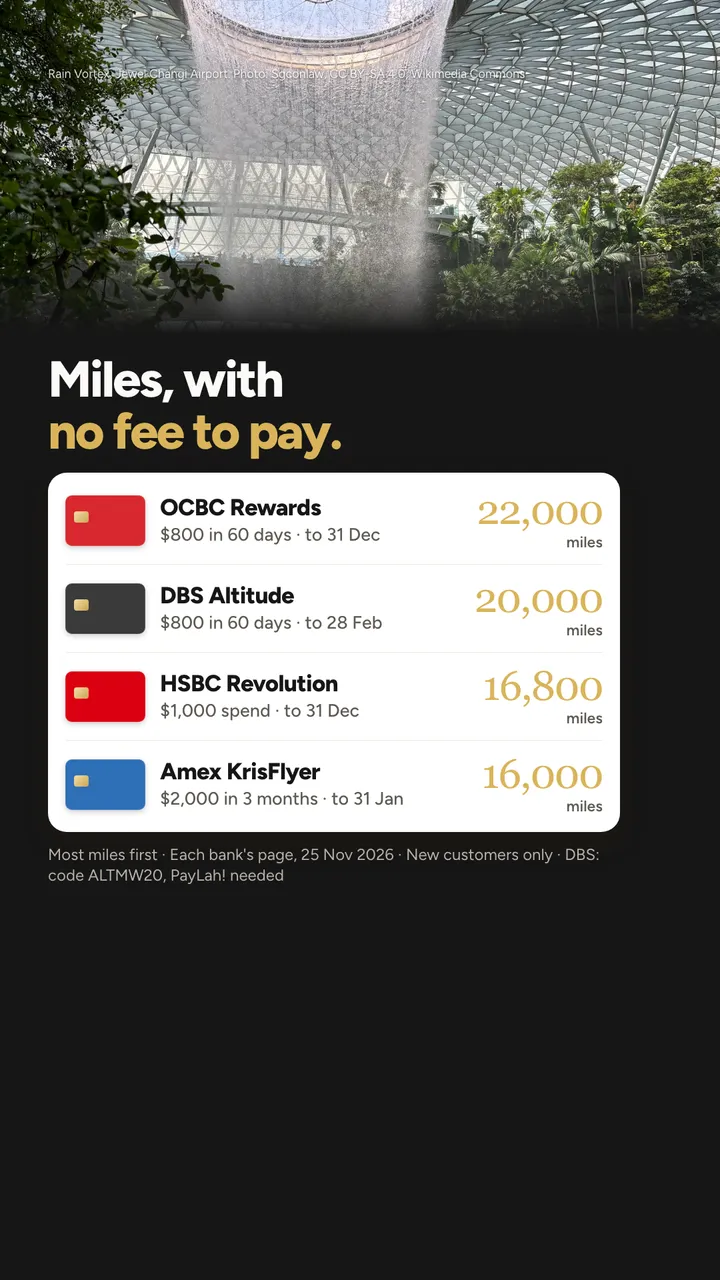
These are miles offers where you don't pay a first-year fee to get the gift:
- OCBC Rewards: 22,000 miles for $800 in 60 days, to 31 December.
- DBS Altitude: 20,000 miles for $800 in 60 days, to 28 February, with the code ALTMW20 and PayLah! needed.
- HSBC Revolution: 16,800 miles for $1,000 spend, to 31 December.
- Amex KrisFlyer: 16,000 miles for $2,000 in 3 months, to 31 January.
A useful way to compare them is miles per dollar of minimum spend: the gift divided by what you have to spend to get it.
| Card | Miles | Minimum | Miles per $1 of minimum |
|---|---|---|---|
| OCBC Rewards | 22,000 | $800 | 27.5 |
| DBS Altitude | 20,000 | $800 | 25 |
| HSBC Revolution | 16,800 | $1,000 | 16.8 |
| Amex KrisFlyer | 16,000 | $2,000 | 8 |
That number is only a rough guide, because the windows differ too: 60 days, 3 months, or (for HSBC, on the slide) no window shown, which is a reason to read the bank's terms rather than assume. Whether the gift comes on top of the miles the card earns normally on that spending is in each offer.s terms too.
What this means for you: if an offer has a promo code, it's worth copying it from the bank's own page at the moment you apply, and keeping a screenshot of the offer with the date on it.
Pay the fee, get 30,000 miles
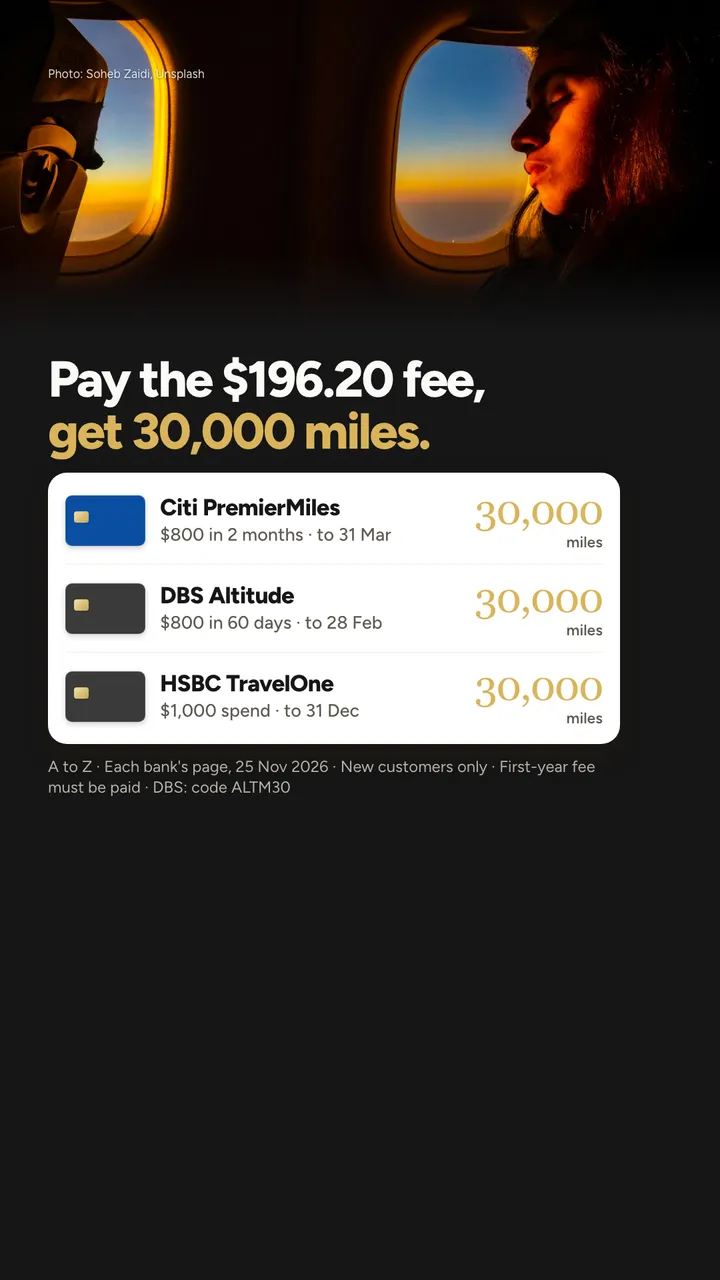
Three cards give 30,000 miles if you pay the $196.20 first-year annual fee: Citi PremierMiles ($800 in 2 months, to 31 March), DBS Altitude ($800 in 60 days with the code ALTM30, to 28 February) and HSBC TravelOne ($1,000 spend, to 31 December). They're listed A to Z because the gift is the same.
Here's the thing I find most useful on this slide: DBS Altitude appears on both. Without the fee, 20,000 miles. With the $196.20 fee, 30,000 miles. Same card, same $800 minimum. So you can put a price on the difference:
$196.20 for 10,000 extra miles is $196.20 divided by 10,000, which is about 2 cents a mile.
Whether 2 cents a mile is good value isn't something I can answer for you. It depends entirely on what you'd use the miles for, which is the next slide. But it turns "should I pay the fee?" from a feeling into a number you can compare.
What this means for you: when a card offers more miles for paying the fee, divide the fee by the extra miles. Then you know what you're really buying. I wrote about how the Altitude card earns after the gift in my DBS Altitude review, and about the other two in the Citi PremierMiles and HSBC TravelOne reviews.
What 30,000 miles actually gets you
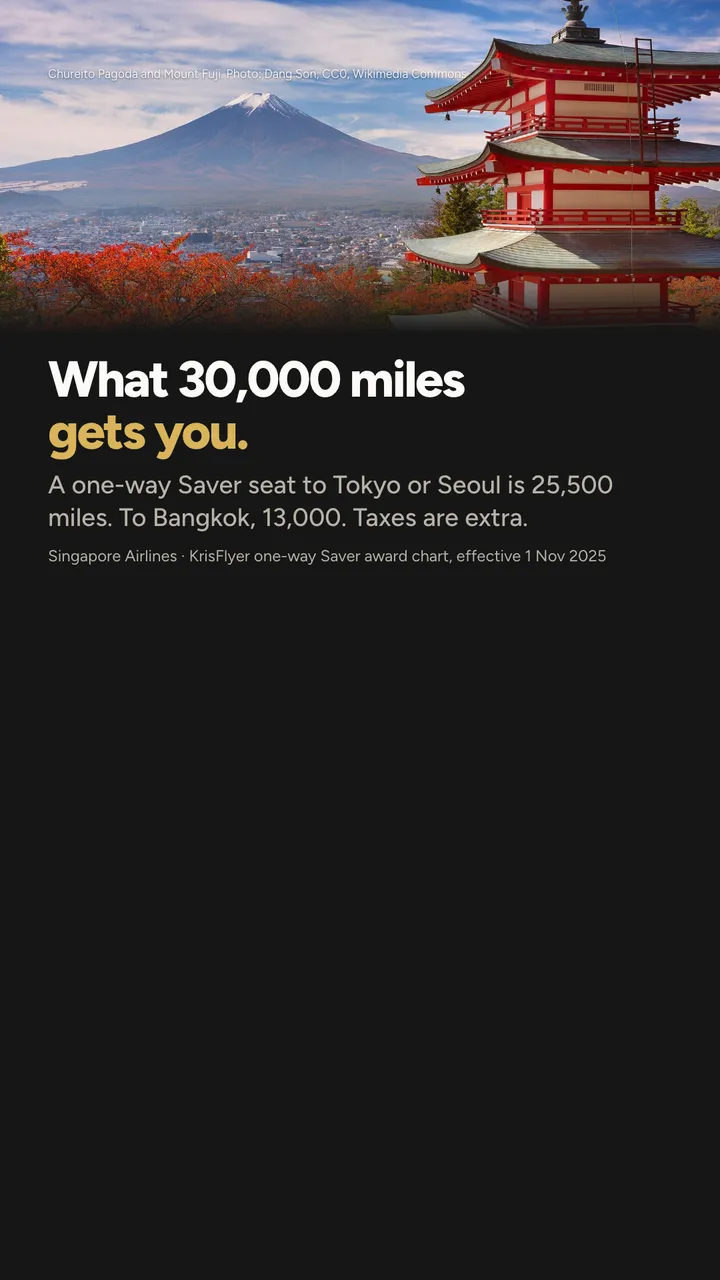
Miles are only worth what you can turn them into, so this slide puts 30,000 miles against Singapore Airlines' own award chart. On the KrisFlyer one-way Saver chart effective 1 November 2025, a Saver seat from Singapore to Tokyo or Seoul is 25,500 miles, and to Bangkok it's 13,000. Taxes and surcharges are paid in cash on top.
So, with 30,000 miles:
- One way to Tokyo uses 25,500, leaving 4,500. Coming back needs another 25,500 you don't have yet.
- There and back to Bangkok is two one-way seats, 13,000 plus 13,000, which is 26,000, leaving 4,000.
That's why I'd describe a 30,000-mile gift as "a short trip, or half a longer one", not a free holiday. And Saver seats are limited, so having the miles doesn't guarantee a seat on the date you want.
If you go back to the 2 cents a mile from the last section, a one-way Tokyo seat at 25,500 miles is roughly 25,500 times 2 cents, about $500 of fee-equivalent miles, plus the taxes. You can compare that with the cash fare for your dates, which is the only fair test.
What this means for you: before chasing miles, it's worth checking that the route you'd actually fly is on the chart at a number you can reach, and how long your miles last before they expire. My dad found a KrisFlyer statement in a cupboard once, a little over 20,000 miles, long expired. I kept it, "for reference".
Bigger offers, bigger conditions
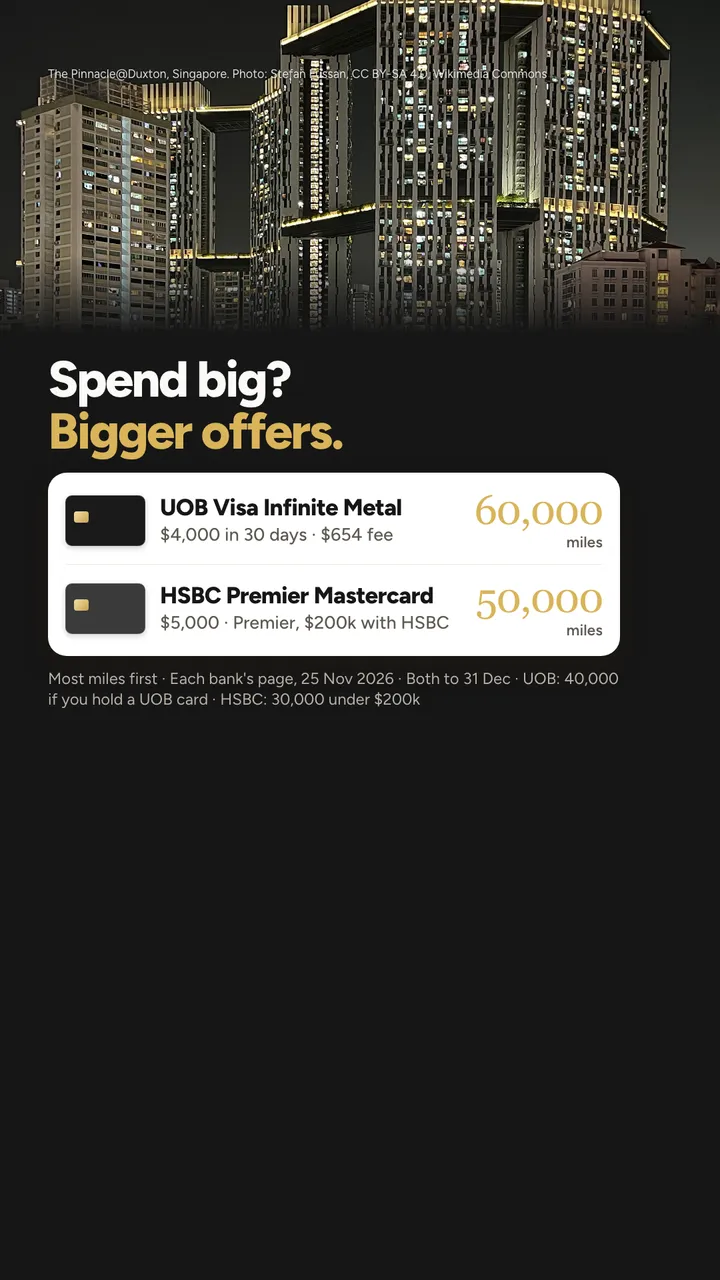
Two premium offers, both ending 31 December:
- UOB Visa Infinite Metal: 60,000 miles for $4,000 in 30 days, with a $654 fee. If you already hold a UOB card, it's 40,000.
- HSBC Premier Mastercard: 50,000 miles for $5,000 spend, for HSBC Premier customers with $200,000 with HSBC. Under $200,000, it's 30,000.
The miles are bigger, and so is everything around them. $4,000 in 30 days is a lot of ordinary spending for most households; it usually means timing a big planned purchase, like an insurance premium or a renovation payment, to fall inside the window (and checking that kind of payment counts, because some don't). The HSBC offer depends on how much you have with the bank, which is a relationship condition, not a spending one.
Using the same arithmetic as before: $654 for 60,000 miles is about 1.1 cents a mile, but only if the $4,000 was spending you'd do anyway. If you'd have to find $4,000 of extra spending, the real cost is much higher.
What this means for you: for premium offers, read the "if you already hold" lines first. On both of these, existing customers or smaller balances get noticeably fewer miles than the headline.
Read this before you apply
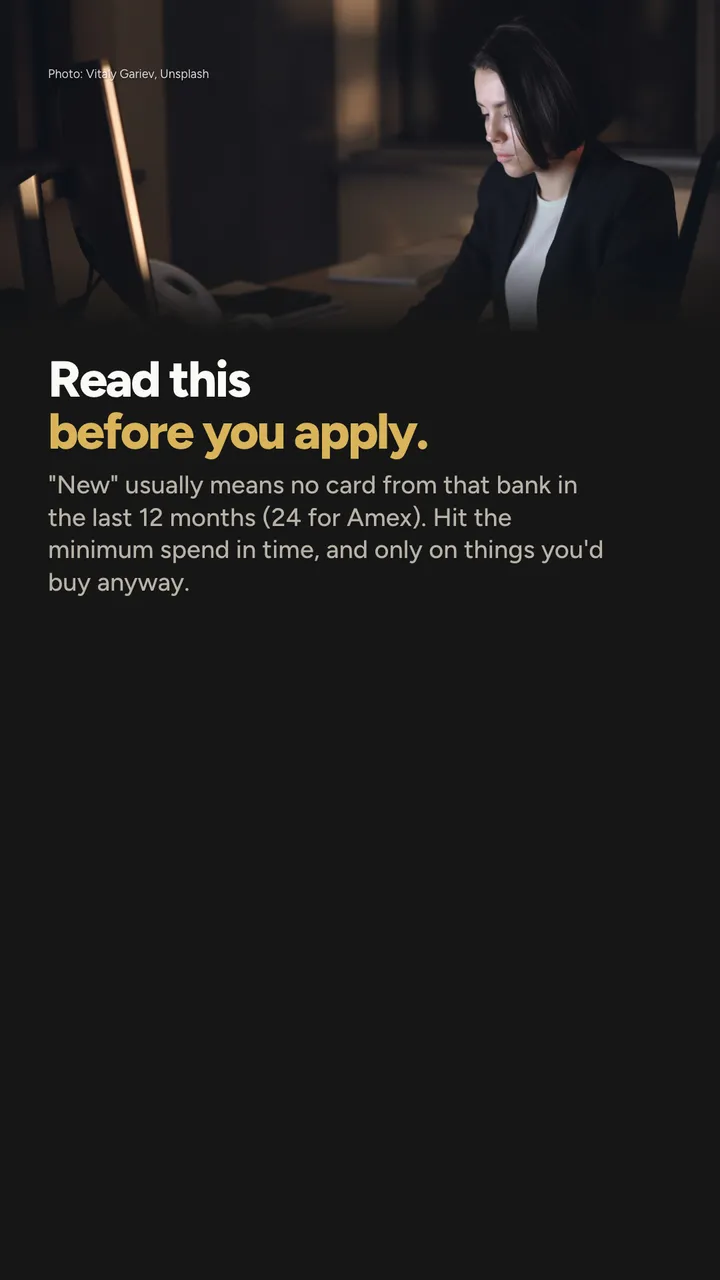
This is the slide I'd keep if you only kept one.
"New" has a definition. It usually means you haven't held a card from that bank in the last 12 months, or 24 for Amex. If you cancelled a card from the same bank last year, you may not qualify, and you'll often only find out when the gift doesn't arrive.
The window has a start date. "$800 in 60 days" counts from a date set in the terms, so it's worth checking when your 60 days begin, and writing the end date down somewhere you'll see it.
Only on things you'd buy anyway. This is the condition nobody prints. Say Wei Ling usually puts about $500 a month on her cards. This is made up, but it's a pretty ordinary picture. An offer needing $800 in 60 days fits her normal spending with room to spare: two months of $500 is $1,000. An offer needing $4,000 in 30 days doesn't. To get it she'd have to spend $3,500 more than usual in a month. If that's a purchase she was making anyway, fine. If it isn't, the gift has cost her more than it gave.
My sister has a yellow Post-it on her fridge, written years ago when she got her first card: "MIN SPEND = the bank's goal. Not mine." It has moved house with her twice, and it's still the clearest rule I know.
What this means for you: before applying, write down three things: the end date of the offer, the end date of your spending window, and whether the minimum fits your normal month.
Knowing how much more to spend
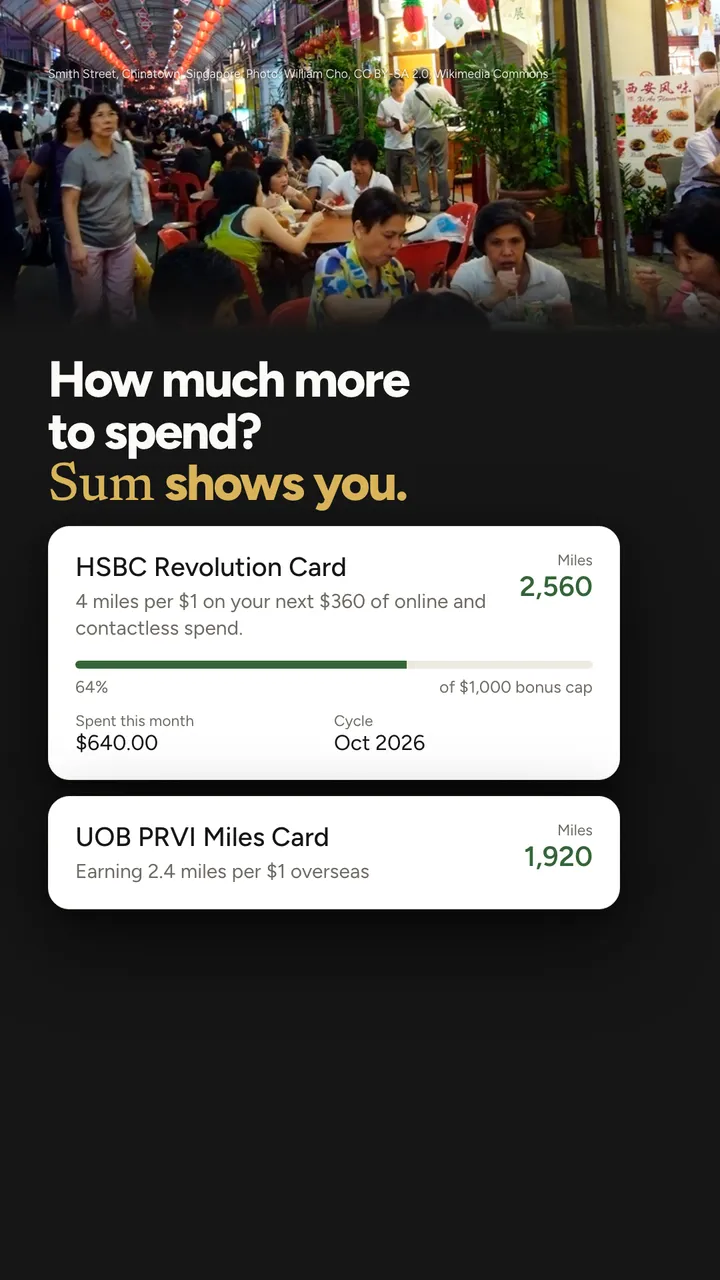
The hardest part of a sign-up offer isn't the arithmetic, it's knowing where you stand halfway through the window. Banks show you a statement once a month, which is too late to help.
This slide shows Sum's card trackers on sample data. The HSBC Revolution card has $640 spent this month, 64% of its $1,000 bonus cap, and the tracker says plainly what's left: 4 miles per $1 on the next $360 of online and contactless spend. Below it, a UOB PRVI Miles card is earning 2.4 miles per $1 overseas.
What this means for you: whatever you use, the useful question during a sign-up window is "how much more do I need, and by when?", not "how much have I spent?".
If you only remember three things
- A sign-up gift is a reward for a condition: new customer, minimum spend, a window and an end date. Miss one and there's no gift.
- Put a price on it. Divide a fee by the extra miles, and work out a percentage gift on your likely spend, not the maximum.
- Only spend what you'd spend anyway. A gift you spend extra to earn isn't a gift.
How I keep track of this
On the first of the month, with a kopi, I import last month's card statements into Sum, and each card's tracker shows what I spent on it, where it stands against its minimum spend and cap, and what it earned. When a card is new, I check it more often, because a 60-day window is two statements and I'd rather not find out on the second one that I was $40 short. The card optimiser is part of Sum's free plan, and Sum is free to start. If you want the rates the cards pay after the gift, I went through them category by category in which card pays most for what you buy.
As for my sister: we went through her offer at the table, end date, window, minimum, and whether her December spending would get there without trying. I didn't tell her which card to take, and she hasn't said. On Wednesday she sent a photo of the Post-it on her fridge. Under "MIN SPEND = the bank's goal. Not mine." she'd added a second line in a different pen: "And check the date."
If there's a card offer you'd like me to work through, email me at [email protected]. I read every one.
Talk soon, Brandon
Questions people ask
What does "new customer" mean for a credit card sign-up offer in Singapore?
Usually that you haven't held a card from that bank in the last 12 months, or 24 months for American Express. Each bank sets its own rule in the offer's terms, so it's worth reading them before you apply.
How do I know whether paying a card's first-year fee for more miles is worth it?
Divide the fee by the extra miles. On the offers as at 25 Nov 2026, DBS Altitude gave 20,000 miles with no fee or 30,000 miles if you paid the $196.20 fee, so the extra 10,000 miles cost about 2 cents each. Whether that is good value depends on what you'd use the miles for.
Try the numbers yourself

Sum is launching in Singapore soon.
Your banks, cards, CPF and HDB flat, added up into one net worth. Statements sorted, card caps tracked, bills remembered.
Brandon · Finance team, Sum
Brandon is on Sum's finance team in Singapore. Brandon reads the CPF Board, IRAS and MAS updates so you don't have to, and turns our carousels into the longer version. Questions, corrections or something to share? Email Brandon at [email protected].
Got something interesting to share?
A money story, a question, something we got wrong, or a tip other Singaporeans should hear. Reach out to me at [email protected], or leave your email and I'll write to you.
Sources: OCBC: 365 Credit Card; Citi: Citi Cash Back+ Card; GXS Bank: GXS Credit Card; HSBC: Revolution Credit Card; HSBC: TravelOne Credit Card; DBS: Altitude Card; Citi: PremierMiles Card; Singapore Airlines: KrisFlyer one-way Saver award chart, effective 1 Nov 2025 (PDF).
Any app screens shown use sample data, not a real person's. Sum is free to start; some features need a paid plan.
Information only, not financial advice.