Which card pays most for what you buy? Eating out, groceries, online, transport and miles
Singapore cashback and miles cards ranked by rate for eating out, groceries, online, transport and travel, as at Nov 2026, with the minimums and caps.

A few Fridays ago, four of us from Sum went for dinner at the hawker centre near the office. Satay, carrot cake, a plate of sambal stingray we argued about for ten minutes. When the stingray stall auntie said "$28, can tap", Arjun, one of our backend developers, took out his wallet and laid four cards on the table like a hand at mahjong.
"OK, Brandon. Which one is for food?"
Hui Min, one of our designers, looked at the cards. "Isn't it the same everywhere? It's just a card."
It isn't, and that's most of my job. When a bank changes a card's rewards, I'm the one who reads the new terms so Sum's card optimiser stays right. So I know, for example, that "food" on one card means restaurants and on another means restaurants only if you've chosen dining as one of your categories, and only once you've spent $1,600 that month. What I didn't have that night was a simple answer for Arjun. He tapped the first card his thumb found (I didn't ask which), and the auntie had already moved on to the next customer.
This post is the simple answer, or as simple as it gets. Our carousel this week ranks Singapore's cashback and miles cards by rate in each everyday category, from each bank's own terms as at November 2026. I'll go through it one slide at a time, with the minimums, the caps and the arithmetic that the slides only have room to hint at.
The card that pays most depends on what you're buying
Most cashback and miles cards in Singapore pay a bonus rate on a few categories and a much lower base rate on everything else. The bonus usually comes with two conditions:
- a minimum spend: the total you must put on that card in a month (or a statement cycle) before any bonus is paid;
- a cap: the most bonus the card will pay in a month, or sometimes a quarter, after which the rate drops back.
So a card's headline rate is the start of the story, not the end. Every slide that follows lists the top four cards for one category, ranked by rate (ties A to Z), with the minimum and cap underneath. Cashback and miles are on separate slides, because a percentage and a "miles per $1" aren't the same unit and comparing them needs a value per mile that is up to you.
What this means for you: before comparing rates, it's worth writing down roughly what you spend in a month on eating out, groceries, online shopping and transport. The rest of this post only makes sense against your own numbers.
Eating out: 8% has a catch, and it's the cap
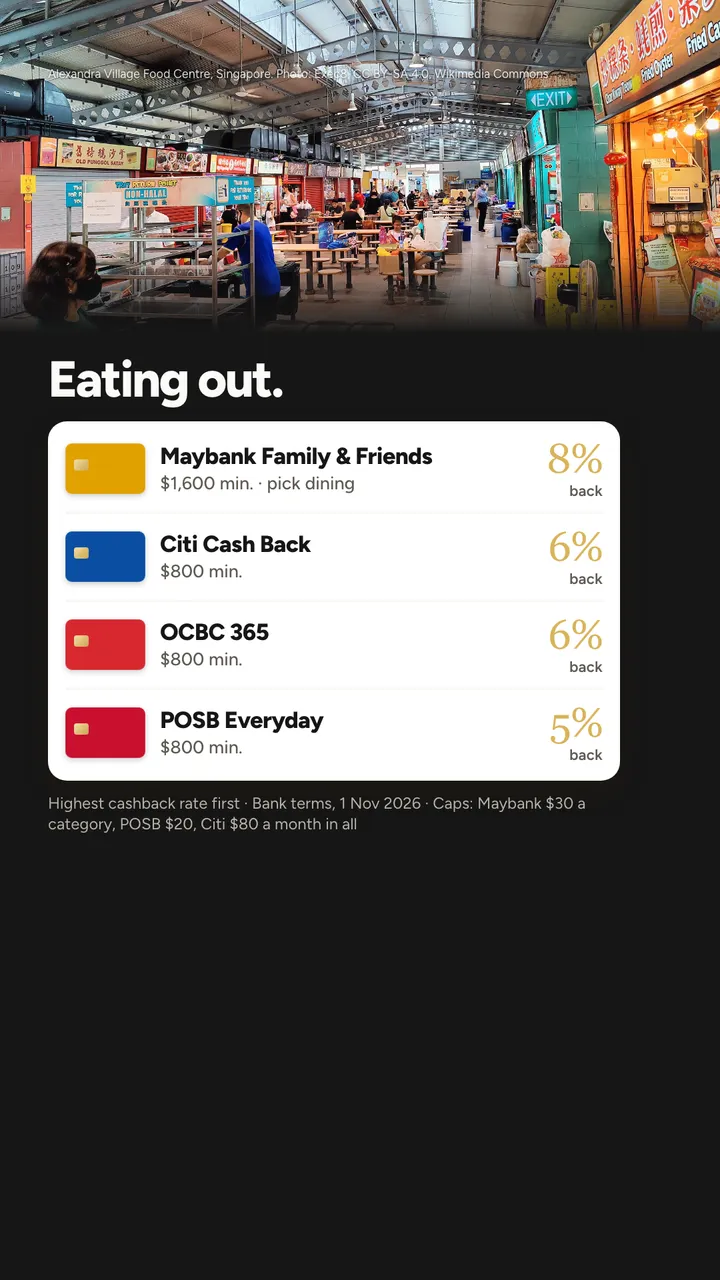
Maybank Family & Friends pays the highest rate on dining, 8%, but only if you pick dining as one of your categories and spend $1,600 on the card that month. Citi Cash Back and OCBC 365 pay 6% and POSB Everyday 5%, each with an $800 minimum.
Here's where the cap changes the picture. Say Jun Hao is 29 and spends $450 a month eating out. This is an example, not a real person.
| Card | Rate | Bonus on $450 | Cap | What he gets |
|---|---|---|---|---|
| Maybank Family & Friends | 8% | $36.00 | $30 a category | $30.00 |
| Citi Cash Back | 6% | $27.00 | $80 a month in all | $27.00 |
At 8%, $450 would earn $36, but the cap stops it at $30. So the 8% card pays Jun Hao $3 a month more than a 6% card, and asks him to put $1,600 on it instead of $800. Whether that's worth it depends on whether he already spends $1,600 on one card. If he doesn't, he'd earn the bonus on neither.
What this means for you: divide the cap by the rate to see the most spending a bonus covers. $30 divided by 8% is $375. Any dining above $375 a month on that card earns no bonus.
Groceries: the highest rate has the highest bar
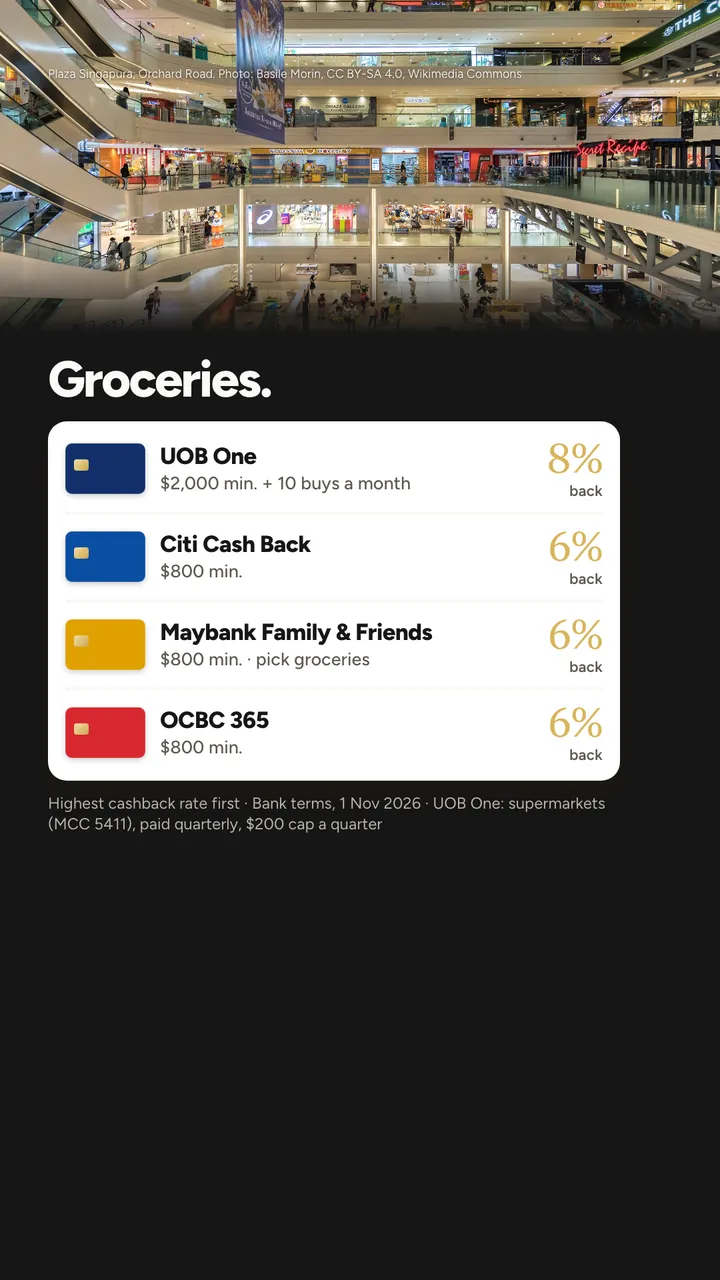
UOB One pays 8% at supermarkets, but it asks the most of you: $2,000 of spending a month and at least 10 purchases. It's also paid quarterly, with a $200 cap a quarter. The next three, Citi Cash Back, Maybank Family & Friends (with groceries picked) and OCBC 365, pay 6% from $800.
"MCC 5411" on the slide is a merchant category code, a four-digit label the card network gives every shop. 5411 means grocery stores and supermarkets. The card doesn't know what you bought, only the code of the shop you bought it in. That's why a supermarket inside a department store, or groceries bought on a marketplace, may not count.
A worked example. Say Jun Hao also spends $500 a month at the supermarket.
- On UOB One, if he meets the $2,000 and 10 purchases every month: $500 × 8% = $40 a month, or $120 a quarter. That's under the $200 quarterly cap.
- On a 6% card with an $800 minimum: $500 × 6% = $30 a month, or $90 a quarter.
The difference is $30 a quarter, for putting $1,200 more on the card every month and keeping count of 10 purchases. For some households that's easy, because the card already carries most of the family's spending. For others it's a stretch.
What this means for you: if you're unsure whether your supermarket counts, your statement often gives it away. If the bonus never appeared for that shop, the code is probably different.
Shopping online: why a 10% card can really be 6%
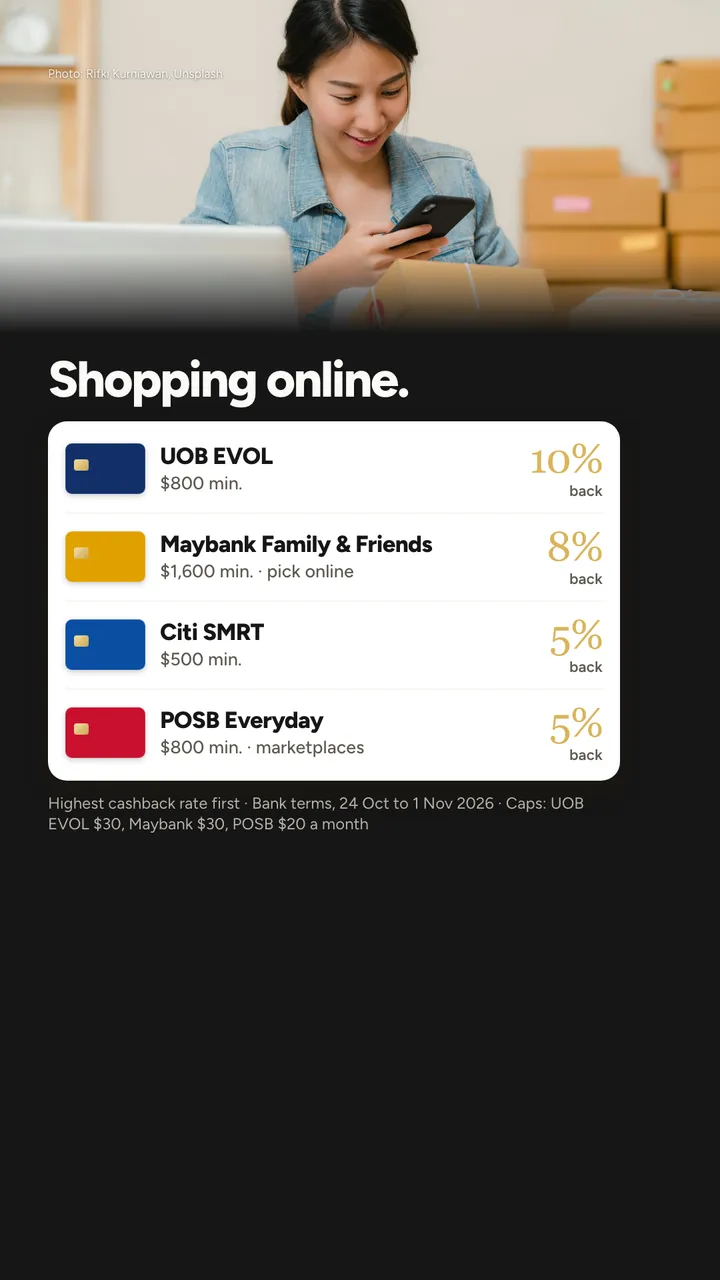
UOB EVOL pays 10% on online spending from $800 a month, Maybank Family & Friends 8% with online picked, and Citi SMRT and POSB Everyday 5% (POSB on the big marketplaces).
The cap on UOB EVOL is $30 a month. $30 divided by 10% is $300. So the 10% applies to the first $300 of online spending each month and no more. If you spend $500 online in a month, you still get $30, which works out to $30 ÷ $500 = 6% on the lot.
I find this one of the most useful sums in cards: cap ÷ rate = the spending the bonus covers. Do it for every card you hold and you'll know where each one stops being worth reaching for.
What this means for you: when I imported my first month of card statements into Sum, the third-biggest category was a pile of small online orders under $20 each. If online is one of your big categories too, the cap matters more than the rate.
Getting around: "transport" means different things on each card
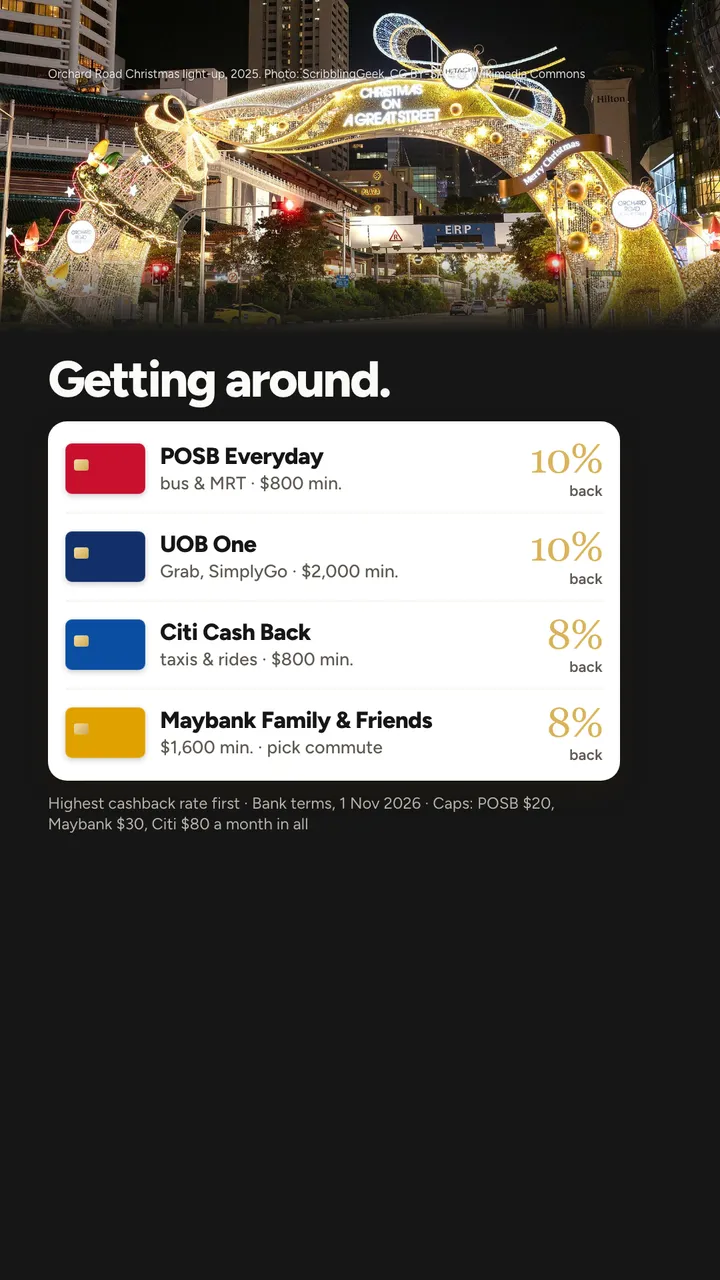
Read the small line under each card on this slide, because each bank draws the transport line in a different place. POSB Everyday's 10% is on bus and MRT fares. UOB One's 10% is on Grab and SimplyGo. Citi Cash Back's 8% is on taxis and ride-hailing. Maybank Family & Friends' 8% needs commute picked as a category.
A worked example. Say Mei Xin, 31 (also an example), taps her card for bus and MRT and spends about $120 a month on fares, plus $80 on rides home after late shifts.
- POSB Everyday on fares, if she spends $800 on the card: $120 × 10% = $12, well under the $20 cap.
- Citi Cash Back on rides, if she spends $800 on it: $80 × 8% = $6.40.
Neither is a big number on its own. Over a year, $12 a month is $144, which is why people bother.
What this means for you: if you tap a card at the MRT gantry, it's worth checking which of your cards it is. A card that pays well on rides may pay only its base rate on fares.
Miles in Singapore: 4 miles per $1, until $1,000
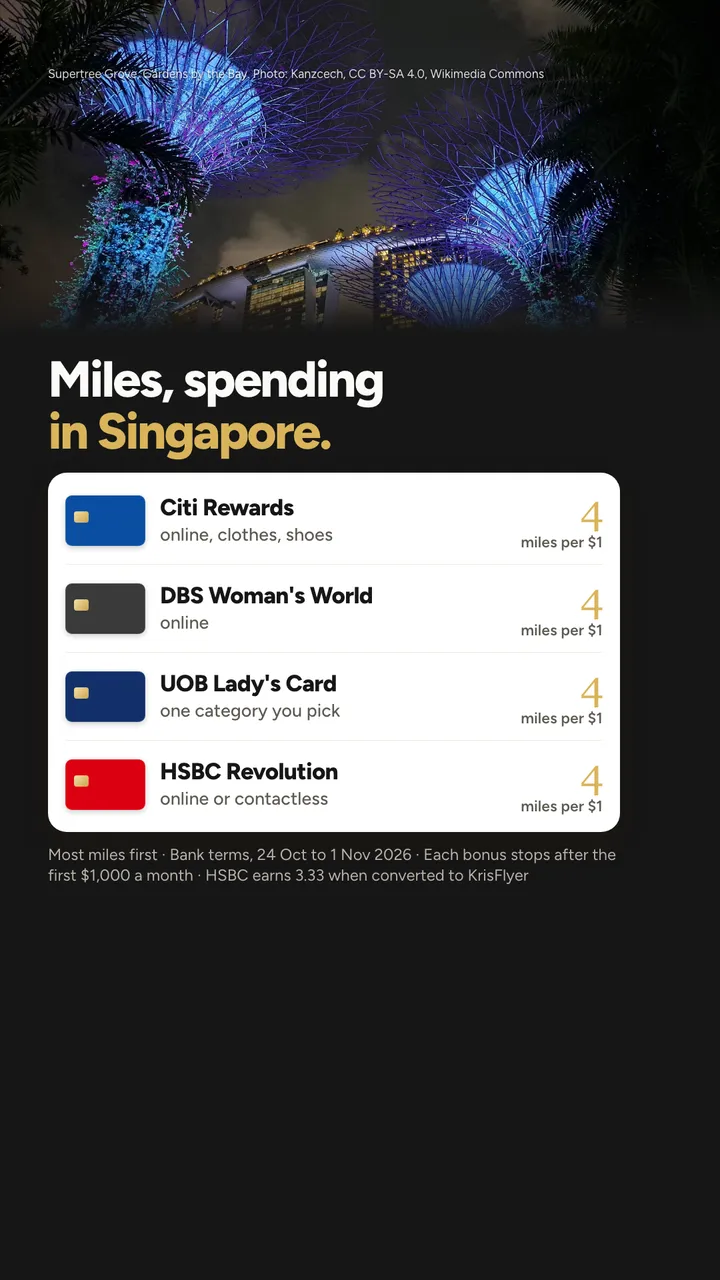
Four cards earn 4 miles per $1 on local spending in their bonus categories: Citi Rewards (online, clothes and shoes), DBS Woman's World (online), UOB Lady's Card (one category you pick) and HSBC Revolution (online or contactless). Each bonus stops after the first $1,000 a month, so the most bonus miles any of them earns in a month is $1,000 × 4 = 4,000.
The HSBC line needs a word. HSBC's card earns its own points, and those points convert to KrisFlyer miles at a rate that works out to 3.33 miles per $1, not 4. If KrisFlyer is where your miles go, 3.33 is the number to use.
A worked example. Say Mei Xin spends $600 a month online.
- On a card earning 4 miles per $1 online: $600 × 4 = 2,400 miles a month.
- On HSBC Revolution, converted to KrisFlyer: $600 × 3.33 = 1,998 miles, roughly 2,000.
Over a year that's 28,800 against about 24,000. I wrote more about how miles cards work, and what a mile is worth, in our miles cards comparison.
What this means for you: "online" is decided by how the shop's payment is coded, not by whether you used your phone. Ethan's reviews of each card list what counts, for example the Citi Rewards review and the UOB Lady's Card review.
Miles overseas: small differences, big trips
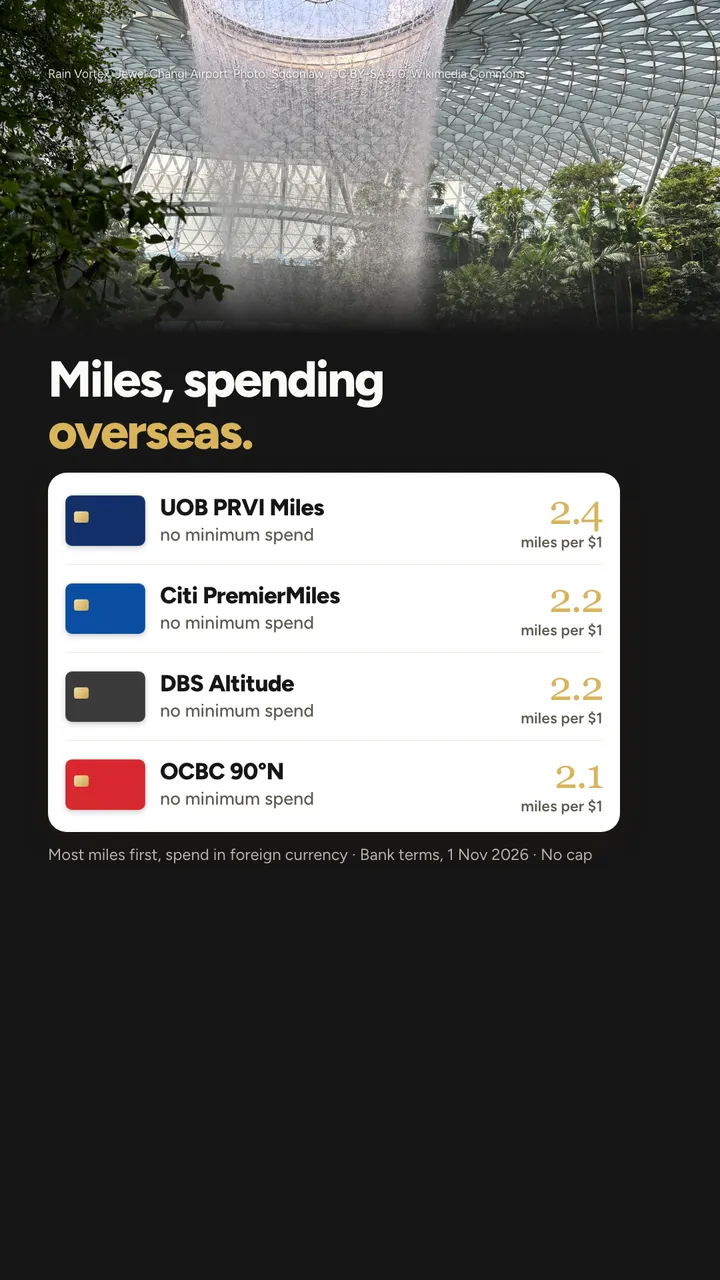
General miles cards pay more on spending in a foreign currency than at home. UOB PRVI Miles earns 2.4 miles per $1, Citi PremierMiles and DBS Altitude 2.2, and OCBC 90°N 2.1. None needs a minimum spend and none has a cap.
The gaps look tiny. On a big trip they add up. Say a couple spends $3,000 on a holiday in Japan, all in yen:
| Card | Miles per $1 | Miles on $3,000 |
|---|---|---|
| UOB PRVI Miles | 2.4 | 7,200 |
| Citi PremierMiles | 2.2 | 6,600 |
| DBS Altitude | 2.2 | 6,600 |
| OCBC 90°N | 2.1 | 6,300 |
The gap between the top and bottom rows is 900 miles on one trip.
Note the words "spend in foreign currency". If a shop overseas asks whether you'd like to pay in Singapore dollars and you say yes, most of these cards treat it as local spending and pay the lower rate, and the shop's exchange rate is usually worse too. I picked the wrong one in a shop in Tokyo once, buying a souvenir for my mum, and only found out reading the terms on a slow Sunday. There's more on this in which card for which trip.
What this means for you: when a terminal or a website asks which currency to pay in, choosing the local currency is usually what earns the overseas rate.
No minimum, no categories: simple, and nearly as good
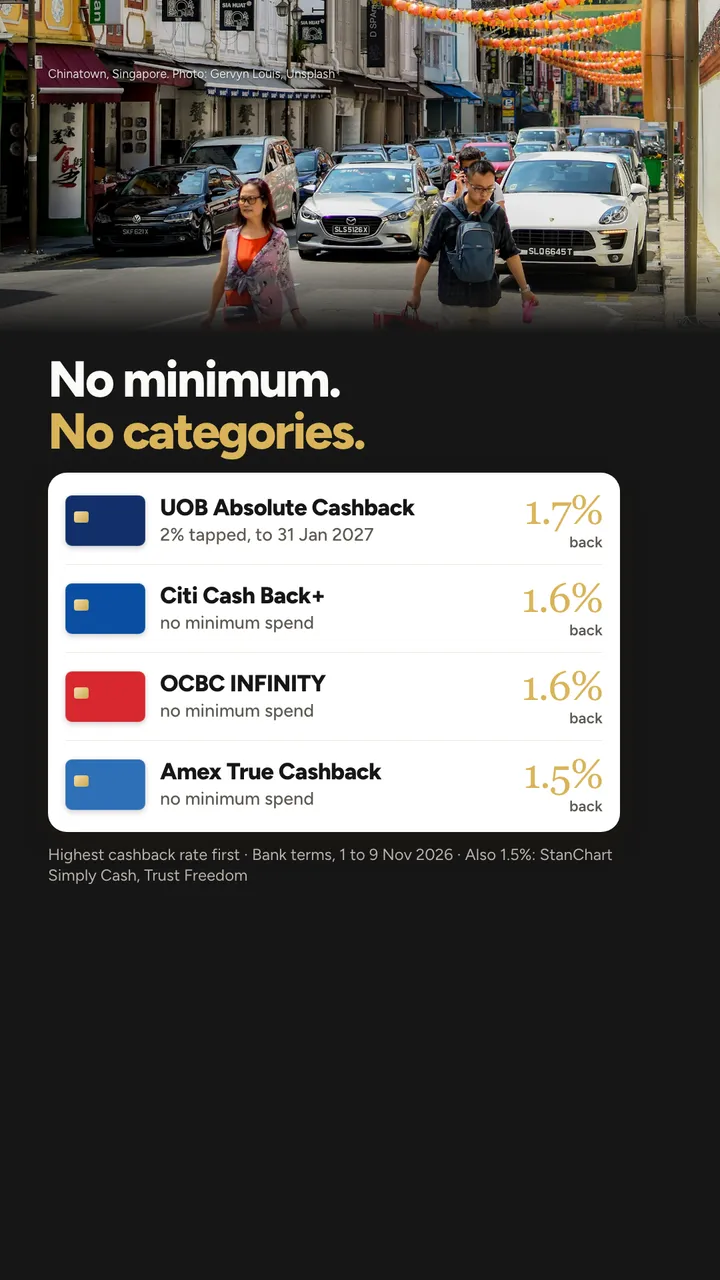
Some people would rather not track any of this, and that's a fair choice. These cards pay one rate on almost everything, with no minimum and no category to pick. UOB Absolute Cashback pays 1.7% (2% when you tap to pay, until 31 Jan 2027), Citi Cash Back+ and OCBC INFINITY 1.6%, and Amex True Cashback 1.5%. Standard Chartered Simply Cash and Trust Freedom also pay 1.5%.
A worked example. Say Jun Hao puts $1,500 a month on one card:
- at 1.7%: $1,500 × 1.7% = $25.50 a month;
- at 1.5%: $1,500 × 1.5% = $22.50 a month.
That's $3 a month, or $36 a year, between the top and bottom of the slide. Compare that with the eating-out example, where a category card earned $27 to $30 on $450 of dinners alone. A flat card earns less on your biggest categories, but it never misses a minimum and never quietly hits a cap.
What this means for you: a common pattern is one category card for the one or two things you spend most on, and a flat card for everything else. Whether that fits you depends on how much tracking you're happy to do.
Minimums and caps are the hard part, so track them
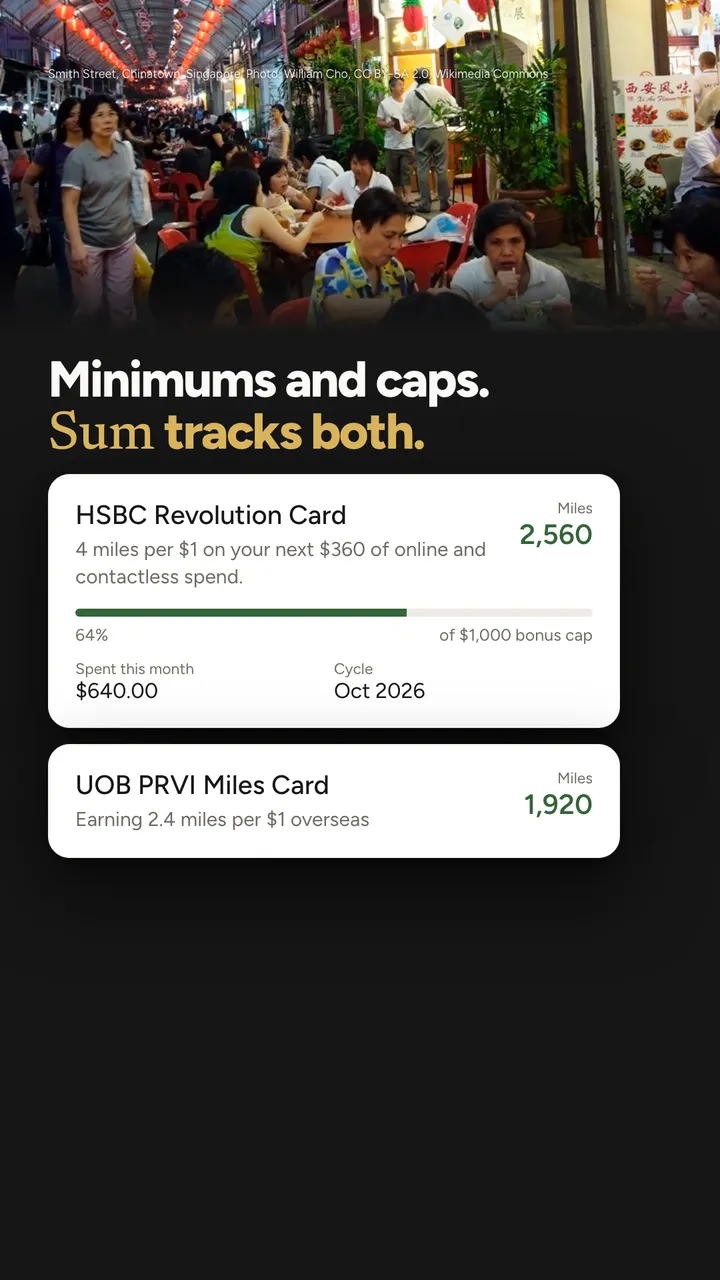
Every example above assumed someone knows, mid-month, how much they've put on each card and how close they are to the cap. Almost nobody does. That's the slide I care most about, because it's the gap between the rate on paper and the rewards you actually get.
This screen is Sum's card tracker, on sample data. The HSBC Revolution card has had $640 of online and contactless spending this month. Its bonus stops at $1,000, so $1,000 minus $640 leaves $360 still earning 4 miles per $1, and $640 is 64% of the way. The miles so far are $640 × 4 = 2,560. The UOB PRVI Miles card below it shows 1,920 miles earned on overseas spending.
What this means for you: the most useful time to know you're near a cap is before the purchase, not on the statement.
If you only remember three things
- The headline rate only applies between the minimum spend and the cap. Cap ÷ rate tells you where the bonus stops.
- Categories are decided by the shop's merchant code, and each bank draws the lines differently: "transport" can mean MRT on one card and Grab on another.
- Overseas, paying in the local currency is usually what earns the overseas rate.
How I keep track of this
On the first of the month, with a kopi, I import last month's card statements into Sum. Each card's tracker shows what it earned, and whether I hit the minimum and where the cap stopped me. During the month, if I'm about to make a bigger purchase, I check the tracker first. On cards like Maybank Family & Friends or UOB Lady's, where you choose the categories, Sum lets you set the ones you've picked, so the tracker counts the right spending. The card optimiser is part of Sum's free plan, and Sum is free to start.
A week after that dinner, Arjun messaged me a photo of the four cards on his desk, each with a sticky note on it: "food", "online", "MRT", "everything else". Then: "Is this right?" I said it depended on his caps. He replied with a thumbs up, and a fifth sticky note that said "caps?".
If there's a card question you'd like me to work through properly, email me at [email protected]. I read every one.
Talk soon, Brandon
Questions people ask
Which Singapore credit card gives the highest cashback on dining?
On the banks' terms as at 1 Nov 2026, Maybank Family & Friends pays 8% on dining when you pick it and spend $1,600 a month, capped at $30 a category. Citi Cash Back and OCBC 365 pay 6% and POSB Everyday 5%, each with $800 a month.
How do I work out how much a capped cashback card really pays?
Divide the monthly cap by the rate. A 10% bonus capped at $30 a month stops at $300 of spending ($30 divided by 10%). Anything you spend in that category above $300 earns no bonus that month.
Try the numbers yourself

Sum is launching in Singapore soon.
Your banks, cards, CPF and HDB flat, added up into one net worth. Statements sorted, card caps tracked, bills remembered.
Brandon · Finance team, Sum
Brandon is on Sum's finance team in Singapore. Brandon reads the CPF Board, IRAS and MAS updates so you don't have to, and turns our carousels into the longer version. Questions, corrections or something to share? Email Brandon at [email protected].
Got something interesting to share?
A money story, a question, something we got wrong, or a tip other Singaporeans should hear. Reach out to me at [email protected], or leave your email and I'll write to you.
Sources: Maybank: Family & Friends Card; Citi: Cash Back Card; OCBC: 365 Credit Card; POSB: Everyday Card; UOB: One Card; UOB: EVOL Card; Citi: SMRT Card; Citi: Rewards Card; DBS: Woman's World Card; UOB: Lady's Card; HSBC: Revolution Credit Card; UOB: PRVI Miles Card; Citi: PremierMiles Card; DBS: Altitude Card; OCBC: 90°N Card; UOB: Absolute Cashback Card; Citi: Cash Back+ Card; OCBC: INFINITY Cashback Card; American Express: True Cashback Card; Standard Chartered: Simply Cash Credit Card; Trust: Freedom Credit Card.
Any app screens shown use sample data, not a real person's. Sum is free to start; some features need a paid plan.
Information only, not financial advice.