HSBC TravelOne card review: where 2.4 miles per $1 can go, and where it's 2
How the HSBC TravelOne card earns as at 1 Nov 2026: 3X and 6X points, 1.2 and 2.4 miles per $1 (1.0 and 2.0 as KrisFlyer), 16 airline partners, fees and expiry.
- 20 airline and hotel partners
- Transfers in about a working day, no fee for now
- 4 lounge visits a year
- KrisFlyer is one of the stingier ratios
- Points expire after 37 months
- $65,000 income for new HSBC customers
Ethan's own opinion of the card as reviewed below. His full rating is at the end.
The HSBC TravelOne is a general travel card: 3 points per $1 in Singapore dollars, 6 in foreign currency, no cap and no minimum. The catch comes after you earn. The same points turn into different numbers of miles depending on the airline, which is why two people can quote different "miles per $1" for this card and both be right.
Here's what it earns, the partner list and the ratios that change the miles figure, the fees and lounge visits, and a worked year you can redo with your own numbers.
The HSBC TravelOne at a glance
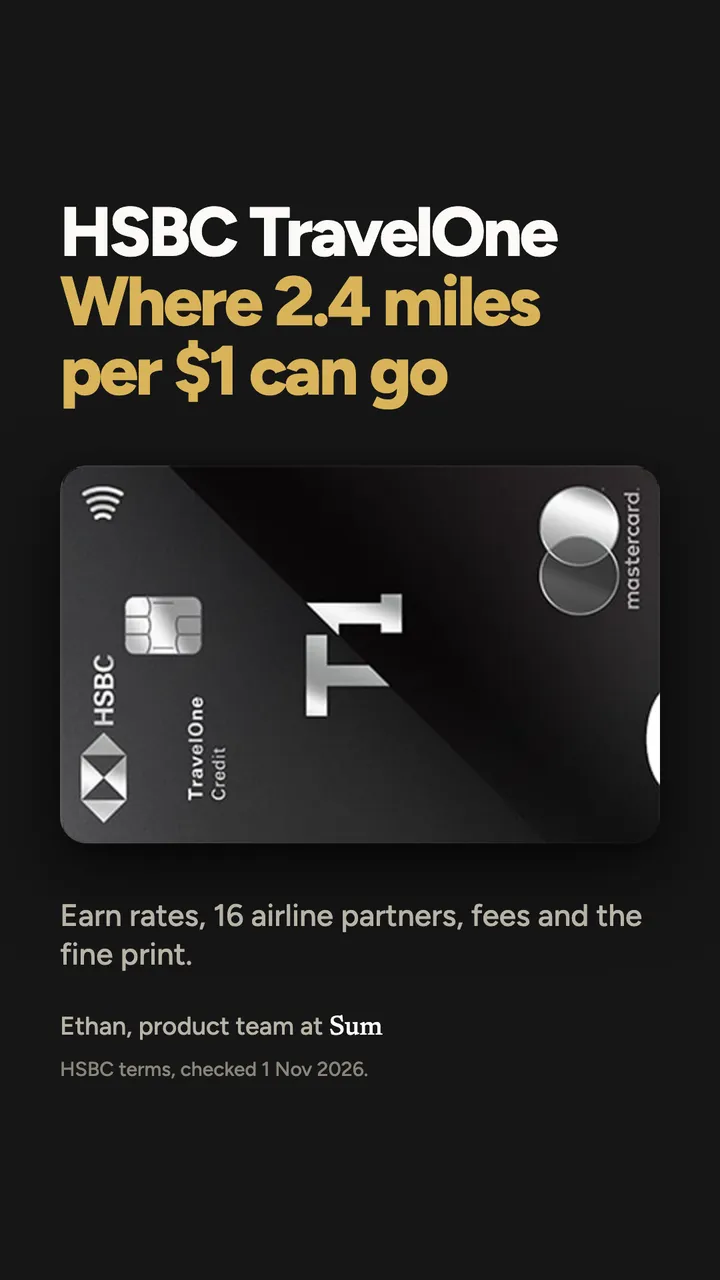
| HSBC TravelOne Mastercard | |
|---|---|
| Minimum income | $65,000 a year for new HSBC customers and foreigners; $30,000 for existing customers with $50,000 or more with HSBC, as listed on the product page |
| Annual fee | $196.20 including GST |
| Fee waiver | From the second year, with over $25,000 of spending a year |
| Supplementary cards | Free, up to 5 |
| Local spend (SGD) | 3 HSBC points per $1 |
| Foreign currency spend | 6 HSBC points per $1 |
| In miles | 1.2 and 2.4 per $1 at 25,000 points per 10,000 miles; 1.0 and 2.0 as KrisFlyer |
| Minimum spend or cap | None |
| Points expiry | 37 months |
| Converting | No fee for now |
| Lounge access | 4 visits a year, Mastercard Travel Pass by DragonPass |
| Foreign currency fee | 2.25% plus up to 1% card network charge |
Figures from the TravelOne points terms (effective 31 March 2025), HSBC's Rewards terms (effective 31 March 2025), the rewards page, HSBC's tariff guide and the product page, checked 1 Nov 2026.
How many points does the TravelOne earn?
Clause 4 of the terms builds the rate from two parts: - 1 point for every $1 on all qualifying purchases; and - 2 more points for every $1 charged in Singapore dollars, or 5 more for every $1 charged in a foreign currency.
So it's 3 points per $1 locally and 6 points per $1 in foreign currency. Clause 4 defines it by the currency the purchase is charged in: SGD is local, anything else is foreign currency. There are no categories, no minimum spend and no cap.
A $100 dinner in Singapore earns 300 points. The same $100 charged in Korean won earns 600.
Each part is rounded to the nearest whole point (clause 4). Sum's app reads that as per purchase. Because it rounds to the nearest point rather than down, small purchases don't lose much:
| Purchase | 1X part | 2X or 5X part | Points | Exact |
|---|---|---|---|---|
| Kopi, $1.40 (SGD) | 1.4 → 1 | 2.8 → 3 | 4 | 4.2 |
| Lunch, $12.40 (SGD) | 12.4 → 12 | 24.8 → 25 | 37 | 37.2 |
| Dinner in Seoul, S$33.20 | 33.2 → 33 | 166 | 199 | 199.2 |
Bottom line: the earn rate is simple and the rounding barely changes it. The real question is what happens when the points become miles.
Which airlines HSBC points can move to
HSBC's rewards page lists 16 airline programmes and 4 hotel programmes, each with its own ratio. Here they are grouped by ratio, with what the TravelOne's 3X and 6X become:
| Points for 10,000 | Programmes | Local, per $1 | Foreign currency, per $1 |
|---|---|---|---|
| 25,000 | Asia Miles, British Airways, Qantas, Flying Blue, Etihad, EVA Air, Vietnam Airlines | 1.2 | 2.4 |
| 30,000 | KrisFlyer, Thai Royal Orchid Plus | 1.0 | 2.0 |
| 35,000 | Air Canada Aeroplan, Qatar Avios, Turkish Miles&Smiles, United MileagePlus, Hainan Fortune Wings | 0.86 | 1.71 |
| 50,000 | JAL Mileage Bank | 0.6 | 1.2 |
The sum for each cell is points per $1 × 10,000 ÷ the points needed. KrisFlyer in foreign currency: 6 × 10,000 ÷ 30,000 = 2.0.
Two partners don't fit the table. airasia is listed at 25,000 HSBC points for 20,000 airasia points, which are a different currency from airline miles. The hotel programmes are Marriott Bonvoy and IHG One Rewards (25,000 for 10,000), Accor (25,000 for 5,000) and Wyndham (30,000 for 10,000).
Korean Air isn't on the list. None of the 16 is a Korean airline. For Seoul, KrisFlyer is on the list, and Singapore Airlines flies there from Singapore. The other programmes have their own partner airlines, which each airline lists on its own site.
Bottom line: 2.4 miles per $1 overseas is the figure at a 25,000-point partner. As KrisFlyer it's 2.0. Pick the programme you'd actually redeem with before comparing this card with any other.
How long transfers take, and what they cost
HSBC's Rewards terms say most airline and hotel transfers complete within one working day of your request in the HSBC app (section C, clause 6). Hainan Airlines takes up to five working days and JAL up to ten. Once accepted, a transfer can't be cancelled or moved to another programme (section E, clause 2).
The redemption fee is waived until HSBC decides otherwise (section E, clause 6), and the product page says the same.
The points expire at the end of 37 months, counted from the month after they were awarded (section B, clause 7). The terms' own example: points earned in October 2023 expire on 30 November 2026.
Bottom line: transfers are quick, so there's little reason to convert early and start an airline's expiry clock. The clock to watch is the 37 months on the points themselves.
Paying overseas, and the fee
HSBC's tariff guide lists a 2.25% foreign currency transaction fee, plus up to 1% charged by Mastercard, so up to 3.25% in all. Purchases converted to Singapore dollars at the till carry a separate 1% fee, and earn the local 3X rather than 6X.
Take $1,000 charged in won over a Seoul trip: - Points: $1,000 × 6 = 6,000, which is 2,000 KrisFlyer miles or 2,400 Asia Miles. - Fee: up to $1,000 × 3.25% = $32.50.
That's $32.50 for 2,000 KrisFlyer miles, about 1.6 cents a mile, or 1.35 cents at a 25,000-point partner. The miles cards post goes through why paying in SGD at the till rarely helps.
Bottom line: the higher rate abroad comes with a fee. The useful number is what each mile costs, and that depends on the airline again.
The annual fee, the waiver and the fee-payment points
The annual fee is $196.20 including GST (HSBC's tariff guide and the product page). From the second year, the product page lists two possibilities: - spend over $25,000 a year and the fee is waived, with no points for it; or - pay the fee and get up to 25,000 points, or up to 30,000 points from 1 January 2026.
HSBC describes those 30,000 points as "up to 12,000 miles", which is the 25,000-point ratio. As KrisFlyer, 30,000 points are 10,000 miles. So paying the fee works out to $196.20 ÷ 10,000 = about 2 cents a KrisFlyer mile, or about 1.6 cents an Asia Mile.
The product page also says that if you ask for the fee to be waived, the equivalent points are taken back from your balance.
Bottom line: check which applies to you before the card year renews, and do the cents-per-mile sum with the airline you'd use.
Lounge visits and travel extras
The product page lists 4 complimentary lounge visits a year for the primary cardholder through Mastercard Travel Pass by DragonPass, covering over 1,300 lounges. Guests can use those visits, and they can also be used for meals at some airport restaurants.
It also lists complimentary travel insurance, with up to $150,000 of overseas medical cover, when the full air ticket is charged to the card. As with any insurance, the policy wording decides what's covered.
Bottom line: the lounge visits belong to the primary cardholder, and the insurance depends on charging the full air ticket to the card.
What doesn't earn points
Clause 3 lists merchant category codes (MCCs) that earn nothing. An MCC is a four-digit code the merchant's bank assigns to describe the business. The list includes money transfers, utilities, insurance, rent, parking, hospitals, schools, tax, charities, government services, stored-value top-ups and cleaning or maintenance services. HSBC's Rewards terms also name PayPal, Skrill, CardUp, SmoovPay, iPayMy, EZ-Link, TransitLink, NETS FlashPay, YouTrip and AXS among payments that don't count (section B, clause 4).
Bottom line: a big insurance premium or a tax bill on this card earns nothing. Leave those out of your estimate.
How it compares on miles per $1
Ranked by foreign currency miles per $1 with no minimum spend, as at 24 Oct 2026, in KrisFlyer miles from each bank's terms as Sum's card catalogue reads them:
| Card | Local (SGD) | Foreign currency |
|---|---|---|
| UOB PRVI Miles | 1.4 | 2.4 |
| DBS Altitude | 1.3 | 2.2 |
| Citi PremierMiles | 1.2 | 2.2 |
| OCBC 90°N | 1.3 | 2.1 |
| HSBC TravelOne | 1.0 | 2.0 |
| Standard Chartered Journey | 1.2 | 2.0 |
At a 25,000-point partner, the TravelOne's row reads 1.2 and 2.4, which is how the miles cards post lists it. The other cards' figures are KrisFlyer figures, so the fair comparison depends on where you'd send the points.
A worked year
Say Priya is 32 and puts $1,500 a month on the card in Singapore dollars, plus $6,000 a year in foreign currency over two trips and some overseas online shopping. She's in her second year and spends under $25,000, so she pays the fee. Made-up example.
| Sum | HSBC points | |
|---|---|---|
| Local spend | $1,500 × 12 = $18,000 × 3 | 54,000 |
| Foreign currency | $6,000 × 6 | 36,000 |
| Fee-payment points | up to | 30,000 |
| Total | up to 120,000 |
That's 120,000 ÷ 3 = 40,000 KrisFlyer miles, or 120,000 × 0.4 = 48,000 Asia Miles. What she pays for the card: the $196.20 fee and up to $6,000 × 3.25% = $195 in foreign currency fees, $391.20 in all.
For scale, the miles cards post lists 25,500 KrisFlyer miles for a one-way Saver Economy seat to Seoul, as at its own check.
Bottom line: swap in your own spending, your trips and the airline you'd use. The calculator page runs the same sums in KrisFlyer miles: HSBC TravelOne on the card rewards calculator.
Three things to remember
- 3 points per $1 in SGD, 6 in foreign currency, no cap. In miles, that's 1.2 and 2.4 at most partners, 1.0 and 2.0 as KrisFlyer.
- The partner decides the miles. 16 airlines, four different ratios, and no Korean airline on the list.
- Points expire after 37 months, and transfers are quick and free for now, so there's no need to convert early.
Ethan's rating
Earn rate
- Very low
- Low
- Moderate

- High
- Very high
Effort to earn
- Effortless
- Easy
- Some effort
- Shiong
- Very shiong
Value for the fee
- Way overpriced
- Overpriced
- Fair
- Good value
- Great value
Against other miles cards
- Bottom
- Below average
- Average
- Above average
- Top
Where it earns
- DiningFair
- GroceriesFair
- TransportFair
- OnlineFair
- TravelFair
- OverseasGood
- Everything elseFair
One person's opinion, from the terms in this review. Your own spending decides what a card is worth to you.
Track it in Sum
Import your card statements. The card optimiser counts miles cards in KrisFlyer miles, so cards from different banks compare on the same airline. The trackers open into the purchases behind each number.
Ethan
Got something interesting to share?
Something here doesn't match your statement, or HSBC changed the terms? Reach out to me at [email protected], or leave your email and I'll write to you.
Questions people ask
How many miles does the HSBC TravelOne earn?
3 HSBC points per $1 in Singapore dollars and 6 per $1 in foreign currency. At 25,000 points per 10,000 Asia Miles that's 1.2 and 2.4 miles per $1; at KrisFlyer's 30,000 per 10,000 it's 1.0 and 2.0.
Which airlines can HSBC TravelOne points be transferred to?
HSBC's rewards page lists 16 airline programmes, including KrisFlyer, Asia Miles, British Airways, Qantas, Flying Blue, Etihad, EVA Air, JAL, Qatar, Turkish, United, Thai, Vietnam Airlines, Air Canada, Hainan and airasia, plus 4 hotel programmes.
Do HSBC TravelOne points expire?
Yes. HSBC points expire at the end of 37 months, counted from the month after they were awarded.
Is the HSBC TravelOne annual fee waived?
The S$196.20 fee is waived from the second year if you spend over S$25,000 a year, per the product page. Paying the fee from the second year brings up to 30,000 points.
How many lounge visits does the HSBC TravelOne include?
4 complimentary visits a year for the primary cardholder, through Mastercard Travel Pass by DragonPass, per the product page.
Is there a fee to convert HSBC points to miles?
Not at the moment. HSBC's Rewards terms say the redemption fee for miles and hotel points is waived until HSBC decides otherwise.
Try the numbers yourself

Sum is launching in Singapore soon.
Your banks, cards, CPF and HDB flat, added up into one net worth. Statements sorted, card caps tracked, bills remembered.
Ethan · Product team, Sum
Ethan is on Sum's product team in Singapore. Financial planning and investing took care of Ethan's own money long ago, so this isn't for the pay. The economy right now is rough on Singaporeans, and we are grateful Ethan is determined to alleviate some of this pain here at Sum.
If we listed a wrong number, or you caught a term that changed before we did, email Ethan at [email protected].
Sources: HSBC: TravelOne Credit Card Reward Points Programme T&C, effective 31 March 2025 (PDF); HSBC: TravelOne Credit Card; HSBC: Credit card rewards and partner redemption rates; HSBC: Rewards Programme T&C, effective 31 March 2025 (PDF); HSBC: Retail banking and wealth management bank tariffs (PDF).
Any app screens shown use sample data, not a real person's. Sum is free to start; some features need a paid plan.
Information only, not financial advice.