Citi PremierMiles card review: why the currency decides your miles
How the Citi PremierMiles card earns as at 1 Nov 2026: 1.2 and 2.2 miles per $1, why SGD airline fares earn less, rounding, the S$196.20 fee and lounges.
- No categories, no monthly cap
- Citi Miles never expire
- 10,000 miles when the fee is paid
- 1.2 miles per $1 locally is on the low side
- $27.25 for every airline transfer
- SGD charges from overseas sites earn the local rate
Ethan's own opinion of the card as reviewed below. His full rating is at the end.
The Citi PremierMiles is a general travel card: one rate in Singapore dollars, a higher one in foreign currency, no cap and miles that never expire. The catch is the word "overseas". Most travel cards in Sum's card optimiser read the currency of the charge, not where the shop is, and this one states it more plainly than most. A fare billed in SGD is local spend, even when the airline and its website are both overseas.
Here's what it earns, what it costs, the fine print that changes the numbers, and a worked year you can redo with your own numbers.
The Citi PremierMiles at a glance
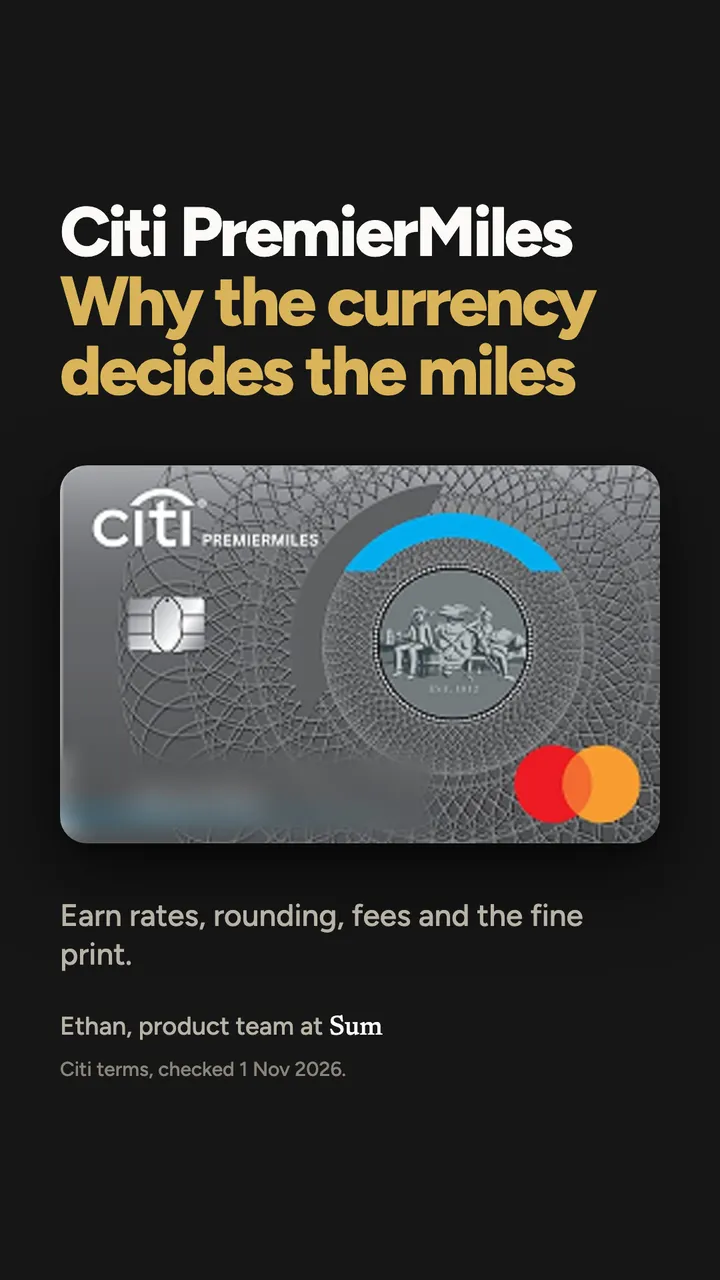
| Citi PremierMiles (Mastercard) | |
|---|---|
| Minimum income | $30,000 a year (Singaporeans and PRs), $42,000 (foreigners), as listed on the Citi product page |
| Annual fee | $196.20 including GST, with 10,000 Citi Miles when it's paid |
| Local spend (SGD) | 1.2 Citi Miles per $1 |
| Foreign currency spend | 2.2 Citi Miles per $1 |
| Minimum spend or cap | None |
| Rounding | Worked out on each purchase, rounded down to the nearest Citi Mile |
| Miles expiry | Never |
| Converting to airline miles | 10,000 Citi Miles = 10,000 KrisFlyer miles, $27.25 per transfer |
| Foreign currency fee | Up to 3.25% (Cardmember's Agreement, clause 6.9) |
| Lounge access | 2 Priority Pass visits per calendar year, principal cardmember only |
Figures from the PremierMiles Cardmember's Agreement and Program terms (printed February 2025, in effect from 1 May 2025), the Citi product page and Citi's points transfer page, checked 1 Nov 2026.
How many miles does the Citi PremierMiles earn?
The card earns Citi Miles, Citi's own unit. On Citi's points transfer page, 10,000 Citi Miles become 10,000 KrisFlyer miles (Singapore Airlines), so for KrisFlyer a Citi Mile is simply a mile.
Clause 3.1 of the Program terms sets out two rates: - Local retail purchases: 1.2 Citi Miles for every $1. - Overseas retail purchases: 2.2 Citi Miles for every $1.
A $250 grocery run is $250 × 1.2 = 300 miles. A $250 dinner in Bangkok, charged in baht, is $250 × 2.2 = 550 miles.
There's no bonus category to pick, no minimum before the rate applies and no monthly cap. Supplementary cardholders' spending counts towards the main account's miles (clause 3.1), and the miles land in the main cardholder's account.
Bottom line: the rate isn't the interesting part. The definition of "overseas" is.
Why an airline fare in SGD earns 1.2, not 2.2
The answer sits in the definitions at the top of the Program terms (clause 1.1): - a local retail purchase is "a retail purchase denominated in S$"; - an overseas retail purchase is one "denominated in a currency other than S$".
Nothing about where the shop is, where you are, or where the website's company is registered. Only the currency. So when a foreign airline's website offers to charge you in SGD and you accept, the card sees a Singapore-dollar purchase and pays 1.2.
There's a second catch in the Cardmember's Agreement. Clause 6.9(c) says an SGD transaction made with a merchant registered overseas, or processed through an overseas intermediary, carries an administrative fee of 1%. So the SGD option doesn't always avoid fees either. Clause 6.9(b) charges the same 1% when a shop or terminal converts to SGD for you overseas, which is called dynamic currency conversion.
Take a $1,200 fare as an example: - Charged in New Taiwan dollars: $1,200 × 2.2 = 2,640 miles. Citi's foreign currency fee of up to 3.25% adds up to $1,200 × 3.25% = $39. - Charged in SGD, processed overseas: $1,200 × 1.2 = 1,440 miles, plus the 1% fee, $1,200 × 1% = $12, plus whatever exchange rate the airline's site has built into its SGD price.
The New Taiwan dollar option earns 2,640 − 1,440 = 1,200 more miles for at most $39 − $12 = $27 more in fees. That's $27 ÷ 1,200 = about 2.25 cents for each extra mile, before counting the airline's own exchange rate, which you can't see. The miles cards post goes through why the shop's rate is rarely the better deal.
Bottom line: the card reads the currency, not the country. Your statement shows how a past booking was charged.
How the rounding works on small purchases
Clause 3.2 says Citi Miles are worked out on the amount of each purchase and rounded down to the nearest Citi Mile. That's much gentler than cards that count in $5 blocks, because the most any purchase can lose is a fraction of one mile.
| Purchase | 1.2 × amount | Miles | Per $1 |
|---|---|---|---|
| Teh peng, $1.80 | 2.16 → 2 | 2 | 1.11 |
| Bubble tea, $4.20 | 5.04 → 5 | 5 | 1.19 |
| Lunch, $12 | 14.4 → 14 | 14 | 1.17 |
| Groceries, $21.99 | 26.39 → 26 | 26 | 1.18 |
| Dinner, $100 | 120 | 120 | 1.2 |
Some reviews read this clause as rounding the dollar amount down first, so $21.99 would count as $21 and earn 25 miles. The clause as written works out the miles on the purchase amount and rounds the miles. Sum's optimiser follows the clause. If your statement says otherwise, tell me.
Bottom line: lots of small purchases cost you very little in rounding here, even next to a card with a higher headline rate that counts in $5 steps.
The annual fee, and the 10,000 miles that come with it
The annual fee is $196.20 including GST, as listed on the product page. Clause 3.4 adds 10,000 Citi Miles when the membership renews, as long as you've made retail purchases on the card in that membership year. Clause 3.5 says the miles only count if the fee is actually paid. The product page adds that the miles are reversed if the fee is waived.
So paying the fee works out to $196.20 for 10,000 miles, which is $196.20 ÷ 10,000 = about 2 cents a mile.
Bottom line: a fee waiver and the 10,000 miles don't come together. Ask for one and you give up the other.
Turning Citi Miles into airline miles
Citi Miles stay with Citi until you transfer them. Citi's points transfer page lists ten airline programmes, including KrisFlyer, Asia Miles (Cathay), Qantas and Flying Blue, at 10,000 Citi Miles for 10,000 airline miles. Each transfer costs $27.25 including GST, usually charged 2 to 3 business days after you ask, and the miles arrive within 14 business days. Minimum amounts differ by programme. The Citi Mobile app shows them.
Clause 3.6 is short: "There is no expiry date for Citi Miles." So there's no rush. Two transfers a year cost 2 × $27.25 = $54.50. One transfer, when you actually have a flight in mind, costs $27.25. The page also mentions an "Instant Points Transfer" with the fee waived, without saying which programmes it covers, so check that one in the app.
Bottom line: once Citi Miles become airline miles, the airline's own expiry rules apply. Miles that never expire are only safe while they're still Citi Miles.
Lounge visits
The product page lists 2 Priority Pass visits to airport lounges each calendar year, for the principal cardmember only. Further visits cost US$35 per person, charged to the card. The World Select Mastercard also lists a Flight Delay Pass: a lounge visit if your flight is delayed by at least 2 hours.
Bottom line: one trip each way on your own, or one visit for two people. A nice extra, not a reason on its own.
Hotel promotions until 31 December 2026
Citi is running two hotel promotions through its own booking links, both dated on the product page: 10 Citi Miles per $1 on Kaligo (kaligo.com/bonus-miles) until 31 December 2026, and up to 7.2 Citi Miles per $1 on Agoda (agoda.com/bonusmiles) for bookings made by 31 December 2026, for stays until 30 April 2027.
Bottom line: both end, and Citi's page points to its own links for each. Sum counts Kaligo charges at the promotion rate until 31 December. An Agoda booking made through Citi's link looks the same on a statement as one made without it, so Sum notes it rather than counting it.
What doesn't earn miles
Clause 3.3 lists what earns nothing. The main ones: bill payments, payments to schools and other educational institutions, government payments (tax, fines, postal services, parking), insurance premiums, payments to banks and brokerages, non-profits, gambling, top-ups to payment apps, prepaid cards and wallets, and transit-related transactions. Citi's exclusion list adds categories such as utilities, rentals through property agents and hospitals, and names BUS/MRT, EZ-Link, TransitLink and YouTrip.
Bottom line: the MRT gantry and insurance premiums earn nothing. Leave them out when you estimate the card's year.
How it compares on miles per $1
Ranked by miles per $1 with no minimum spend, as at 24 Oct 2026, from each bank's terms:
| Card | Local (SGD) | Foreign currency |
|---|---|---|
| UOB PRVI Miles | 1.4 | 2.4 |
| DBS Altitude | 1.3 | 2.2 |
| OCBC 90°N | 1.3 | 2.1 |
| Citi PremierMiles | 1.2 | 2.2 |
These are the "one rate on everything" cards. On foreign currency, the PremierMiles matches the Altitude. In SGD it earns 0.1 mile per $1 less than the Altitude and the 90°N. Rounding differs too: the DBS Altitude review shows how $5 blocks take more from small purchases. Specialised cards pay up to 4 miles per $1 in certain categories, usually with a cap of about $1,000 a month. The miles cards post lays those out.
A worked year
Say Hui Min is 35 and puts $1,800 a month on the card in Singapore dollars, plus one $2,500 trip a year charged in foreign currency. Made-up example.
| Sum | Miles | |
|---|---|---|
| Local spend | $1,800 × 12 = $21,600 × 1.2 | about 25,920 (a few fewer after rounding) |
| Trip | $2,500 × 2.2 | 5,500 |
| Renewal miles | fee paid | 10,000 |
| Total | about 41,400 |
What she pays for the card itself: the $196.20 annual fee, up to $2,500 × 3.25% = $81.25 in foreign currency fees, and one $27.25 transfer. That's $304.70 in the year.
If $1,500 of that trip (say the flights and the hotel) had been booked on websites charging in SGD, she'd earn $1,500 × (2.2 − 1.2) = 1,500 fewer miles, and some of the fees would just change shape into the 1% charge and the website's exchange rate.
Bottom line: swap in your own monthly spend, your trips and how they were charged. The calculator page does the same sums for a few typical months: Citi PremierMiles on the card rewards calculator.
Three things to remember
- 1.2 miles per $1 in SGD, 2.2 in foreign currency, no cap, no minimum, miles never expire. That's the card.
- "Overseas" means the currency, not the country. An airline site charging in SGD earns 1.2, and may add a 1% fee.
- The 10,000 renewal miles come only when the $196.20 fee is paid. That's about 2 cents a mile. A waiver gives them up.
Ethan's rating
Earn rate
- Very low
- Low
- Moderate

- High
- Very high
Effort to earn
- Effortless
- Easy
- Some effort
- Shiong
- Very shiong
Value for the fee
- Way overpriced
- Overpriced
- Fair
- Good value
- Great value
Against other miles cards
- Bottom
- Below average
- Average
- Above average
- Top
Where it earns
- DiningFair
- GroceriesFair
- TransportFair
- OnlineFair
- TravelFair
- OverseasGood
- Everything elseFair
One person's opinion, from the terms in this review. Your own spending decides what a card is worth to you.
Track it in Sum
Import your card statements. The card optimiser reads each purchase the way the bank's terms do, currency included, so an SGD charge from an overseas website shows at the local rate. The trackers show what each card earned in the month.
Ethan
Got something interesting to share?
Something here doesn't match your statement, or Citi changed the terms? Reach out to me at [email protected], or leave your email and I'll write to you.
Questions people ask
How many miles does the Citi PremierMiles card earn?
1.2 Citi Miles per $1 on purchases in Singapore dollars and 2.2 Citi Miles per $1 on purchases in a foreign currency. Citi Miles transfer 1:1 to KrisFlyer, so that is 1.2 and 2.2 KrisFlyer miles per $1.
Does an overseas airline website charging in SGD earn 2.2 miles?
No. The terms define an overseas purchase by its currency, not by where the merchant is. A fare charged in SGD earns the local 1.2 miles per $1, and may also carry a 1% fee if it is processed outside Singapore.
Do Citi Miles expire?
No. The PremierMiles Program terms say there is no expiry date for Citi Miles. Once transferred to an airline, that airline's own rules apply.
What is the Citi PremierMiles annual fee?
S$196.20 including GST. When it is paid, Citi credits 10,000 Citi Miles, as long as you made retail purchases on the card in that membership year. If the fee is waived, the miles are taken back.
How much does it cost to transfer Citi Miles to KrisFlyer?
S$27.25 including GST per transfer, and the miles arrive within 14 business days. 10,000 Citi Miles become 10,000 KrisFlyer miles.
How many lounge visits does the Citi PremierMiles card include?
Two Priority Pass visits per calendar year for the principal cardmember. Further visits cost US$35 per person.
Try the numbers yourself

Sum is launching in Singapore soon.
Your banks, cards, CPF and HDB flat, added up into one net worth. Statements sorted, card caps tracked, bills remembered.
Ethan · Product team, Sum
Ethan is on Sum's product team in Singapore. Financial planning and investing took care of Ethan's own money long ago, so this isn't for the pay. The economy right now is rough on Singaporeans, and we are grateful Ethan is determined to alleviate some of this pain here at Sum.
If we listed a wrong number, or you caught a term that changed before we did, email Ethan at [email protected].
Sources: Citi: PremierMiles Cardmember's Agreement and PremierMiles Program T&C, printed Feb 2025, effective 1 May 2025 (PDF); Citi: PremierMiles Card; Citi: Points Transfer (FAQ as of July 2025); Citi: Rewards exclusion list, effective 16 Dec 2024 (PDF).
Any app screens shown use sample data, not a real person's. Sum is free to start; some features need a paid plan.
Information only, not financial advice.