Standard Chartered Smart card review: fast food, streaming and the $800 line
How the Standard Chartered Smart card pays as at 1 Nov 2026: 8% or 10% at fast food, streaming and bus/MRT, the $800 minimum, points that expire and fees.
- 8% to 10% at named fast food, coffee and transport
- No cap on the bonus
- Lower annual fee than most
- Closed to new applications
- Under $800, everything earns 0.5%
- Redeemed in $10 blocks; points expire
Ethan's own opinion of the card as reviewed below. His full rating is at the end.
The Standard Chartered Smart card pays a high rate at a short list of named fast food, coffee, streaming and bus/MRT merchants. The catch is that the headline rate depends on everything else you spend: under $800 in the month, everything earns 0.5%. The product page says Standard Chartered is no longer accepting new applications. Cardholders still earn under the terms below, so this review is for people who hold one and want to know what it actually pays.
Here's how it earns, which merchants count, the $800 line, how the points turn into cash and when they expire, the fees, and a worked year you can redo with your own numbers.
The Smart card at a glance
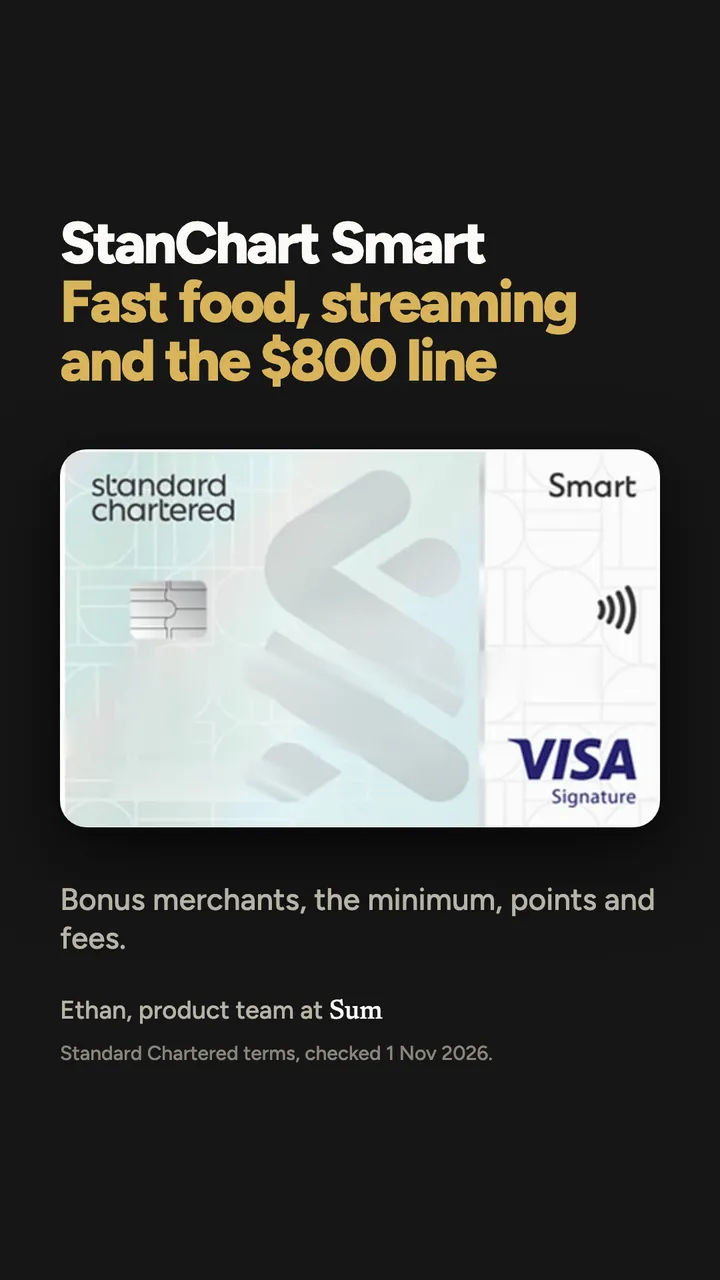
| Standard Chartered Smart (Visa) | |
|---|---|
| New applications | Closed, per the product page |
| Annual fee | Waived the first year, then $99.19 including GST |
| Below $800 in the month | 0.5% on everything |
| $800 to $1,499.99 | 8% at bonus merchants, 0.5% elsewhere |
| $1,500 and up | 10% at bonus merchants, 1% elsewhere |
| Cap | None |
| How it's paid | 360° Rewards Points: 3,200 points = $10 cashback |
| Points expiry | 3 years from account opening, then a further 3 years |
| Foreign currency fee | 3.5% (1% Visa charge plus 2.5% bank fee) |
Figures from the Smart terms (version 13 November 2025), Standard Chartered's Credit Card Terms, the product page and the pricing guide, checked 1 Nov 2026.
How does the Smart card's cashback work?
The Smart card doesn't pay cash straight onto your bill. It pays 360° Rewards Points, and clause 9 sets the exchange: 3,200 points for $10. So one point is worth $10 ÷ 3,200 = 0.3125 cents.
Clause 7 sets the points per $1, based on your total eligible spending in the statement month (from one statement date to the day before the next):
| Spending in the month | Bonus merchants | Everything else |
|---|---|---|
| Under $800 | 1.6 points per $1 (0.5%) | 1.6 points per $1 (0.5%) |
| $800 or more | 25.6 points per $1 (8%) | 1.6 points per $1 (0.5%) |
| $1,500 or more | 32 points per $1 (10%) | 3.2 points per $1 (1%) |
To check one: 25.6 points × 0.3125 cents = 8 cents per $1, which is 8%. Clause 6 says there's no cap on either kind of point. Supplementary cards' spending counts towards the total (clause 4).
The points are worked out on the exact amount, not in $5 blocks, and rounded to a whole point (clauses 14.3.1 and 24.5 of the Credit Card Terms). At a third of a cent a point, the rounding is too small to see.
Bottom line: the rate on a burger isn't decided by the burger. It's decided by your total on the card that month.
Which merchants earn 8% or 10%?
Clause 5 lists them by name: - Smart Dining: Burger King, Domino's Pizza, KFC, McDonald's, Pizza Hut, Starbucks, Subway, The Coffee Bean & Tea Leaf, Toast Box and Ya Kun Kaya Toast. - Smart Streaming: Amazon Prime Video, Disney+, HBO GO, iQIYI, Netflix, Spotify, Viu and YouTube. - Smart Transport: bus and MRT fares through SimplyGo, plus EV charging (merchant code 5552) until 31 December 2026.
It's a list of merchants, not a category. "Smart Dining" doesn't mean restaurants in general. It means ten names. A burger from a chain that isn't named, a plate of chicken rice at a hawker centre or a taxi ride earns the 0.5% or 1% rate, whatever the total.
One detail on streaming. Standard Chartered's general exclusions list leaves out "recurring payments", where you've let a merchant charge your card at a fixed interval. The Smart terms name the streaming services as bonus merchants, and Sum treats them that way. If a subscription ever shows no bonus on your statement, that's the clause to ask the bank about.
Bottom line: go through last month's statement and mark which purchases were at a named merchant. That share is what the 8% applies to.
The $800 line
This decides almost everything. Say Darren spends $150 a month at bonus merchants and the rest elsewhere. Made-up example.
| Total in the month | Bonus ($150) | Everything else | Cashback |
|---|---|---|---|
| $790 | $150 × 0.5% = $0.75 | $640 × 0.5% = $3.20 | $3.95 |
| $800 | $150 × 8% = $12.00 | $650 × 0.5% = $3.25 | $15.25 |
| $1,500 | $150 × 10% = $15.00 | $1,350 × 1% = $13.50 | $28.50 |
Ten dollars of spending separate $3.95 from $15.25. The terms' own example works the same way: $600 at bonus merchants and $900 elsewhere, $1,500 in all, earns 22,080 points, which is $69.
The minimum is everything on the card, not just the named merchants. It counts eligible spending only, so insurance premiums, tax and other excluded payments don't help reach it, and it uses the posting date, not the day you paid (clause 3). A purchase on the last day of a statement month may land in the next one.
Bottom line: if your monthly total sits near $800, watch the tracker in the last week of each statement month. The same spending can earn almost four times as much on one side of the line.
How do the points become cash, and when do they expire?
Clause 8 says points are credited around the statement date, and clause 9 says you redeem them in blocks of 3,200 points for $10. It isn't automatic. In Darren's $800 month, the points are 150 × 25.6 = 3,840 plus 650 × 1.6 = 1,040, so 4,880 points: one $10 block, with 1,680 points carried over.
Then expiry. Clause 9 says points are valid for 3 years from the date the card account was opened, and points earned after that first period are valid for a further 3 years. They don't roll on forever.
Bottom line: unredeemed points are cashback you haven't collected yet, and they have a date on them. Whole blocks can be redeemed as they build up.
The annual fee
Clause 12 says the fee is waived for the first year, then $91 before GST. The pricing guide lists it as $99.19 including GST from 6 December 2025.
In Darren's $800 months, the card earns $15.25, so the fee is about 6.5 months of that. At 0.5% on everything, it's the cashback on $99.19 ÷ 0.5% = $19,838 of spending.
Bottom line: whether the fee is small depends on which side of $800 you usually land.
Paying overseas
The terms don't limit the bonus to Singapore dollars, but most overseas spending isn't at the named merchants, so it earns 0.5% or 1%. Standard Chartered's pricing guide lists 1% for Visa and 2.5% for the bank on foreign currency transactions, so 3.5% in all. On $1,000 abroad that's $35 in fees against $5 to $10 of cashback.
Bottom line: foreign currency spending here costs more in fees than it earns, though it does still count towards the $800.
What doesn't earn anything
Clause 10 points to Standard Chartered's Retail Transaction Exclusions. As at 1 Nov 2026 they include cash advances, insurance premiums, recurring payments, bills paid through the bank's online banking, AXS and ATM payments, the 0% instalment plan, fees, betting, top-ups to prepaid cards and wallets (EZ-Link and SimplyGo top-ups are named), and merchant codes for utilities, parking, hospitals, schools, tax and government services.
Note the difference between a SimplyGo fare, which is a bonus merchant, and a top-up, which earns nothing.
Bottom line: those payments don't count towards the $800 either. Leave them out when you check which side of the line you're on.
How it compares
Cashback cards with a bonus for fast food or dining at $800 a month, as at 24 Oct 2026, from each bank's terms:
| Card | Fast food | Streaming | Cap on the bonus |
|---|---|---|---|
| UOB EVOL | 10% if paid online or by phone contactless | 10% (selected services) | $30 and $20 a month |
| StanChart Smart | 8% (named merchants) | 8% (named services) | None |
| OCBC 365 | 6% (dining) | 0.25% | $160 a month across its bonus categories |
| Citi Cash Back | 6% (dining) | 0.2% | $80 a month in total |
The Smart card's rate is high on a short list, with no cap. The others cover more places but stop at a monthly limit. How much of your spending fits each card's list decides which number matters. Rates, exclusions and fees differ, so read each one's terms.
A worked year
Say Faizal is 30. He puts $1,000 a month on the card: $150 at named merchants (fast food and coffee, two streaming subscriptions, bus and MRT fares) and $850 elsewhere. It's his second year, so the fee is charged. Made-up example.
| Sum | Points | |
|---|---|---|
| Bonus merchants | $150 × 25.6 × 12 | 46,080 |
| Everything else | $850 × 1.6 × 12 | 16,320 |
| Total | 62,400 |
That's 19 blocks of 3,200, so $190 in cash, with 1,600 points left over. Take away the $99.19 fee and he keeps $90.81.
If three of those months came in at $760 instead, because of a quiet month or a trip where a different card was used, each of those months would earn only 760 × 1.6 = 1,216 points. The year would be 50,448 points, or $150 in cash.
At $1,500 a month with the same $150 at named merchants, each month would earn 150 × 32 + 1,350 × 3.2 = 9,120 points, which is 109,440 points or $340 a year. That's arithmetic, not a target: spending more to earn cashback rarely adds up.
Bottom line: swap in your own monthly total and your own share at the named merchants. The calculator page does the same sums: Standard Chartered Smart on the card rewards calculator.
Three things to remember
- 8% or 10% only at named merchants, and only from $800 a month in total. Below $800, everything earns 0.5%.
- The cashback comes as points: redeem 3,200 for $10, and they expire 3 years from when the account opened.
- New applications have closed. If you hold the card, the $800 line is the number to watch.
Ethan's rating
Earn rate
- Very low
- Low
- Moderate
- High

- Very high
Effort to earn
- Effortless
- Easy
- Some effort
- Shiong
- Very shiong
Value for the fee
- Way overpriced
- Overpriced
- Fair
- Good value
- Great value
Against other rewards cards
- Bottom
- Below average
- Average
- Above average
- Top
Where it earns
- DiningBonus rate
- GroceriesLow
- TransportBonus rate
- OnlineGood
- TravelLow
- OverseasLow
- Everything elseLow
One person's opinion, from the terms in this review. Your own spending decides what a card is worth to you.
Track it in Sum
Import your card statements. The card optimiser reads each purchase the way the bank's terms do, and the trackers show how far a card is from a minimum like $800 before the statement month ends, so the last week isn't guesswork.
Ethan
Got something interesting to share?
Something here doesn't match your statement, or Standard Chartered changed the terms? Reach out to me at [email protected], or leave your email and I'll write to you.
Questions people ask
Can I still apply for the Standard Chartered Smart card?
No. As at 1 Nov 2026 the product page says Standard Chartered is no longer accepting new applications. Existing cardholders still earn under the terms.
How much cashback does the Standard Chartered Smart card give?
8% at its named fast food, coffee, streaming and bus/MRT merchants with $800 of eligible spending in the statement month, 10% with $1,500. Other spending earns 0.5%, or 1% at $1,500. Below $800, everything earns 0.5%.
Is there a cap on Smart card cashback?
No. Clause 6 of the terms says there is no cap on the points you can earn each month.
How do I redeem Smart card cashback?
It is paid as 360° Rewards Points. You redeem 3,200 points for $10 cashback; it isn't credited automatically.
Do Smart card points expire?
Yes. Points are valid for 3 years from the date the card account opened, and points earned after that for a further 3 years.
What is the Smart card annual fee?
Waived for the first year, then $91 before GST, which the pricing guide lists as $99.19 including GST.
Try the numbers yourself

Sum is launching in Singapore soon.
Your banks, cards, CPF and HDB flat, added up into one net worth. Statements sorted, card caps tracked, bills remembered.
Ethan · Product team, Sum
Ethan is on Sum's product team in Singapore. Financial planning and investing took care of Ethan's own money long ago, so this isn't for the pay. The economy right now is rough on Singaporeans, and we are grateful Ethan is determined to alleviate some of this pain here at Sum.
If we listed a wrong number, or you caught a term that changed before we did, email Ethan at [email protected].
Sources: Standard Chartered: Smart Credit Card Promotion Terms and Conditions, version 13 November 2025 (PDF); Standard Chartered: Smart Credit Card (product page); Standard Chartered: Credit Card Terms (PDF); Standard Chartered: Credit Cards Retail Transaction Exclusions; Standard Chartered: Pricing Guide.
Any app screens shown use sample data, not a real person's. Sum is free to start; some features need a paid plan.
Information only, not financial advice.