OCBC 365 card review: what 6% on the weekly shop really adds up to
How the OCBC 365 card pays cashback from 1 Nov 2026: 6% on dining, groceries, land transport and petrol after S$800, the S$160 cap, posting dates and fees.
- 6% on dining, groceries, transport and petrol
- One simple $160 cap across all four
- Fee waived 2 years, then with $10,000 spend
- Under $800, the whole month earns 0.25%
- Telco, streaming and EV charging dropped
- Month counted by posting date
Ethan's own opinion of the card as reviewed below. His full rating is at the end.
The OCBC 365 is a cashback card built on four everyday categories, and its terms changed on 1 November 2026. It pays 6% on dining, groceries, land transport and petrol. The catch: a month short of $800 earns 0.25% on everything, the month is now counted by posting date, and past the $160 cap those categories earn nothing more.
Here's what the card now earns, the $800 minimum and the posting date, the $160 cap, and a worked year you can redo with your own spending.
The OCBC 365 at a glance
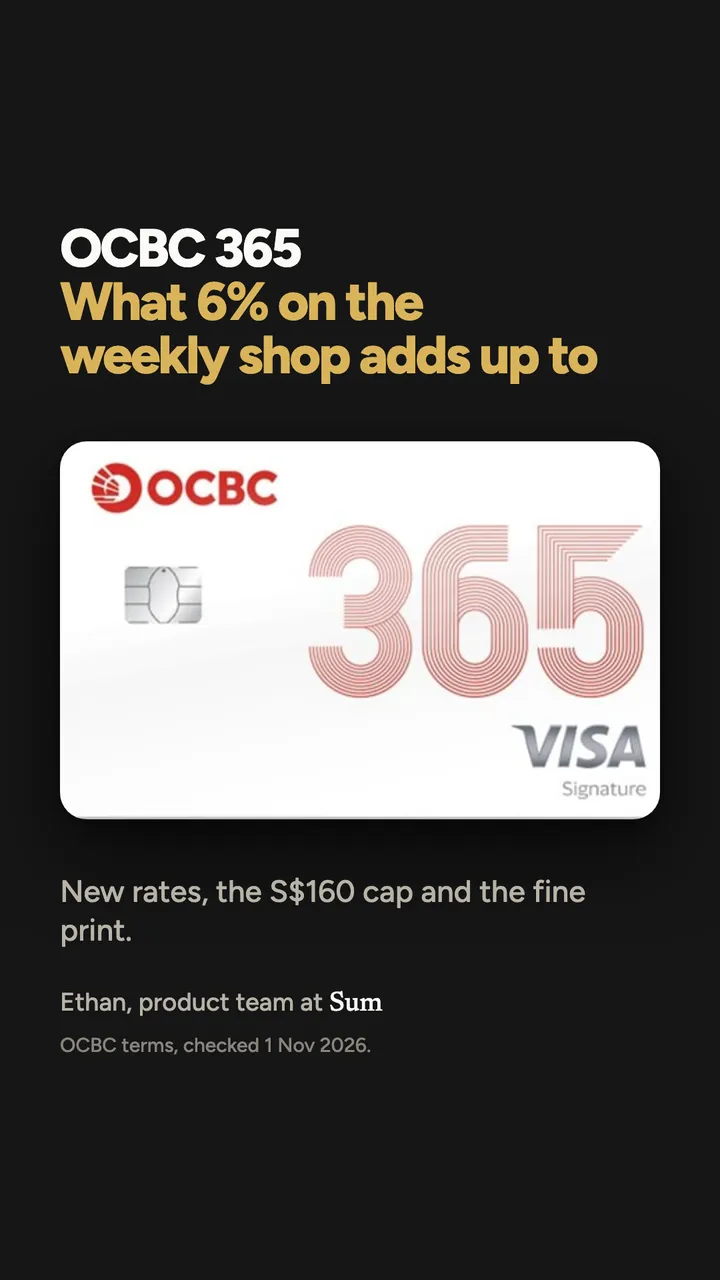
| OCBC 365 Credit Card | |
|---|---|
| Minimum income | $30,000 a year (Singaporeans and PRs aged 21 to 55), as listed on the OCBC product page |
| Annual fee | $196.20 including GST, waived for the first two years; then waived with $10,000 of spend in a year |
| Supplementary card | $98.10, waived for the first two years |
| 6% categories | Dining, groceries, land transport, petrol |
| 3% category | Watsons, until 31 Mar 2027 |
| Everything else | 0.25% |
| Minimum spend | $800 in the calendar month, by posting date |
| Cap | $160 a month across the 6% and 3% categories |
| Advertising platforms | 1% with full payment, no minimum, no cap |
| Credited | The following month, off the bill |
Figures from the OCBC 365 Cashback Programme terms (version date 1 November 2026) and OCBC's product page, checked 1 Nov 2026.
What changed on 1 November 2026
Until 31 October, the card had two tiers. Spending $800 in a month gave a cap of $80 and $1,600 gave $160, and the rates differed by category: 5% on dining, 6% on petrol, 3% on groceries, land transport, telco bills, streaming and EV charging.
From 1 November, OCBC's page describes one simplified tier: - 6% on dining, groceries, land transport and petrol; - one minimum, $800, and one cap, $160; - fast food now counts as dining; - telco bills, streaming and EV charging drop to the 0.25% base; - cashback is worked out by posting date, not transaction date.
Bottom line: the old rules are out of date both ways. Groceries and transport pay twice what they did. The phone bill pays a twelfth.
How much cashback does the OCBC 365 earn?
Clause 2A sets the bonus rates, in a month that meets the minimum spend:
| Category | Merchant codes | Rate |
|---|---|---|
| Dining | 5811 caterers, 5812 restaurants, 5814 fast food | 6% |
| Groceries | 5411 supermarkets | 6% |
| Land transport | 4011, 4111, 4112 rail and commuter transport, 4121 taxis and ride-hailing, 4131 buses | 6% |
| Petrol | 5541, 5542 service stations and fuel dispensers | 6% |
| Watsons | Merchant name "WATSONS", until 31 Mar 2027 | 3% |
Clause 2B pays 0.25% on everything else, and on everything if the month falls short of $800.
A $180 supermarket shop in a qualifying month earns $180 × 6% = $10.80. In a month short of $800, it earns $180 × 0.25% = $0.45.
A merchant category code is the four-digit code a shop's bank assigns it. Clause 1e says OCBC doesn't decide the code, and the code doesn't always match what the shop sells.
Bottom line: a minimart or a bakery may not be coded 5411 or 5812, even if it feels like groceries or dining. Your statement, read line by line, shows it.
What doesn't count in each category
The terms carve a few things out of the 6% even when the shop looks right: - Dining: hotel dining and wedding banquets not processed under the dining codes, and orders made by telephone or mail. - Land transport: EZ-Link and TransitLink top-ups. - Petrol: fleet card top-ups. - Watsons: Watsons purchases on Lazada, Shopee, Amazon and other marketplaces, which earn the base.
Some transactions earn nothing and don't count toward $800 at all. Clause 3(c) points to OCBC's Rewards Transaction Exclusion List. The version dated 24 Sep 2026 includes insurance premiums, school fees, tax, rent (merchant code 6513), cash advances, fees, wallet top-ups such as GrabPay and ShopeePay, AXS payments and AXS Pay+Earn.
Bottom line: a wedding banquet at a hotel can be a big bill that earns 0.25%. Ask the hotel how it charges.
The $800, and why the posting date now matters
The 6% needs $800 of spend in the calendar month (clause 3a), from the principal and supplementary cards together.
From 1 November, clause 4(a) works out cashback on "the sum of posted transactions in the calendar month", and clause 4(e) says purchases that haven't posted yet don't count. OCBC's page says the same: from 1 November, rates are based on posting date.
Posting is when the shop's bank sends the charge through, often a day or a few after you pay. A supermarket run on the last Saturday of the month that posts on the Monday belongs to next month's $800.
Say a month's receipts add up to $820, but $70 of it, a shop on the 30th and a fill-up on the 31st, posts in the following month. By posting date the month has $750. It earns 0.25% on everything, instead of 6% on the categories. On $600 of category spend that's $1.50 instead of $36.
Bottom line: in a month close to $800, the last few days count for less than they look.
The $160 cap, and what happens past it
Clause 3(a) caps the 6% and 3% cashback at $160 a calendar month, for the whole account, principal and supplementary together.
At 6%, that's $160 ÷ 6% = $2,666.67 of spend across the four categories.
Past the cap is the part that's easy to miss. Clause 2B pays the 0.25% base on card transactions "excluding" the 6% categories when the minimum is met. Read with the cap, category spend past $2,666.67 earns nothing more that month, not the base.
Say a household puts $3,000 into the four categories in December: - 6% on $3,000 would be $180 - Capped at $160 - The last $333.33 of category spend earns $0
Bottom line: most households won't reach $2,666.67 in these four categories. The ones that do should know which month it happens in.
Rounding, and the advertising platforms
Clause 4(a) rounds the month's cashback to the nearest cent, on the sum of posted transactions rather than purchase by purchase. A $1.40 kopi and a $1.19 bus fare don't each lose their fraction of a cent. It's all added up first.
Clause 2C pays 1% on advertising with PropertyGuru, 99.co, EdgeProp, StreetSine and Facebook or Meta ads, paid in full, with no minimum spend and no cap (clause 3b), or 0.5% if paid in instalments. That's mostly for property agents and small businesses.
Bottom line: rounding barely matters on this card.
The annual fee
The principal card's fee is $196.20 including GST, waived for the first two years. After that, OCBC's page says the fee is waived automatically with $10,000 of spend in a year, counted from the month the card was issued. That's about $833 a month, close to the $800 minimum anyway.
Bottom line: reach $800 most months and you're likely to reach $10,000 a year. Check it in the month the fee would be charged.
How it compares on cashback
Ranked by cashback on groceries and dining in a qualifying month, as at 24 Oct 2026 (OCBC 365 from the 1 Nov 2026 terms), from each bank's terms:
| Card | Groceries and dining | Minimum spend | Monthly cap on the bonus |
|---|---|---|---|
| OCBC 365 | 6% both | $800 a calendar month | $160 across categories |
| Citi Cash Back | 6% both (8% petrol, rides) | $800 a statement month | $80, base included |
| POSB Everyday | 5% Sheng Siong (no minimum), 5% dining out | $800 a calendar month for dining | Daily$20 per category |
| HSBC Live+ | 5% dining, groceries at base | $600 in each month of the quarter | $250 a quarter, base included |
| DBS Live Fresh | 0.3% both (6% shopping, transport) | $800 a calendar month | $50 shopping, $20 transport |
Compare the cap column too. At $160, the 365's is the largest monthly cap in this table.
A worked year
Say Kelvin is 41 and runs most of his family's household spending through the card: $600 of groceries, $350 of dining, $250 of petrol and $100 of rides and fares a month, plus $300 of other things like clothes and online orders. Made-up example.
| Sum | Cashback | |
|---|---|---|
| Four categories | ($600 + $350 + $250 + $100) × 6% | $78.00 |
| Everything else | $300 × 0.25% | $0.75 |
| Month | $78.75 | |
| Year | $78.75 × 12 | $945.00 |
The month is $1,600, past $800 even if a few days' purchases post late, and the $78 is well under the $160 cap. His $19,200 of spending in the year is past the $10,000 that waives the annual fee, so on these numbers the fee doesn't come into it.
If he moved the $300 of "other things" to another card, the 365 would still reach $800 on the four categories alone, and earn the same $78.
Bottom line: swap in your own groceries, dining, petrol and rides, and check two things: that the month passes $800 by posting date, and that the four categories stay under $2,666.67. The calculator page does the same sums for a few typical months: OCBC 365 on the card rewards calculator.
Three things to remember
- From 1 Nov 2026: 6% on dining (fast food included), groceries, land transport and petrol, in a calendar month with $800 of spend. Everything else, and every month short of $800, earns 0.25%.
- The month is counted by posting date. A purchase on the 31st can land in the next month's $800.
- The $160 cap covers all four categories together, and past it they earn nothing more. That's $2,666.67 of category spend.
Ethan's rating
Earn rate
- Very low
- Low
- Moderate
- High

- Very high
Effort to earn
- Effortless
- Easy
- Some effort
- Shiong
- Very shiong
Value for the fee
- Way overpriced
- Overpriced
- Fair
- Good value
- Great value
Against other cashback cards
- Bottom
- Below average
- Average
- Above average
- Top
Where it earns
- DiningBonus rate
- GroceriesBonus rate
- TransportBonus rate
- OnlineNothing much
- TravelNothing much
- OverseasLow
- Everything elseNothing much
One person's opinion, from the terms in this review. Your own spending decides what a card is worth to you.
Track it in Sum
Import your card statements. The card optimiser reads each line the way the bank's terms do, by category code. The trackers show where a month stands against a minimum like the $800 and a cap like the $160, so a month that's going to fall just short shows up before the 31st, not after.
Ethan
Got something interesting to share?
Something here doesn't match your statement, or OCBC changed the terms? Reach out to me at [email protected], or leave your email and I'll write to you.
Questions people ask
How much cashback does the OCBC 365 card give?
From 1 Nov 2026: 6% on dining, groceries, land transport and petrol, and 3% at Watsons until 31 Mar 2027, in a calendar month with at least S$800 of spend. Everything else earns 0.25%.
What is the OCBC 365 cashback cap?
S$160 a calendar month on the 6% and 3% categories together, for the principal and supplementary cards combined. The 0.25% base and the advertising platform cashback are outside the cap.
Does fast food earn 6% on the OCBC 365 card?
Yes, from 1 Nov 2026. Fast food restaurants (code 5814) are included in dining alongside restaurants and caterers.
Is the OCBC 365 minimum spend counted by transaction date or posting date?
From 1 Nov 2026, by posting date: the terms work cashback out on the sum of transactions posted in the calendar month.
Is the OCBC 365 annual fee waived?
The S$196.20 fee is waived for the first two years, and after that OCBC's page says it's waived automatically with S$10,000 of spend in a year.
Do telco bills and streaming still earn bonus cashback on OCBC 365?
No. Under the terms from 1 Nov 2026 they earn the 0.25% base rate.
Try the numbers yourself

Sum is launching in Singapore soon.
Your banks, cards, CPF and HDB flat, added up into one net worth. Statements sorted, card caps tracked, bills remembered.
Ethan · Product team, Sum
Ethan is on Sum's product team in Singapore. Financial planning and investing took care of Ethan's own money long ago, so this isn't for the pay. The economy right now is rough on Singaporeans, and we are grateful Ethan is determined to alleviate some of this pain here at Sum.
If we listed a wrong number, or you caught a term that changed before we did, email Ethan at [email protected].
Sources: OCBC: Terms and Conditions Governing OCBC 365 Credit Card Cashback Programme, version date 1 November 2026 (PDF); OCBC: 365 Credit Card; OCBC: Cards Rewards Transaction Exclusion List, updated 24 September 2026 (PDF).
Any app screens shown use sample data, not a real person's. Sum is free to start; some features need a paid plan.
Information only, not financial advice.