Standard Chartered Simply Cash card review: what a flat 1.5% adds up to
How the Standard Chartered Simply Cash card pays 1.5% cashback as at 1 Nov 2026: per-purchase sums, big one-off buys, instalment plans, fees and a worked year.
- 1.5% with nothing to track
- No cap, even on a big purchase
- Worked to the cent, paid automatically
- $196.20 fee from the second year
- 3.5% foreign currency fee, more than it earns
- No cashback on instalment plans
Ethan's own opinion of the card as reviewed below. His full rating is at the end.
The Standard Chartered Simply Cash is a flat-rate cashback card: 1.5% on almost everything, with no minimum spend, no cap and no categories. The catch sits in what the 1.5% doesn't reach. The bank's instalment plans earn nothing, the 3.5% foreign currency fee is more than the cashback, and a $196.20 annual fee starts in the second year.
Here's how the 1.5% is worked out, what happens on a big one-off purchase and on instalments, the fees, and a worked year you can redo with your own numbers.
The Simply Cash card at a glance
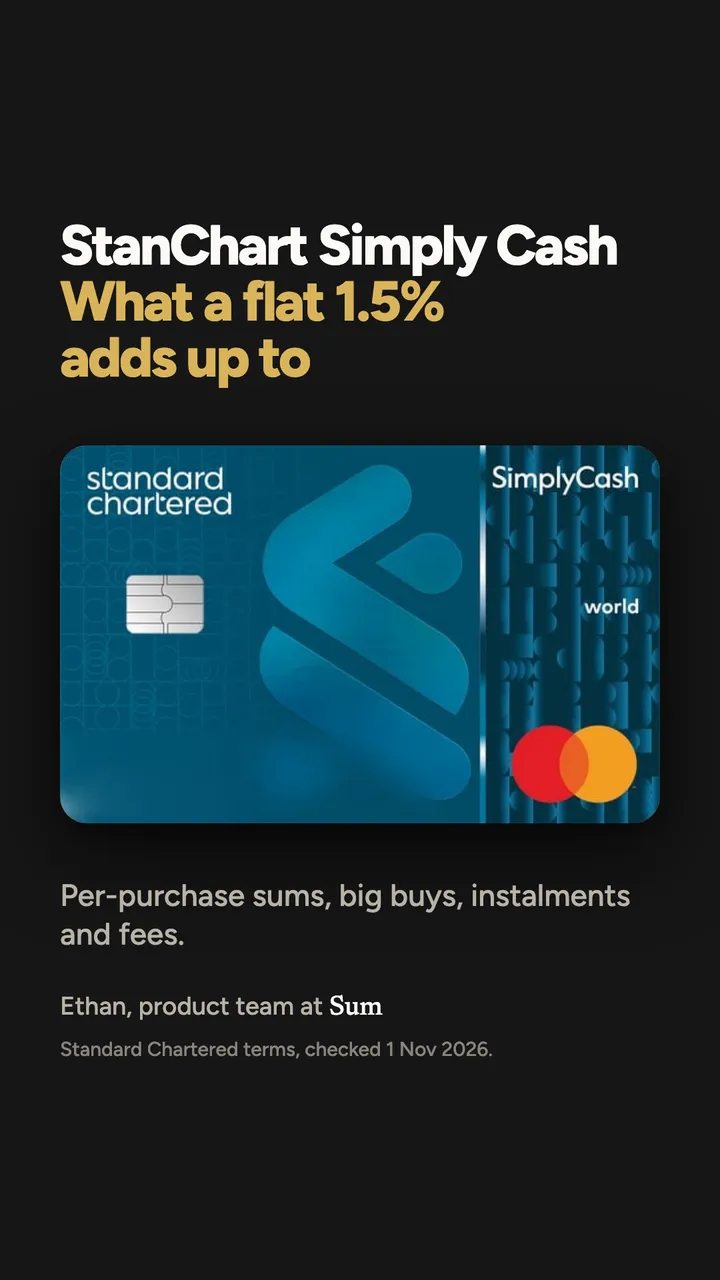
| Standard Chartered Simply Cash (Mastercard) | |
|---|---|
| Minimum income | $30,000 a year, as listed on the product page |
| Annual fee | Waived the first year, then $196.20 including GST |
| Supplementary cards | Free, up to 4 (pricing guide) |
| Cashback | 1.5% on eligible spending |
| Minimum spend or cap | None |
| Foreign currency spend | 1.5%, with a 3.5% foreign currency fee |
| How it's paid | Shown on that month's statement, taken off the next bill |
| Rewards points | None (the card doesn't earn 360° Rewards Points) |
Figures from the Simply Cash terms (version V.062025), Standard Chartered's Credit Card Terms, the product page and the pricing guide, checked 1 Nov 2026.
How much cashback does the Simply Cash card pay?
Clause 1 of the terms says the card gives 1.5% cashback on eligible retail transactions, and the product page FAQ adds the rest: no tiers, no minimum spend, no cap.
$100 of eligible spending earns $100 × 1.5% = $1.50. A month of $1,500 earns $22.50. The first dollar and the ten-thousandth dollar earn the same.
Spending on supplementary cards counts too, and the cashback goes to the principal account (clause 2).
Bottom line: the question isn't how to get the most out of a month. It's whether 1.5% across everything beats what your spending would earn on a card with categories.
How is the 1.5% worked out on each purchase?
Clause 2 says cashback is worked out for each individual purchase, to two decimal places, without rounding. As I read it, anything past the second decimal place is dropped.
| Purchase | 1.5% | Cashback |
|---|---|---|
| Kopi, $1.60 | $0.024 | $0.02 |
| Chicken rice, $5.50 | $0.0825 | $0.08 |
| Groceries, $87.35 | $1.31025 | $1.31 |
| Fridge, $1,799 | $26.985 | $26.98 |
Each purchase gives up less than one cent. Over a month of small purchases that's a few cents.
Bottom line: unlike cards that count in $5 blocks, small purchases here earn very close to the full 1.5%.
When does the cashback arrive?
The cashback is worked out per statement month, from one statement date to the day before the next (clause 6), and only on purchases that have posted by the statement date. It's shown on that month's statement and then taken off the following month's bill automatically (clause 2).
Two things can take it back: - Refunds. If you return something, its amount comes off the month's total for cashback, and any reversal shows on the next statement (clause 4). - Missing the minimum payment. Clause 5 lets the bank take back cashback if the minimum payment due isn't paid.
Bottom line: a purchase on the last day of a statement month may post in the next one, so its cashback shows a month later than you'd expect.
What does 1.5% mean on a big one-off purchase?
There's no cap, so a big purchase earns the same rate as a small one.
Say a fridge costs $1,800, a round number for the arithmetic. Paid in full on the card, it earns $1,800 × 1.5% = $27.
In proportion: $27 is 1.5% of the price, so a $50 difference in price between two shops matters almost twice as much as the cashback does.
Bottom line: on a big purchase, the price comes first and the card second. Once the price is settled, a flat card makes the second part a one-line sum.
Does an instalment plan still earn cashback?
Pay one time or pay monthly? It depends on the card, and on whose instalment plan it is. On this card the answer is in two places.
- Standard Chartered's own 0% Interest Instalment Plan: clause 55 of the Credit Card Terms says it is not eligible for rewards or rebates unless the bank agrees otherwise. The Retail Transaction Exclusions also list purchases made under that plan among the "recurring payments" that earn nothing.
- EasyPay (converting a purchase into instalments afterwards): the exclusions list says the monthly instalments of an EasyPay transaction earn nothing, and each EasyPay application has a service fee (clause 11.1 of the Credit Card Terms).
A store's instalment plan is usually run by a bank, so which card it goes on decides the rules. On this card, the comparison for the $1,800 fridge looks like this:
| How it's paid | Cashback | Interest |
|---|---|---|
| In full | $27 | None, if the bill is paid in full |
| Bank's 0% plan, 12 × $150 | $0 | None |
The 0% is real. On this card, it costs the $27.
Bottom line: before choosing instalments, check whose plan it is and which bank runs it, and what your card's terms say about rewards on it. Spreading a payment can suit your cash flow. It just gives up the cashback here.
Paying overseas: 1.5%, and a 3.5% fee
The terms set no separate rate for foreign currency, so overseas spending earns 1.5% too. But Standard Chartered's pricing guide lists a 1% card network charge and a 2.5% bank fee on foreign currency transactions, 3.5% in all.
On a $1,000 hotel bill paid in a foreign currency, that's $35 in fees against $15 of cashback, so the card costs $20 more than the cashback brings in. Paying in Singapore dollars at the till (dynamic currency conversion) still has a 1% charge in the pricing guide, and the shop sets the exchange rate.
Bottom line: this card doesn't pay for itself abroad. Before a trip, look at the foreign currency fee of whichever card you'll use.
The annual fee
The product page and the pricing guide list the fee as waived for the first year, then $196.20 including GST. Supplementary cards are free, up to four. I couldn't find a published spending level that waives the fee after the first year.
The sum: $196.20 is the cashback on $196.20 ÷ 1.5% = $13,080 of spending. Below about $1,090 a month, the fee takes all the cashback in a year it's charged.
Bottom line: look at what you actually put on cards in a year before comparing a fee-charging flat card with one that has no fee.
What doesn't earn cashback
Clause 3 points to Standard Chartered's Retail Transaction Exclusions. As at 1 Nov 2026 they include cash advances, insurance premiums, recurring payments (including the 0% instalment plan), bills paid through the bank's online banking, AXS and ATM payments, fees and interest, betting, top-ups to prepaid cards and wallets (EZ-Link and SimplyGo top-ups are named) and merchant codes for utilities, parking, hospitals, schools, tax and government services.
Bottom line: a tax bill or an insurance premium earns nothing here. Leave those out when you estimate a year.
How it compares on cashback per $1
Ranked by base cashback rate with no minimum spend, as at 24 Oct 2026, from each bank's terms, with what each pays on a $1,800 purchase:
| Card | Rate | On $1,800 | Worth knowing |
|---|---|---|---|
| UOB Absolute Cashback | 1.7% | $30.60 | 0.3% in some categories |
| Citi Cash Back+ | 1.6% | $28.80 | |
| OCBC INFINITY | 1.6% | $28.80 | |
| Amex True Cashback | 1.5% | $27.00 | Each purchase rounded to the dollar first |
| Trust Freedom | 1.5% | $27.00 | 0.5% on foreign spend, default mode |
| StanChart Simply Cash | 1.5% | $27.00 |
The differences are small on any one purchase. Annual fees, exclusions and foreign currency rates differ by card, and over a year they can matter more than a tenth of a percent, so read each one's terms.
A worked year
Say Kumar is 41. He puts $1,500 a month of eligible spending on the card, buys a $1,800 washing machine once in the year and pays it in full, and spends $2,000 on a holiday in foreign currency. It's his second year, so the fee is charged. Made-up example.
| Sum | Cashback | |
|---|---|---|
| Monthly spending | $1,500 × 12 = $18,000 × 1.5% | $270.00 |
| Washing machine | $1,800 × 1.5% | $27.00 |
| Holiday | $2,000 × 1.5% | $30.00 |
| Total | $327.00 (a few cents less after per-purchase sums) |
What the card costs him: the $196.20 fee and $2,000 × 3.5% = $70 in foreign currency fees, so $266.20. That leaves $60.80 for the year. In his first year, with the fee waived, it would be $257.
If the washing machine went on the bank's 0% instalment plan instead, the $27 would go. That's almost half of what's left.
Bottom line: put in your own yearly spending, big purchases and travel. The calculator page does the same sums: Standard Chartered Simply Cash on the card rewards calculator.
Three things to remember
- 1.5% on almost everything, no minimum, no cap, worked out to the cent on each purchase.
- Instalments through the bank's 0% plan, and EasyPay instalments, earn nothing. On a big purchase, paying in full is what earns the 1.5%.
- The $196.20 fee from year two equals the cashback on $13,080 of spending, and the 3.5% foreign currency fee is more than the 1.5% earned.
Ethan's rating
Earn rate
- Very low
- Low
- Moderate

- High
- Very high
Effort to earn
- Effortless
- Easy
- Some effort
- Shiong
- Very shiong
Value for the fee
- Way overpriced
- Overpriced
- Fair
- Good value
- Great value
Against other cashback cards
- Bottom
- Below average
- Average
- Above average
- Top
Where it earns
- DiningFair
- GroceriesFair
- TransportFair
- OnlineFair
- TravelFair
- OverseasLow
- Everything elseFair
One person's opinion, from the terms in this review. Your own spending decides what a card is worth to you.
Track it in Sum
Import your card statements. The card optimiser works out cashback the way each bank's terms do, and when a big purchase is coming up, you can see what each card would earn on it before you're at the counter.
Ethan
Got something interesting to share?
Something here doesn't match your statement, or Standard Chartered changed the terms? Reach out to me at [email protected], or leave your email and I'll write to you.
Questions people ask
How much cashback does the Standard Chartered Simply Cash card give?
1.5% on eligible spending, with no minimum spend, no cap and no tiers, as at 1 Nov 2026.
Is there a cap on Simply Cash cashback?
No. Standard Chartered's FAQ says there is no cap on the cashback you can earn.
Does the Simply Cash card earn cashback on instalment plans?
Not on Standard Chartered's own 0% Interest Instalment Plan, which the Credit Card Terms say isn't eligible for rewards, and not on the monthly instalments of an EasyPay plan.
When is Simply Cash cashback credited?
It is worked out each statement month, shown on that statement and taken off the following statement's bill.
What is the Simply Cash annual fee?
Waived for the first year, then $196.20 including GST, as listed on the product page and pricing guide.
Does the Simply Cash card give 1.5% on overseas spending?
Yes, the terms set no different rate for foreign currency, but foreign currency purchases carry a 3.5% fee, which is more than the cashback.
Try the numbers yourself

Sum is launching in Singapore soon.
Your banks, cards, CPF and HDB flat, added up into one net worth. Statements sorted, card caps tracked, bills remembered.
Ethan · Product team, Sum
Ethan is on Sum's product team in Singapore. Financial planning and investing took care of Ethan's own money long ago, so this isn't for the pay. The economy right now is rough on Singaporeans, and we are grateful Ethan is determined to alleviate some of this pain here at Sum.
If we listed a wrong number, or you caught a term that changed before we did, email Ethan at [email protected].
Sources: Standard Chartered: Simply Cash Credit Card Terms and Conditions, version V.062025 (PDF); Standard Chartered: Simply Cash Credit Card (product page, fees and FAQ); Standard Chartered: Credit Card Terms (PDF); Standard Chartered: Credit Cards Retail Transaction Exclusions; Standard Chartered: Pricing Guide.
Any app screens shown use sample data, not a real person's. Sum is free to start; some features need a paid plan.
Information only, not financial advice.