5 money lessons from Singapore's older generation, and what they mean today
Save first, every cent counts, don't owe anyone. Brandon from Sum works through five sayings from Singapore's older generation, with the arithmetic shown.

A few Sundays ago, after the rice, the soup and my mum asking if I was eating enough, I asked my parents something I had somehow never asked in 33 years. "When you were my age, what did you do about money?"
We were putting this carousel together at work, and my share of the asking was my own family. I expected a short answer. My dad said, "Ask your mother." My mum went to the bedroom and came back with a stack of old passbooks held together by a rubber band.
I'd never seen them. Page after page of printed deposits, and beside some of the withdrawals, small pencil notes in her handwriting: school fees, aircon, my sister's braces. The deposit on pay day was always the first line of the month.
I grew up in an HDB flat in the north-east and money never felt tight. I'm starting to understand how much quiet effort that took. My dad looked over from the evening news and said, "Your mother is the finance team." Rachel laughed for slightly too long.
For this carousel we asked Singapore's older generation for their best money advice, and five sayings came up the most. Here's what each one means today, with the arithmetic shown, because it turns out I work in finance and my mum got there first.
The people who taught us

None of these five lessons is clever, and that's why I like them. They weren't written by anyone selling anything. They came from people who had one income, one passbook and no app, and who had to make it work anyway.
A saying also lasts because it's short. "Save first" fits in your head on the day your pay comes in, when a 30-page guide doesn't. What a saying leaves out is the why, so that's what I'll add.
Save before you spend, not after
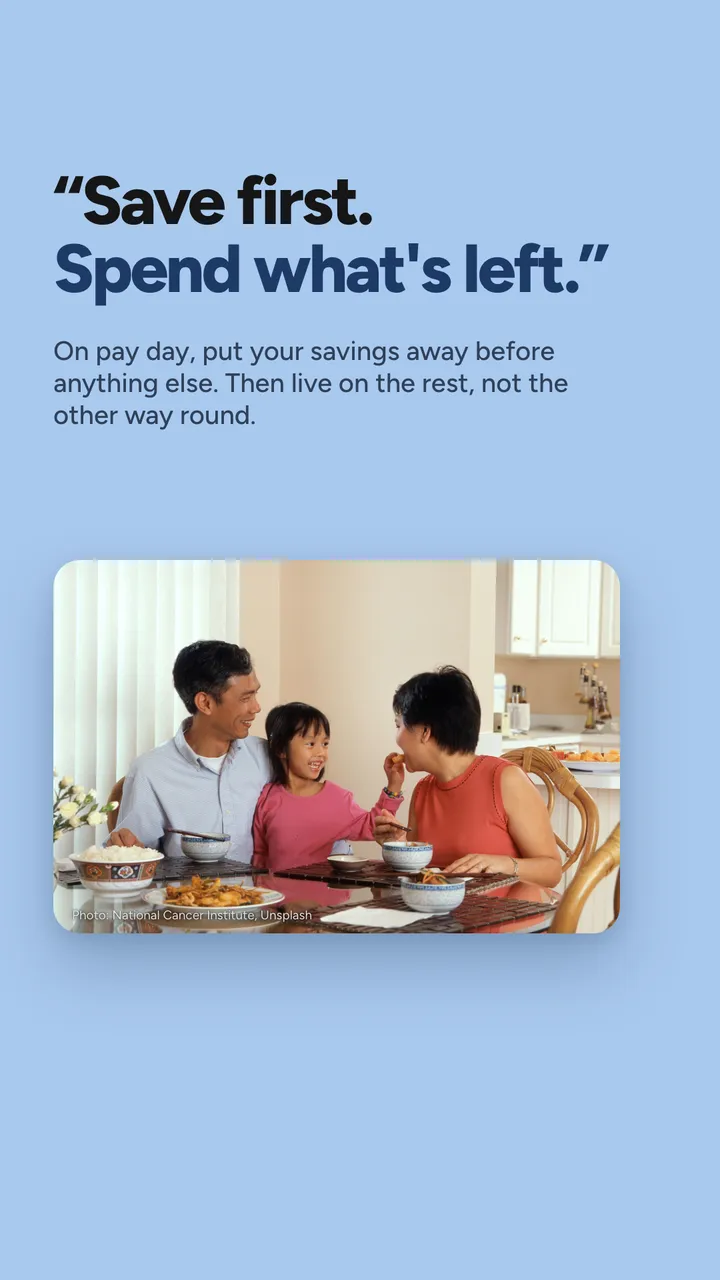
Most of us budget the other way round, and I did for years. Pay comes in, the month happens, and whatever survives until the 30th gets saved. The trouble is that "whatever survives" is decided by every small choice you make for 30 days, usually when you're tired.
Saving first swaps those 30 decisions for one. You pick an amount, you move it on pay day, and you live on the rest. My mum did this at a counter. Today a standing instruction to a separate account does the same job, and it doesn't rely on you remembering.
A worked example
Say Mei Fen is 29 and earns $4,500 a month. This is made up, but it's an ordinary picture. Her 20% employee CPF contribution is $900, so $3,600 reaches her bank account.
| Saving what's left | Saving first | |
|---|---|---|
| Lands in her account | $3,600 | $3,600 |
| Moved on pay day | $0 | $500 |
| Left to live on | $3,600 | $3,100 |
| Saved by month end | Whatever survives | $500 |
Over a year that's $500 × 12 = $6,000, without one decision after the first.
What this means for you
The amount matters less than the order. If $500 is out of reach, try a figure small enough that you wouldn't feel it, then raise it when your pay goes up. It's worth keeping the money in a separate account too, since a balance you can see in your spending account tends to look available.
Why every cent still counts
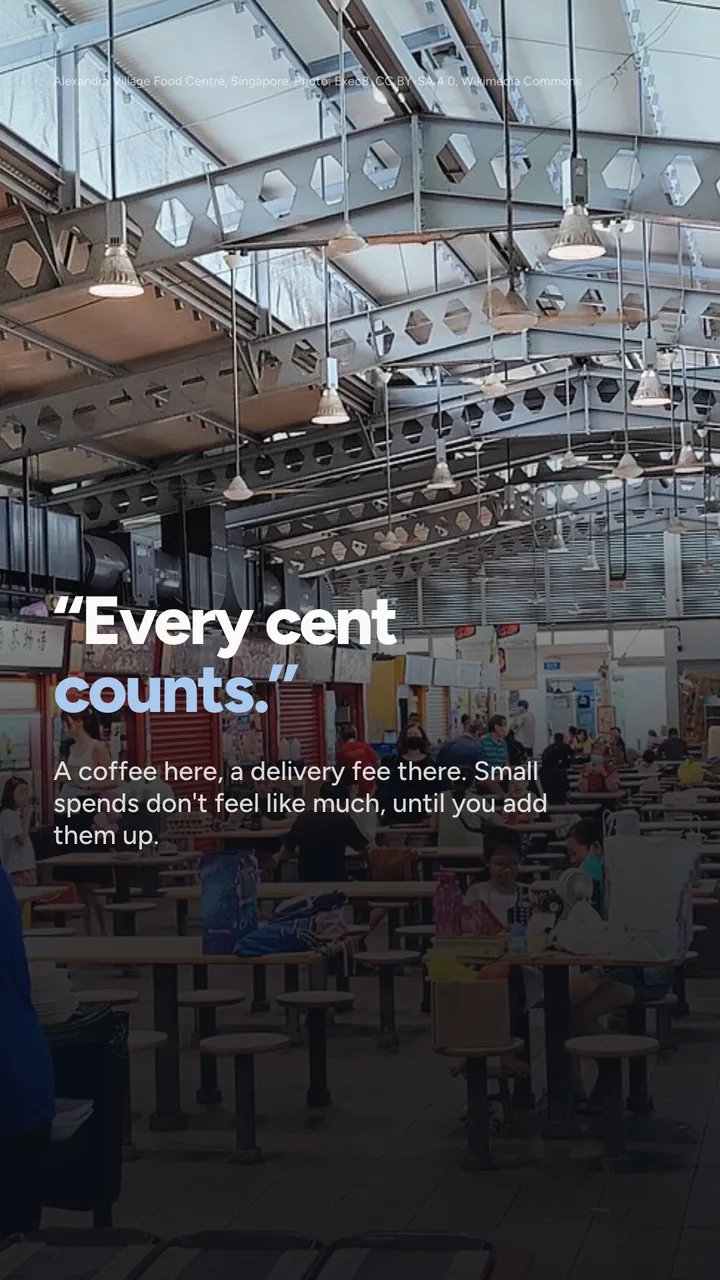
Most Sundays I go with my dad to the supermarket near my parents' block. He checks the receipt line by line in the car park, on the steering wheel, with his reading glasses on. He once walked back in over a kai lan promotion that hadn't come off.
I used to find this funny. The cents weren't the point, though. My dad is someone who always knows what things cost, and that habit is harder to keep now than it was for him. His spending happened in cash, in front of him. Ours happens with a tap, a saved card and a fee added at checkout, so it barely registers.
This isn't a saying about guilt, and I don't read it as "never buy a coffee". I read it as: know what you're paying, then decide. I wrote about how those extra fees build up in why delivery and ride apps cost more.
What small spends look like, added up
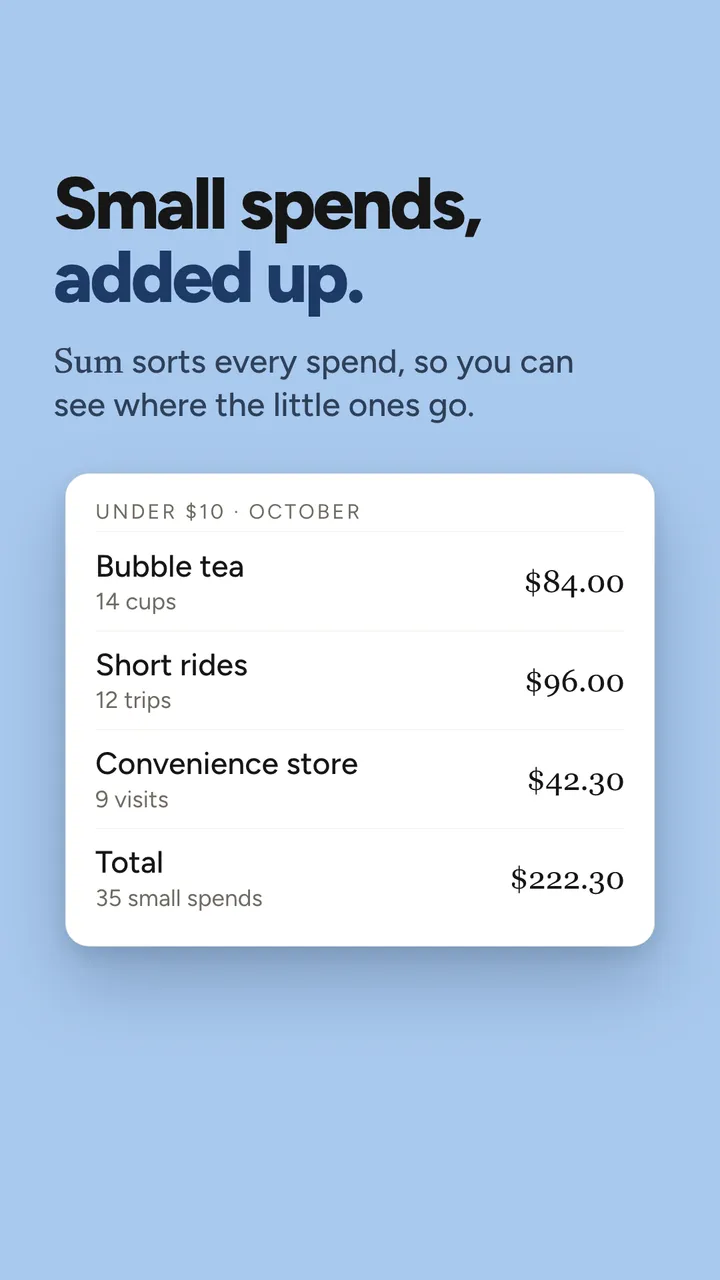
Here's the arithmetic on that sample month:
- Bubble tea: 14 cups at $6 = $84.00
- Short rides: 12 trips at $8 = $96.00
- Convenience store: 9 visits at $4.70 = $42.30
- Total: 35 spends, $222.30
Not one of those 35 would make you stop and think. Together, $222.30 × 12 = $2,667.60 a year. Put that beside Mei Fen's $6,000 and it's a useful thing to know, whether you keep every cup or not. Some of these will be worth it to you. Nobody else gets to decide which.
What this means for you
Try this with last month's card statement: add up every line under $10 and count them. Then ask which of them you'd buy again. You don't have to change a thing. My dad would simply like you to have looked.
"Don't owe anyone money", with one footnote
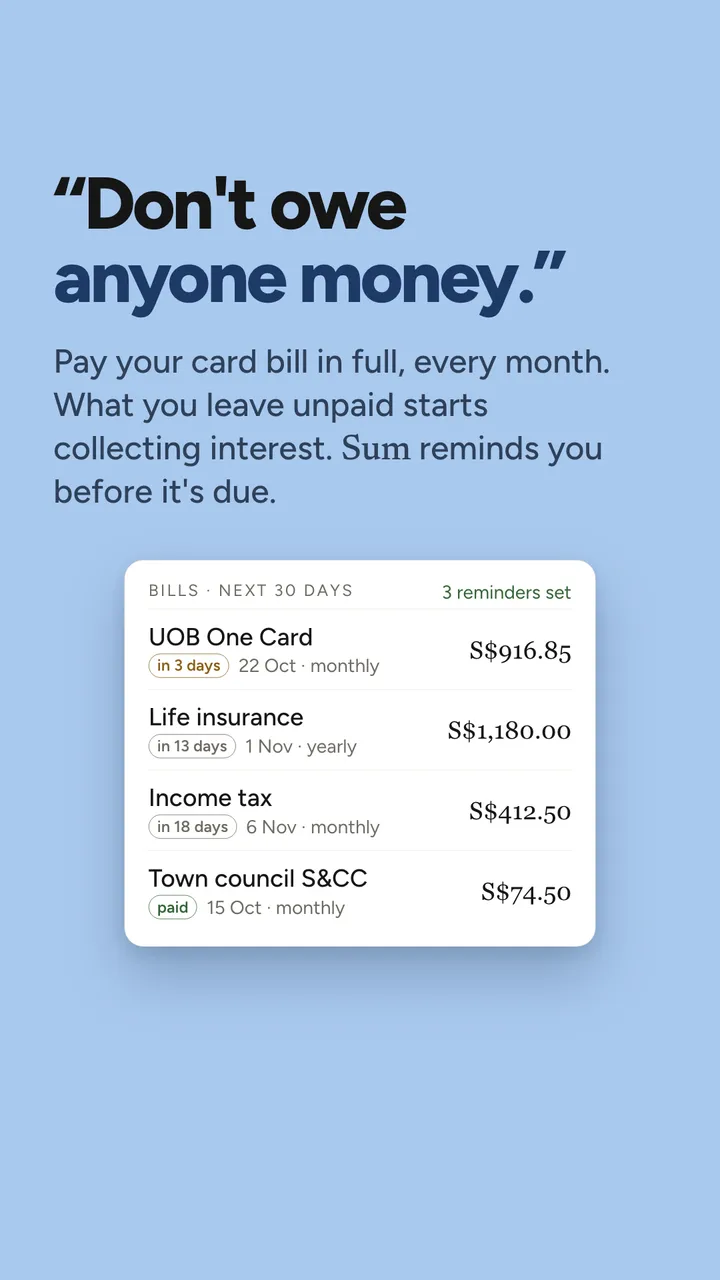
I should declare an interest: I owe HDB a lot of money. So does most of my generation, jointly with someone they love. A home loan has a set schedule and pays for something you live in, and I don't think my parents meant that. They meant the kind of debt that grows quietly while you aren't looking. Today, that's mostly a credit card balance.
A credit card gives you a stretch of time to pay with no interest, as long as you clear the full bill by the due date. Leave part of it unpaid and that stops. As one example, POSB gives 25 interest-free days if you pay in full. On unpaid balances its published rate, as at 6 Nov 2026, is 27.80% a year, worked out daily from the date of each transaction until it's fully paid. Rates differ by card, so yours is in your card's terms.
A worked example
Say Arif leaves $2,000 unpaid at 27.80% for 30 days. A rough estimate, leaving aside fees:
- $2,000 × 27.80% = $556 a year
- $556 ÷ 365 = about $1.52 a day
- $1.52 × 30 = about $45.70 for one month
That's money that buys nothing: more than seven of those $6 bubble teas. The minimum payment on your statement keeps you out of late-fee trouble, but the rest of the balance keeps collecting interest.
The other way this goes wrong is simply forgetting. My two cards fall due about two weeks apart, and one bill once went four days late in a deadline week. I had the money. I just wasn't looking.
What this means for you
If you can, set up a payment for the full statement amount, not the minimum. And check which date each card falls due, because they rarely line up.
Keep something for a rainy day
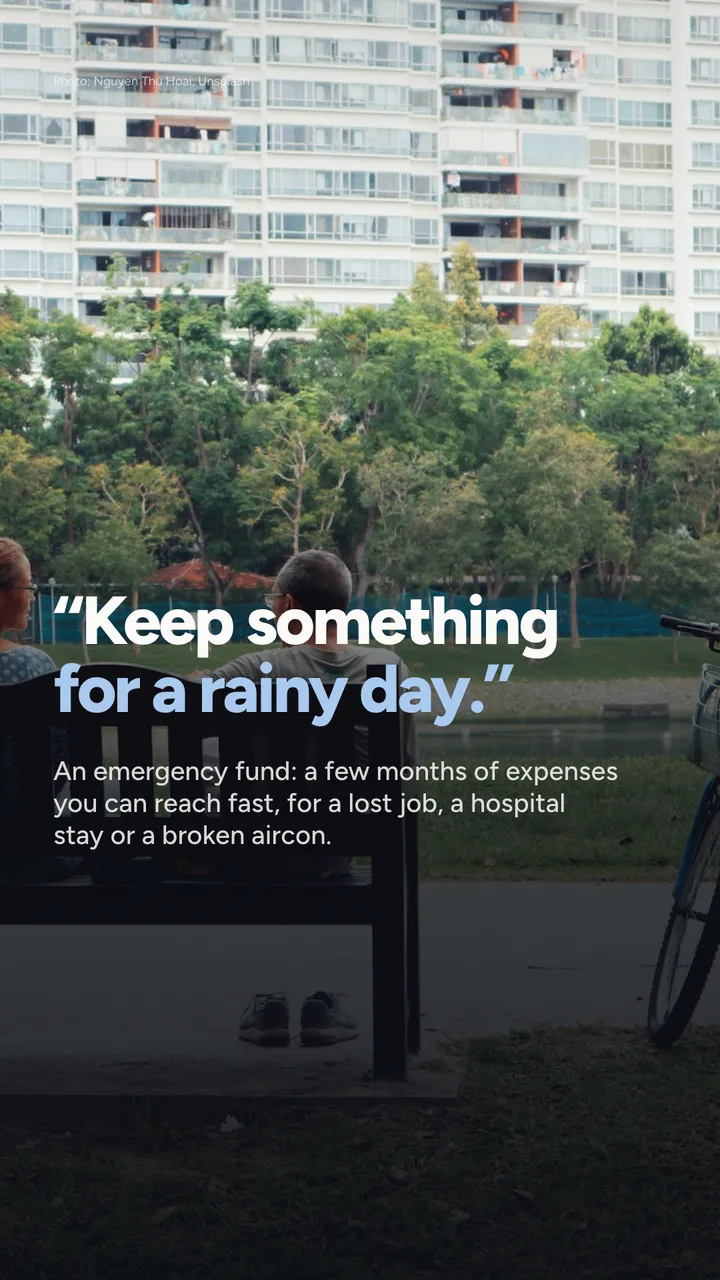
My parents' fridge died on a Tuesday night in the hottest week of the year. The butter went soft, the freezer contents went into a neighbour's cooler box, and by Saturday they were in an electronics shop choosing another one. Nobody panicked about the money, because some of it had been sitting there for exactly this.
That's an emergency fund: money set aside for things you didn't choose, kept somewhere you can reach quickly. MoneySense, the national financial education programme, suggests at least three to six months' worth of expenses.
A worked example
Say Hafiz spends $2,800 in a typical month. His range is:
- Three months: $2,800 × 3 = $8,400
- Six months: $2,800 × 6 = $16,800
Notice that it's sized on what he spends, not what he earns. And a common misconception: your CPF doesn't count here. It's yours, but it's set aside for housing, healthcare and retirement, so it won't reach you in the week the aircon gives up.
I keep about three months of expenses in a separate savings account, and I've left its app off my home screen on purpose.
Giving the rainy day a number
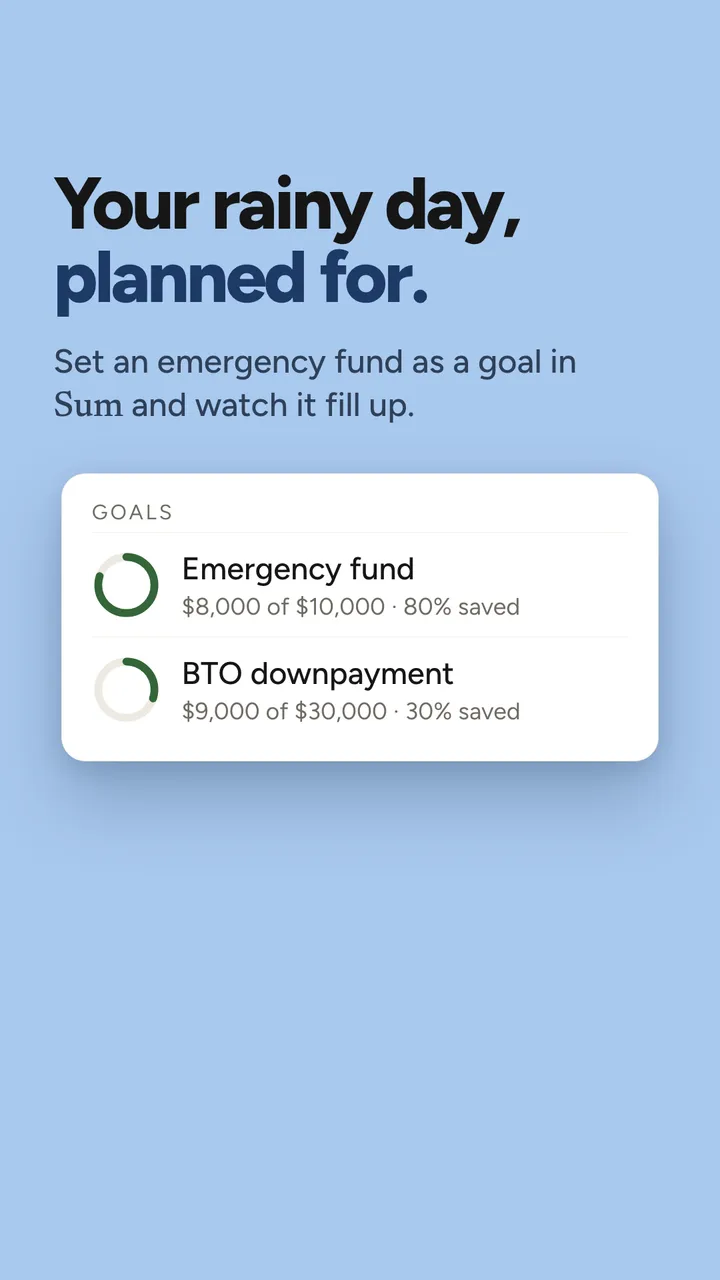
"Keep something" is a lovely instruction and a hard one to act on, because you can't tell when you're done. A number fixes that. On the slide, the sample emergency fund is at $8,000 of $10,000, so $2,000 is left. At $400 a month that's $2,000 ÷ $400 = 5 months.
My mum's version of this was the pencil notes. Each pot of money had a name, so it was harder to borrow from it by accident. A goal does the same thing. It's also why the two goals on that slide sit apart: the BTO money and the rainy day money have different jobs, and I covered how to keep them separate in saving for a big buy.
What this means for you
Add up a typical month, multiply by three, and compare it with what you have set aside. If there's a gap, the gap is your first goal.
If it sounds too good to be true, it is
When my mum first saw Sum on my phone, her question wasn't about features. It was "Then it can take money out or not?" She has never been impressed by anything just because it's new, and I've come to think that's a skill.
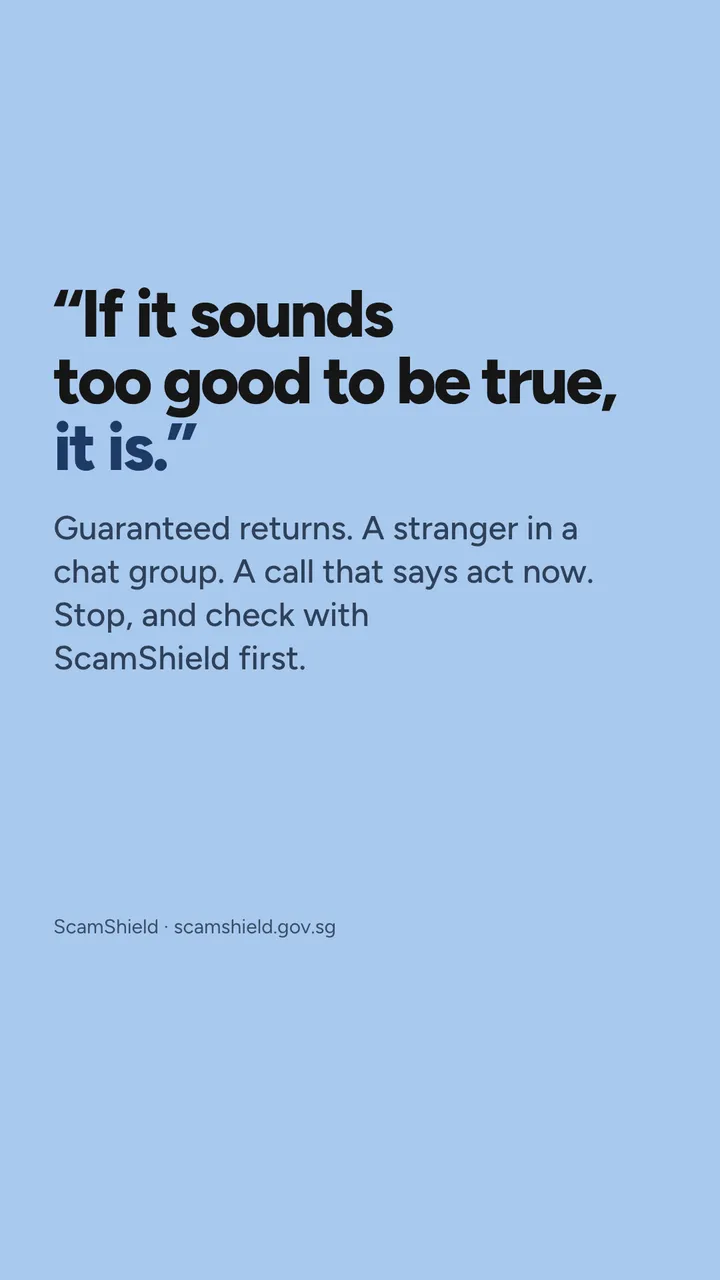
The three signs on the slide each do a specific job for the person behind them:
- Guaranteed returns. Every real investment comes with risk. A promise that removes it is the first thing to doubt.
- A stranger in a chat group. Scams borrow trust from a group, so you see other people apparently doing well.
- A call that says act now. Urgency is there to stop you from asking anyone. A real bank or agency can wait while you check.
The useful part is the first word of the last line: stop. Hang up, leave the chat, and ask someone. ScamShield is the Government's anti-scam service, and its helpline at 1799 runs 24 hours a day for exactly the moment when you're unsure. It can check whether something is a scam and direct scam victims to their bank. It can't make police reports, so that's a separate step.
What this means for you
Save 1799 in your phone, and in your parents' phones. It's a two-minute job on a Sunday, and they did teach you the lesson first.
They built this. Now it's our turn
I used to think of saving as a private thing. Then I looked at those passbooks again. Money in a bank doesn't sit still: it gets lent out for homes and businesses. So a generation of careful savers wasn't only looking after their own families. Their deposits were part of how the country grew.
Our version looks different. We have more accounts, more cards and more ways to spend than they did. What we can keep is the habit of knowing where we stand.
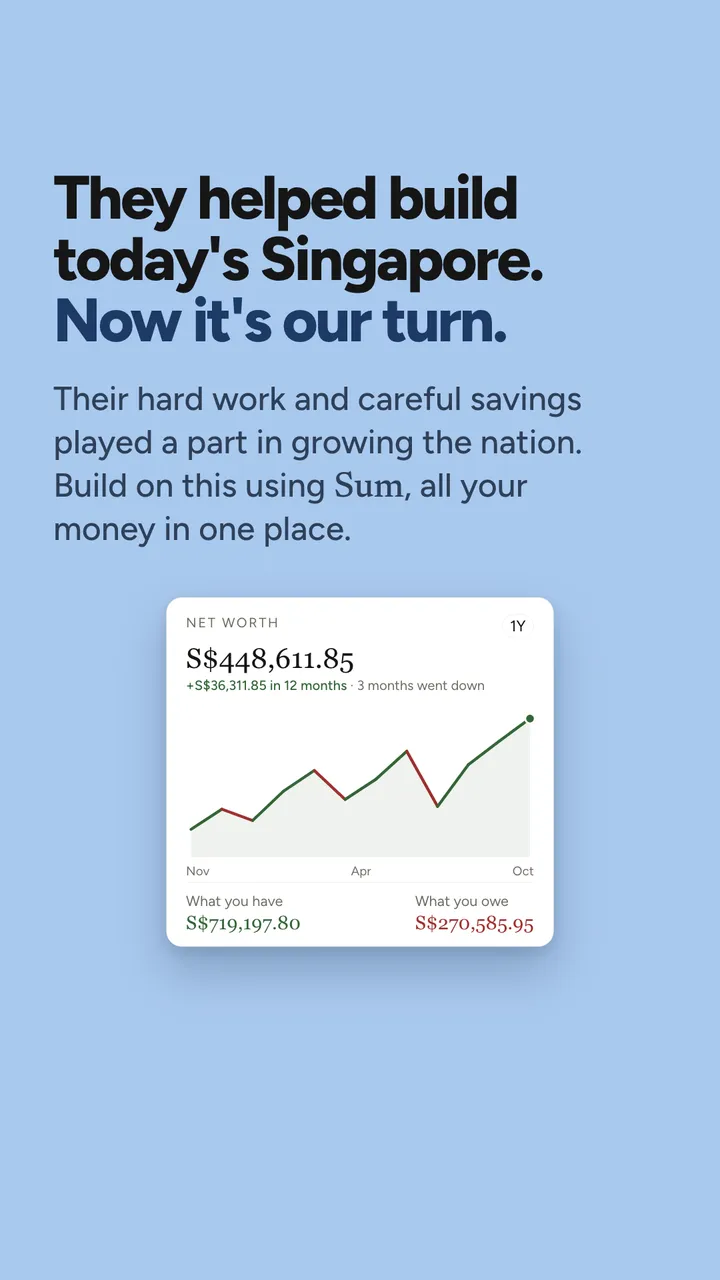
That's what the chart on the slide shows. Net worth is what you have, minus what you owe. On the sample figures, $719,197.80 minus $270,585.95 is $448,611.85. Three months on that chart went down, and the year still ended higher, which is how real money behaves.
From a passbook to your phone
A passbook did something simple and powerful: everything your money did was on one page, and you had to look at it. My mum's only had one account to worry about. I had four banking apps, a CPF login, a brokerage account, two cards and a spreadsheet I updated once a year.
That's the job Sum does for me now. Link a bank, or import a statement, and Sum reads it and sorts every line. It's read-only, so it can see but never move money, which is the answer my mum wanted. Once I explained, she said, "OK, so it's like the passbook, but on the phone." I've never described it better.
If you only remember three things
- Move your savings on pay day, before you spend. The order matters more than the amount.
- Keep a few months of expenses somewhere you can reach fast, and give that money a number.
- If you're being rushed, or promised something with no risk, stop and call 1799.
How I keep track of this
On the 1st of each month, with a kopi, I import last month's card statements and Sum sorts every line by category. I look at the three biggest categories, then at where the small spends went. My bills sit in one list with a reminder before each is due, so both cards get paid in full. My emergency fund is a goal with a ring on it, and I check the net worth line last. Spending by category, budgets, goals and bill reminders are all on the free plan, and Sum is free to start.
It takes about ten minutes, which is roughly how long my dad takes with a supermarket receipt.
My mum put the passbooks back in the bedroom that night, rubber band and all. I asked if I could keep one. She said, "What for? You have the app."
If your parents or grandparents have a money saying I've missed, email me at [email protected]. I read every one.
Talk soon, Brandon
Questions people ask
What does save first, spend what's left mean?
It means moving your savings out on pay day, before any spending, and living on what remains. The amount is set once, so it doesn't depend on what's left at the end of the month.
How big should an emergency fund be in Singapore?
MoneySense, the national financial education programme, suggests at least three to six months' worth of expenses. Work it out from your own monthly spending, and keep it somewhere you can reach quickly.
How do I check if something is a scam in Singapore?
Call the ScamShield Helpline at 1799, which runs 24 hours a day, or check through scamshield.gov.sg. The helpline can't make police reports, so reporting to the police is a separate step.

Sum is launching in Singapore soon.
Your banks, cards, CPF and HDB flat, added up into one net worth. Statements sorted, card caps tracked, bills remembered.
Brandon · Finance team, Sum
Brandon is on Sum's finance team in Singapore. Brandon reads the CPF Board, IRAS and MAS updates so you don't have to, and turns our carousels into the longer version. Questions, corrections or something to share? Email Brandon at [email protected].
Got something interesting to share?
A money story, a question, something we got wrong, or a tip other Singaporeans should hear. Reach out to me at [email protected], or leave your email and I'll write to you.
Sources: MoneySense, Your Financial Basics (emergency funds), updated 16 Oct 2026; POSB, Finance/Interest Charge on credit cards, as at 6 Nov 2026; ScamShield, Helpline, updated 25 May 2026.
Any app screens shown use sample data, not a real person's. Sum is free to start; some features need a paid plan.
Information only, not financial advice.