Why are delivery and ride apps so expensive this year? Four changes behind the prices you pay
CPF for riders, fuel fees, fewer rivals and new rules abroad. Brandon from Sum explains why delivery and rides cost more in 2026, and what you can control.

It was a wet Thursday night a few weeks ago, the kind where neither of us had the energy to cook or to walk to the hawker centre in the rain. So I did what a lot of people do at 8pm on a wet Thursday. I opened a delivery app, picked two plates of chicken rice and a drink, and went to check out.
Then I scrolled down to the total, and stopped. Below the food there was a delivery fee, a platform fee and a small-order fee, because my order was just under the minimum. Rachel looked over my shoulder and said, "Since when got so many fees?"
I didn't have a good answer. I'd noticed rides and delivery feeling more expensive this year, the same way everyone has, but I'd never actually looked at why. So that weekend, being the kind of person who reads fare breakdowns on a Saturday morning (yes, really), I did.
It turns out there isn't one villain. There are four separate changes, and they all landed in roughly the same stretch of time. Here they are, slide by slide, with the arithmetic shown, plus the part I care about most: what's still in your control.
Four changes behind the price you pay
Before we start, one thing worth saying plainly. This isn't about any one company. Every app in this space faces the same costs and the same rules, and most of what follows applies to all of them.
It also helps to know what you're actually paying for when you order. A delivery or ride price is usually a few separate pieces stacked together: the food or the fare itself, a delivery fee, a platform fee (a flat charge the app adds to each order or ride), and sometimes extras like a small-order fee or a surcharge. When people say "delivery got expensive", they usually mean one of those pieces went up, not all of them.
What this means for you
Next time you check out, scroll to the breakdown before you pay. It takes five seconds, and it tells you which piece is doing the damage.
Change 1: riders and drivers now get CPF
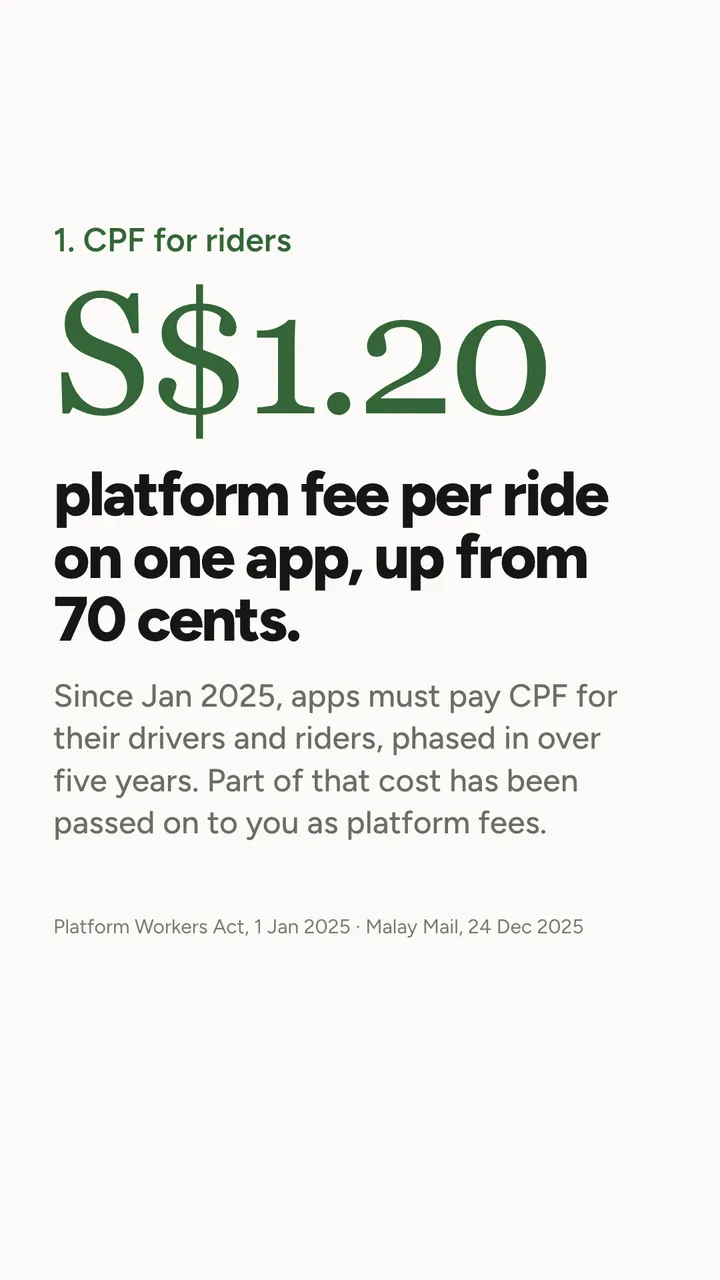
Since 1 January 2025, the Platform Workers Act has treated delivery riders and ride-hail drivers as their own group of workers, with some of the protections employees get. The big one is CPF. Apps now have to pay CPF contributions for their platform workers born on or after 1 January 1995 (older workers can opt in), and the rates are phased in over five years rather than all at once.
I think this is a good thing, honestly. A rider who spends ten years on a bike deserves something in their retirement account at the end of it. But CPF contributions are a real cost, and part of that cost has been passed on to us as platform fees. On one ride app, the platform fee went from 70 cents a ride to between S$1 and S$1.20 from January 2025.
A worked example
Say Darren takes 10 rides a month. This is made up, but it's a pretty ordinary picture. If his platform fee went from 70 cents to S$1.20, that's 50 cents more per ride:
- 10 rides x 50 cents = S$5 a month
- S$5 x 12 months = S$60 a year
Not a disaster on its own. But it's one of four, and the others stack on top.
What this means for you
Because the CPF rates step up over five years, it wouldn't be surprising to see platform fees adjusted again. It's worth knowing that this part of the price is structural, not a promotion that will come back.
Change 2: fuel, and a fee that goes to drivers
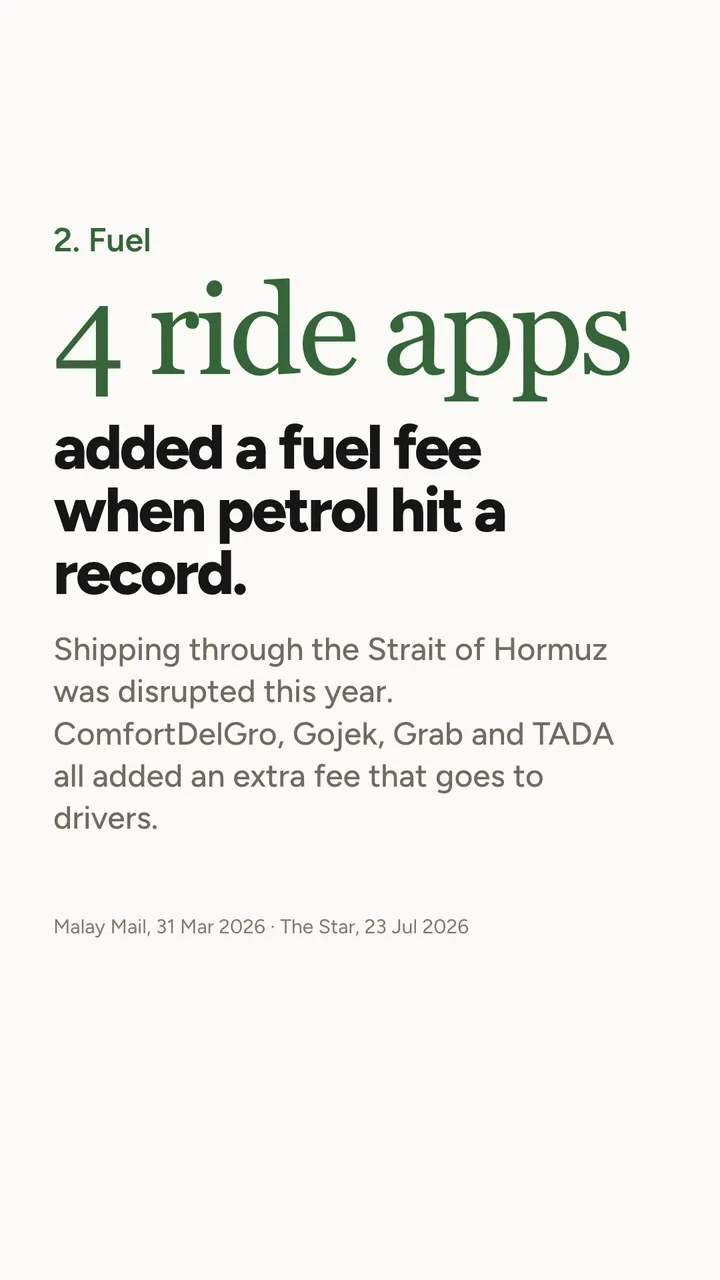
You'll remember this one from the news, or, in my case, from the family group chat, where petrol prices have been a regular topic all year. Shipping through the Strait of Hormuz, the narrow sea route a large share of the world's oil passes through, was disrupted this year, and petrol prices here hit a record.
Drivers pay for their own petrol, so the ride apps responded. ComfortDelGro, Gojek, Grab and TADA each added an extra fee per ride, and that fee goes to the driver rather than the app. Grab's, for example, was 90 cents a trip (The Star, 23 May 2026). The apps extended these fees a few times, and the latest report I could find said they would stay until 30 September 2026 (The Star, 23 July 2026). I couldn't find an announcement either way about what happened after that.
A worked example
Say Darren's 10 rides a month each carried a 90-cent fuel fee:
- 10 rides x 90 cents = S$9 a month
- Add the S$5 from the platform fee above, and his rides cost S$14 a month more than before, or S$168 a year, for exactly the same trips.
What this means for you
Look at the fare breakdown on your next ride and see whether a fuel or driver fee is still there. Fees like this tend to be temporary and tied to petrol prices, so it's worth checking rather than assuming.
Change 3: fewer rivals
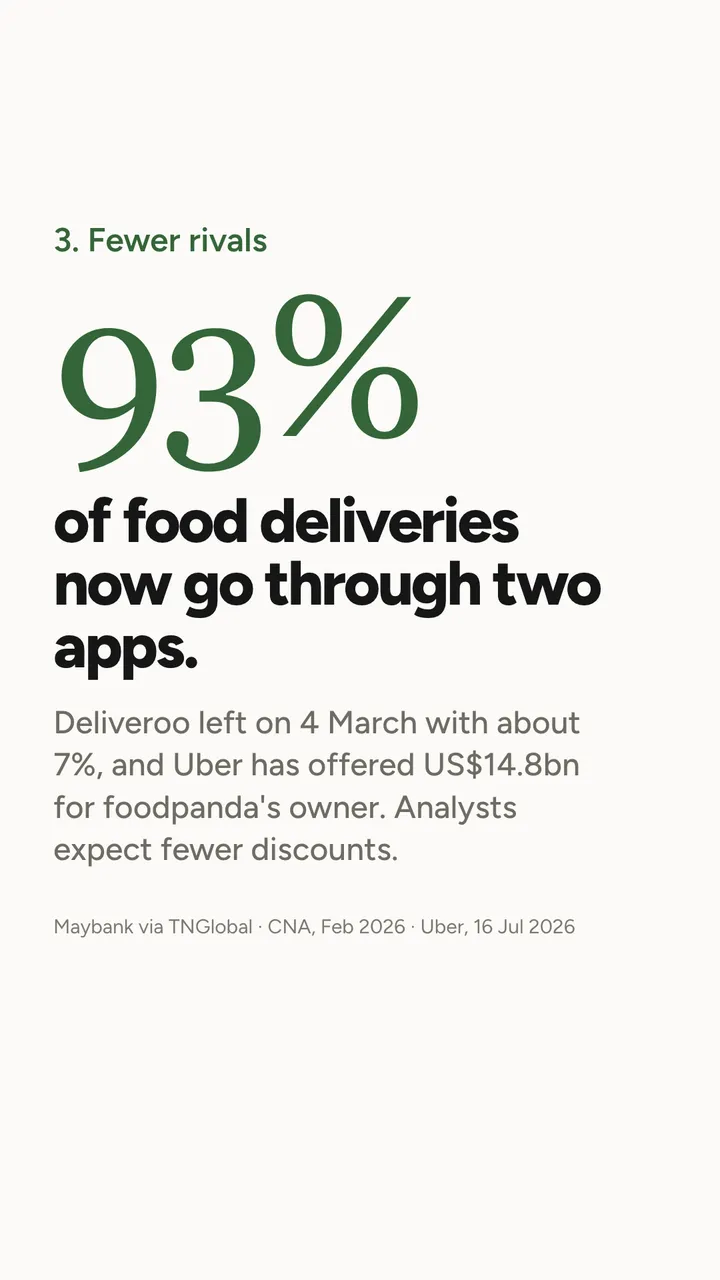
Deliveroo's last day in Singapore was 4 March 2026. It had about 7% of food deliveries. With it gone, two apps now handle about 93% between them: Maybank's figures put them at 69% and 24%, and 69 plus 24 is 93.
Then, in July, Uber offered US$14.8 billion for Delivery Hero, the German company that owns foodpanda. As I write this, the offer is still going through acceptance and approvals, so nothing has changed hands yet.
Why does any of this matter to your supper order? Because discounts are partly a competition expense. When three apps are fighting for your order, promo codes and free delivery are how they win you over. With fewer rivals, there's less reason to keep paying for those, which is why analysts quoted at the time expected fewer discounts.
A worked example
Say Mei orders delivery 8 times a month, and used to get S$3 off on half of those orders through promo codes. Again, an example, not a real person.
- 4 orders x S$3 = S$12 a month in discounts
- If those promos dry up, that's S$144 a year she'd now be paying, without ordering a single extra meal.
What this means for you
Discounts were never really the price. The price is what you pay without them. If your delivery spending seems to have crept up while your habits stayed the same, this might be part of why.
Change 4: governments are looking at the apps' cut
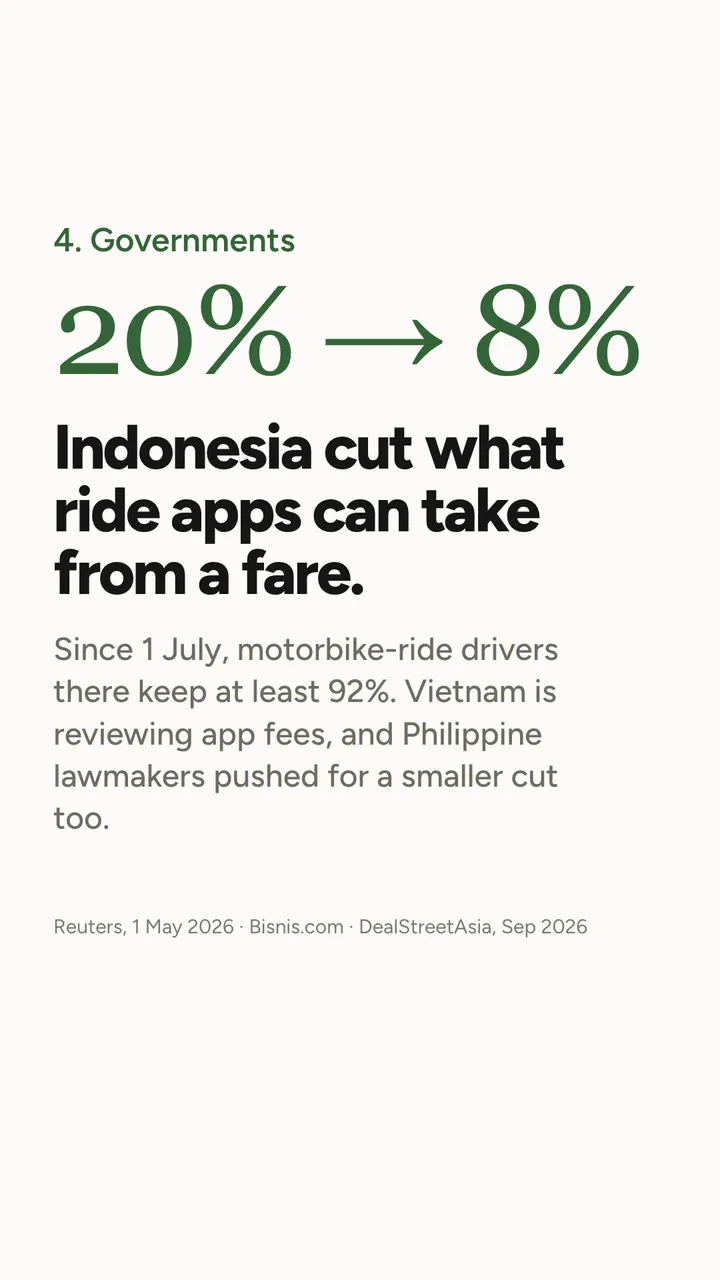
This one is happening outside Singapore, but it's part of the same story. Ride apps make most of their money from a commission: the share of each fare the app keeps, with the rest going to the driver.
In May, Indonesia's President announced a cap on that commission, from 20% down to 8%. Since 1 July, motorbike-ride drivers there keep at least 92% of each fare. Vietnam is reviewing app fees, and lawmakers in the Philippines pushed for a smaller cut too.
A worked example
Take a fare of 10 dollars, just to keep the maths easy:
| Commission | App keeps | Driver keeps |
|---|---|---|
| 20% | $2.00 | $8.00 |
| 8% | $0.80 | $9.20 |
The driver gets $1.20 more on every $10 fare. Good for drivers. The app, though, now earns $1.20 less on each ride in that market, and companies that operate across the region tend to look for that money somewhere.
What this means for you
There's no such cap in Singapore, and I'm not going to guess what any app will do about it. The useful thing is just to know that the fees you pay here are part of a regional picture, not set in isolation.
And next: cars with no driver
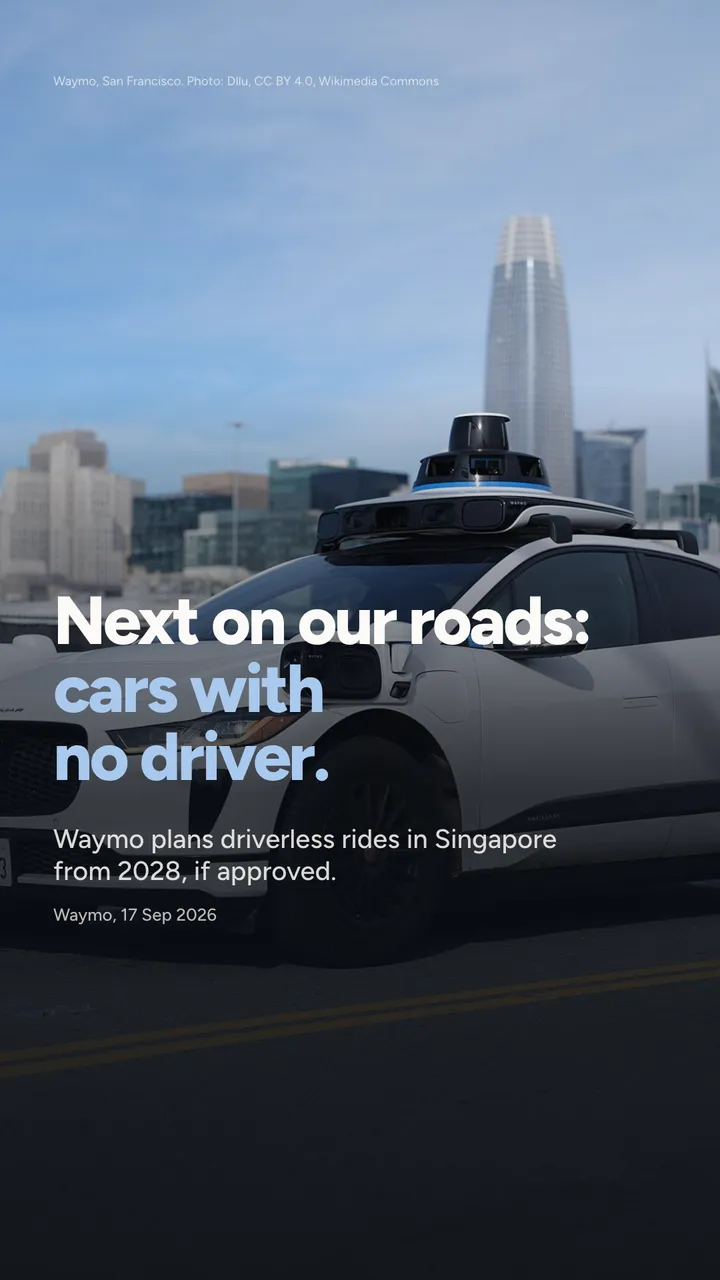
In September, Waymo, the driverless car company owned by Google's parent Alphabet, said it plans to run fully driverless rides in Singapore from 2028, if regulators approve. The early work is meant to start in the west of the island, around Labrador and Harbourfront, with testing through 2027.
I'll admit I find this both fascinating and slightly strange to imagine on the PIE. It changes nothing about what you pay for a ride today, and nobody knows yet what a driverless ride here will cost. I've included it because it's part of where this industry is heading, and because it's a reminder that prices aren't fixed forever, in either direction.
What this means for you
Nothing to do yet. If it comes up at dinner, you now know the date and the "if approved".
But wait: what's still in your control
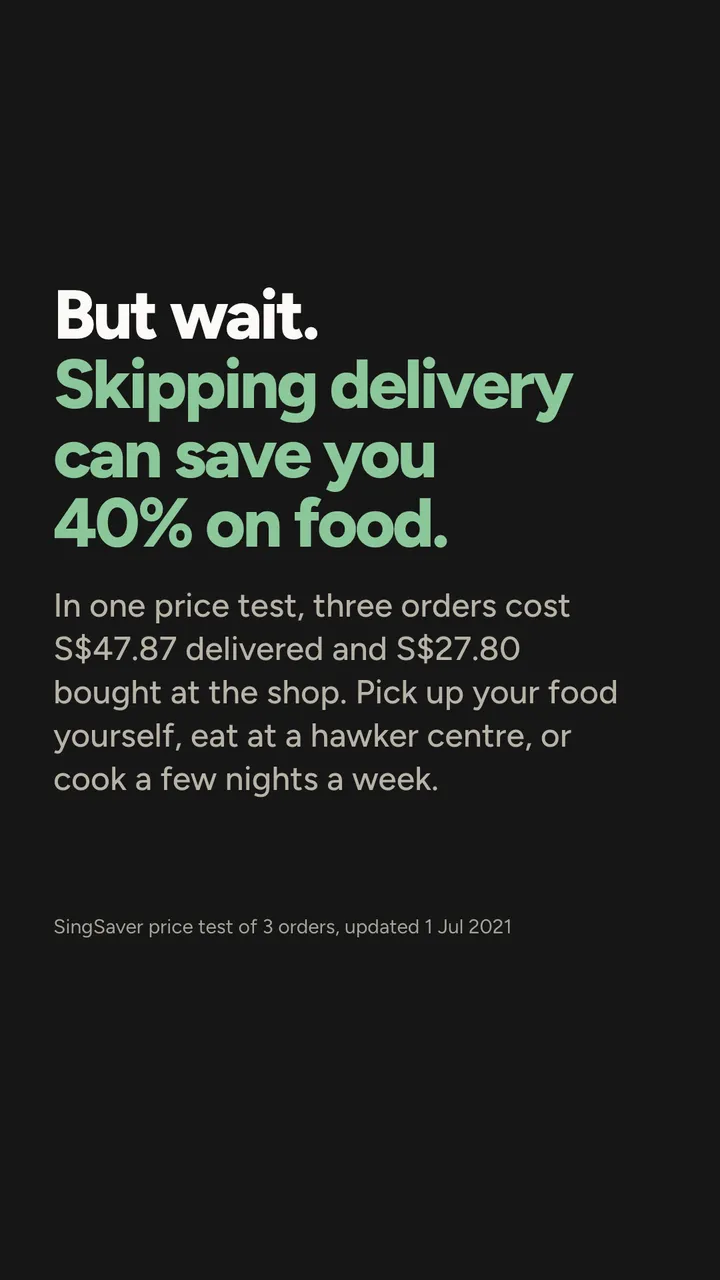
Here's the part I like. You can't change CPF rules, fuel prices or who buys whom. You can change how often you pay for someone to carry your food.
In one price test, three orders cost S$47.87 delivered, and S$27.80 when bought at the shop. The difference is S$47.87 minus S$27.80, which is S$20.07. Divide that by S$47.87 and you get about 42%, which is where "about 40%" comes from. Part of the gap is the delivery and platform fees, and part is that menu prices on delivery apps are often higher than at the counter.
One honest caveat: that test is from 2021, and prices have moved since. Treat the 40% as a sense of scale, not a rule.
A worked example
Say Wei Ling orders delivery 12 times a month, at about S$24 an order. That's roughly what the sample month on the next slide works out to: S$286.40 divided by 12 orders is S$23.87.
If she picked up 4 of those orders herself instead, and saved about 40% on each:
- S$23.87 x 40% = about S$9.55 saved per order
- 4 orders x S$9.55 = about S$38 a month
- S$38 x 12 = about S$458 a year
She'd still get delivery 8 times a month. She'd just walk downstairs for the other four.
What this means for you
The three cheaper options on the slide are all ordinary: pick it up yourself, eat at a hawker centre, or cook a few nights a week. You don't have to do all of them. Swapping the easiest one or two orders a week is usually enough to notice.
How much do you actually spend on delivery?
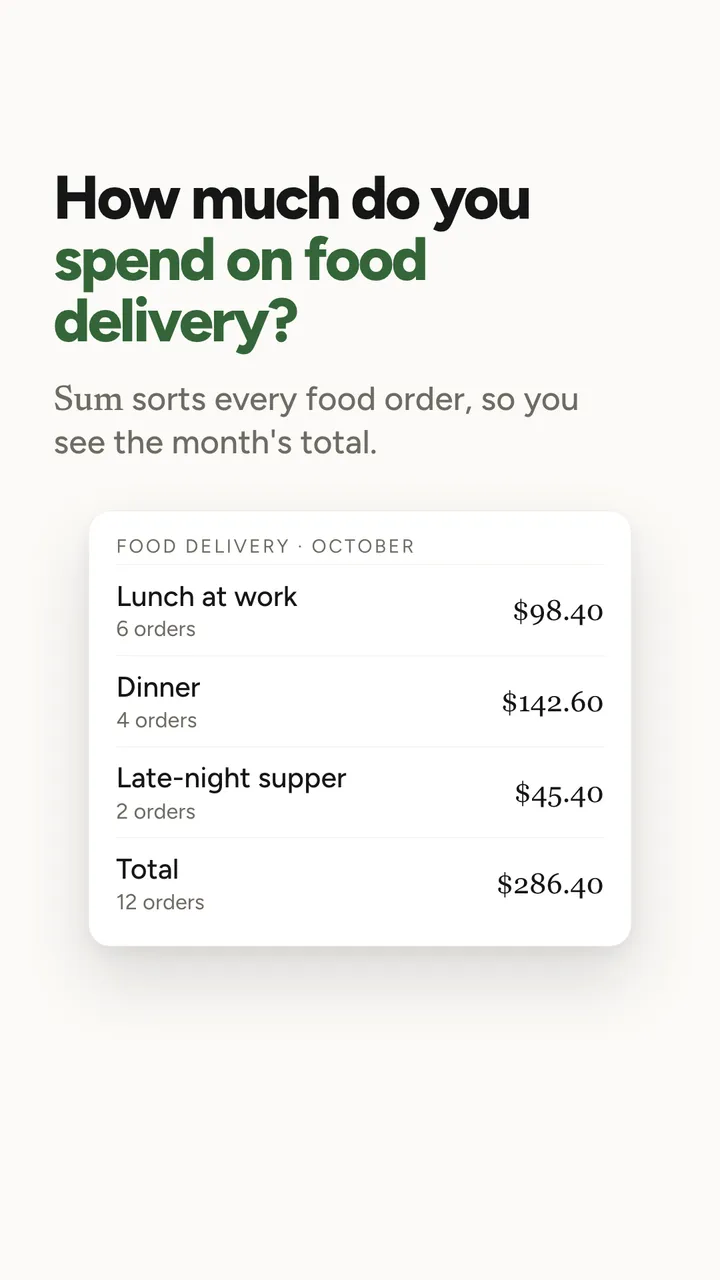
Most of us guess low. Each order feels small, and they arrive one at a time across different days and sometimes different cards, so the total never shows up anywhere on its own.
The slide shows a sample month, split by when the orders happened:
| Orders | Total | Per order | |
|---|---|---|---|
| Lunch at work | 6 | $98.40 | $16.40 |
| Dinner | 4 | $142.60 | $35.65 |
| Late-night supper | 2 | $45.40 | $22.70 |
| Total | 12 | $286.40 | $23.87 |
The per-order column is just the total divided by the orders. What I find interesting is that lunch is the most frequent, but dinner costs more than twice as much per order. If you were going to swap one kind of order for a pickup, the table tells you which one would save the most.
What this means for you
Before deciding whether to cut back, find out what the number is. A month of your own data beats any rule of thumb.
If you own the shares, see them in proportion
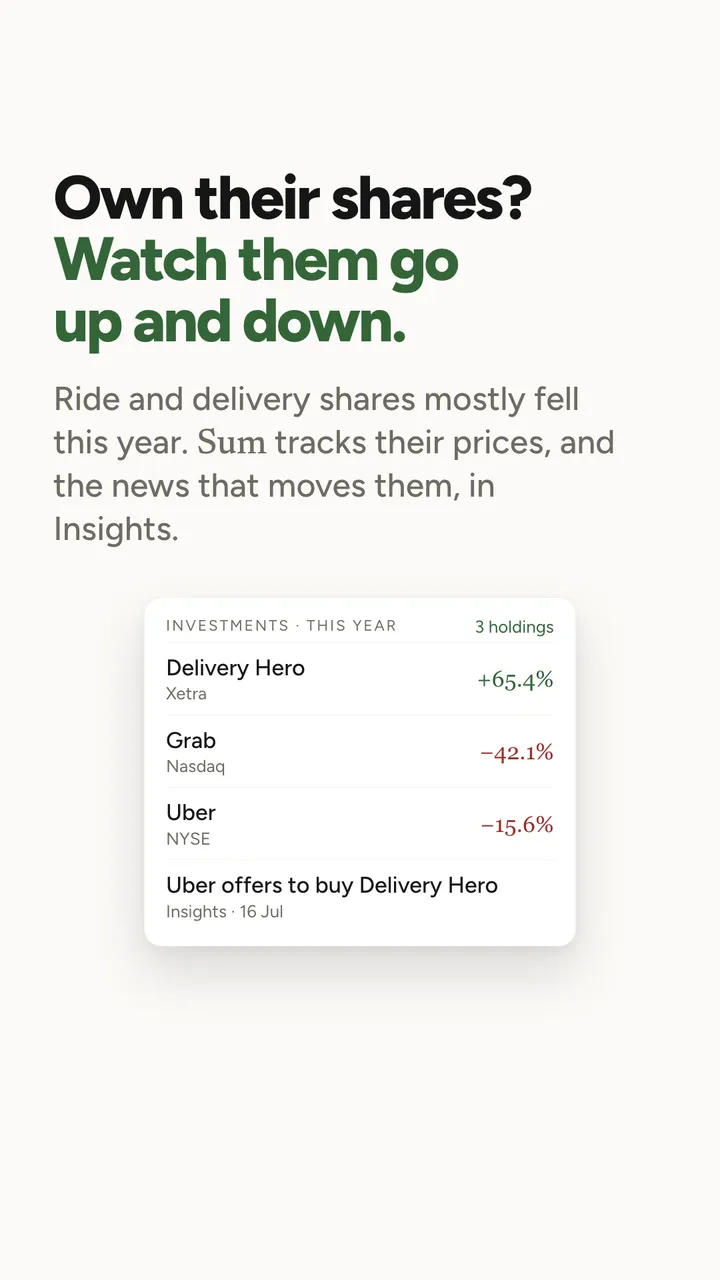
Some of us are on both sides of these apps: we pay their fees, and we also own their shares, maybe through a brokerage account opened on a bored weekend (I won't say whose). The slide shows how three of them moved this year, from the start of 2026 to 21 to 22 October:
- Delivery Hero, listed on Xetra in Germany: up 65.4%
- Grab, listed on Nasdaq: down 42.1%
- Uber, listed on the NYSE: down 15.6%
"Up 65.4% this year" means the price is 65.4% higher than it was on the first trading day of 2026. To see what a fall means in dollars: if a holding was worth $1,000 at the start of the year and fell 42.1%, it would now be worth $1,000 minus $421, which is $579.
On the why: Uber's cash offer for Delivery Hero was announced on 16 July 2026, and a takeover offer at a set price per share usually pulls the share price towards that price. For Grab and Uber, the sources behind this deck don't give a single reason for the falls, so I won't invent one. Past performance is not a guide to future returns, and none of this is a view on whether to buy, sell or hold anything.
What this means for you
If you own any of these, the useful habit is looking at the whole holding, and at the news that's actually about the company, rather than reacting to a red day. Seeing it in proportion to everything else you have helps a lot.
Every yum, tracked
The closing slide puts the two halves of this post together: what you spend on food, and what you own.
If you only remember three things
- Delivery and rides cost more this year for four separate reasons: CPF for platform workers, fuel fees, fewer rivals, and governments in the region looking at the apps' cut. None of them is a single company's doing.
- You can't change those, but you can change how often you pay for delivery. In one price test, picking up the food cost about 40% less.
- Know your own number first. Add up a month of delivery orders before deciding anything.
How I keep track of this
When I import my card statements on the 1st of the month, Sum reads them and sorts every line by category, so food delivery shows up as its own total instead of a dozen small charges spread across two cards. That number is the first thing I look at after the kopi. Spending by category and budgets are on Sum's free plan, and Sum is free to start.
Shares in a brokerage account count towards net worth on Essential. Live prices, profit and loss, and Insights, where Sum shows the news that moves the shares you own, are on Pro. I like that last one mostly because it means I don't have to check prices myself.
If you want more on the habit side of this, I wrote about why saving is so hard and the psychology of budgeting. We post a new carousel most days on TikTok and Instagram, and the longer version lands here. If something in this post looks out of date by the time you read it, email me at [email protected].
As for that wet Thursday, I did place the order in the end. But the next week, when it rained again, we walked to the hawker centre with an umbrella. The chicken rice was the same. The fees were not.
Talk soon, Brandon

Sum is launching in Singapore soon.
Your banks, cards, CPF and HDB flat, added up into one net worth. Statements sorted, card caps tracked, bills remembered.
Brandon · Finance team, Sum
Brandon is on Sum's finance team in Singapore. Brandon reads the CPF Board, IRAS and MAS updates so you don't have to, and turns our carousels into the longer version. Questions, corrections or something to share? Email Brandon at [email protected].
Got something interesting to share?
A money story, a question, something we got wrong, or a tip other Singaporeans should hear. Reach out to me at [email protected], or leave your email and I'll write to you.
Sources: CPF Board: What payments to platform workers attract CPF contributions; Malay Mail: Ride-hailing fees in Singapore to rise in 2025, 24 Dec 2024; The Star: Grab extends 90-cent fuel surcharge till 31 July, 23 May 2026; The Star: ComfortDelGro, Grab, Gojek, Tada to retain additional driver fee till 30 Sept, 23 Jul 2026; NTU (CNA): Deliveroo's Singapore exit may lead to higher fees, fewer discounts, 26 Feb 2026; TNGlobal: Grab outlook resilient despite rising foodpanda competition (Maybank), 9 Sep 2026; The Next Web: Uber's takeover offer for Delivery Hero confirmed, Jul 2026; DealStreetAsia (Reuters): Indonesia lowers ride-hailing driver commission to 8%, May 2026; Malay Mail: Waymo to deploy fully autonomous ride-hailing in Singapore in 2028, 18 Sep 2026; SingSaver: The real cost of food delivery in Singapore (updated 1 Jul 2021).
Any app screens shown use sample data, not a real person's. Sum is free to start; some features need a paid plan.
Information only, not financial advice.