Want the iPhone Duo? How to save for a big buy without touching your safety net
The iPhone Duo is S$3,099 in Singapore. Brandon from Sum works out a timeline, keeps the emergency fund whole and finds the money in small spends.

Last Wednesday, after futsal, nobody was chasing anybody for PayNow. For once, the court booking wasn't the topic. One of my NS friends had his phone out and was playing a video of the iPhone Duo folding open, slowly, the way you'd show someone a magic trick. Four grown men leaned in.
Then he turned to me. "Brandon, you finance guy. Can buy or not?"
I'll admit I didn't have a clever answer. What I said was something like: it depends on what else that money needs to do this year. He gave me the thumbs up he gives every explanation, and the conversation moved on to whose turn it was to book the court.
But the question stayed with me on the train home, because it's a good one, and it isn't really about a phone. It's about any big thing you want: a phone, a laptop, a trip, a sofa for a new flat. Whether you can buy it isn't a yes or a no. It's a plan, and a plan has a price, a timeline and a few things it isn't allowed to touch.
I'm not going to tell you whether a phone is worth it to you. That's yours to decide, and plenty of people will love this one. What I can do is walk through how I'd plan for it, slide by slide, with the arithmetic shown, so you can redo it with your own numbers.
Start with the thing you want

There's nothing wrong with wanting something new. Wanting things is a big part of why people save at all. The trouble usually starts when the wanting and the paying happen in the same five minutes, with no plan in between.
The phrase on the cover that matters most is the last one: without touching your safety net. A safety net is the money you keep for things you didn't choose, like a retrenchment, a hospital bill or a parent who suddenly needs help. A planned buy is the opposite: something you did choose. The whole idea of this carousel is to keep those two piles of money apart, so that getting the thing you want never makes you more fragile.
What this means for you
Before you look at prices, ask yourself one question: if I bought this today, which pile would the money come from? If the honest answer is "the same account as my emergencies", that's worth fixing first, and it's what the rest of this post is about.
Know the full number
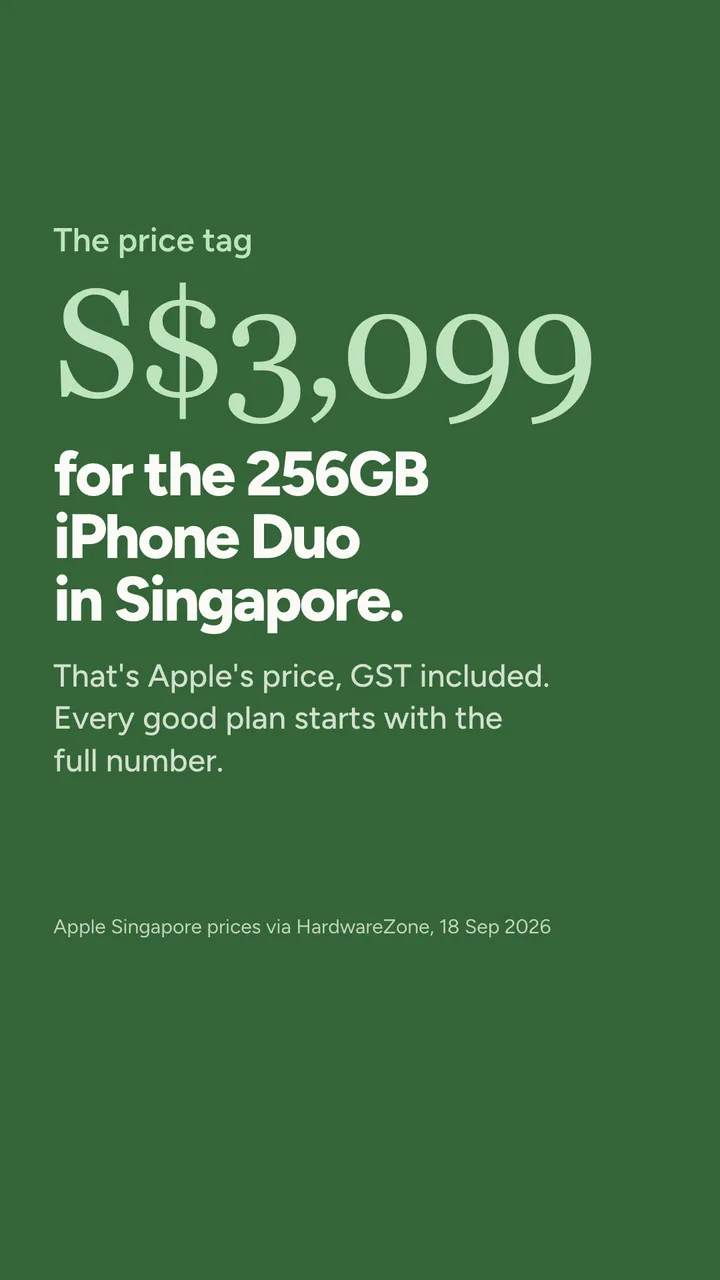
The iPhone Duo went on sale in Singapore on 23 October 2026. According to HardwareZone's list of Apple's Singapore prices (as at 18 September 2026), it starts at S$3,099 for the 256GB model and goes up to S$4,899 for 2TB. Those are Apple's prices with GST already included, so the number on the tag is the number that leaves your account.
Why does the slide make a fuss about the "full number"? Because the number we carry around in our heads is usually smaller than the real one. We remember the starting price and forget the storage upgrade, the case, the screen protector, the extended cover. None of those are bad choices. They just need to be in the plan.
A worked example
Say Darren is 29 and wants the phone. This is made up, but it's a pretty ordinary picture. His list looks like this:
| Item | Amount |
|---|---|
| The phone, 256GB | S$3,099 |
| A case | S$60 |
| A screen protector | S$30 |
| Full number | S$3,189 |
The case and protector are his own guesses, not Apple's prices. The point is that his target is S$3,189, not S$3,099. Planning for S$3,099 and finding out about the extra S$90 at the counter is exactly the kind of thing that sends people to their emergency money.
What this means for you
Write down the full number, extras and all, before you work out anything else. If you're thinking of a different storage size, use that price. The plan is only as good as the number at the top of it.
Give it a timeline
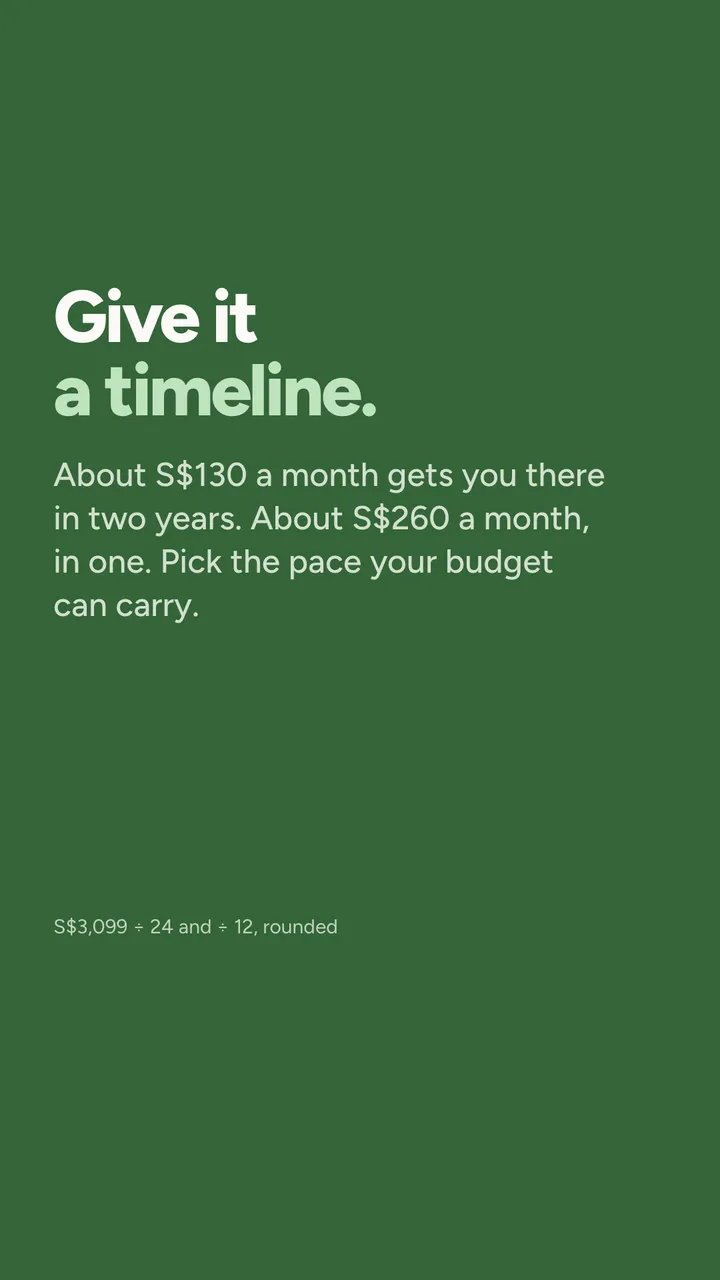
A timeline turns a big, slightly scary number into a monthly one you can actually check against your budget. The arithmetic is simple division:
- Over two years: S$3,099 divided by 24 months is S$129.13, so about S$130 a month.
- Over one year: S$3,099 divided by 12 months is S$258.25, so about S$260 a month.
- Over six months: S$3,099 divided by 6 is S$516.50 a month.
Here's the thing: none of those is the "right" answer. The right pace is the one your budget can carry every single month without you borrowing from somewhere else to make it work. A plan you keep for 24 months beats a plan you abandon in month three.
Doing it for Darren
Darren's full number is S$3,189. He looks at his last three months and sees he usually has about S$300 left after his bills, his own savings and his share of things at home. If he puts all S$300 towards the phone, S$3,189 divided by S$300 is 10.63, so about 11 months.
But that leaves him nothing spare for the month his laptop dies or a friend gets married. So he picks S$200 a month instead. S$3,189 divided by S$200 is 15.9, so 16 months. It's slower, and it's a plan he'll actually keep.
What this means for you
Work out what's genuinely left in a normal month, not your best month. Then choose a pace below that number, so there's room for the months that don't go to plan. If the timeline comes out longer than you'd like, that's useful information too.
Keep your safety net whole
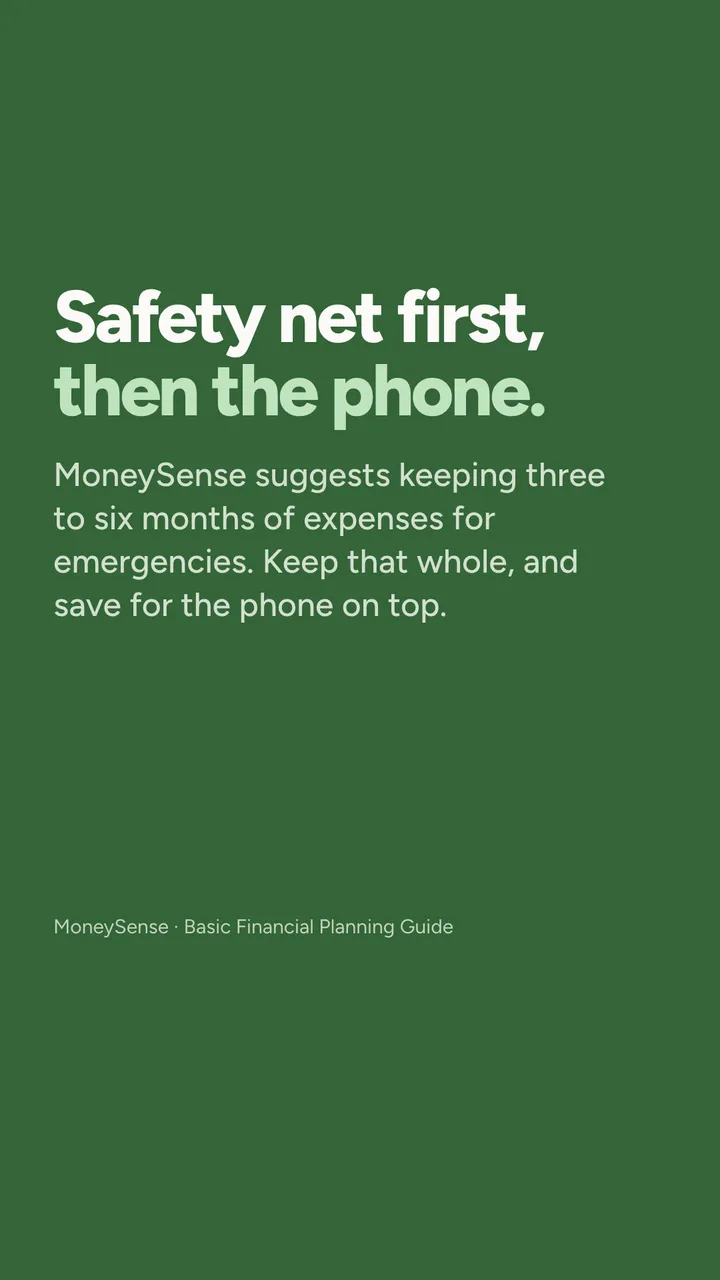
An emergency fund is money set aside for things you can't plan for. MoneySense, the national financial education programme, suggests in its Basic Financial Planning Guide that you keep enough to cover at least three to six months of expenses. If your income is irregular, say you freelance or earn mostly on commission, the same guide suggests aiming for 12 months.
Two words in that sentence do a lot of work. "Expenses" means what you spend, not what you earn. And "months" means the money has to last while you have no income at all. So the question isn't "how much do I make?" but "how long could I keep going if the pay stopped?"
Doing it for Darren
Darren's monthly expenses come to about S$2,400. Three months is S$2,400 times 3, which is S$7,200. Six months is S$14,400. Say he has S$8,000 saved. That clears the three-month line, but only just: S$8,000 minus S$7,200 leaves S$800 above it.
If he took the phone money out of that pile today, S$8,000 minus S$3,189 would leave S$4,811, which is about two months of expenses. That's the trade the slide is warning about. He'd have the phone, and less time to get back on his feet if something went wrong.
So the S$200 a month goes into a separate pot, on top. The S$8,000 stays where it is.
What this means for you
Add up roughly what you spend in a month, multiply by three, and compare it with what you have set aside. If you're below the line, it's worth filling that first, even if it pushes the phone back a few months. A common misconception is that your CPF counts as your emergency fund. It doesn't: CPF savings are set aside for retirement, housing and healthcare, and you can't simply withdraw them when the water heater breaks.
Find the money in small spends
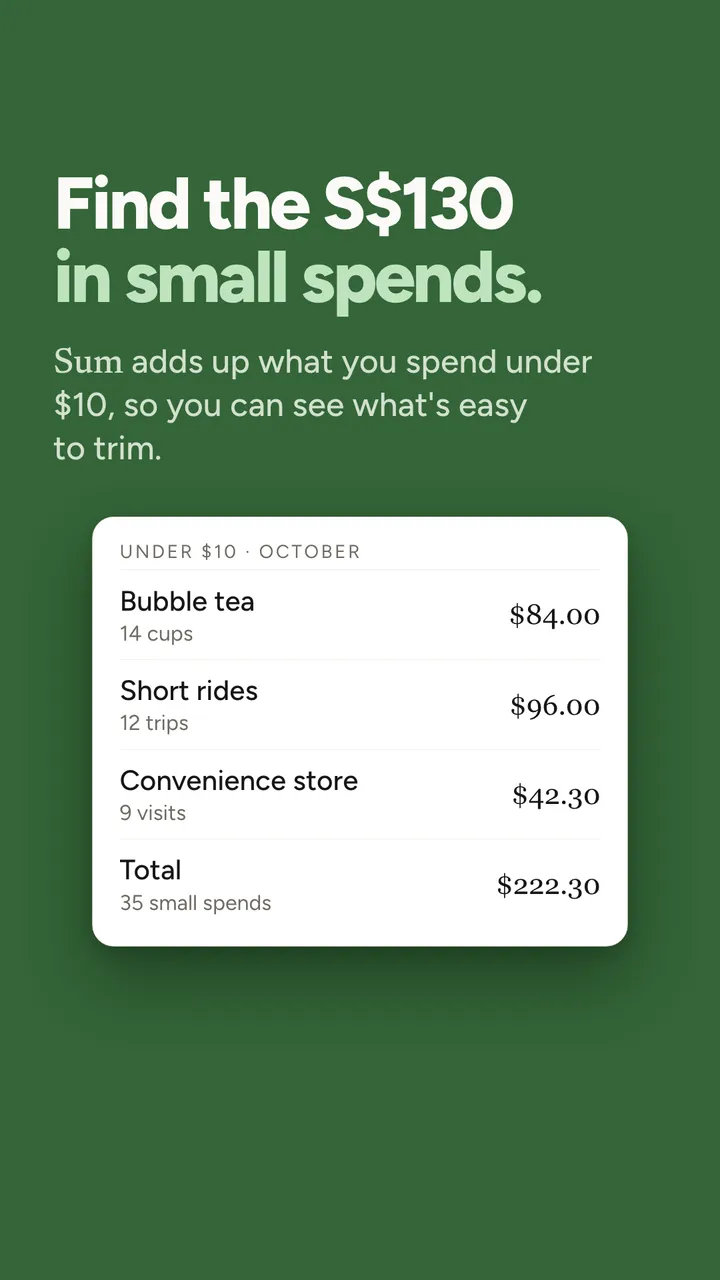
Most of us, when we want to save a bit more, look at the big things first: rent, the car, insurance. Those matter, but they're hard to change quickly. The small spends are easier, partly because we barely notice them.
The card on the slide is sample data, but it's a believable month:
- Bubble tea: 14 cups, $84.00
- Short rides: 12 trips, $96.00
- Convenience store: 9 visits, $42.30
Add them up: $84.00 plus $96.00 plus $42.30 is $222.30, from 35 small spends. None of them felt like a decision. Together they're more than the S$130 a month the phone needs.
I'm not suggesting anyone gives up bubble tea. I'm suggesting you look at the total and decide on purpose. Say you kept half: half of $222.30 is $111.15. Add a little from somewhere else and you're at S$130 without touching anything you'd really miss.
What this means for you
Look at one month of your own spending and pick out everything under $10. Count how many there were and what they added up to. Then choose one category to trim, not all of them. One change you keep beats five you forget by the second week.
Make it a goal you can see
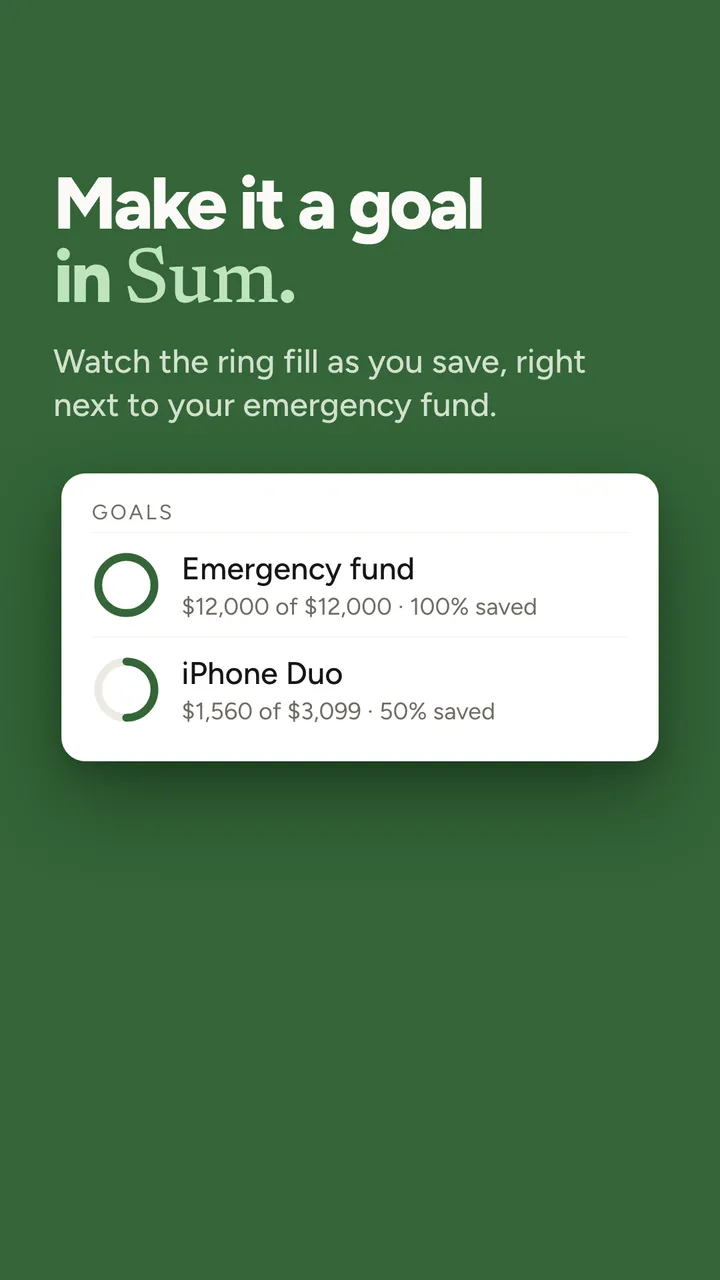
Saving "in general" is hard, because general money is easy to borrow from. Saving for something with a name is easier, because you can picture what it's for. I wrote more about this in why saving is so hard.
The sample goals on the slide show two rings side by side:
- Emergency fund: $12,000 of $12,000, so 100% saved
- iPhone Duo: $1,560 of $3,099, so about 50% saved
The order matters. The safety net is full, and the phone is being saved on top, exactly as the previous slide suggested. To work out what's left on the phone: $3,099 minus $1,560 is $1,539. At S$130 a month, $1,539 divided by $130 is 11.8, so about 12 more months.
Seeing both rings together also does something quietly useful. If the emergency fund ring ever dropped below 100%, you'd notice straight away, and you'd know to top that up before the phone.
What this means for you
Give your big buy a name and a number, and keep it next to your emergency fund rather than mixed in with it. Two pots, two rings, one clear order.
Keep the habit after the phone
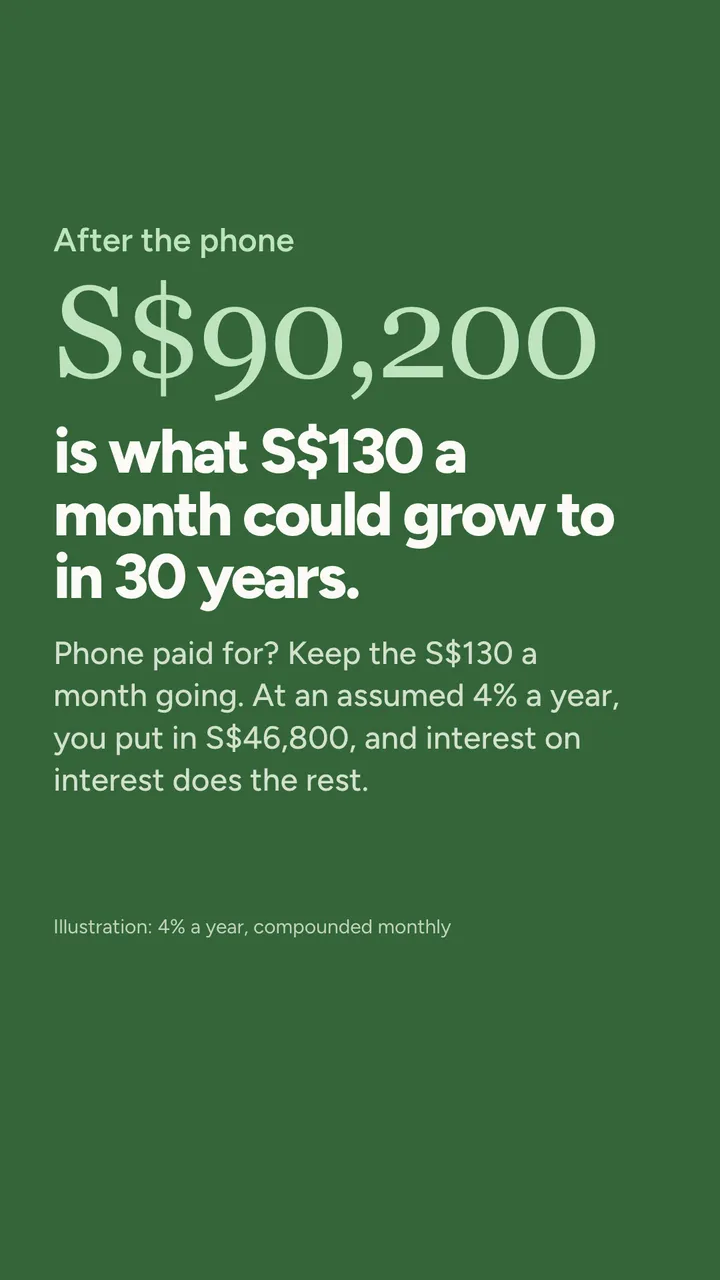
Here's the part I find most interesting. Once the phone is paid for, you've spent a year or two proving you can live without that S$130 a month. That's a habit. The question is what it does next.
The slide imagines keeping it going. Compound interest means you earn interest not just on what you put in but on the interest you've already earned, so growth speeds up over time. This is a worked example at an assumed 4% a year, compounded monthly. It isn't a promise, and it isn't a return on anything in particular:
| Keep saving S$130 a month for | You put in | It could grow to |
|---|---|---|
| 10 years | S$15,600 | about S$19,100 |
| 20 years | S$31,200 | about S$47,700 |
| 30 years | S$46,800 | about S$90,200 |
The "put in" column is just S$130 times the number of months: 120, 240 and 360. Look at the last row. Over 30 years you put in S$46,800, and interest on interest adds roughly another S$43,400. Most of that extra arrives in the later years, which is why the habit matters more than the size of any one month.
What this means for you
When a goal finishes, decide on purpose what happens to that monthly amount, rather than letting it quietly turn back into spending. Point it at the next goal, or at your longer-term savings. Where you keep it and what it earns is a separate question, and one for the official pages or a licensed adviser rather than a blog post.
Want it? Plan it
The closing slide sums up the whole idea in two short sentences. Wanting something isn't the problem. Not having a plan for it is.
If you only remember three things
- Start with the full number, extras included, and pick a monthly pace your normal month can carry.
- Keep your emergency fund whole, at least three months of expenses, and save for big buys on top of it.
- When the goal is done, keep the habit. The same monthly amount, left alone for long enough, adds up to far more than you put in.
How I keep track of this
When I'm saving for something, I set it up as a goal in Sum, next to my emergency fund, so I can see both rings at once. Each month, when I import my card statements, Sum reads them and sorts every line by category, which is where the small spends finally show up together instead of one at a time. Budgets tell me how much is left for the month, and that's where the monthly amount for a goal comes from.
Goals, budgets and spending by category are all on Sum's free plan, and Sum is free to start. If you want to go further, I wrote about the psychology of budgeting and how to start tracking your expenses. We post a new carousel most days on TikTok and Instagram, and the longer version lands here.
As for my friend from futsal, I don't know yet whether he's getting the phone. But I did send him the arithmetic for S$130 a month. He replied with a thumbs up.
Talk soon, Brandon

Sum is launching in Singapore soon.
Your banks, cards, CPF and HDB flat, added up into one net worth. Statements sorted, card caps tracked, bills remembered.
Brandon · Finance team, Sum
Brandon is on Sum's finance team in Singapore. Brandon reads the CPF Board, IRAS and MAS updates so you don't have to, and turns our carousels into the longer version. Questions, corrections or something to share? Email Brandon at [email protected].
Got something interesting to share?
A money story, a question, something we got wrong, or a tip other Singaporeans should hear. Reach out to me at [email protected], or leave your email and I'll write to you.
Sources: HardwareZone, iPhone 18 Pro, Pro Max and iPhone Duo Singapore prices, 18 Sep 2026; MoneySense, Basic Financial Planning Guide.
Any app screens shown use sample data, not a real person's. Sum is free to start; some features need a paid plan.
Information only, not financial advice.