HSBC Revolution card review: what tap or online 10X points add up to
How the HSBC Revolution card earns as at 1 Nov 2026: 10 points per $1 on tap and online spend, the $1,000 cap, KrisFlyer vs Asia Miles and what earns nothing.
- No annual fee
- 10X points on dining, shopping, travel and taxis
- Small taps count, worked on the month's total
- 0.33 miles per $1 outside the bonus
- Bonus stops at $1,000 a month
- No supermarkets, petrol or fast food
Ethan's own opinion of the card as reviewed below. His full rating is at the end.
The HSBC Revolution pays 10 points per $1 on contactless and online spending in a long list of categories, and 1 point on the rest. The catch is the list. It goes by a four-digit code you can't see, and the bonus stops after $1,000 a month.
Here's what it earns, which taps count, the monthly cap, the airline choice that changes the miles figure, and a worked month you can redo with your own numbers.
The HSBC Revolution at a glance
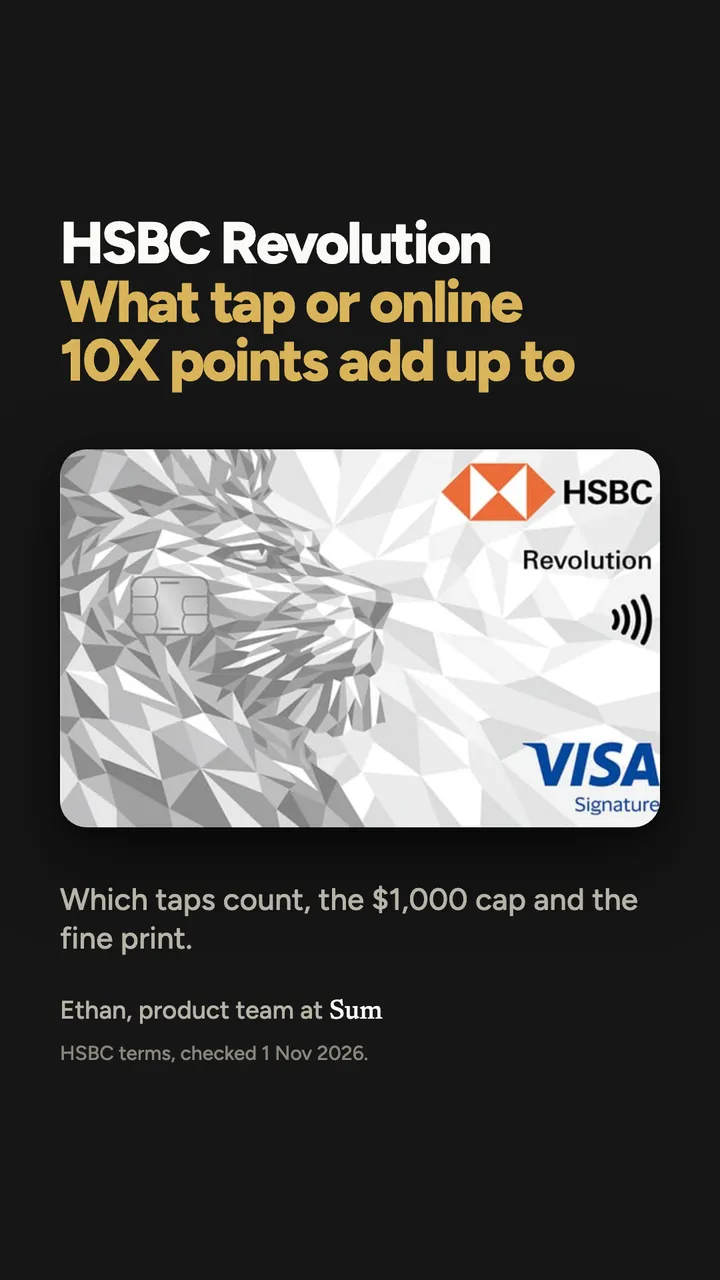
| HSBC Revolution Visa Signature | |
|---|---|
| Minimum income | $30,000 a year for existing HSBC customers with $50,000 or more with HSBC; $65,000 for new customers and foreigners, as listed on the product page |
| Annual fee | Waived, per the product page |
| Supplementary cards | Free, up to 5 |
| Eligible tap and online spend | 10 HSBC points per $1 (1 base + 9 bonus) |
| All other eligible spend | 1 point per $1 |
| Bonus cap | 9,000 bonus points a month, the first $1,000 of eligible spend |
| In miles | 10X is 3.33 KrisFlyer miles or 4 Asia Miles per $1 |
| Points expiry | 37 months |
| Converting to miles | No fee for now; KrisFlyer at 30,000 points per 10,000 miles |
| Foreign currency fee | 2.25% plus up to 1% card network charge |
Figures from the Revolution points terms (effective 1 April 2026), HSBC's Rewards terms (effective 31 March 2025), the rewards page, HSBC's tariff guide and the product page, checked 1 Nov 2026. The card moved from Visa Platinum to Visa Signature on 1 April 2026.
How many points does the Revolution earn?
The card pays HSBC Reward points. Clause 7.1 of the terms sets two layers on what it calls Eligible Transactions: - Base Points: 1 point for every $1. - Bonus Points: 9 more points for every $1.
That's 10 points per $1 on eligible spending. Everything else that qualifies earns the 1 base point per $1 (clause 8).
There's a higher tier too. If you keep an average daily balance of at least $50,000 in a sole HSBC Everyday Global Account in Singapore dollars for the calendar month, the bonus becomes 19 points, so 20 points per $1, with a cap of 22,800 bonus points (the first $1,200). Joint accounts don't count.
Bottom line: the headline rate is for a specific kind of spending. On the rest the Revolution earns about a tenth as much, so know how much of your month is eligible before comparing it with a flat-rate card.
Which taps count: the category list
An Eligible Transaction has to pass two tests.
First, how you pay. It must be a Visa contactless payment (payWave, Apple Pay, Google Pay or Samsung Pay) or a Visa online transaction, including cards saved with a merchant for future purchases (clauses 5 and 6). Inserting the card or swiping it doesn't count.
Second, who you pay. The merchant has to be on HSBC's list in clause 7, by merchant category code (MCC). An MCC is a four-digit code the merchant's bank assigns to the business. HSBC says plainly that it doesn't set it. The list covers: - Travel: airlines, car rental, hotels and cruise lines booked with them directly. - Shopping: department stores, clothes and shoes, electronics, bookshops, pharmacies, florists, marketplaces and specialty retail. - Dining, excluding hotel dining: restaurants (5812), bars (5813), caterers (5811), bakeries (5462) and confectionery shops (5441). - Others: taxis (4121) and membership clubs (7997).
What's not on it matters as much: fast food (5814), supermarkets, petrol, travel agencies and booking sites (4722), utilities and streaming.
Take a hawker drinks stall with a card terminal. The category isn't decided by what you buy. It's decided by how the stall's bank has labelled the stall. So whether a $1.80 drink earns 10 points a dollar or 1 depends on a code you can't see. Here's a month of drinks, depending on that code:
| If the stall codes as | Eligible? | 20 drinks at $1.80 = $36 | KrisFlyer miles |
|---|---|---|---|
| 5812, restaurants | Yes, by tap | 36 base + 324 bonus = 360 points | 120 |
| 5814, fast food | No | about 36 points | about 12 |
| 5499, food stores | No | about 36 points | about 12 |
Points to KrisFlyer miles at 30,000 points per 10,000 miles, so divide by 3.
The statement descriptor doesn't tell you the stall's code. The only reliable way to know is whether the bonus points turn up, which takes until the end of the following month.
Bottom line: "dining" on this card means certain codes, not anything you eat. If a regular place matters to your sums, watch whether its bonus points arrive before counting on them.
Why small taps don't lose out
Clause 7.2 says points on Eligible Transactions are worked out on the month's total, posted in that calendar month and rounded down to the nearest $1. That's kinder than cards that round each purchase or count in $5 blocks.
So 20 taps of $1.80 are $36 in the month, and earn the full 360 points. On a card that counts per $5 block, each of those $1.80 drinks would earn nothing.
Bonus points are credited by the last day of the following calendar month (clause 10). Base points follow your statement cycle.
Bottom line: small contactless purchases at eligible merchants earn the full rate on this card, which is unusual.
The $1,000 cap
Bonus points stop at 9,000 a month (clause 7.2), which is $1,000 of eligible spending at 9 bonus points per $1. Base points have no cap.
So on $1,300 of eligible spending in one month: - Base: 1,300 points. - Bonus: 9 × $1,300 = 11,700, capped at 9,000. - Total: 10,300 points, not 13,000.
The last $300 earns 1 point per $1, the same as a supermarket.
Bottom line: past $1,000 of eligible spending in a month, the rate on the extra is 0.33 KrisFlyer miles per $1.
KrisFlyer or Asia Miles: why the miles figure moves
HSBC's product page says 10X is "up to 4 miles" per $1. That figure assumes Cathay Pacific's Asia Miles, which HSBC's rewards page lists at 25,000 points for 10,000 miles. Singapore Airlines' KrisFlyer is listed at 30,000 points for 10,000 miles.
| Partner | Points for 10,000 | 10X in miles per $1 | 1X in miles per $1 |
|---|---|---|---|
| Asia Miles, British Airways, Qantas, Etihad, Flying Blue | 25,000 | 4 | 0.4 |
| KrisFlyer, Thai Royal Orchid Plus | 30,000 | 3.33 | 0.33 |
The same 9,000 bonus points are 3,600 Asia Miles or 3,000 KrisFlyer miles. The miles cards post makes the same point: 4 becomes 3.33 when converted to KrisFlyer.
HSBC's Rewards terms say the miles redemption fee is waived until HSBC decides otherwise (section E, clause 6), and the points expire at the end of 37 months, counted from the month after they were awarded (section B, clause 7).
Bottom line: compare cards using the airline you'd actually fly. These points do expire, so note when your oldest batch is due.
Paying overseas
The bonus categories apply abroad too, as long as you tap or pay online at an eligible merchant. HSBC's tariff guide lists a 2.25% foreign currency transaction fee plus up to 1% charged by Visa, and a separate 1% on purchases converted to Singapore dollars at the till.
A $200 restaurant bill in Bangkok, tapped and paid in baht: 10 × $200 = 2,000 points, which is 667 KrisFlyer miles. The fees come to up to $200 × 3.25% = $6.50, which is about 1 cent a mile.
Bottom line: abroad, a tapped restaurant earns 10X, a supermarket earns 1X, and the fee applies either way.
What doesn't earn points
Clause 4 and the MCC table in clause 4.2 list what earns nothing at all, base points included. They include: - AXS and ATM transactions, cash advances, balance transfers and HSBC's fees; - payments through PayPal, Skrill, CardUp, SmoovPay and iPayMy, and top-ups to EZ-Link, TransitLink, NETS FlashPay and YouTrip; - insurance, utilities, schools, hospitals, rent, parking, tax, charities and government services; - instalment plans, including the monthly amounts under HSBC's instalment plans.
Bottom line: a big bill paid through a payment platform earns nothing on this card, not even the base point.
How it compares on miles per $1
Cards that pay up to 4 miles per $1 in certain spending, with a cap of about $1,000 a month, as at 24 Oct 2026, in KrisFlyer miles from each bank's terms as Sum's card catalogue reads them:
| Card | Bonus rate | Where the bonus applies | Other spend |
|---|---|---|---|
| Citi Rewards | 4 | Online shopping, food delivery and rides; department stores and clothes | 0.4 |
| DBS Woman's World | 4 | Online spending | 0.4 |
| UOB Lady's | 4 | One category you pick | 0.4 |
| HSBC Revolution | 3.33 | Tap or online, listed categories | 0.33 |
| Standard Chartered Journey | 3 | Online rides, food and groceries in SGD | 1.2 |
The Revolution's 3.33 is 4 if its points go to Asia Miles instead. What sets it apart is that contactless counts as well as online, which brings in restaurants and shops you walk into.
A worked month, and a year
Say Aisyah is 30. In a month she taps $450 at restaurants and cafés, spends $300 online on clothes and household things, takes $100 of taxis, and also spends $400 at supermarkets and $150 at fast food places. Made-up example.
| Spend | Points | |
|---|---|---|
| Eligible: restaurants, online shopping, taxis | $850 | 850 base + 7,650 bonus = 8,500 |
| Not eligible: supermarkets, fast food | $550 | about 550 |
| Month | $1,400 | about 9,050 |
That's 9,050 ÷ 3 = about 3,017 KrisFlyer miles, or 9,050 × 0.4 = 3,620 Asia Miles. Over a year, about 108,600 points: roughly 36,200 KrisFlyer miles, with no annual fee and, for now, no conversion fee.
Her real rate on all $1,400 is 3,017 ÷ $1,400 = about 2.2 KrisFlyer miles per $1. More supermarket spending would lower the rate. More restaurant spending would raise it, until her eligible spending reached $1,000.
Bottom line: swap in your own split between eligible and other spending. The calculator page runs the same sums: HSBC Revolution on the card rewards calculator.
Three things to remember
- 10 points per $1 on tap and online spending at listed merchants, 1 point on the rest. In KrisFlyer miles, that's 3.33 and 0.33.
- The merchant's code decides, not what you bought. Restaurants count. Fast food, supermarkets and petrol don't.
- The bonus stops after $1,000 a month, and points expire after 37 months.
Ethan's rating
Earn rate
- Very low
- Low
- Moderate
- High

- Very high
Effort to earn
- Effortless
- Easy
- Some effort
- Shiong
- Very shiong
Value for the fee
- Way overpriced
- Overpriced
- Fair
- Good value
- Great value
Against other miles cards
- Bottom
- Below average
- Average
- Above average
- Top
Where it earns
- DiningBonus rate
- GroceriesLow
- TransportBonus rate
- OnlineBonus rate
- TravelBonus rate
- OverseasFair
- Everything elseLow
One person's opinion, from the terms in this review. Your own spending decides what a card is worth to you.
Track it in Sum
Import your card statements. The card optimiser reads each purchase the way the bank's terms do. The trackers show how much of a cap like the Revolution's $1,000 has been used, so you're not guessing on the 28th. Each tracker opens into the purchases behind it.
Ethan
Got something interesting to share?
Something here doesn't match your statement, or HSBC changed the terms? Reach out to me at [email protected], or leave your email and I'll write to you.
Questions people ask
How many miles does the HSBC Revolution earn?
10 HSBC points per $1 on contactless or online spending in the listed categories, which is 3.33 KrisFlyer miles or 4 Asia Miles per $1, and 1 point per $1 on other eligible spending.
What is the HSBC Revolution bonus cap?
9,000 bonus points per calendar month, which is the first $1,000 of eligible tap and online spending. Base points are not capped.
Does the HSBC Revolution earn bonus points at hawker centres?
Only if the stall's merchant category code is on HSBC's list, such as 5812 restaurants or 5462 bakeries, and you pay by Visa contactless. Fast food (5814) isn't on the list.
Do HSBC Revolution points expire?
Yes. HSBC points expire at the end of 37 months, counted from the month after they were awarded.
Is there an annual fee on the HSBC Revolution?
HSBC's product page says the Revolution's annual fee is waived. Supplementary cards are free.
Is there a fee to convert HSBC points to miles?
Not at the moment. HSBC's Rewards terms say the miles and hotel points redemption fee is waived until HSBC decides otherwise.
Try the numbers yourself

Sum is launching in Singapore soon.
Your banks, cards, CPF and HDB flat, added up into one net worth. Statements sorted, card caps tracked, bills remembered.
Ethan · Product team, Sum
Ethan is on Sum's product team in Singapore. Financial planning and investing took care of Ethan's own money long ago, so this isn't for the pay. The economy right now is rough on Singaporeans, and we are grateful Ethan is determined to alleviate some of this pain here at Sum.
If we listed a wrong number, or you caught a term that changed before we did, email Ethan at [email protected].
Sources: HSBC: Revolution Credit Card Reward Points Programme T&C, effective 1 April 2026 (PDF); HSBC: Revolution Credit Card; HSBC: Rewards Programme T&C, effective 31 March 2025 (PDF); HSBC: Credit card rewards and partner redemption rates; HSBC: Retail banking and wealth management bank tariffs (PDF).
Any app screens shown use sample data, not a real person's. Sum is free to start; some features need a paid plan.
Information only, not financial advice.