OCBC 90°N card review: what 2.1 miles per $1 overseas adds up to
How the OCBC 90°N card earns miles as at 1 Nov 2026: 1.3 and 2.1 miles per $1, S$5 blocks, the S$196.20 fee, renewal miles, cashback and what earns nothing.
- Miles never expire
- 1:1 to KrisFlyer, or take a cash rebate
- No categories, no monthly cap
- Counted in whole $5 blocks per purchase
- Bus and MRT rides earn nothing
- Renewal miles only when the fee is charged
Ethan's own opinion of the card as reviewed below. His full rating is at the end.
The OCBC 90°N is a general spending miles card: one rate at home, a higher rate overseas, no minimum spend, no cap, and miles that never expire. The catch is in two places. Miles come in whole $5 blocks on each purchase, so small purchases earn little or nothing, and the 10,000 renewal miles only come when the fee is actually charged.
Here's what it earns at home and overseas, the $5 blocks that decide the real number, the fee and renewal miles, and a worked year you can redo with your own spending.
The OCBC 90°N at a glance
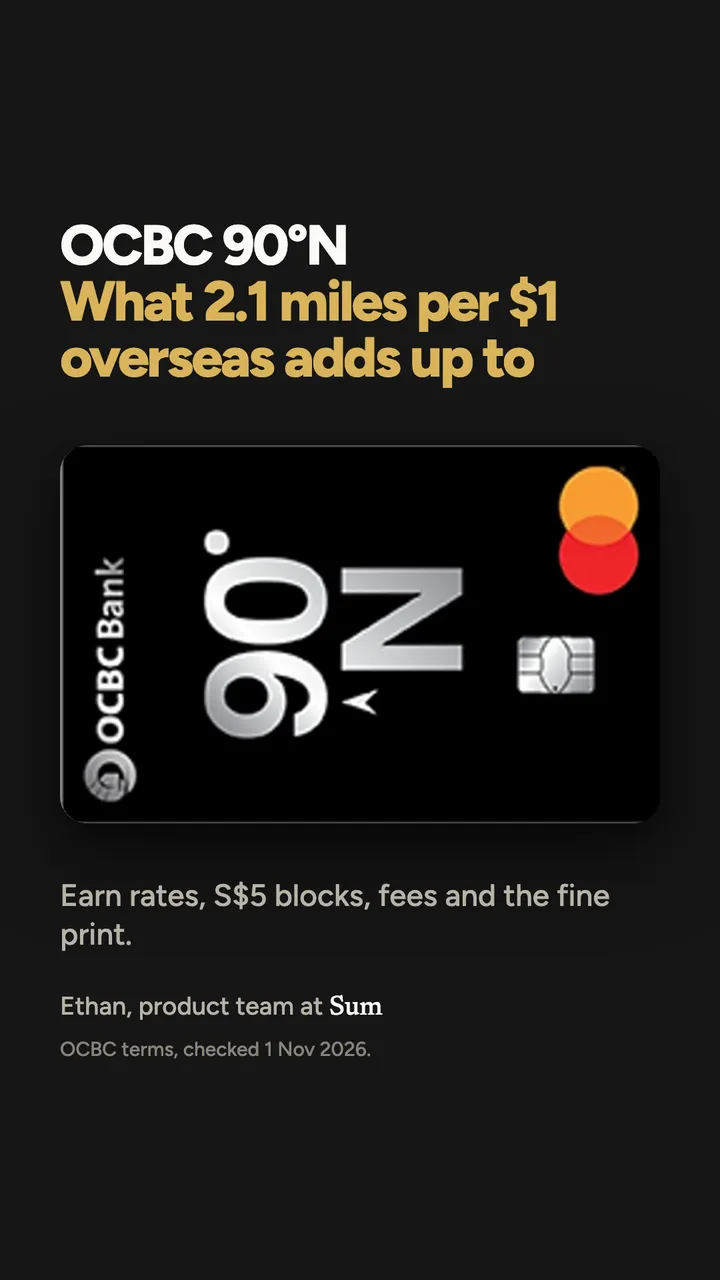
| OCBC 90°N Mastercard or Visa | |
|---|---|
| Minimum income | $30,000 a year for Singaporeans and PRs ($15,000 aged 55 and above), $45,000 for foreigners, as listed on the product page |
| Annual fee | $196.20 including GST, waived in the first year |
| Supplementary card | $98.10 a year, waived in the first year |
| Local spend (SGD) | 6.5 90°N Miles per $5, which is 1.3 miles per $1 |
| Overseas spend | 10.5 90°N Miles per $5, which is 2.1 miles per $1 |
| AXS Pay + Earn | 5 90°N Miles per $5, which is 1 mile per $1 |
| Minimum spend or cap | None |
| Miles expiry | Never |
| Converting | 1 90°N Mile = 1 KrisFlyer mile, or S$10 cash rebate per 1,000 miles |
| Foreign currency fee | 3.25% (1% card network plus 2.25% OCBC) |
Figures from the 90°N programme terms (updated as of 24 November 2025), OCBC's credit card fee schedule (version date 1 October 2025) and the product page, checked 1 Nov 2026. The programme terms set the same rates for the Mastercard and Visa versions. Their travel extras differ.
How many miles does the OCBC 90°N earn?
The card pays 90°N Miles, OCBC's own reward unit. Unlike most bank points, they're already the same size as an airline mile: 1 90°N Mile converts to 1 KrisFlyer mile. So the rates here are miles per $1, with no conversion sum on top.
Clause 1.1 of the terms sets three rates, each per $5: - Local spend: 6.5 miles for every $5, which is 1.3 miles per $1. - Overseas spend: 10.5 miles for every $5, which is 2.1 miles per $1. - AXS Pay + Earn: 5 miles for every $5, which is 1 mile per $1. (Other AXS payments earn nothing, under clause 1.4.2.)
There's no minimum spend, and clause 1.2 sets no cap on what you can earn in a month. A $100 dinner in Singapore is $100 ÷ $5 = 20 blocks, then 20 × 6.5 = 130 miles.
Bottom line: a flat rate means no category to remember, and it's a modest rate. Specialised cards pay up to 4 miles per $1 in their categories, with a cap.
Why a $12 lunch earns 13 miles, not 15.6
Clause 1.1 works out miles on each block of $5 charged per transaction, with nothing for a part-block. Clause 1.2 adds that each transaction is first rounded down to the nearest dollar. Separate purchases are never combined to make up a block.
OCBC's own example in the terms: anything from $10 to $14.99 in one purchase earns 13 miles. A $4.90 purchase earns none, and so do two $2.50 purchases.
| Purchase | Whole $5 blocks | Miles | Per $1 |
|---|---|---|---|
| Kopi, $1.40 | 0 | 0 | 0 |
| Snack, $4.90 | 0 | 0 | 0 |
| Lunch, $12 | 2 | 13 | 1.08 |
| Lunch, $14.99 | 2 | 13 | 0.87 |
| Dinner, $100 | 20 | 130 | 1.3 |
| Overseas dinner, S$92 | 18 | 189 | 2.05 |
Blocks are the purchase rounded down to the dollar, then divided by $5, ignoring any remainder. Miles are blocks × 6.5 locally, or × 10.5 overseas. On the $14.99 lunch, that's 2 blocks and $4.99 that earns nothing.
Bottom line: the headline rate is what bigger purchases earn. If much of your spending is under $10, your real rate is well below 1.3. Your last statement will show you.
What an overseas dinner earns
Say a dinner in Melbourne is charged in Australian dollars and shows on your statement as S$92 once converted. Made-up figure.
- Miles: $92 ÷ $5 = 18 whole blocks (the last $2 earns nothing), then 18 × 10.5 = 189 miles.
- Fee: OCBC's fee schedule lists a 1% card network charge and a 2.25% OCBC fee on foreign currency transactions, together 3.25%. That's $92 × 3.25% = $2.99.
- The fee itself earns nothing. Clause 1.4.1 excludes card fees and charges from miles.
So $2.99 for 189 miles, which is $2.99 ÷ 189 = about 1.6 cents a mile. The same $92 in Singapore dollars at home would earn 18 × 6.5 = 117 miles with no fee.
Splitting a bill can cost you. Each charge is rounded on its own, so a bill split into three uneven parts can leave up to $4.99 unrewarded on each one.
One more piece of fine print. The terms say "overseas spend", while the product page says "foreign currency" spend. A purchase converted to Singapore dollars at the till overseas sits awkwardly between the two, and OCBC's fee schedule charges a separate 1% on Singapore dollar transactions processed overseas. The miles cards post covers why that choice at the till rarely helps.
Bottom line: 2.1 miles per $1 overseas comes with a 3.25% fee. The useful number is what each mile costs you, about 1.5 to 1.6 cents on this card.
The annual fee, and the 10,000 renewal miles
The principal card's annual fee is $196.20 including GST. It's waived for the first year, and clause 1.12 says it's charged from the second renewal date.
When the fee is charged, OCBC credits a renewal bonus of 10,000 90°N Miles (clause 1.12). If the fee is later waived, those 10,000 miles are deducted again, provided your balance has at least 10,000 to take.
The product page also says the fee is automatically waived with at least $10,000 of spending in the year. So the renewal miles and the waiver don't go together: spend $10,000 or more and you keep $196.20 but not the 10,000 miles.
Paying the fee works out to $196.20 ÷ 10,000 = about 2 cents a mile.
Bottom line: check which of the two you'll get before the renewal date. At roughly 2 cents a mile, the renewal miles cost a little more per mile than the overseas spending above.
Turning 90°N Miles into flights or cash
90°N Miles never expire (clause 1.3), and you redeem them in the OCBC app. The product page lists KrisFlyer, Flying Blue, British Airways, Cathay, Etihad Guest and United MileagePlus, plus IHG, Accor and Marriott, with redemptions starting at 1,000 miles.
OCBC's rewards FAQ says an administrative fee applies to each exchange and is shown in the app when you request it. The FAQ doesn't state the amount, so it's left out of the sums here. Check it in the app before you convert.
There's also a cash rebate: the product page lists S$10 for every 1,000 90°N Miles, which is 1 cent a mile. At 1.3 miles per $1, that's 1.3% back on local spending. At 2.1, it's 2.1% on overseas spending, before the 3.25% fee.
There's no rush to convert. Once miles become KrisFlyer miles, though, Singapore Airlines' own expiry rules apply.
Bottom line: converting when you know what you're booking means you pay the conversion fee once, and the airline's clock starts only then.
What doesn't earn miles
Clause 1.4 and the MCC table in clause 1.5 list what earns nothing. A merchant category code (MCC) is a four-digit code the merchant's bank assigns to describe the business. The card's bank reads it to decide what each purchase earns. The list includes: - card fees, interest, income tax payments, cash advances and bill payments made through internet banking; - top-ups to EZ-Link, NETS FlashPay, GrabPay, YouTrip, ShopeePay and Singtel Dash; - insurance premiums, utilities, hospitals, schools, rent, parking, tolls, charities and government services.
Clause 1.6.1 is the one people miss: bus and MRT rides earn nothing. Transport under MCC 4111, 4121 and 4131 is excluded, except Grab, Gojek and licensed taxi operators.
Bottom line: tapping this card on the MRT every day earns no miles. Leave transport out when you estimate what the card earns.
How it compares on miles per $1
Ranked by miles per $1 with no minimum spend, as at 24 Oct 2026, from each bank's terms as Sum's card catalogue reads them:
| Card | Local (SGD) | Foreign currency |
|---|---|---|
| UOB PRVI Miles | 1.4 | 2.4 |
| DBS Altitude | 1.3 | 2.2 |
| OCBC 90°N | 1.3 | 2.1 |
| Citi PremierMiles | 1.2 | 2.2 |
| HSBC TravelOne (as KrisFlyer) | 1.0 | 2.0 |
These are the "one rate on everything" cards. HSBC TravelOne earns 1.2 and 2.4 when its points go to Asia Miles instead. The 90°N's figures are already KrisFlyer figures, because its miles convert 1:1 to KrisFlyer. Rounding differs too: the 90°N and DBS Altitude both work in $5 blocks per purchase. The miles cards post lays out the specialised cards.
A worked year
Say Jun Hao is 35 and puts $1,800 a month on the card in Singapore dollars, mostly purchases of $20 and up, plus $4,000 a year in foreign currency over two trips. Made-up example.
| Sum | Miles | |
|---|---|---|
| Local spend | $1,800 × 12 = $21,600 × 1.3 | about 28,080 (a little less after blocks) |
| Overseas spend | $4,000 × 2.1 | 8,400 |
| Renewal miles | fee waived at $10,000+ spend | 0 |
| Total | about 36,500 |
His spending is well over $10,000, so the product page's automatic waiver applies: no $196.20 fee, and no 10,000 renewal miles. What the card costs him is the foreign currency fee, $4,000 × 3.25% = $130, plus the administrative fee on whatever conversions he makes.
For scale, the miles cards post lists 25,500 KrisFlyer miles for a one-way Saver Economy seat to Tokyo or Seoul, as at its own check.
If most of his local purchases were $5 to $9 instead, each would earn exactly one block, 6.5 miles, and his real local rate would fall to somewhere between 0.7 and 1.3.
Bottom line: swap in your own monthly spend, trips and usual purchase size. The calculator page does the same sums for a few typical months: OCBC 90°N on the card rewards calculator.
Three things to remember
- 1.3 miles per $1 at home, 2.1 overseas, no cap, no minimum, and miles that never expire. One rate, all the time.
- Miles come in whole $5 blocks on each purchase. $14.99 earns the same as $10, and $4.90 earns nothing.
- The renewal miles and the fee waiver don't come together. Spend $10,000 and the fee goes, and so do the 10,000 miles.
Ethan's rating
Earn rate
- Very low
- Low
- Moderate

- High
- Very high
Effort to earn
- Effortless
- Easy
- Some effort
- Shiong
- Very shiong
Value for the fee
- Way overpriced
- Overpriced
- Fair
- Good value
- Great value
Against other miles cards
- Bottom
- Below average
- Average
- Above average
- Top
Where it earns
- DiningFair
- GroceriesFair
- TransportNothing much
- OnlineFair
- TravelFair
- OverseasGood
- Everything elseFair
One person's opinion, from the terms in this review. Your own spending decides what a card is worth to you.
Track it in Sum
Import your card statements. The card optimiser reads each purchase the way the bank's terms do, $5 blocks included, and shows what each card earned. Each card's tracker opens into the purchases behind it, so when a number looks odd you can see which $4.90 snack it was.
Ethan
Got something interesting to share?
Something here doesn't match your statement, or OCBC changed the terms? Reach out to me at [email protected], or leave your email and I'll write to you.
Questions people ask
How many miles does the OCBC 90°N card earn?
6.5 90°N Miles per S$5 spent locally (1.3 per $1) and 10.5 per S$5 spent overseas (2.1 per $1), worked out in whole S$5 blocks on each purchase.
Do OCBC 90°N Miles expire?
No. Clause 1.3 of the programme terms says 90°N Miles have no expiry date.
Is there a cap on OCBC 90°N miles?
No. Clause 1.2 says there is no cap on the miles you can earn each month, and there is no minimum spend.
Is the OCBC 90°N annual fee waived?
The S$196.20 fee is waived in the first year, and OCBC's product page says it is automatically waived with at least S$10,000 of spend. When the fee is charged, you get 10,000 renewal miles; if it is waived, those miles are deducted.
Can I turn 90°N Miles into cash?
Yes. OCBC's product page lists a cash rebate of S$10 for every 1,000 90°N Miles, which is 1 cent a mile.
Do bus and MRT rides earn 90°N Miles?
No. Clause 1.6.1 excludes MCC 4111, 4121 and 4131 transport, except Grab, Gojek and licensed taxi operators.
Try the numbers yourself

Sum is launching in Singapore soon.
Your banks, cards, CPF and HDB flat, added up into one net worth. Statements sorted, card caps tracked, bills remembered.
Ethan · Product team, Sum
Ethan is on Sum's product team in Singapore. Financial planning and investing took care of Ethan's own money long ago, so this isn't for the pay. The economy right now is rough on Singaporeans, and we are grateful Ethan is determined to alleviate some of this pain here at Sum.
If we listed a wrong number, or you caught a term that changed before we did, email Ethan at [email protected].
Sources: OCBC: Terms and Conditions Governing OCBC 90°N Card Programme, updated as of 24 November 2025 (PDF); OCBC: 90°N Card; OCBC: Fees and Charges for Credit Cards, version date 1 October 2025 (PDF); OCBC: FAQ governing Rewards and Travel with OCBC (PDF).
Any app screens shown use sample data, not a real person's. Sum is free to start; some features need a paid plan.
Information only, not financial advice.