HSBC Live+ card review: what 5% on dining, shopping and entertainment adds up to
How the HSBC Live+ card pays as at 1 Nov 2026: 5% on dining, shopping, entertainment and Shell or Caltex, the $600 monthly minimum and the $250 cap.
- Four broad categories, one rate
- $250 cap per quarter, not per month
- Worked out on the month's total, rounded up
- One month under $600 loses the quarter's bonus
- Supermarkets and electronics don't count
- Cashback can only offset card charges
Ethan's own opinion of the card as reviewed below. His full rating is at the end.
The HSBC Live+ is a category cashback card: 5% on dining, shopping, entertainment and Shell or Caltex petrol, 0.3% on the rest. The catch is the minimum. Miss $600 in any one month and the whole quarter drops to 0.3%.
Here's what it pays, the monthly minimum, the quarterly cap, and a worked year you can redo with your own numbers.
The HSBC Live+ at a glance
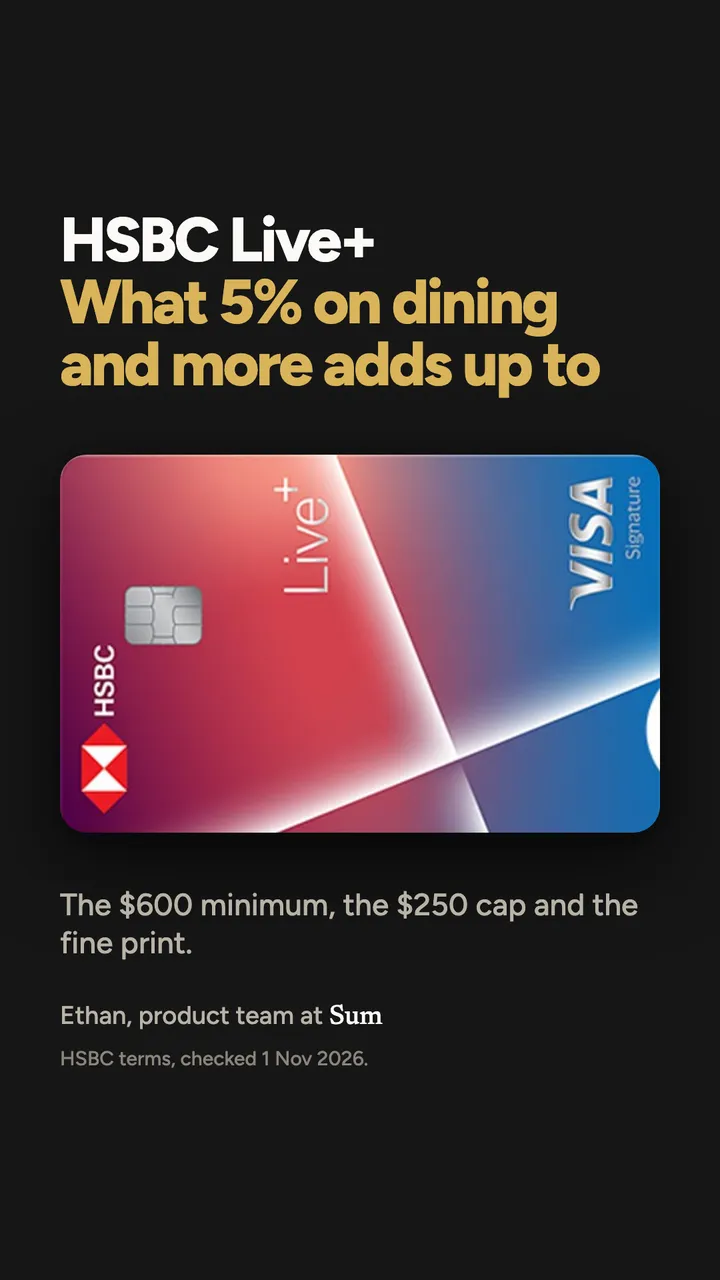
| HSBC Live+ Visa Signature | |
|---|---|
| Minimum income | $30,000 a year for existing HSBC customers with $50,000 or more with HSBC; $65,000 for new customers and foreigners, as listed on the product page |
| Annual fee | $196.20 including GST, waived in the first year |
| Fee waiver | From the second year, with over $12,500 of spending a year |
| Supplementary cards | Free, up to 5 |
| Bonus categories | 5% on dining, shopping, entertainment and Shell or Caltex petrol in Singapore |
| Minimum spend | $600 of eligible purchases in each month of the quarter |
| Everything else | 0.3% |
| Cap | $250 of cashback per calendar quarter |
| How it's paid | Within two months after each quarter, against card charges |
| Foreign currency fee | 2.25% plus up to 1% card network charge |
Figures from the Live+ cashback programme terms (effective 13 March 2026), HSBC's tariff guide and the product page, checked 1 Nov 2026.
How much cashback does the Live+ give?
Clause 4 of the terms pays 5% cashback on eligible purchases at four groups of merchants, once you meet the minimum in clause 5: - Dining: restaurants (5812), fast food (5814), bakeries (5462) and caterers (5811), excluding hotel dining. - Shopping: department stores, discount and variety stores, marketplaces, duty free, clothes and shoes, sporting goods and luggage. - Entertainment: cinemas (7832), streaming and pay TV (4899), digital media (5815) and record stores (5735). - Petrol: Caltex and Shell stations in Singapore.
Everything else that's eligible earns 0.3% (clause 7), alongside the 5% on the four categories. The two don't stack on the same purchase. Clause 6 says that if you miss the minimum, the four categories also drop to 0.3%.
Those four-digit numbers are merchant category codes (MCCs). Each merchant's bank assigns one to the business, and HSBC's terms say plainly that HSBC doesn't choose it. The card reads the code, not the receipt.
Bottom line: "shopping" here is narrower than it sounds. Electronics shops, bookshops, pharmacies and supermarkets aren't on the list, so they earn 0.3%.
So, is the popcorn dining or entertainment?
A popcorn combo is food, bought at a cinema. The card doesn't know you bought popcorn. It knows which merchant charged you and what code that merchant has.
- Popcorn bought at the cinema's own counter is charged by the cinema, so it usually posts under the cinema's code, 7832, which is entertainment.
- Popcorn bought at a café or snack kiosk in the same mall posts under that shop's code, often 5812 or 5814, which is dining.
- Popcorn bought at a supermarket on the way posts as 5411, which isn't on the list at all and earns 0.3%.
For the Live+, the first two give the same answer: both are in the 5% list. What matters more is that the purchase counts towards the month's $600, and that it isn't hotel dining, which is excluded.
Bottom line: if a regular place matters to your sums, check that its cashback shows up as 5% on your statement before counting on it.
The $600 minimum, every month
Clause 5(i) says you need $600 of eligible purchases in each of the three months of a calendar quarter (January to March, April to June, and so on). It's not $1,800 over the quarter. It's $600, three times.
In the quarter your card is issued, clause 5(ii) replaces that with $1,000 over the quarter.
Here's how one weak month changes a quarter. Say the card carries $1,200 of category spending and $1,250 of other spending over October to December, but November's total is only $550:
| Category spend | Other spend | Cashback | |
|---|---|---|---|
| Minimum met every month | $1,200 × 5% = $60.00 | $1,250 × 0.3% = $3.75 | $63.75 |
| November at $550 | $1,200 × 0.3% = $3.60 | $1,250 × 0.3% = $3.75 | $7.35 |
That one month, $50 short, costs $63.75 − $7.35 = $56.40 for the whole quarter.
Insurance, tax, utilities, school fees, rent and payments through AXS, PayPal or CardUp aren't eligible purchases, so they don't count towards the $600 either.
Bottom line: track the minimum month by month, not quarter by quarter. A month with a holiday or a quiet December is where it tends to slip.
The $250 quarterly cap
Clause 10 caps all cashback at $250 per calendar quarter per card account, the 0.3% included.
At 5%, $250 is reached on $250 ÷ 5% = $5,000 of category spending in a quarter, roughly $1,667 a month. Above that, the extra earns nothing for the rest of the quarter.
Clause 8 works out cashback on each month's total of eligible purchases, rounded up to the nearest cent, and the cashback is credited within two months after the quarter ends. Under the terms, it offsets future charges on the card. Withdraw it as cash, or use it against fees, interest or tax payments? Cannot.
Bottom line: for most people the limit is the monthly minimum, not the cap. The cap starts to matter if your category spending is near $1,700 a month.
Paying overseas
The dining, shopping and entertainment categories aren't limited to Singapore. Petrol is. A restaurant abroad with code 5812 counts as dining. HSBC's tariff guide lists a 2.25% foreign currency fee plus up to 1% charged by Visa, and 1% on purchases converted to Singapore dollars at the till.
A $200 dinner in Kuala Lumpur, charged in ringgit, with the minimum met: $200 × 5% = $10 cashback, against up to $200 × 3.25% = $6.50 in fees. A $200 supermarket bill on the same trip earns $0.60 against the same $6.50.
Bottom line: abroad, the 5% only beats the fee in the four categories.
The annual fee and its waiver
The fee is $196.20 including GST (HSBC's tariff guide). The product page says it's waived in the first year, and from the second year when you spend more than $12,500 a year on the card.
That's about $1,042 a month. Meeting the $600 minimum every month is $7,200 a year, so check whether your total spending on the card also clears $12,500.
The Live+ isn't part of HSBC's Reward points programme: HSBC's Rewards terms exclude Live+ cards issued from 21 June 2024 (section A, clause 2). It pays cashback only.
Bottom line: the $600 minimum and the fee waiver are two different targets.
How it compares on cashback per $1
Category cashback cards, as at 24 Oct 2026, from each bank's terms as Sum's card catalogue reads them:
| Card | Dining rate | Minimum spend | Cap |
|---|---|---|---|
| HSBC Live+ | 5% (also shopping, entertainment, Shell and Caltex) | $600 in each month of the quarter | $250 a quarter |
| Citi Cash Back | 6% (also groceries; 8% petrol) | $800 a statement month | $80 a month |
| OCBC 365 | 6% (plus other categories) | $800 a month | $160 a month on the bonus categories |
| Maybank Family & Friends | 6% in 5 categories you pick | $800 a month | $20 a month per category |
The Live+ has the lowest headline rate of the four and the lowest monthly minimum. Its quarterly cap, $250, is a little more than the Citi Cash Back's three months of $80. A flat card like the OCBC INFINITY pays 1.6% on nearly everything with no minimum at all.
A worked year
Say Kelvin is 34. Each month he puts on the card $350 of eating out, $200 of clothes and department store shopping, $50 of cinema tickets and streaming, $120 of petrol at Shell, and $500 of groceries and other spending. That's $1,220 a month, so he clears $600 every month. Made-up example.
| Sum | Cashback | |
|---|---|---|
| Category spend, per quarter | $720 × 3 = $2,160 × 5% | $108.00 |
| Other spend, per quarter | $500 × 3 = $1,500 × 0.3% | $4.50 |
| Quarter | under the $250 cap | $112.50 |
| Year | × 4 | $450.00 |
He spends $1,220 × 12 = $14,640 a year, over $12,500, so the fee is waived. His cashback on everything works out to $450 ÷ $14,640 = about 3.1%.
If his groceries were higher and his eating out lower, the rate would drift down towards 0.3%. If one month fell below $600, that quarter would earn about $11 instead of $112.50.
Bottom line: swap in your own split between the four categories and the rest. The calculator page runs the same sums: HSBC Live+ on the card rewards calculator.
Three things to remember
- 5% on dining, shopping, entertainment and Shell or Caltex, 0.3% on the rest, and the categories follow merchant codes.
- $600 in every month of the quarter, or the whole quarter drops to 0.3%.
- $250 of cashback a quarter at most, paid within two months after the quarter, against card charges.
Ethan's rating
Earn rate
- Very low
- Low
- Moderate
- High

- Very high
Effort to earn
- Effortless
- Easy
- Some effort
- Shiong
- Very shiong
Value for the fee
- Way overpriced
- Overpriced
- Fair
- Good value
- Great value
Against other cashback cards
- Bottom
- Below average
- Average
- Above average
- Top
Where it earns
- DiningBonus rate
- GroceriesLow
- TransportLow
- OnlineGood
- TravelLow
- OverseasLow
- Everything elseLow
One person's opinion, from the terms in this review. Your own spending decides what a card is worth to you.
Track it in Sum
Import your card statements. The card optimiser reads each purchase the way the bank's terms do. The trackers show where a card stands against a monthly minimum before the month ends, which is what matters most on a card like this. Each tracker opens into the purchases behind it.
Ethan
Got something interesting to share?
Something here doesn't match your statement, or HSBC changed the terms? Reach out to me at [email protected], or leave your email and I'll write to you.
Questions people ask
How much cashback does the HSBC Live+ card give?
5% on dining, shopping, entertainment and Shell or Caltex petrol in Singapore when you spend at least S$600 in each month of the quarter, and 0.3% on other eligible spending.
What is the HSBC Live+ minimum spend?
S$600 of eligible purchases in each of the 3 months of a calendar quarter. In the quarter the card is issued, it's S$1,000 for the quarter instead.
What is the HSBC Live+ cashback cap?
S$250 per calendar quarter per card account, covering all cashback on the card, the 0.3% included.
Does a cinema popcorn combo count as dining or entertainment on HSBC Live+?
It follows the merchant's category code, not the food. Bought from the cinema it usually posts under the cinema's code, 7832, which is entertainment. Both dining and entertainment pay 5% once the minimum is met.
When is HSBC Live+ cashback credited?
Within two months after the end of each calendar quarter, to the card account, where it offsets future card charges.
Is the HSBC Live+ annual fee waived?
The S$196.20 fee is waived in the first year, and from the second year when you spend more than S$12,500 a year, per the product page.
Try the numbers yourself

Sum is launching in Singapore soon.
Your banks, cards, CPF and HDB flat, added up into one net worth. Statements sorted, card caps tracked, bills remembered.
Ethan · Product team, Sum
Ethan is on Sum's product team in Singapore. Financial planning and investing took care of Ethan's own money long ago, so this isn't for the pay. The economy right now is rough on Singaporeans, and we are grateful Ethan is determined to alleviate some of this pain here at Sum.
If we listed a wrong number, or you caught a term that changed before we did, email Ethan at [email protected].
Sources: HSBC: Live+ Credit Card Quarterly Cashback Programme T&C, effective 13 March 2026 (PDF); HSBC: Live+ Credit Card; HSBC: Retail banking and wealth management bank tariffs (PDF); HSBC: Rewards Programme T&C, effective 31 March 2025 (PDF).
Any app screens shown use sample data, not a real person's. Sum is free to start; some features need a paid plan.
Information only, not financial advice.