Why the Dow fell, week of 26 to 30 Oct 2026
Big Tech's results led a 0.9% fall in the Dow. Alphabet, Caterpillar, Boeing, Salesforce and Amazon fell most, explained simply, for investors in Singapore.

On Friday afternoon I was in the office pantry waiting for the kettle when Hui Min, one of our designers, came in holding her phone like it had done something wrong. "Google dropped 12% yesterday? Google? But everyone uses Google." She waved at her screen, which had a search bar open. "I literally used it to find this article."
She had a point, and it's the question I want to answer this week. How does a company that billions of people use every day lose an eighth of its share price in one day? The short version is that a share price isn't a vote on whether you like the product. It's what buyers and sellers think the company's future cash is worth, and last week several big companies changed that picture.
This is the long version of our Monday carousel. This week it shows the five Dow stocks that fell the most between Friday 23 and Friday 30 October 2026, what each company does, why it fell where a reason was reported, and what US$1,000 held for the week would have become. No predictions, no tips.
The Dow fell 0.9%, and the Nasdaq fell more
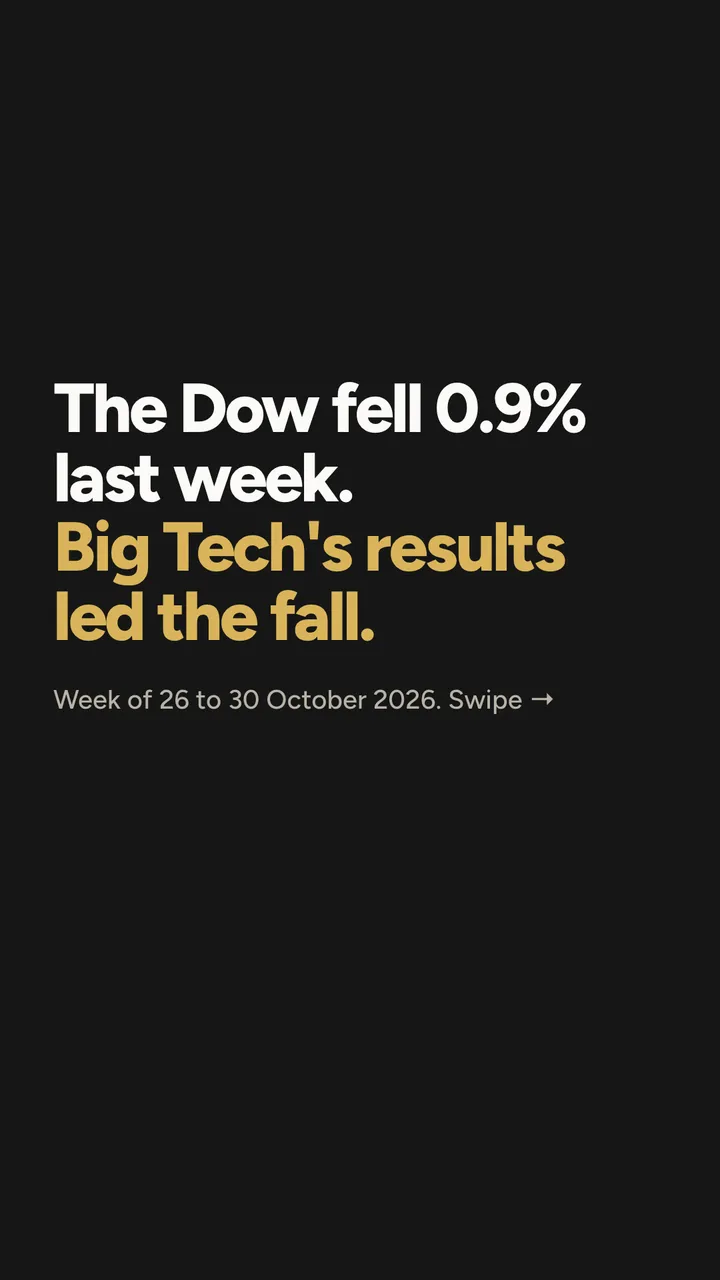
The Dow Jones Industrial Average tracks 30 large American companies, from Apple and Walmart to Coca-Cola and Boeing. This week it went from 52,215.16 to 51,770.31, down 0.9%. As an example, US$1,000 spread like the index would have become about US$991.48. The S&P 500, which covers 500 companies, fell 0.6%, and the Nasdaq Composite, which leans heavily towards technology, fell 2.0%.
Here's the odd part: 16 of the Dow's 30 stocks actually rose. Amgen, a drug maker, rose 6.1%, McDonald's 3.9% and Johnson & Johnson 3.6%, and I couldn't find a company reason for Amgen. So how did the index fall?
A few big moves outweighed many small ones
The Dow is price-weighted: a stock with a higher share price counts for more, whatever the size of the company. A US$1 move in any Dow stock moves the index by the same number of points. This week Caterpillar's shares fell US$64.25 each and Alphabet's US$40.37, the two biggest falls per share in the index. A handful of moves that size can outweigh many small rises.
What this means for you: "the market fell" can hide a week where most stocks rose. If you hold an index fund, which index it follows decides which version of the week you had.
Friday: the Nasdaq's worst day since June
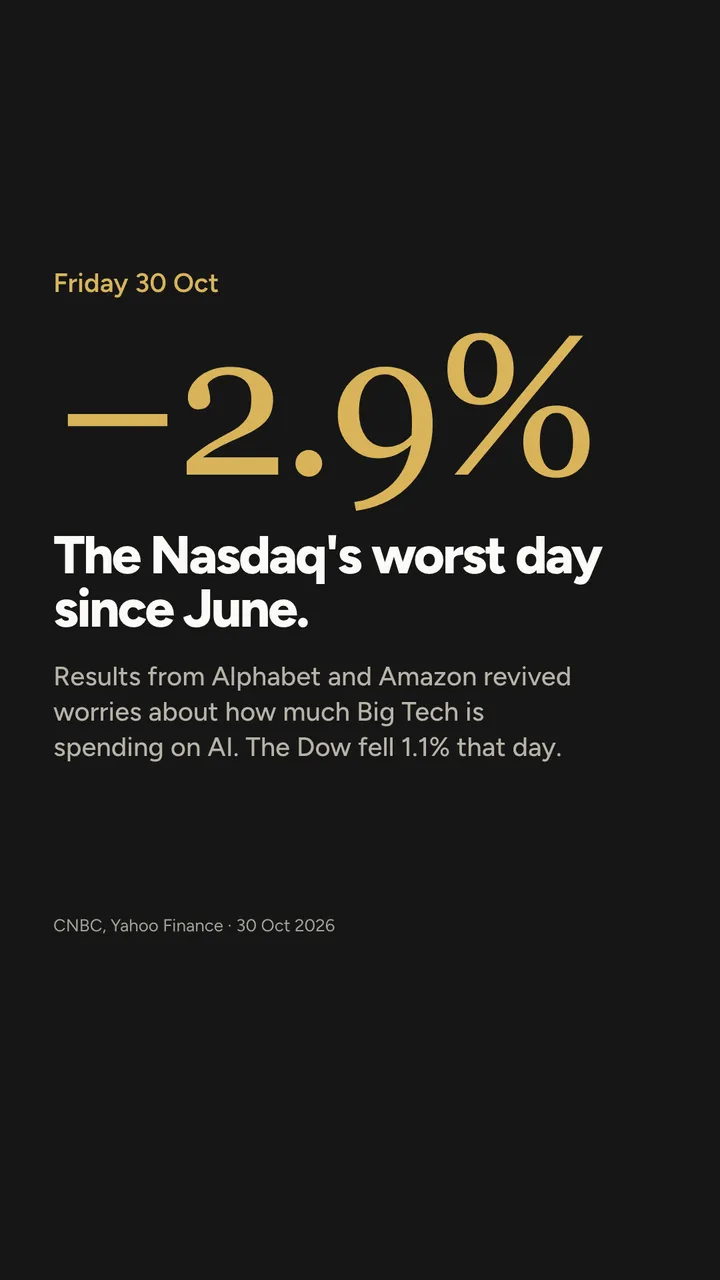
Most of the week was quiet. Monday to Wednesday the Dow rose a little each day, and on Wednesday 28 October the US Federal Reserve held interest rates where they were, at 3.75% to 4%, CNBC reported. Then the big technology companies reported their results.
On Friday the Nasdaq fell 2.9%, its worst day since June, and the Dow fell 1.1%, CNBC reported. Yahoo Finance said results from Alphabet and Amazon had revived worries about how much the biggest technology companies are spending on artificial intelligence. Intel, which isn't in the Dow, fell almost 29% after a weaker outlook than expected, and chip stocks fell with it.
Two words from results season
- Capital spending (often shortened to capex): money a company spends on long-lasting things like buildings, data centres and machines, rather than on day-to-day running costs. It's spent now in the hope of earning more later.
- Free cash flow: the cash a business has left after running itself and paying for that capital spending. If capex is bigger than the cash the business brings in, free cash flow turns negative.
When companies spend heavily now for returns later, investors have to decide how much to trust the "later". This week, more of them were unsure.
What this means for you: when you read that a company is "spending billions", it's worth asking whether that money comes from cash it earns or from somewhere else. That's what free cash flow tells you.
Alphabet fell 12.6% after missing forecasts
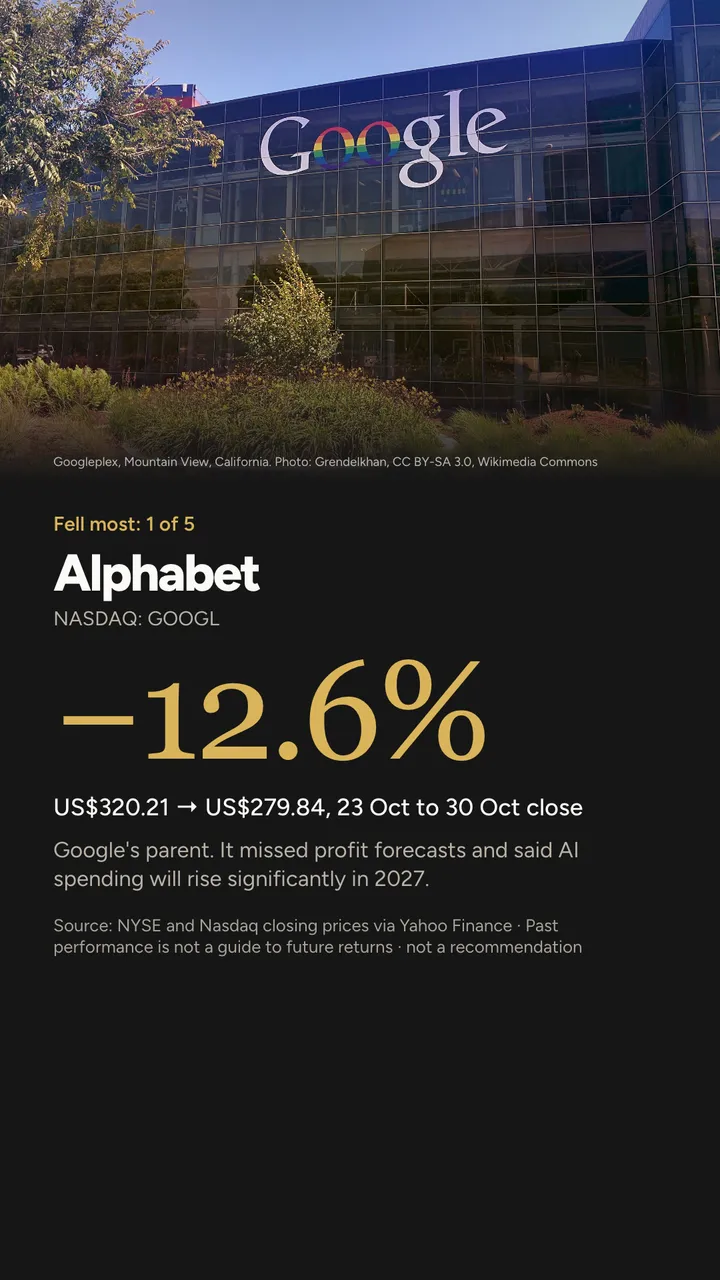
Alphabet owns Google search, YouTube and Google Cloud. After the market closed on 28 October it reported third-quarter results, and CNBC reported it missed analysts' forecasts for both profit and revenue for the first time in nearly four years: adjusted profit of US$2.67 a share against US$3.02 expected, and revenue of US$127.58 billion against US$128.22 billion.
Two more numbers mattered. Free cash flow was minus US$9.07 billion, and the company kept its 2026 capital spending plan at US$195 billion to US$205 billion, while its finance chief said spending will "increase significantly" in 2027. The bright spot was Google Cloud, whose revenue more than doubled to US$30.7 billion. On Thursday the shares fell 12.6%.
The arithmetic
- US$1,000 of Alphabet on 23 October would have become about US$873.93 on 30 October.
- That's US$40.37 a share. Ten shares, US$3,202.10, became US$2,798.40.
So, Hui Min's question. Nobody stopped using Google last week. What changed was the picture of how much Alphabet will spend before that spending pays off, and the price moved to match.
What this means for you: a company can grow, as Google Cloud did, and its shares can still fall, if the costs or the forecasts disappoint. Using a product every day doesn't tell you what its shares will do.
Caterpillar fell 9.4% despite beating forecasts
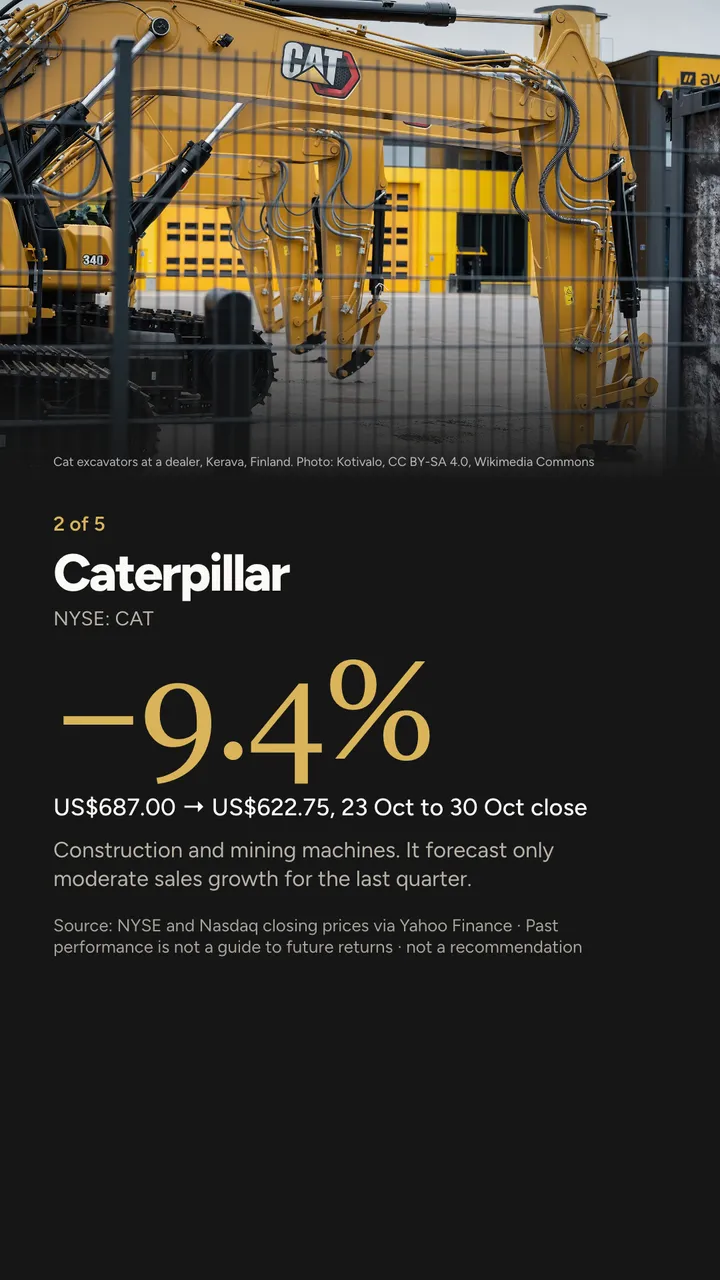
Caterpillar makes the yellow machines you see on construction sites and in mines: excavators, bulldozers, trucks and engines. On 29 October it reported quarterly sales up 17% to US$20.7 billion, and adjusted profit of US$7.20 a share against US$7.08 expected. That's a beat on both counts.
The shares still fell as much as 12% that day, after the company forecast only moderate sales growth for the last quarter of the year, Yahoo Finance reported. CNBC called it the stock's worst day since March 2020. It fell another 3.8% on Friday, and I couldn't find a separate reason for that.
The arithmetic
- US$1,000 of Caterpillar would have become about US$906.48.
- One share fell US$64.25, the biggest fall per share in the Dow this week.
Looking back versus looking forward
Results tell you about the last three months. The outlook, or guidance, is the company's own forecast for the months ahead. Prices are set by people looking forward, so a good quarter with a cautious outlook can be received worse than a weak quarter with a strong one.
What this means for you: when a company "beats" and falls anyway, the outlook is usually the first place to look.
Boeing fell 8.9% on slower production
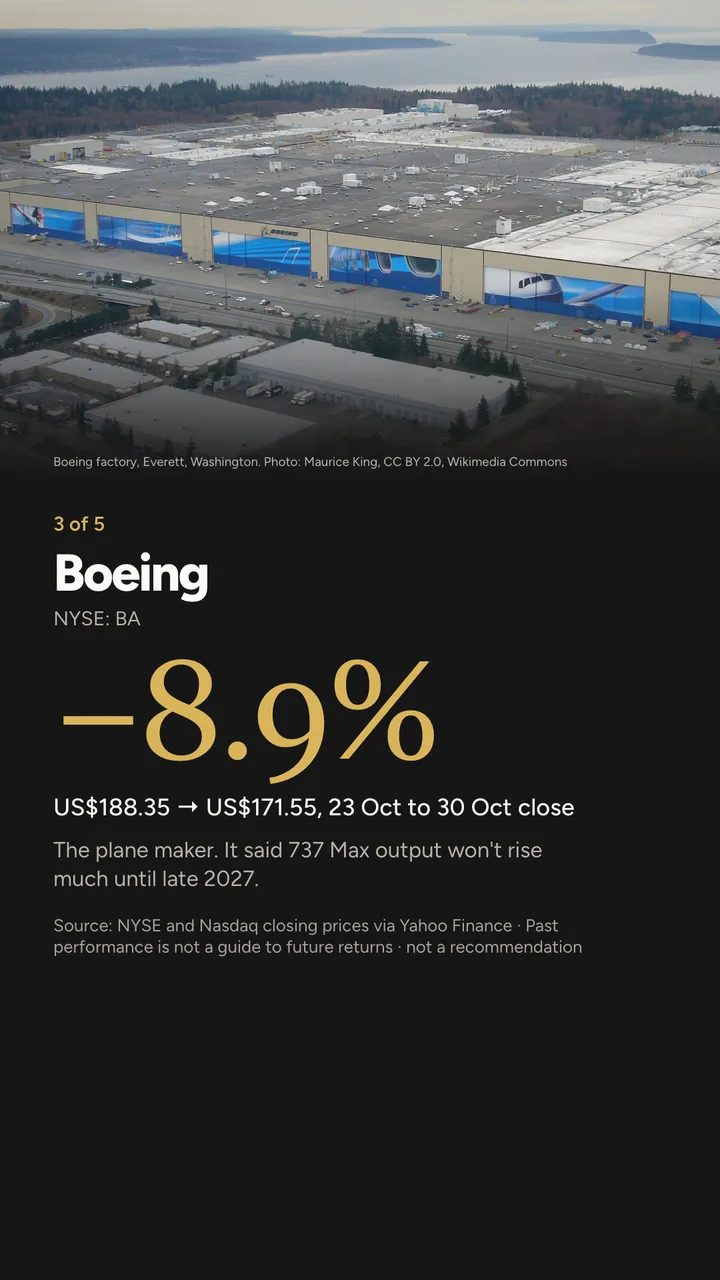
Boeing builds passenger jets, along with defence and space work. On 27 October it reported a third-quarter adjusted loss of 34 cents a share, against an expected loss of 21 cents, and said it won't significantly ramp up production of its 737 Max until late 2027, CNBC reported. It also gave a free cash flow outlook for 2027 of US$3 billion, against the US$5.7 billion analysts had expected, according to CNBC's Investing Club. The shares fell 10.7% that day.
The arithmetic
- US$1,000 of Boeing would have become about US$910.80.
- That's US$16.80 a share.
Why production rate matters
A plane maker is paid mostly when it delivers a plane. If it builds fewer planes a month for longer, the cash arrives later, even when the orders are already there. That's why a production rate, a fairly dull number, can move the shares as much as profit does.
What this means for you: for a company with a long order book, the question is often not "will they sell it?" but "when will they get paid?"
Salesforce fell 7.8% with no company news
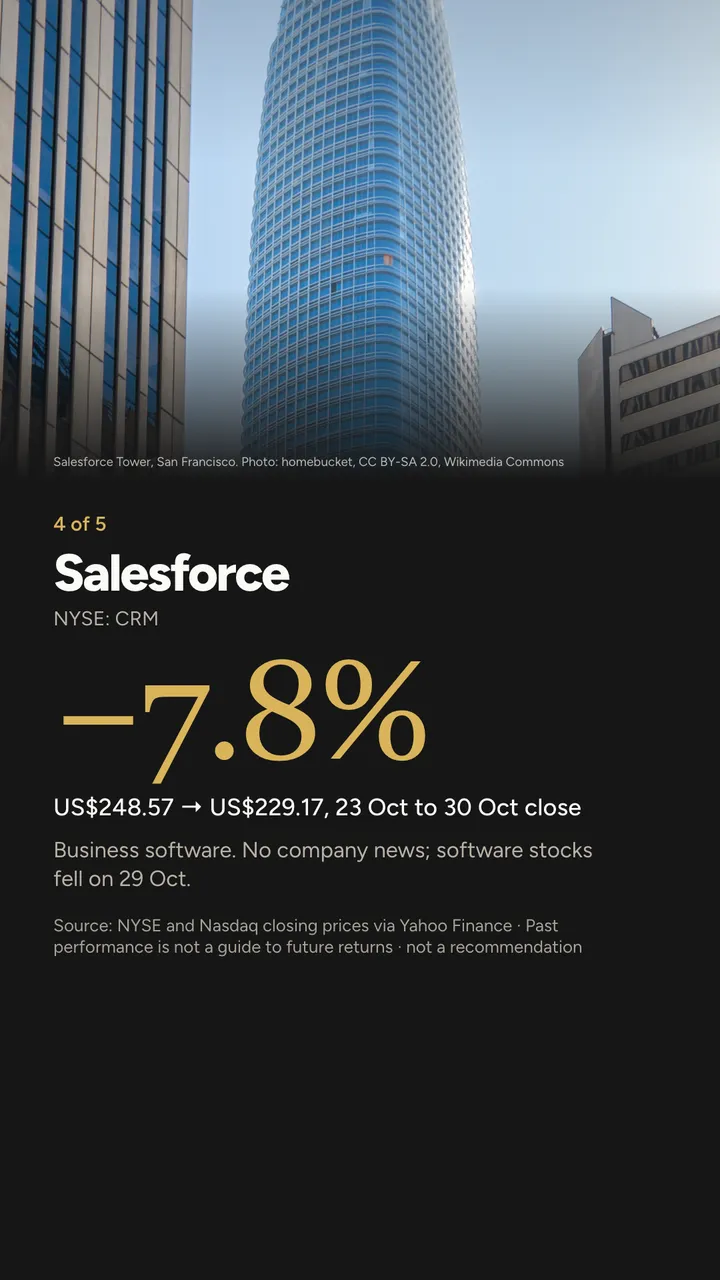
Salesforce makes software that companies use to manage their sales and customer service. It had no company news that I could find. On Thursday 29 October it fell 4.6% as software stocks were sold after two other software companies, ServiceNow and Fortinet, gave weak outlooks and fell 25% and 21%, Yahoo Finance reported. It also fell 2.7% on Tuesday, with no reason reported.
The arithmetic
- US$1,000 of Salesforce would have become about US$921.95.
- That's US$19.40 a share.
Moving with the group
Investors often treat companies in the same industry as a group. When one software company warns, others get sold too, on the worry that the same thing might be happening to them. Sometimes it is, sometimes it isn't, and a week is too short to tell.
What this means for you: if a stock falls with no news of its own, it's worth checking what happened to similar companies that day.
Amazon fell 3.1%, mostly before its results
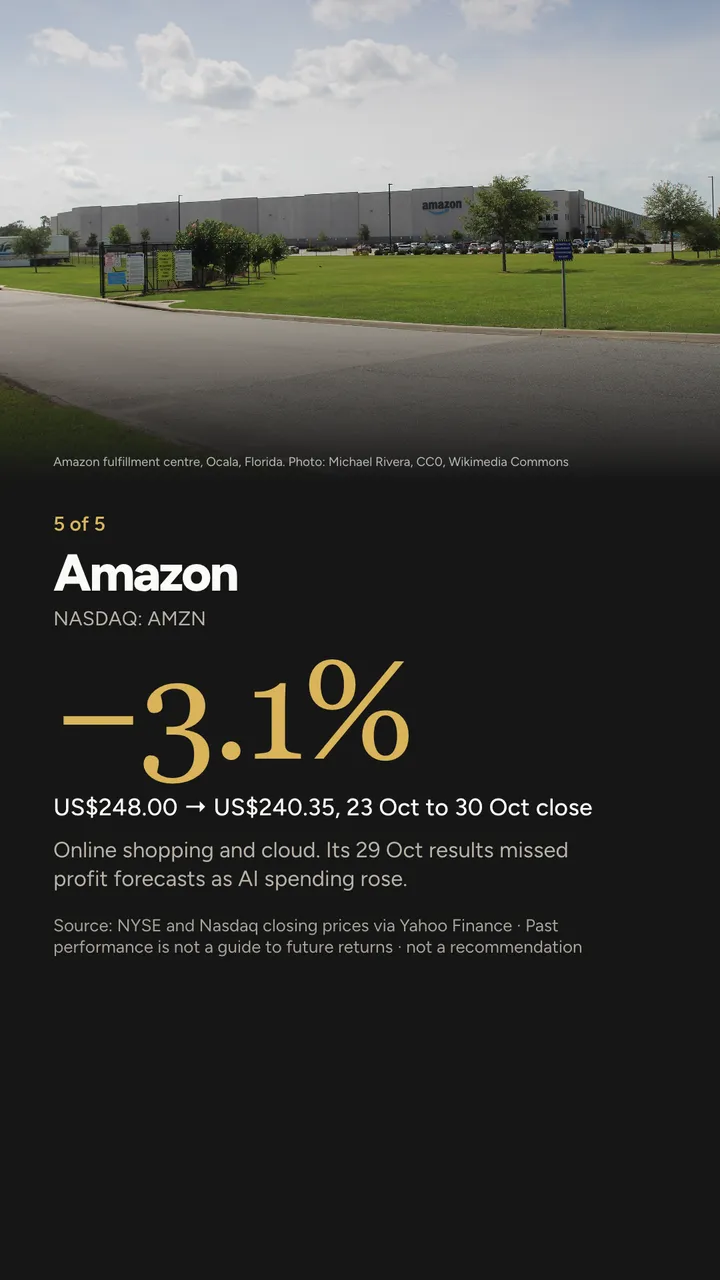
Amazon runs online shopping and Amazon Web Services, its cloud business. The timing here is worth a careful look. Amazon fell 4.2% on Thursday, during the day, along with other technology stocks. Its results came out after that day's close: profit of US$1.89 a share against US$1.96 expected, and capital spending of US$77.3 billion in the quarter against US$58.7 billion expected, CNBC reported. Cloud revenue beat forecasts. On Friday it fell another 1.4%.
The arithmetic
- US$1,000 of Amazon would have become about US$969.15.
- That's US$7.65 a share.
What this means for you: when you read "fell after results", check the dates. Here most of the week's fall came the day before the numbers were out.
The week in one table
| Stock | Ticker | Close, 23 Oct to 30 Oct | Change | US$1,000 became |
|---|---|---|---|---|
| Alphabet | NASDAQ: GOOGL | US$320.21 to US$279.84 | -12.6% | US$873.93 |
| Caterpillar | NYSE: CAT | US$687.00 to US$622.75 | -9.4% | US$906.48 |
| Boeing | NYSE: BA | US$188.35 to US$171.55 | -8.9% | US$910.80 |
| Salesforce | NYSE: CRM | US$248.57 to US$229.17 | -7.8% | US$921.95 |
| Amazon | NASDAQ: AMZN | US$248.00 to US$240.35 | -3.1% | US$969.15 |
| Dow Jones Industrial Average | DJI | 52,215.16 to 51,770.31 | -0.9% | about US$991.48 |
All before fees and currency moves. In Singapore dollars, your result also depends on how the US dollar moved against the Singapore dollar that week.
The pattern: spending now, paying off later
Three of the five fell on their own results, and all three stories were about timing: when the spending pays off at Alphabet and Amazon, when the planes get delivered at Boeing, and how the next quarter looks at Caterpillar. The fourth, Salesforce, fell with its industry. The same Friday also reached Singapore, more gently, as I wrote in this week's STI post.
If you only remember three things
- A share price reflects expectations about future cash, not how popular the product is.
- "Beat forecasts" and "the shares fell" can both be true. The outlook often matters more.
- Check the dates. A stock can fall before its news, and an index can fall while most of its stocks rise.
How I keep track of this
Weeks like this are when I'm glad I stopped checking my portfolio every day. What helps is seeing US shares next to everything else, so a red week sits in proportion with our savings, CPF and the flat.
In Sum, stocks sit inside your net worth beside your bank accounts, CPF and property. Stocks are on the Essential plan; live prices, profit and loss, and dividends are on Pro.
I sent Hui Min the Alphabet section. She replied with a screenshot of a search bar and the words "still using it".
Talk soon, Brandon

Sum is launching in Singapore soon.
Your banks, cards, CPF and HDB flat, added up into one net worth. Statements sorted, card caps tracked, bills remembered.
Brandon · Finance team, Sum
Brandon is on Sum's finance team in Singapore. Brandon reads the CPF Board, IRAS and MAS updates so you don't have to, and turns our carousels into the longer version. Questions, corrections or something to share? Email Brandon at [email protected].
Got something interesting to share?
A money story, a question, something we got wrong, or a tip other Singaporeans should hear. Reach out to me at [email protected], or leave your email and I'll write to you.
Sources: Yahoo Finance, Dow Jones Industrial Average price history; CNBC, Stock market rocked as investors dump tech shares; Nasdaq suffers worst day since June (live updates), 30 Oct 2026; Yahoo Finance, Stock market today: Nasdaq, Dow, S&P 500 clobbered as October closes with brutal sell-off, 30 Oct 2026; CNBC, Dow loses 100 points, S&P 500 snaps 3-day advance as Alphabet and Caterpillar tank (live updates), 29 Oct 2026; Yahoo Finance, Stock market today: Dow, S&P 500, Nasdaq slip as Alphabet stock sinks 12%, 29 Oct 2026; CNBC, Fed holds rates steady, 28 Oct 2026; CNBC, Alphabet sinks 10% as it holds 2026 capex unchanged, expects significant increase in 2027, 28 Oct 2026; Caterpillar, 3Q26 results, 29 Oct 2026; CNBC, Boeing says it won't significantly ramp up 737 Max production until late 2027, 27 Oct 2026; CNBC Investing Club, Boeing shares slide on a disappointing cash flow update, 27 Oct 2026; CNBC, Amazon posts negative free cash flow of $42.4 billion, holds 2026 capex unchanged, 29 Oct 2026.
Any app screens shown use sample data, not a real person's. Sum is free to start; some features need a paid plan.
Information only, not financial advice.