Why the STI fell, week of 26 to 30 Oct 2026
The STI fell 0.8% as Wall Street's tech sell-off reached Singapore. Wilmar, Yangzijiang, MIT, FCT and SGX fell most, explained simply, with the maths.

On Friday night Rachel and I were at a dessert place near our flat, waiting for a bowl of mango sago that was taking its time, when her phone lit up with a news alert. She read it out: "Nasdaq has its worst day since June." Then she looked at me. "Is that bad? Do we own the Nasdaq?"
Not exactly, I said, and started explaining the difference between an American index and the Singapore one as the mango sago arrived. She listened to about half of it: "OK, write it down properly. I'll read it on Monday."
So here it is. Markets fell, in America more than here, and that's a good time to look at why. This is the long version of our Monday carousel. This week it shows the five STI stocks that fell the most between Friday 23 and Friday 30 October 2026, what each company does, why it fell where a reason was reported, and what S$1,000 held for the week would have become. No predictions, no tips.
The STI fell 0.8%, and most of it came on Friday
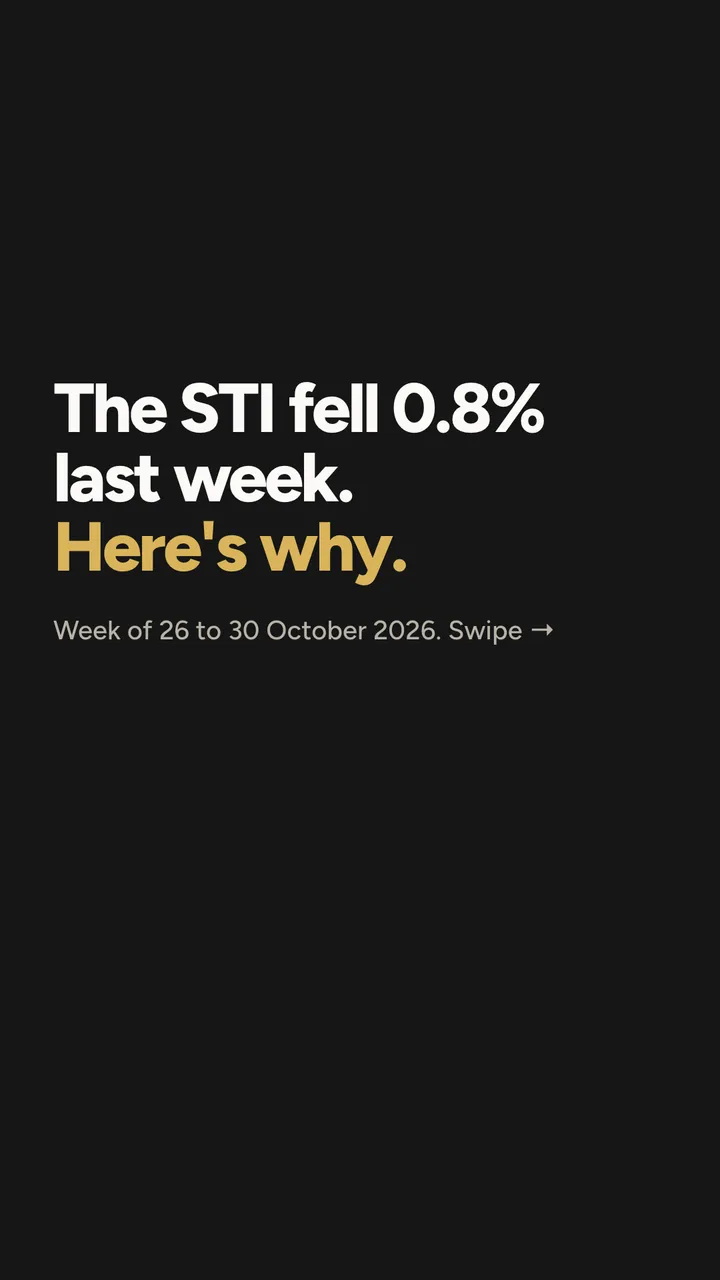
The Straits Times Index tracks 30 of the biggest companies listed on SGX, the Singapore Exchange. This week it went from 5,422.16 to 5,376.74, a fall of 0.8%. As an example, S$1,000 spread exactly like the index would have become about S$991.62, before fees.
Day by day: down 0.1% on Monday, 0.3% on Tuesday, roughly flat midweek, then down 0.4% on Friday. We compare each stock's closing price (the last traded price when the market shuts) on the two Fridays, using Yahoo Finance, and rank all 30 ourselves. There were no SGX holidays that week.
It wasn't a week where everything fell. 18 of the 30 fell, 11 rose and one ended flat. DFI Retail, which runs supermarkets and convenience stores across Asia, rose 4.8% after reporting a 17% rise in third-quarter underlying profit on 27 October, The Business Times reported. OCBC rose 1.0% while DBS fell 1.8% and UOB 0.5%.
What this means for you: a 0.8% week is a small move for an index. It feels bigger when the news alerts are loud. It's worth looking at the number before the headline.
Friday: Wall Street's tech sell-off reached Singapore
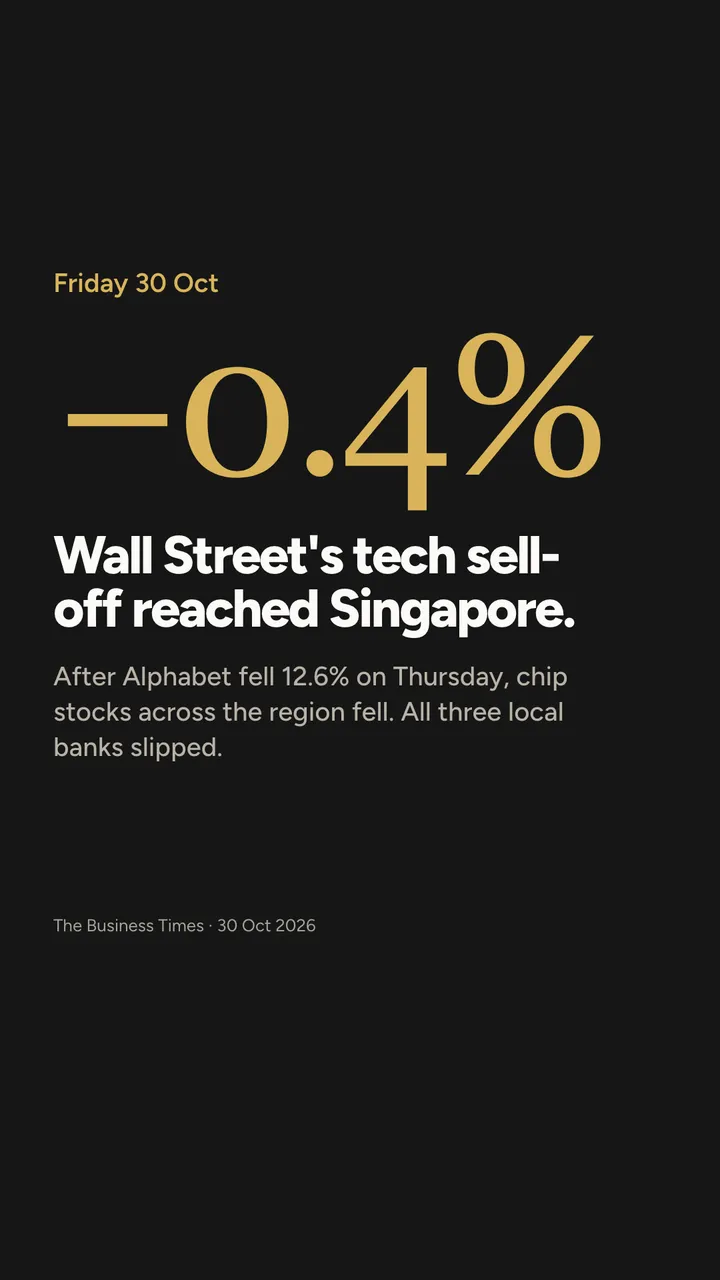
Here's the part Rachel's alert was about. In America, Alphabet, the company behind Google, reported its results and fell 12.6% on Thursday. The Business Times reported that investors then sold chip stocks in Singapore and around the region on Friday, after that rout on Wall Street. Locally, AEM, UMS and Frencken, companies that make equipment and parts for the chip industry, fell sharply, and all three banks slipped.
Why American news shows up in Singapore a day later
The time difference does most of the work. When the US market closes on Thursday afternoon in New York, it's Friday morning here. So a bad Thursday on Wall Street tends to show up in Asian markets on Friday. The same thing happened in Tokyo and Seoul that day, The Business Times reported.
Why Singapore fell less
The STI is mostly banks, property trusts, telcos and industrial companies, with very few of the large technology companies that fill the Nasdaq. So a technology sell-off usually reaches it through the edges, like the chip equipment makers, rather than head on. That's how the index is built, not a prediction.
What this means for you: if most of what you own is Singapore shares, an American tech headline may matter less to you than it sounds. If you own US tech through a fund, it may matter more. It's worth knowing which one you are. (The American side of this week is in the Dow post.)
Wilmar fell 9.9% after weaker profit and a probe into fires
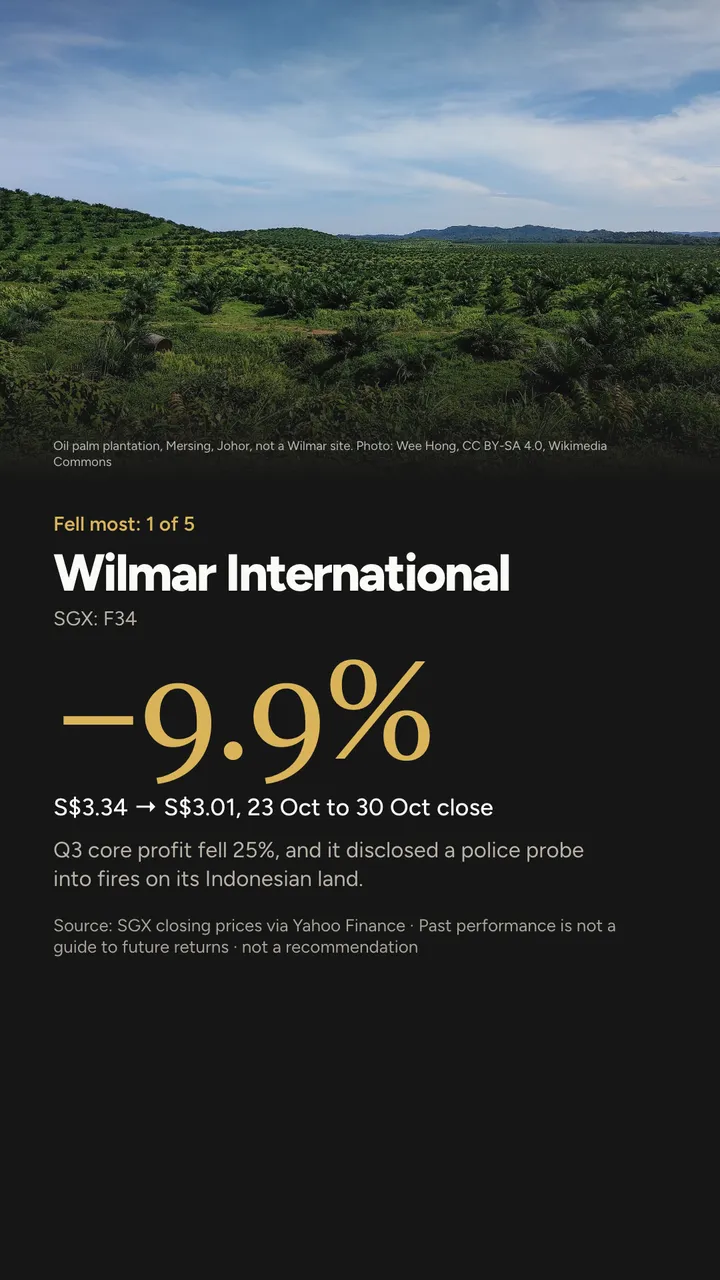
Wilmar International is a Singapore-listed agribusiness group: palm oil, oilseeds, sugar, rice and flour, sold across Asia. It was the week's biggest faller, and two pieces of company news came on the same day.
On 28 October it reported third-quarter results. Core net profit, the profit from its everyday business with one-off items taken out, fell 25.2% to US$267.3 million. Wilmar put that down to higher raw material costs in food products and weaker soybean crushing margins. The same day, answering questions from SGX's regulator, it disclosed that Indonesian police are making preliminary inquiries into fires on about 28 hectares of its subsidiaries' land in West Kalimantan, The Business Times reported. The shares fell 4.9% on Thursday and 3.2% on Friday.
The arithmetic
- S$1,000 of Wilmar on 23 October would have become about S$901.20 on 30 October.
- One board lot (the standard trading size on SGX, 100 shares for prices up to S$10 since 5 October): S$334 became S$301, a loss of S$33 before fees.
Wilmar's headline Q3 profit, which includes one-offs, was positive. The core figure was down a quarter on a year earlier, and investors usually look harder at that one.
What this means for you: when a company "returns to profit", it's worth reading one line further for the core or underlying number.
Yangzijiang fell 6.8%, and no single reason was reported
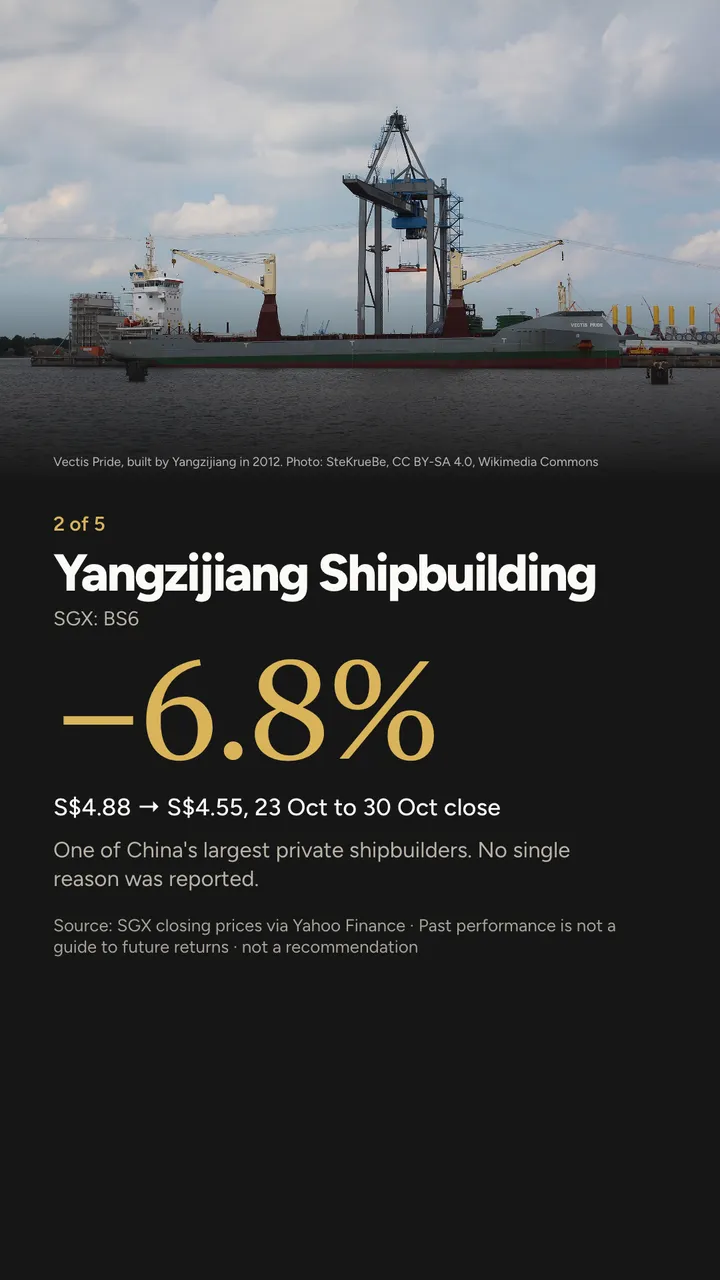
Yangzijiang Shipbuilding is one of China's largest private shipbuilders, building container ships and bulk carriers in Jiangsu, and it's listed in Singapore. Its shares went from S$4.88 to S$4.55, with the biggest daily fall, 3.5%, on Thursday. I looked for a reason in the company's announcements and the business press and couldn't find one. So I'll say that plainly instead of guessing.
The arithmetic
- S$1,000 of Yangzijiang would have become about S$932.38.
- One board lot of 100 shares: S$488 became S$455, a loss of S$33.
What this means for you: "no reason reported" is a real answer. Be a little wary of anyone who always has a confident reason for every move.
Mapletree Industrial Trust fell 3.9% after a lower payout
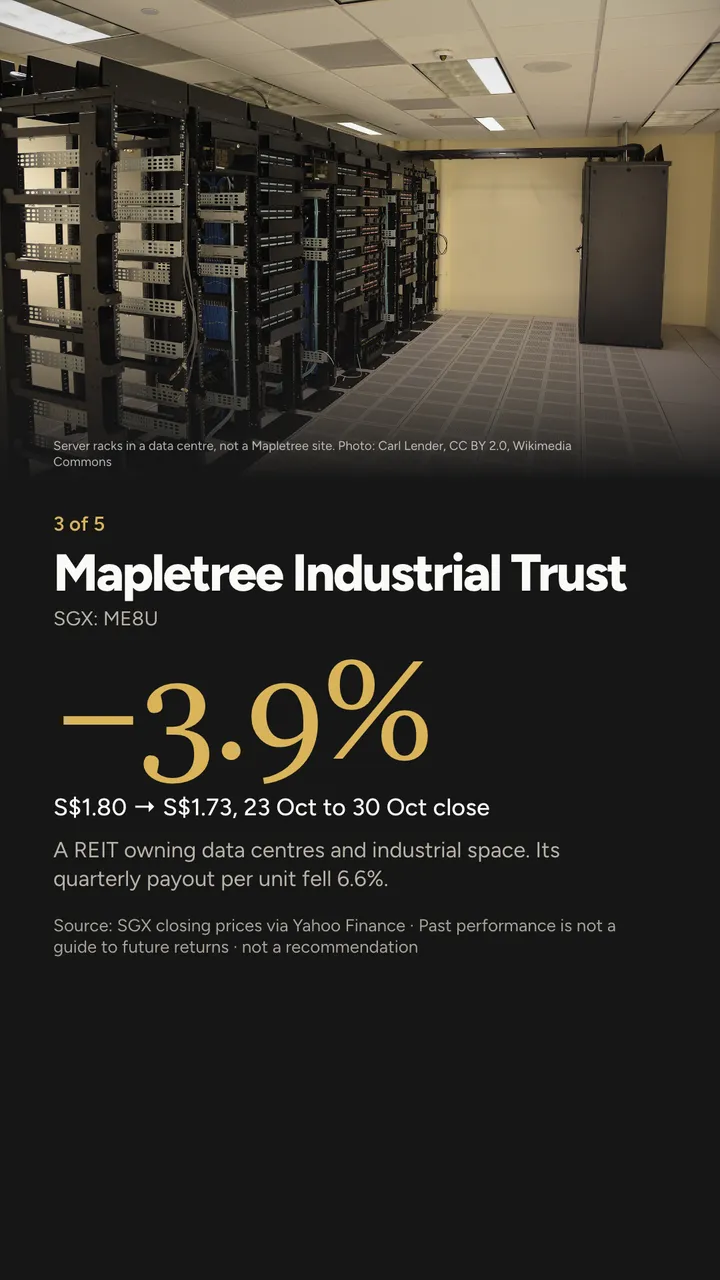
Mapletree Industrial Trust is a REIT, a real estate investment trust: it owns buildings, collects the rent and pays most of it out to unitholders. Its buildings are data centres and industrial space in Singapore and North America. (If REITs are new to you, I wrote a longer explainer on what a REIT is.)
On 27 October, after the market closed, it reported a quarterly DPU, distribution per unit, of 2.97 cents, down 6.6% on a year earlier. It gave several reasons: a lease that ended in San Diego, Singapore properties it had sold, a weaker yen and the cost of its interest-rate hedges going up. Occupancy fell to 89.7% from 90.7%. The next day the units fell 2.8%, and The Business Times linked the fall to the lower DPU.
The arithmetic
- S$1,000 of MIT would have become about S$961.11.
- One board lot of 100 units: S$180 became S$173, a loss of S$7.
Why the payout moves the price
For many holders a REIT is about the payout. If it falls, the same price buys less income, so some sell until the two feel in proportion again. That's the general idea, not a rule.
What this means for you: if you hold a REIT for its payout, the DPU line in its results is the one to read first. MIT's next ex-distribution date is 3 November, according to SGX, so the price will also adjust for that this week, which brings me to the next one.
Frasers Centrepoint Trust fell 3.7%, mostly on paper
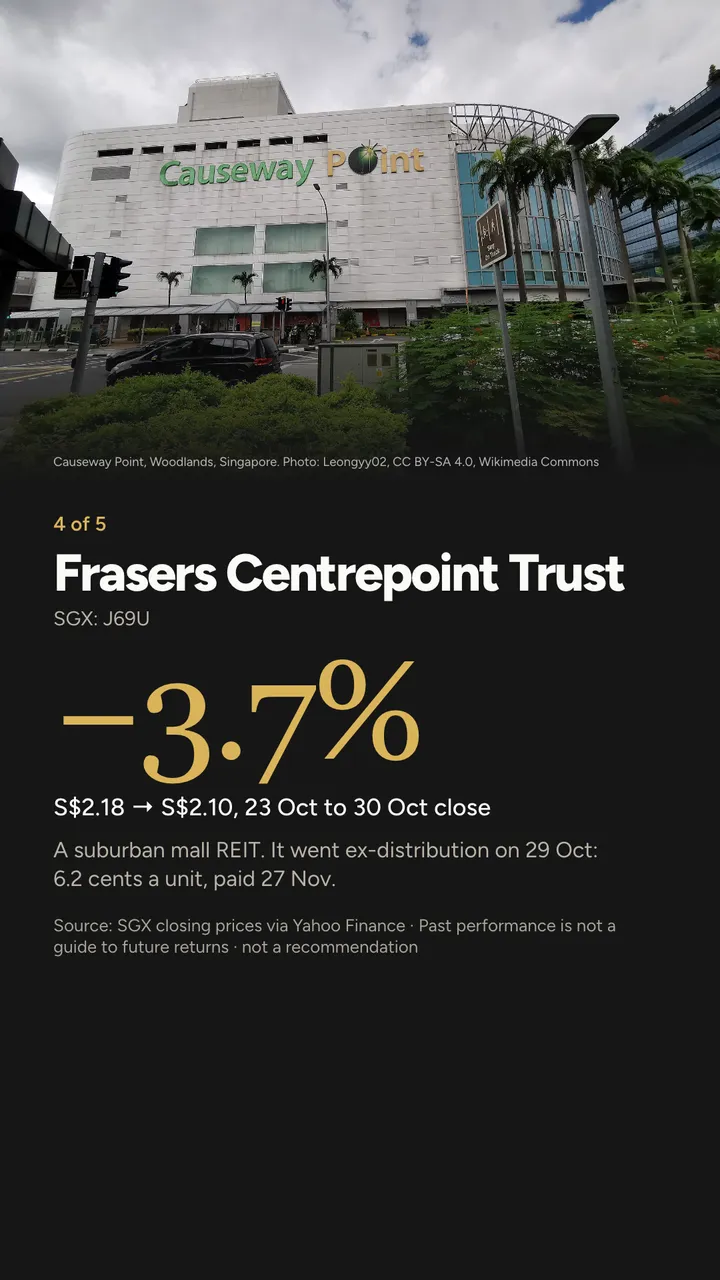
Last week, Frasers Centrepoint Trust, which owns suburban malls like Causeway Point and Northpoint City, was the STI's top performer after a record payout. This week it's in the bottom five. Both are true, and they're connected.
On Thursday 29 October FCT went ex-distribution. That's the first day a buyer no longer gets the upcoming payout. The payout was 6.214 cents a unit, about 2.9% of the 23 October price, according to SGX and The Business Times, and it will be paid on 27 November to those who held the units before that date. When a unit stops carrying the payout, its price usually drops by roughly that amount, because a buyer is getting less.
The arithmetic, both ways
- On price alone, S$1,000 of FCT would have become about S$963.30.
- But S$1,000 on 23 October bought about 458.7 units, and the payout on those is about S$28.50, arriving on 27 November.
- Price plus payout: about S$991.80. That's a fall of about 0.8%, not 3.7%.
- One board lot of 100 units: S$218 became S$210, with S$6.21 of payout to come.
What this means for you: before you worry about a REIT's fall, check its ex-date. Part of what looks like a loss may be your payout, just paid in a different form.
SGX fell 2.7%, with no single reason reported
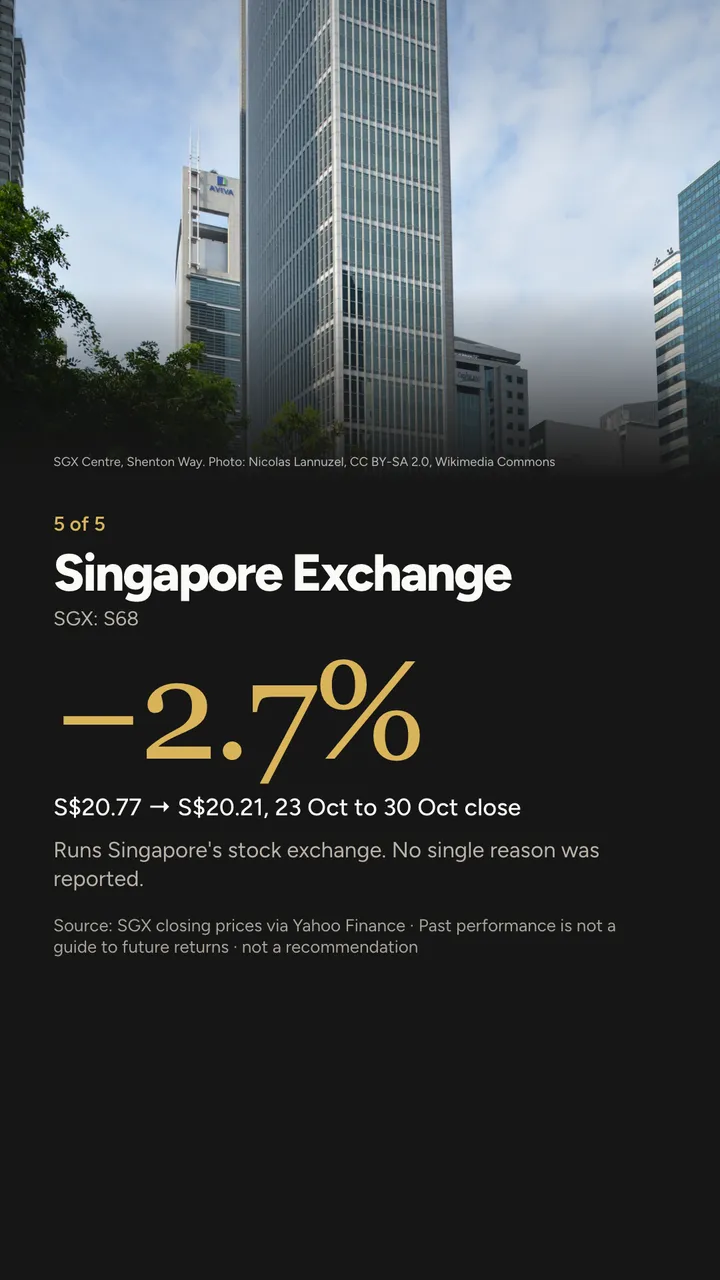
Singapore Exchange is the company that runs the stock exchange itself: it earns fees when people trade, list and clear shares. Its own shares went from S$20.77 to S$20.21, and I couldn't find a reported reason. It isn't ex-dividend until 13 November, according to SGX, so that isn't the explanation either.
The arithmetic
- S$1,000 of SGX would have become about S$973.04.
- That's S$0.56 a share.
What this means for you: a stock with no news can still be in the bottom five. Just behind SGX was Sembcorp, also down 2.7%; The Business Times linked its fall to Indonesia cutting gas exports to Singapore.
The week in one table
| Stock | Ticker | Close, 23 Oct to 30 Oct | Change | S$1,000 became |
|---|---|---|---|---|
| Wilmar International | SGX: F34 | S$3.34 to S$3.01 | -9.9% | S$901.20 |
| Yangzijiang Shipbuilding | SGX: BS6 | S$4.88 to S$4.55 | -6.8% | S$932.38 |
| Mapletree Industrial Trust | SGX: ME8U | S$1.80 to S$1.73 | -3.9% | S$961.11 |
| Frasers Centrepoint Trust | SGX: J69U | S$2.18 to S$2.10 | -3.7% | S$963.30 (S$991.80 with the payout) |
| Singapore Exchange | SGX: S68 | S$20.77 to S$20.21 | -2.7% | S$973.04 |
| Straits Times Index | STI | 5,422.16 to 5,376.74 | -0.8% | about S$991.62 |
All before fees. Every reason above comes from a dated report or the company's own announcement; where I couldn't find one, I've said so.
The pattern: one loud headline, five quieter stories
The headline was American technology. But the five were a plantation group's profit and a probe, a REIT's lower payout, a REIT's payout date, and two with no reported reason. Only Friday came from Wall Street.
If you only remember three things
- American news often shows up in Singapore a day later, because of the time difference.
- A REIT's price drops on its ex-date because buyers no longer get the payout. Count the payout before calling it a loss.
- "No reason reported" is a real answer. Not every move has a story.
How I keep track of this
I'll admit that after Rachel's alert, my first instinct was to open my brokerage app. What I actually did, once the mango sago was finished, was look at the whole picture: the shares next to our savings, CPF and the flat. In proportion, a 0.8% week is a small line.
In Sum, stocks sit inside your net worth beside your bank accounts, CPF and property. Stocks are on the Essential plan; live prices, profit and loss, and dividends are on Pro.
I'll send Rachel this on Monday, as promised. I already know her one-line summary: "So the Nasdaq is not ours." Mostly not.
Talk soon, Brandon

Sum is launching in Singapore soon.
Your banks, cards, CPF and HDB flat, added up into one net worth. Statements sorted, card caps tracked, bills remembered.
Brandon · Finance team, Sum
Brandon is on Sum's finance team in Singapore. Brandon reads the CPF Board, IRAS and MAS updates so you don't have to, and turns our carousels into the longer version. Questions, corrections or something to share? Email Brandon at [email protected].
Got something interesting to share?
A money story, a question, something we got wrong, or a tip other Singaporeans should hear. Reach out to me at [email protected], or leave your email and I'll write to you.
Sources: Yahoo Finance, Straits Times Index price history; The Business Times, Singapore shares fall as chip stocks take a beating; STI down 0.4%, 30 Oct 2026; The Business Times, Wilmar back in the black with Q3 profit of US$281 million, 28 Oct 2026; The Business Times, Wilmar slides almost 5% after weaker Q3 earnings; Indonesian police probe plantation fires, 29 Oct 2026; The Business Times, Mapletree Industrial Trust posts 6.6% drop in Q2 DPU to S$0.0297, 27 Oct 2026; The Business Times, Singapore stocks end flattish even as local banks gain; STI up 0.02%, 28 Oct 2026; The Business Times, FCT posts 2.6% higher H2 DPU to hit new full-year record payout, 22 Oct 2026; SGX, corporate actions (Frasers Centrepoint Trust ex-date 29 Oct 2026); The Business Times, DFI Retail Group shares up 5% after rise in Q3 underlying profit, 27 Oct 2026.
Any app screens shown use sample data, not a real person's. Sum is free to start; some features need a paid plan.
Information only, not financial advice.