The STI's top 5 stocks, week of 2 to 6 Nov 2026
The STI fell 3.7% as the banks slid, yet 15 of the 30 rose. DFI Retail, Jardine Matheson, SIA, FLCT and Keppel DC REIT led, explained with the maths.

On Saturday afternoon Rachel was at our dining table with the last stack of marking for the year, and I was next to her with the week's closing prices, which is how the two of us relax. I said, mostly to myself, that half the STI had gone up and the index had still fallen 3.7%.
She looked up. "Half the class improved and the average dropped? Then a few of them must have done very badly." I said three of them had. "And those three carry a lot of the marks?" They do, I said. She went back to her script. "Then your average is not really about the class."
That's a better explanation than the one I was going to write, so I'm using it. Here's the long version of our Monday carousel: the five STI stocks that rose the most between Friday 30 October and Friday 6 November 2026, what each company does, why it moved where a reason was reported, and what S$1,000 (or US$1,000) held for the week would have become. No predictions, no tips.
The STI fell 3.7%, and half of it still rose
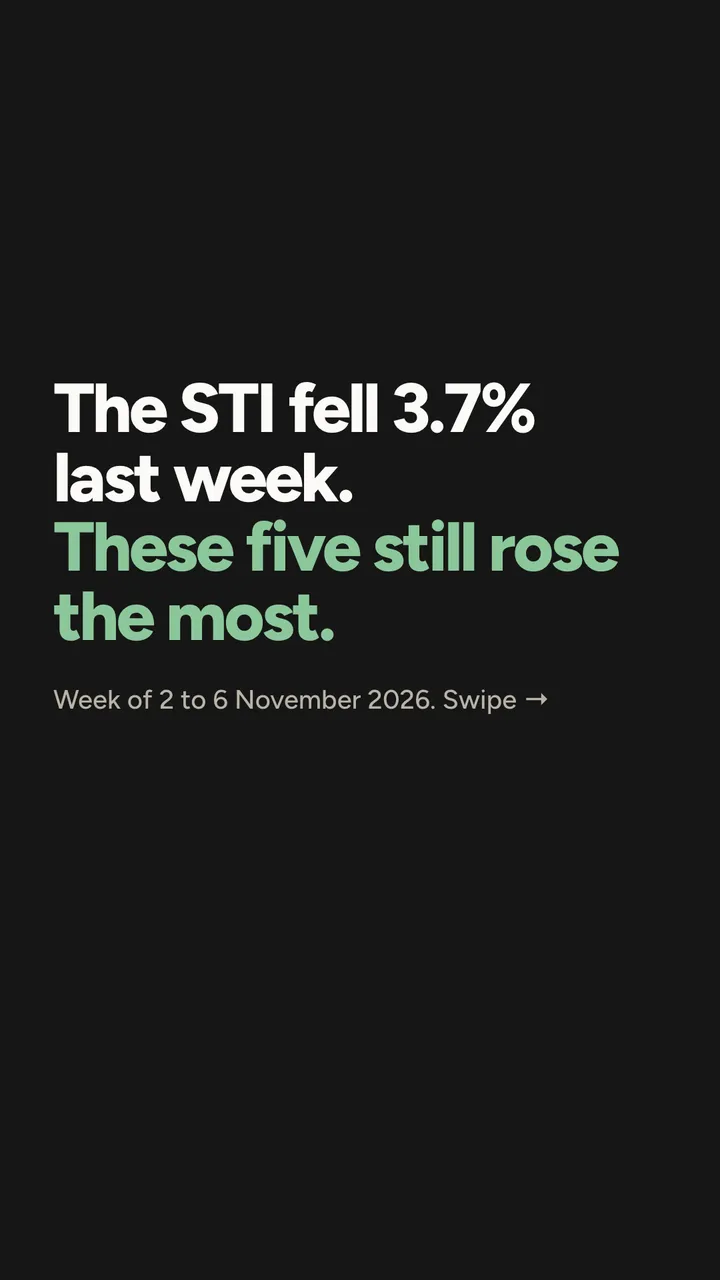
The Straits Times Index tracks 30 of the biggest companies listed on SGX, the Singapore Exchange. This week it went from 5,376.74 to 5,179.17. S$1,000 spread exactly like the index would have become about S$963.25, before fees and dividends.
To find the top five, we compare each stock's closing price (the last traded price when the market shuts) on the two Fridays, using Yahoo Finance, and rank all 30 ourselves. There were no SGX holidays that week.
The three banks
Fifteen of the 30 rose. The index fell because it is weighted by size: a big company moves it more than a small one, and the three local banks are a large slice of it. All three reported third-quarter results that week.
- UOB fell 10.9%. On 4 November it reported net profit of S$1.25 billion, short of the S$1.38 billion analysts polled by Bloomberg expected, The Business Times reported. It fell 5% that day alone.
- OCBC fell 5.3%. Its S$2.04 billion profit on 6 November came in slightly above estimates. Most of the fall came earlier: 3.3% on Monday, before its results.
- DBS fell 4.7%. On 5 November it reported profit of S$2.81 billion, down 5%, which it put down to lower markets trading income.
Friday was the biggest down day, 2.2%, or 117.08 points. The Business Times reported the index was also tracking regional falls after a sharp sell-off in US tech stocks, and only SATS closed higher that day. I couldn't find a reported reason for the falls in ST Engineering (8.8%) or Keppel (6.3%).
What this means for you: the index is not an average of 30 equal things. If you own none of the banks, your week may look nothing like the headline. If you own an STI fund, it probably looks a lot like it.
DFI Retail Group rose 6.9%, with no single reason reported
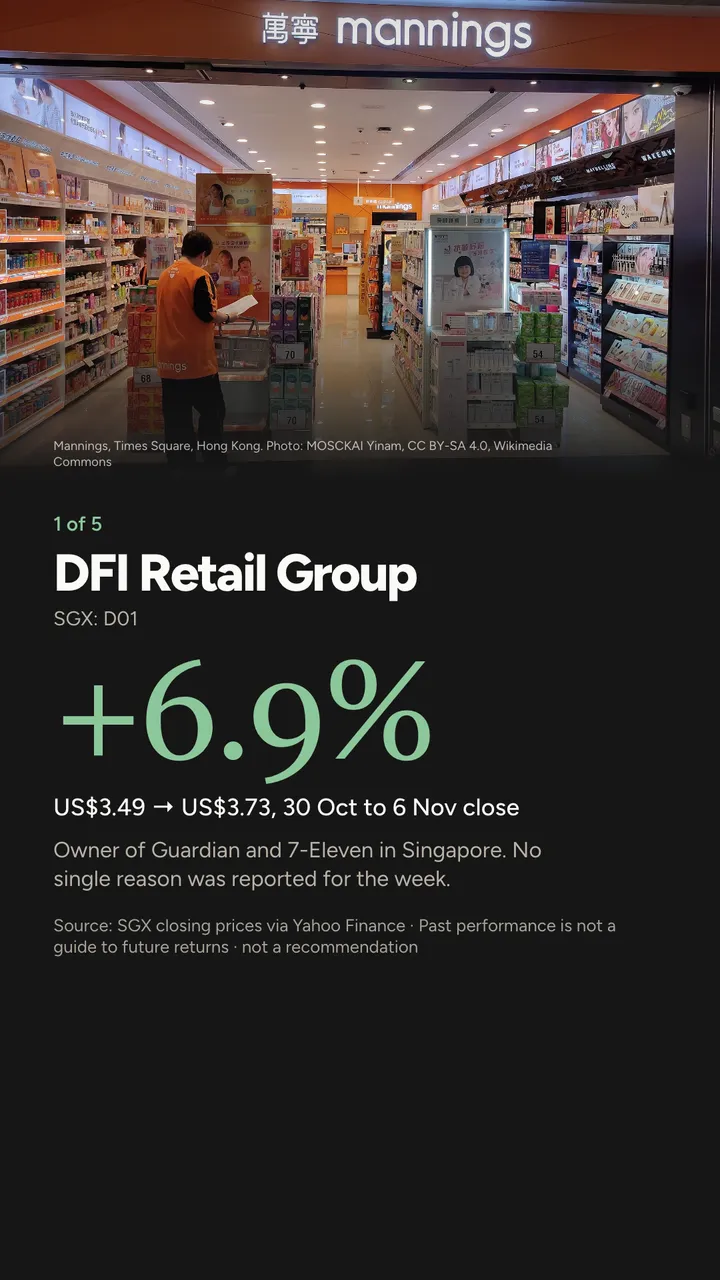
DFI Retail Group runs shops: Guardian and 7-Eleven in Singapore, Mannings and Wellcome in Hong Kong. It is listed on SGX but quoted in US dollars.
Its shares rose 6.2% on 4 November, the STI's biggest gain that day, and The Business Times reported the move without a cause. Its last company news was the week before: on 27 October it reported a 17% rise in third-quarter underlying profit. Underlying profit leaves out one-off items such as gains from selling a business, so it's closer to what the normal business earned. No report I could read connected that to this week.
The arithmetic
- US$1,000 of DFI shares would have become about US$1,068.77.
- One board lot (100 shares, the standard trading size on SGX for prices up to S$10): US$349 became US$373, a gain of US$24 before fees.
What this means for you: sometimes the honest answer to "why did it go up?" is that nobody said. A price can move without a story, and a story written afterwards isn't always the reason.
Jardine Matheson rose 5.5%, again with no single reason
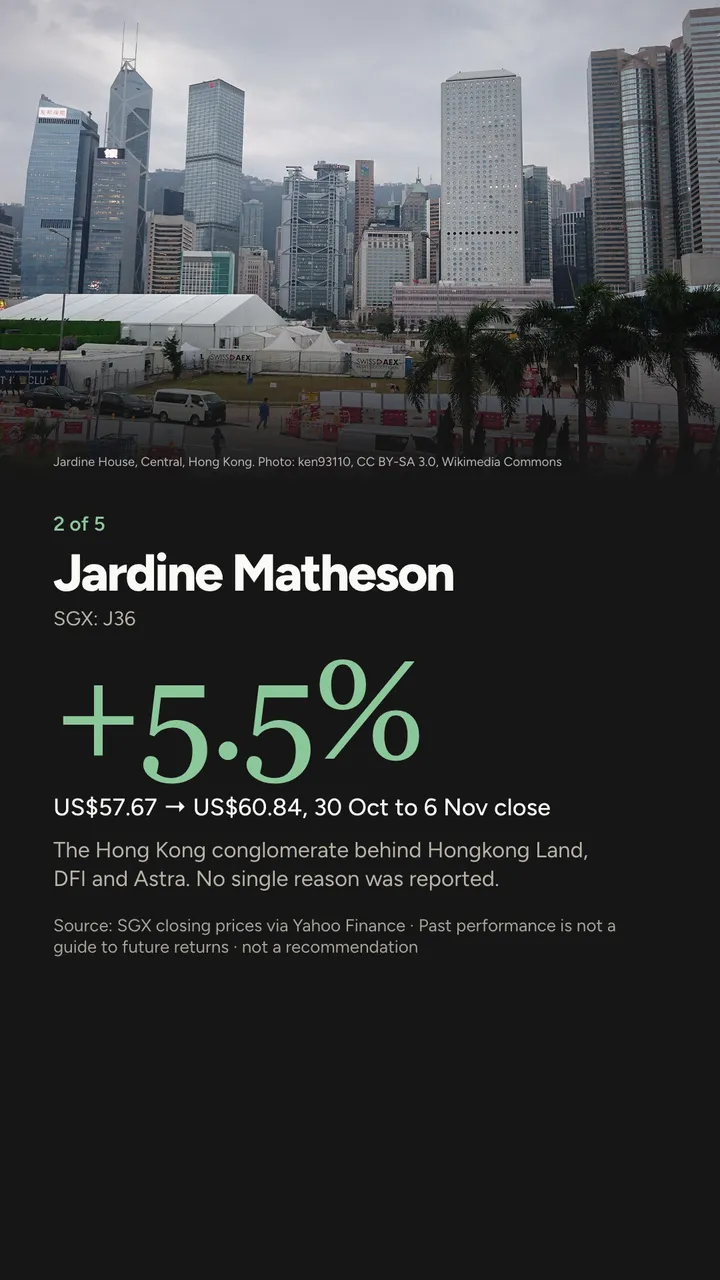
Jardine Matheson is a conglomerate: one company that owns big stakes in several others, including Hongkong Land, DFI Retail and Astra in Indonesia. It led the STI on both Monday and Tuesday, rising 2.1% and 1.4%, on days when the index fell. No reason was reported for either.
The arithmetic
- US$1,000 of Jardine shares would have become about US$1,054.97.
- One board lot at these prices is about US$5,767, so the gain was about US$317 before fees.
What a holding company discount is
A company like this can trade for less than its stakes appear to be worth. That gap is called a holding company discount. On 21 October, The Business Times reported DBS's analysts putting Jardine's at about 37%, against a long-term average of 32%. That's one research team's estimate on one date, and I'm using it to explain the idea, not to say what the shares will do. Part of the logic is simple: you can't directly get at the stakes, you have to trust the parent to manage them.
Family resemblance only goes so far, too. This week the parent rose 5.5%, DFI rose 6.9% and Hongkong Land fell 0.2%.
What this means for you: if you hold a parent and its listed children, add them up. You may own more of one group than the number of tickers suggests.
Singapore Airlines rose 3.9%, in a week oil fell
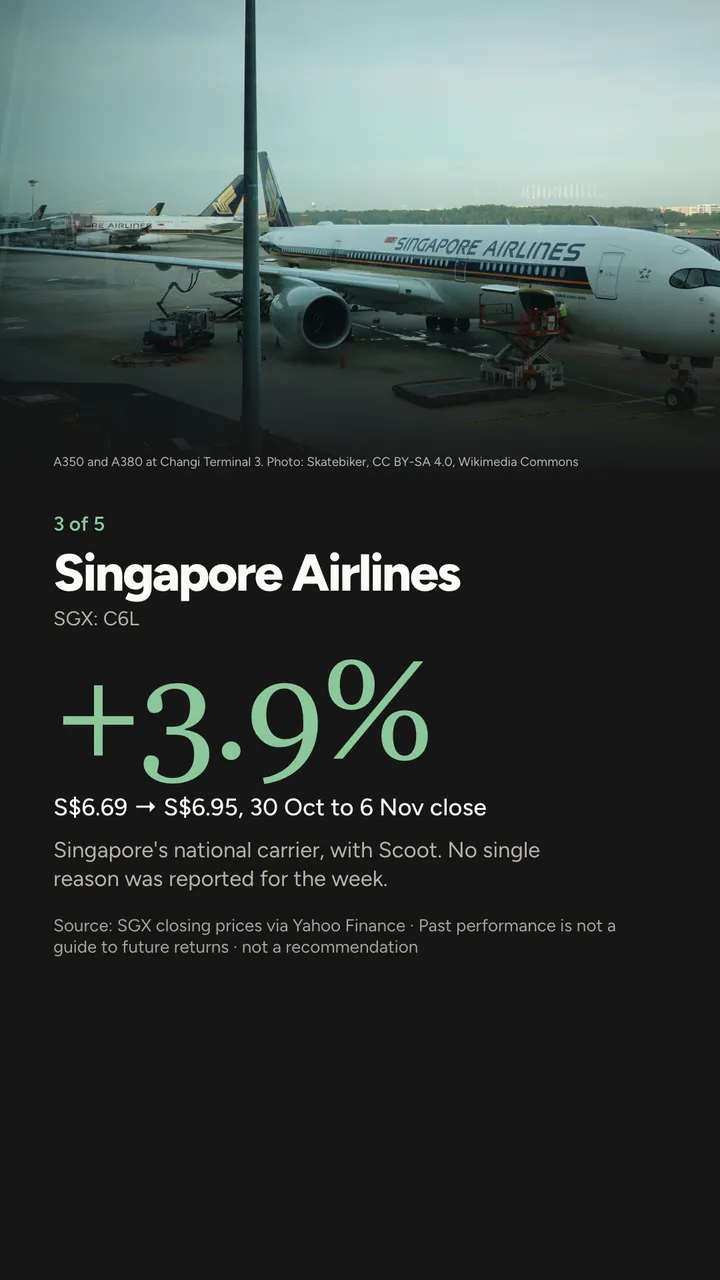
Singapore Airlines (SIA) flies under its own name and as Scoot. No single reason was reported for its rise.
I'm going to be careful here, because this is the tempting one. Oil fell sharply that week: US crude by 12% and Brent, the international benchmark, by 16%, CNBC reported. Jet fuel is a big cost for an airline, so the two sit naturally together in a sentence. But no report I could read tied SIA's rise to oil, so I'm putting them side by side, not calling one the cause.
The arithmetic
- S$1,000 of SIA shares would have become about S$1,038.86.
- One board lot: S$669 became S$695, a gain of S$26 before fees.
What this means for you: two things happening in the same week is not the same as one causing the other. It's worth asking "who said so?" before believing a neat explanation, including mine.
FLCT rose 3.4%, and its results came at the end
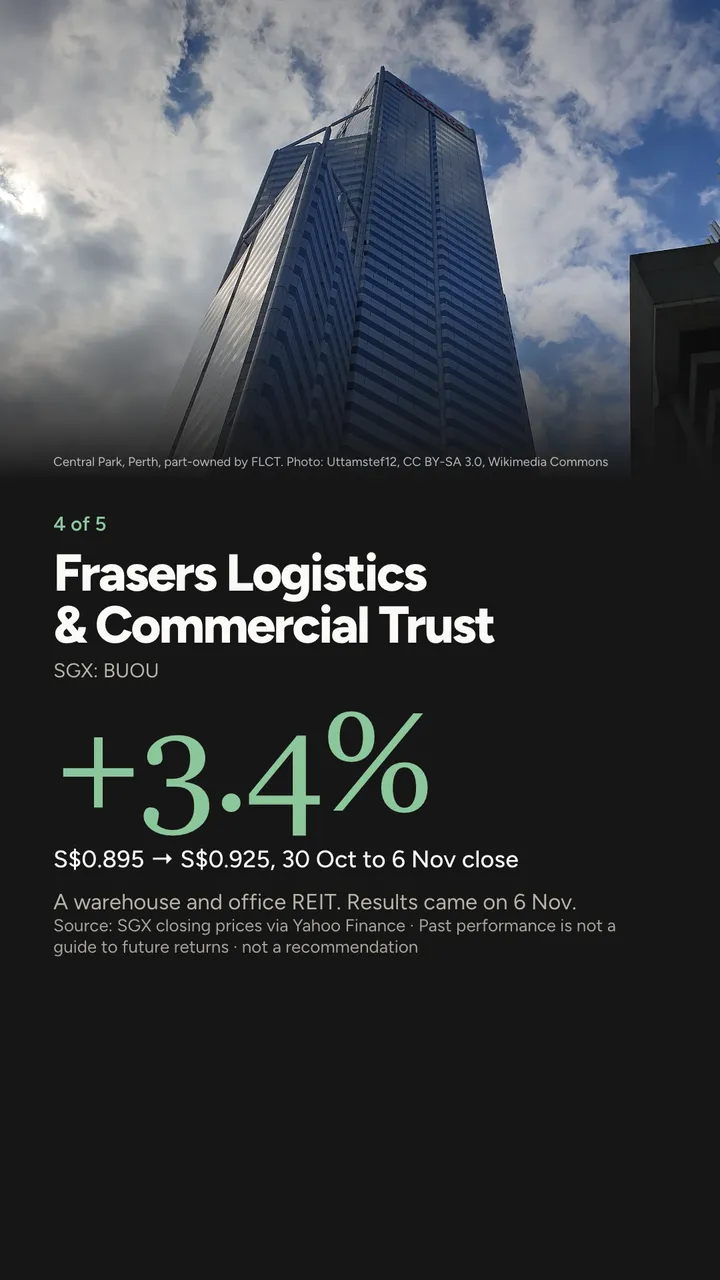
Frasers Logistics & Commercial Trust (FLCT) is a REIT, a real estate investment trust, that owns warehouses and offices. It pays out most of its rental income to unitholders.
Its units reached S$0.925 on Thursday. Its full-year results came on Friday morning, and The Edge Singapore reported them flat at 92.5 cents shortly after the open, so the results don't explain the week's rise. No single reason was reported for it.
Reading the results
For the year to 30 September, its distribution per unit (DPU, the cash paid for each unit) was 5.9 cents, down 0.8%. Using that figure:
- Yield: 5.9 cents divided by S$0.925 is about 6.4%. It's backward-looking, it tells you what was paid.
- Net asset value (NAV): S$1.07 a unit, down from S$1.10. The portfolio's valuation came in 2.3% below its carrying value. S$0.925 divided by S$1.07 is about 0.86, so the units trade at about 86% of NAV.
The next payout is 2.95 cents a unit. The ex-distribution date is 18 November: buy on or after that date and you don't get it. On 1,000 units that's S$29.50.
The arithmetic
- S$1,000 of FLCT units would have become about S$1,033.52.
- One board lot: S$89.50 became S$92.50, a gain of S$3, which a minimum brokerage fee would more than cover.
What this means for you: a small percentage on a low-priced unit can be very few dollars. Check the fee against the gain, not just the percentage.
Keppel DC REIT rose 2.8%, along with other REITs
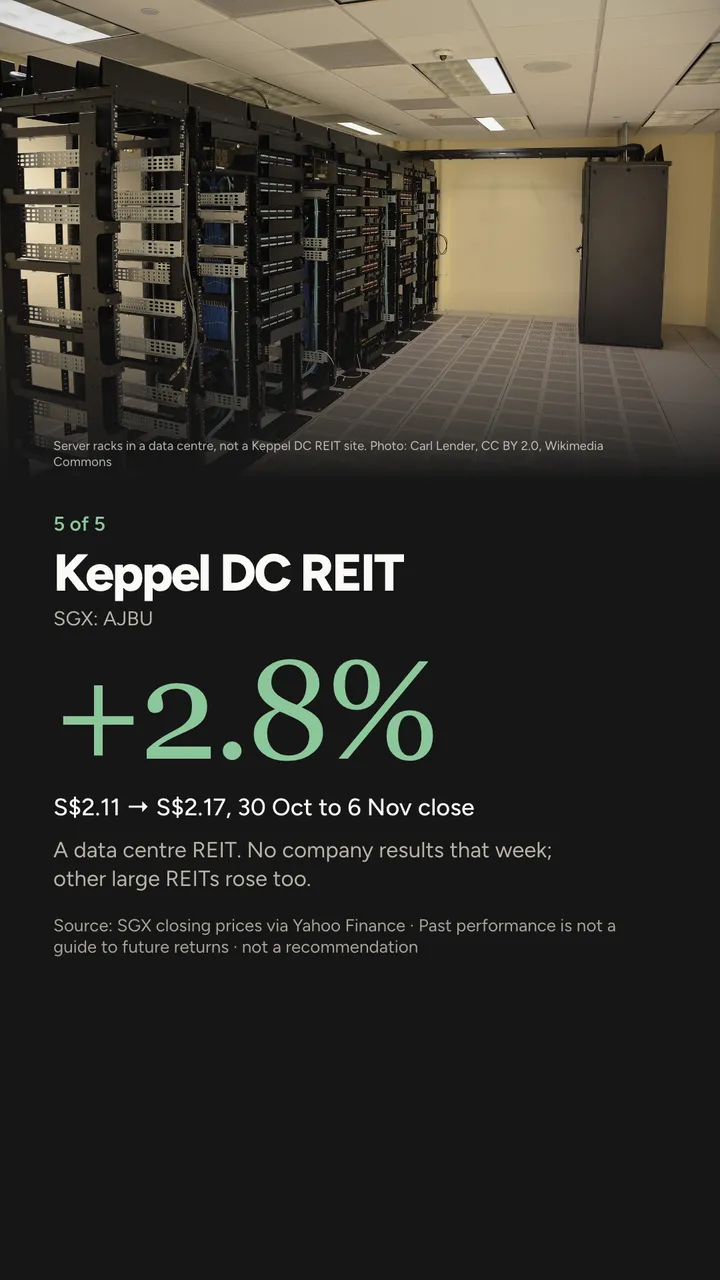
Keppel DC REIT owns data centres, the buildings full of servers behind your banking app. It had no results that week. Its newsroom shows a board appointment and routine filings. Other large REITs rose too: CICT and Mapletree Pan Asia Commercial Trust 2.6% each, CapitaLand Ascendas 2.3%. On 5 November a column in The Business Times said REITs were starting to look like shelter as tech and banks fell, while warning that the same bond-yield worry could reach them.
The arithmetic
- S$1,000 of Keppel DC units would have become about S$1,028.44.
- One board lot: S$211 became S$217, a gain of S$6 before fees.
A data centre landlord is not a chip maker
Singapore's chip-related stocks had a terrible week: The Business Times reported AEM down 20%, UMS 18.9% and Frencken 16.2%. Keppel DC rose. Both are "tech" in casual conversation, but one sells equipment and the other collects rent on buildings. They can still be hit by the same worries, just not always in the same week.
What this means for you: a label like "tech" covers very different businesses. It's worth checking how a company actually earns its money.
The week in one table
| Stock | Ticker | Close, 30 Oct to 6 Nov | Change | S$1,000 or US$1,000 became |
|---|---|---|---|---|
| DFI Retail Group | SGX: D01 | US$3.49 to US$3.73 | +6.9% | US$1,068.77 |
| Jardine Matheson | SGX: J36 | US$57.67 to US$60.84 | +5.5% | US$1,054.97 |
| Singapore Airlines | SGX: C6L | S$6.69 to S$6.95 | +3.9% | S$1,038.86 |
| Frasers Logistics & Commercial Trust | SGX: BUOU | S$0.895 to S$0.925 | +3.4% | S$1,033.52 |
| Keppel DC REIT | SGX: AJBU | S$2.11 to S$2.17 | +2.8% | S$1,028.44 |
| Straits Times Index | STI | 5,376.74 to 5,179.17 | -3.7% | about S$963.25 |
All before fees, dividends and currency moves. One week tells you what happened, and nothing about what comes next.
If you only remember three things
- The STI is weighted by size, so three banks can pull it down in a week when half its stocks rise.
- "No single reason was reported" is a real answer. Be wary of tidy explanations nobody actually reported.
- A yield is last year's payout divided by today's price, and the ex-distribution date decides who gets the next one.
How I keep track of this
The index tells me about the index. What I want to know is what my own money did, which needs everything in one place: savings, CPF, the flat, and any shares, in proportion.
In Sum, SGX shares and REIT units in your CDP account sit inside your net worth beside your bank accounts, CPF and HDB flat. Stocks and CDP holdings are on the Essential plan; live prices, profit and loss, and dividends are on Pro. If you hold US shares too, the Dow had a much stranger week: the Dow's top five for the same week. Last week's falls are in why the STI fell, 26 to 30 October.
I showed Rachel the first section. She corrected "weighted" to a sentence a Secondary 2 student could read, and asked if the marks for this one were also out of 100.
Talk soon, Brandon

Sum is launching in Singapore soon.
Your banks, cards, CPF and HDB flat, added up into one net worth. Statements sorted, card caps tracked, bills remembered.
Brandon · Finance team, Sum
Brandon is on Sum's finance team in Singapore. Brandon reads the CPF Board, IRAS and MAS updates so you don't have to, and turns our carousels into the longer version. Questions, corrections or something to share? Email Brandon at [email protected].
Got something interesting to share?
A money story, a question, something we got wrong, or a tip other Singaporeans should hear. Reach out to me at [email protected], or leave your email and I'll write to you.
Sources: Yahoo Finance, Straits Times Index price history; The Business Times, Singapore tech stocks plunge as Nasdaq bloodbath spills into region, 6 Nov 2026; The Business Times, Singapore stocks end flat as Democrats win in US midterm elections, 4 Nov 2026; The Business Times, Singapore shares end lower as local banks decline; STI falls 1.4%, 2 Nov 2026; The Business Times, Singapore stocks extend decline; STI down 0.7%, 3 Nov 2026; The Business Times, Stocks to watch: DBS, CAReit, Starhill Global Reit, Koh Brothers Eco Engineering, 5 Nov 2026; The Business Times, Stocks to watch: OCBC, IHH Healthcare, FLCT, SingPost, Koh Brothers Eco Engineering, 6 Nov 2026; The Business Times, DFI Retail Group shares up 5% after rise in Q3 underlying profit, 27 Oct 2026; The Business Times, DBS downgrades JMSEA to 'hold', deems parent Jardine Matheson a better buy, 21 Oct 2026; CNBC, Nasdaq rebounds 1% following worst session in 18 months as traders snap up tech shares, 6 Nov 2026; The Edge Singapore, FLCT reports FY2026 DPU of 5.9 cents, 0.8% lower y-o-y, 6 Nov 2026; Frasers Logistics & Commercial Trust, distribution timetable; Keppel DC REIT, newsroom; The Business Times, As tech and banks take a beating, S-Reits look like safe shelter - but watch out, 5 Nov 2026.
Any app screens shown use sample data, not a real person's. Sum is free to start; some features need a paid plan.
Information only, not financial advice.