Which card for which trip? JB, Bangkok, Bali, Tokyo and Seoul
What Singapore cards pay in ringgit, baht, rupiah, yen and won as at Nov 2026, the 3.25% overseas fee, the caps, and why paying in SGD earns less.

A few Sundays ago, after dinner at my parents' place, my sister put her phone on the table and said she'd booked Da Nang for December with two friends from the hospital. Then she asked the question I get asked more than any other.
"Which card should I bring?"
"Depends where," I said.
"I just told you where."
My dad looked up from the news. He and my mum were going to JB for a weekend soon. "Same card can or not?" My mum didn't ask anything. She just mentioned, to nobody in particular, that some people have been talking about a Japan trip for a long time.
So I turned over the envelope with her shopping list on it and drew three columns: JB, Da Nang, Tokyo. It took longer than I expected, because almost nothing stayed the same from one column to the next. A card that looked generous in ringgit went quiet in yen. A card with no fee anywhere paid less than one with a fee. My sister took a photo of the envelope and read it twice. "So the card also must check the map."
Pretty much. Card terms are written by currency, and most people pick a card for "overseas", as if overseas were one place.
This post is that envelope, tidied up: the fee first, then the trips Singaporeans usually take, then the two things that quietly change the numbers. Every rate comes from the banks' own terms, as at 6 November 2026. Each list runs A to Z. Miles and cashback can't be ranked against each other, so I'm not going to pretend one card wins.
Most cards add 3.25% to what you spend overseas
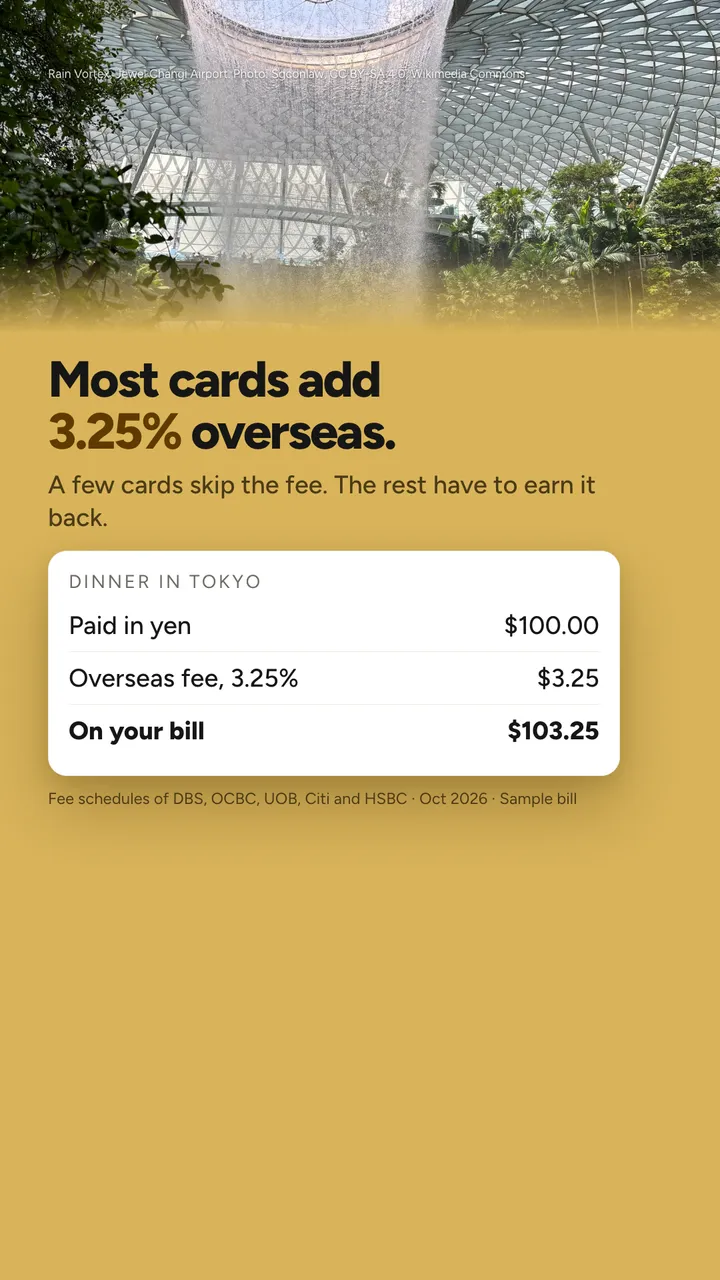
When you pay in a foreign currency, your bank adds a foreign currency fee. At DBS, OCBC, UOB, Citi and HSBC it comes to as much as 3.25%. It's usually two pieces stacked together: about 1% from the card network (Visa or Mastercard) and 2.25% from the bank.
So a card earning miles or cashback overseas is paying you that rate and charging you 3.25% alongside it. Mari and GXS, on these lists, skip the fee. The rest have to earn it back.
Here's how to compare the two. Say Mei Ling spends $1,200 on a trip. This is made up, but it's a pretty ordinary holiday.
| Fee-free card at 1.5% back | Card at 2.4 miles per $1, 3.25% fee | |
|---|---|---|
| Fee | $0 | $1,200 × 3.25% = $39 |
| Earned | $1,200 × 1.5% = $18 | $1,200 × 2.4 = 2,880 miles |
The second column is, in effect, buying 2,880 miles for $39. That's $39 ÷ 2,880, or about 1.35 cents a mile, and she gives up the $18 as well. Whether that's a good price depends entirely on what she'd do with the miles. Someone with a flight in mind may be happy with it. Someone with miles expiring in a drawer (I know a family like this) may not.
What this means for you: it's worth finding the fee on your own card's schedule before you go. Then divide the fee by the miles to get your cost per mile, and you'll have a number you can actually compare.
A weekend in JB
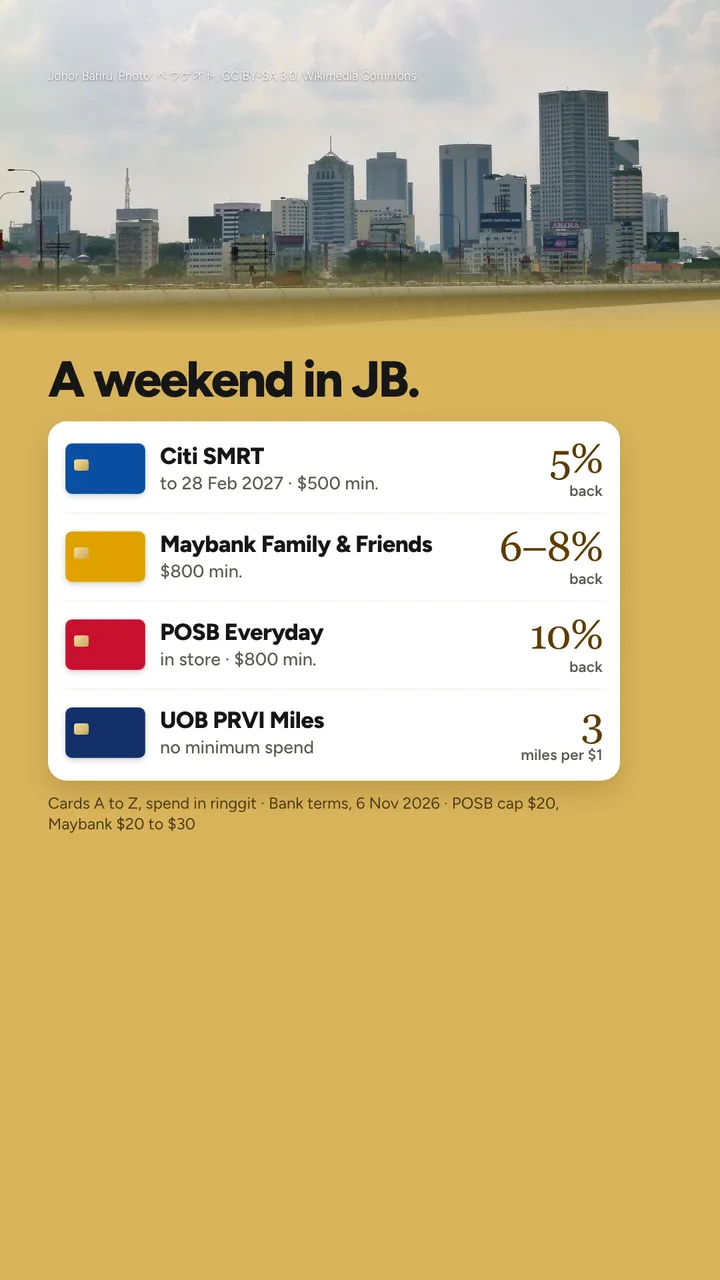
Look at the small print under each name. Three of these four need a minimum spend, and that's the whole story of this slide.
- Citi SMRT: 5% on ringgit spending, a promotion that runs to 28 February 2027 and has its own terms, with a $500 minimum.
- Maybank Family & Friends: ringgit and rupiah spending is a bonus category you get automatically, at 6% with $800 of spend in a calendar month and 8% with $1,600, capped at $20 or $30.
- POSB Everyday: 10% in store in ringgit with $800 of spend in a calendar month, with the bonus capped at $20. It lands within 90 days of the month's end, so don't go looking for it the Monday after.
- UOB PRVI Miles: 3 miles per $1, no minimum, no cap.
Say Jun Wei spends $300 in ringgit, in store, on a weekend in JB. Also made up.
| Card | In a month he clears the minimum | In a month he doesn't |
|---|---|---|
| Maybank Family & Friends | $300 × 6% = $18 | $300 × 0.22% = $0.66 |
| POSB Everyday | $300 × 0.3% = $0.90, plus the $20 bonus cap = $20.90 | $300 × 0.3% = $0.90 |
| UOB PRVI Miles | $300 × 3 = 900 miles | The same 900 miles |
A weekend in JB doesn't clear $800 on its own, so those rates depend on what else went on the card that month. And on POSB, the 9.7% bonus reaches its cap at $20 ÷ 9.7%, about $206 of spending, so the last $94 of Jun Wei's weekend earned only the base rate. Any of these cards may also add the foreign currency fee: at 3.25%, that's $300 × 3.25% = $9.75.
What this means for you: before a JB trip, look at how far you already are from the card's minimum this month. It's the difference between $18 and 66 cents on the same weekend.
Bangkok or Da Nang
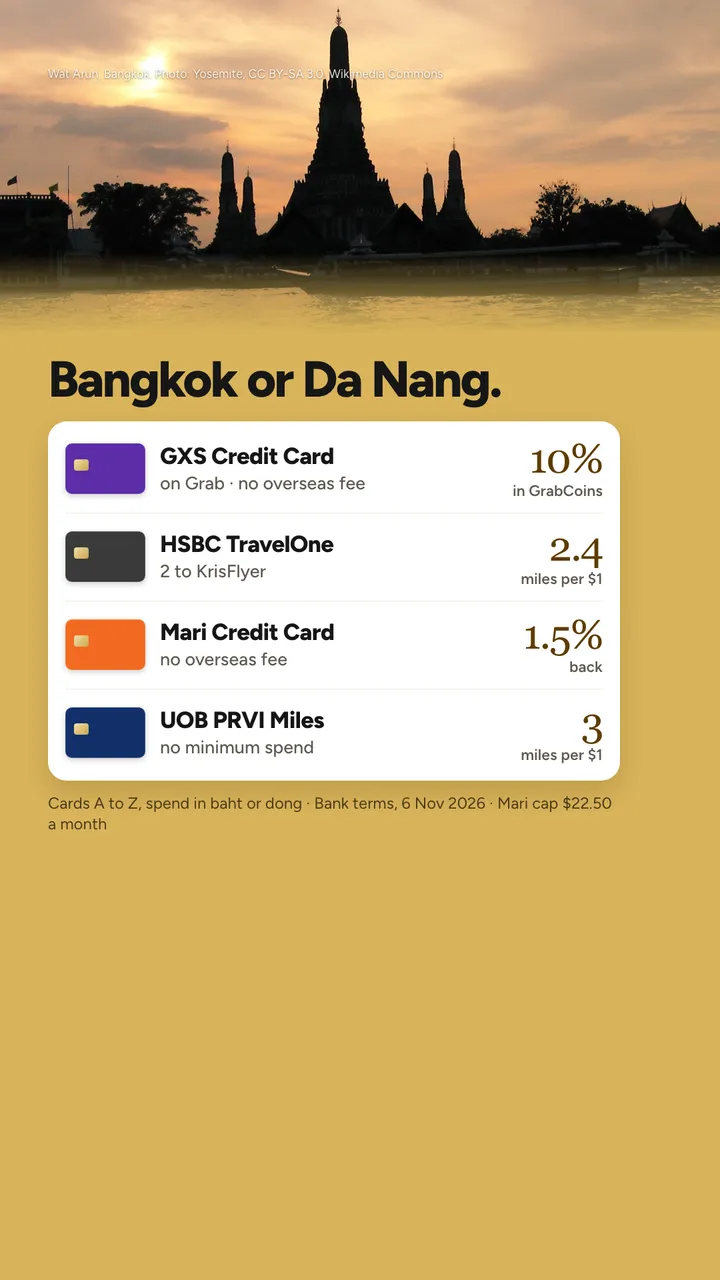
The GXS line needs reading slowly. The 10% is only on Grab, only outside Singapore, and it's paid in GrabCoins. GXS's page is clear that GrabCoins are part of Grab's loyalty programme and have no cash value, and its own illustration puts 500 GrabCoins at about S$1. There's no minimum, no cap and no foreign exchange fee. So $80 of Grab rides and food in Da Nang earns about $8 worth of coins to use on Grab, not $8 in your bank account. The card is still in beta, and it has a $196.20 annual fee, with the first year at $0 if you're approved by 31 December 2026.
The HSBC line has two numbers for a reason. TravelOne earns 6 points per $1 in foreign currency. Many of its airline partners take 25,000 points for 10,000 miles, which gives 2.4. KrisFlyer takes 30,000, which gives 2. The sum is 6 × 10,000 ÷ 30,000 = 2. So the rate depends on where you plan to send the points.
The UOB line has a condition. The 3 miles is for spending in baht or dong with a merchant whose payment gateway is in that country. Book the same Bangkok hotel through a site that processes in Singapore, and the terms count it as local. At 3 miles per $1, the 3.25% fee on $100 is $3.25 ÷ 300 miles, or about 1.08 cents a mile.
What this means for you: a list like this mixes three kinds of reward: cash, miles and coins that only work in one app. It's worth deciding which one you'd actually use before you look at the percentages.
Bali or Jakarta
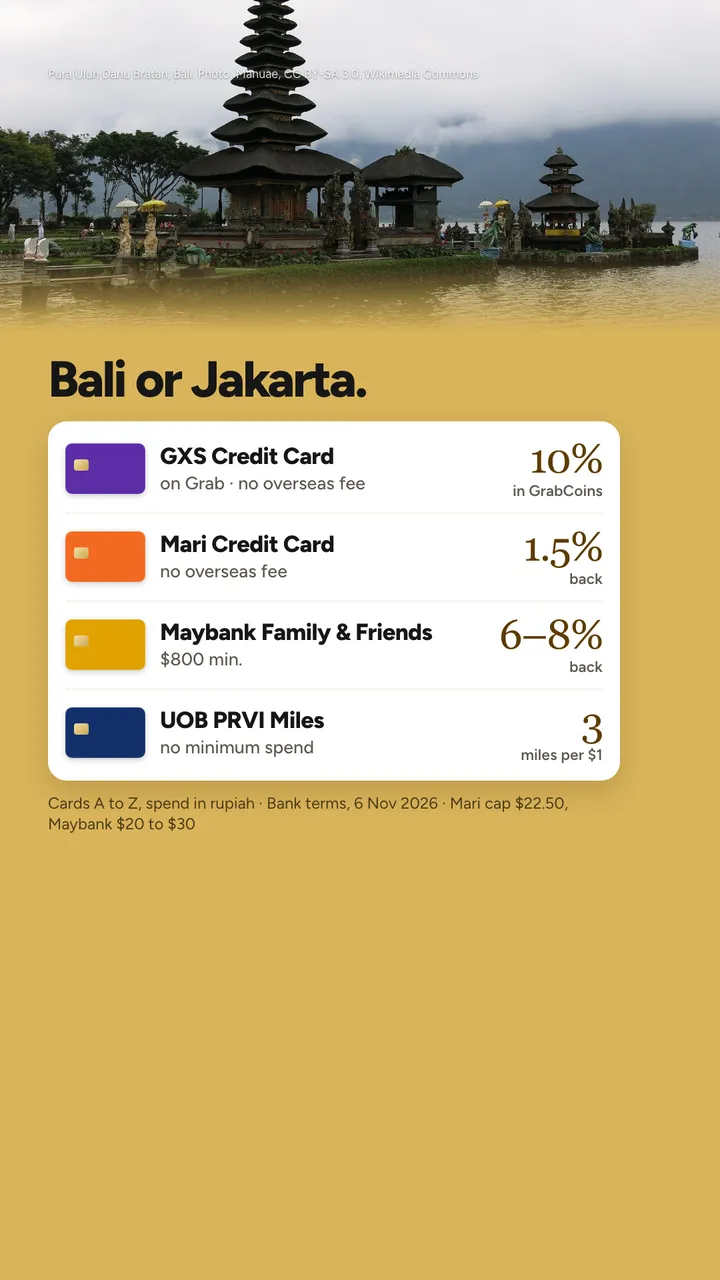
The Maybank card comes back here, because its automatic bonus covers rupiah as well as ringgit. It's a sixth category on top of the five you pick.
The interesting part of Indonesia is the size of the bills. A villa for a week can easily be the biggest single charge of a trip, and that's where caps start to matter. Say Priya spends $2,000 in rupiah on a week in Bali. Made up, as usual.
| Card | Earned | Foreign currency fee |
|---|---|---|
| Mari | First $1,500 × 1.5% = $22.50, then the overseas rate stops for the month | $0 |
| UOB PRVI Miles | $2,000 × 3 = 6,000 miles | $2,000 × 3.25% = $65 |
On Maybank, $2,000 in one calendar month would reach the $1,600 level: 8%, capped at $30. That cap is reached after $30 ÷ 8% = $375 of spending. Past that point the bonus stops, however big the villa is.
Mari's overseas rate is a promotion that runs to 31 December 2027.
What this means for you: high percentages on this list usually come with low caps. On one large bill, a capped 8% can pay about as much as an uncapped rate that looks far smaller. Dividing the cap by the rate tells you where it stops.
Tokyo, Osaka or Seoul
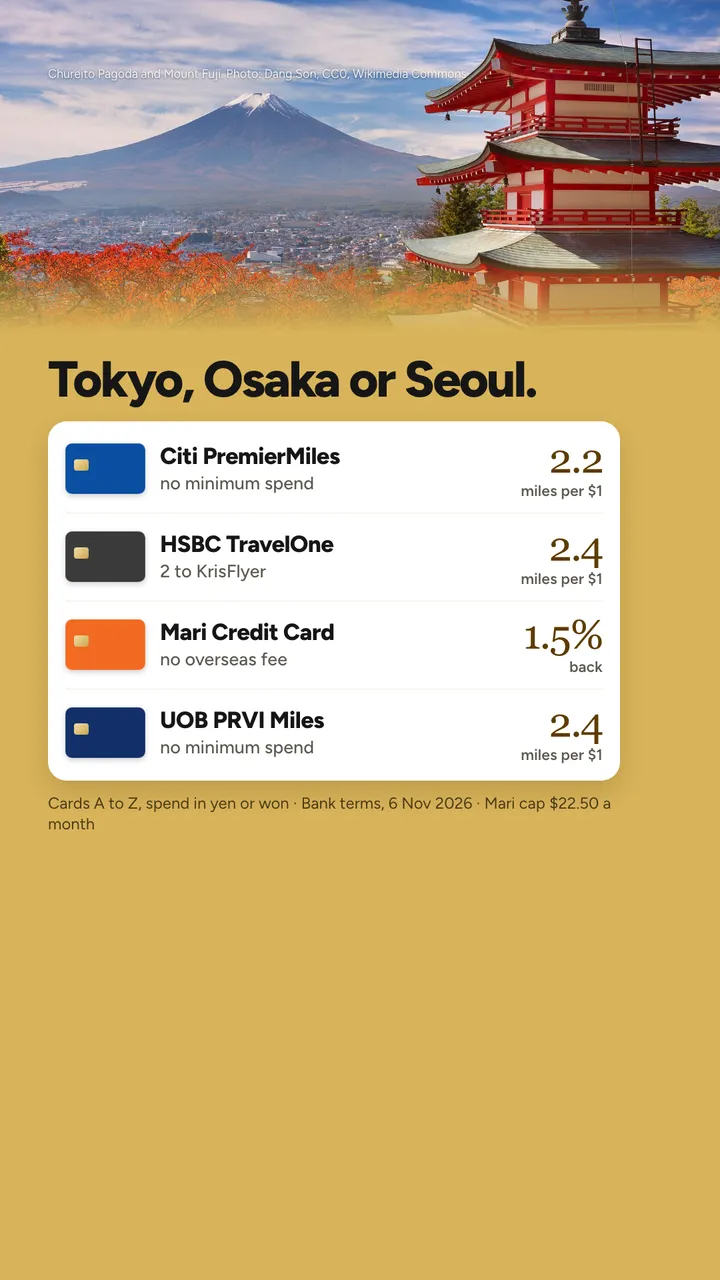
Everything regional has gone. UOB PRVI Miles drops from 3 to 2.4, because yen and won aren't among its four Southeast Asian currencies. What's left is the plain overseas rate.
Take $1,500 spent in yen, before the fee:
| Card | Sum | Earned |
|---|---|---|
| Citi PremierMiles | $1,500 × 2.2 | 3,300 miles |
| HSBC TravelOne | $1,500 × 2.4 (or × 2 as KrisFlyer) | 3,600 miles (3,000 as KrisFlyer) |
| Mari | $1,500 × 1.5% | $22.50, no fee |
| UOB PRVI Miles | $1,500 × 2.4 | 3,600 miles |
On the three miles cards the fee would be up to $1,500 × 3.25% = $48.75. Moving the miles can also cost something: Citi charges $27.25 per transfer to an airline, for example, so it's worth checking your own card's terms for this too.
What this means for you: if you mostly fly one airline, compare the rates in that airline's miles, not the headline. The 2.4 and the 2 above are the same HSBC card.
Asked to pay in SGD? Say no
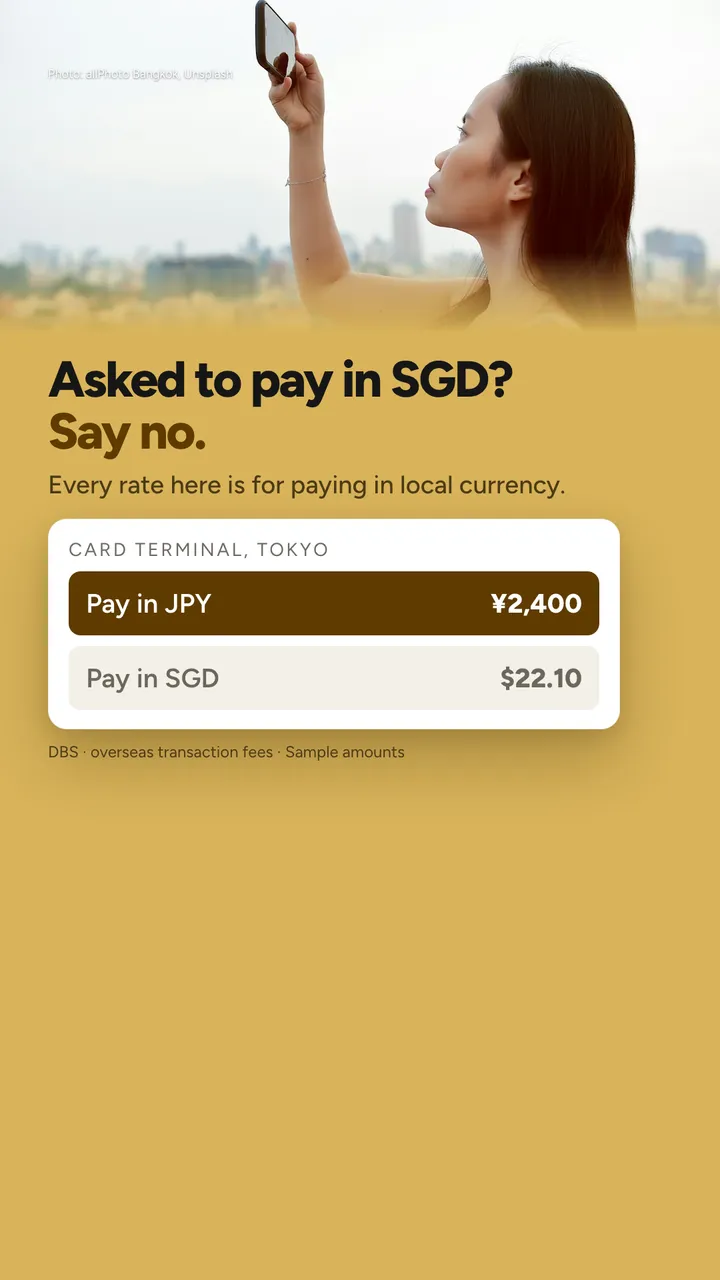
I've told my own terminal story in Tokyo, so I'll keep this short. When a terminal or a website offers to charge you in Singapore dollars, that's dynamic currency conversion. It feels safe, because you can see the exact amount. But every rate in this post assumes you said no.
Three things change when you say yes:
- The rate you earn. Your card treats it as SGD spending. UOB PRVI Miles drops to 1.4, Citi PremierMiles to 1.2. Currency bonuses like the ringgit ones don't apply, because it isn't ringgit any more, and Mari's overseas cashback is for foreign currencies only.
- The exchange rate. The shop or its payment provider sets it, not your bank or the card network.
- The fee. It doesn't disappear. DBS and UOB list a 1% fee on SGD charges processed overseas.
On a $1,000 hotel bill in Bangkok, UOB PRVI Miles in baht earns $1,000 × 3 = 3,000 miles. In SGD, it's $1,000 × 1.4 = 1,400. That's 1,600 miles gone with one tap, before you count whatever is inside the hotel's rate.
What this means for you: pick the local currency on the terminal, and check the currency menu on hotel and airline sites too.
Some rates stop at a cap
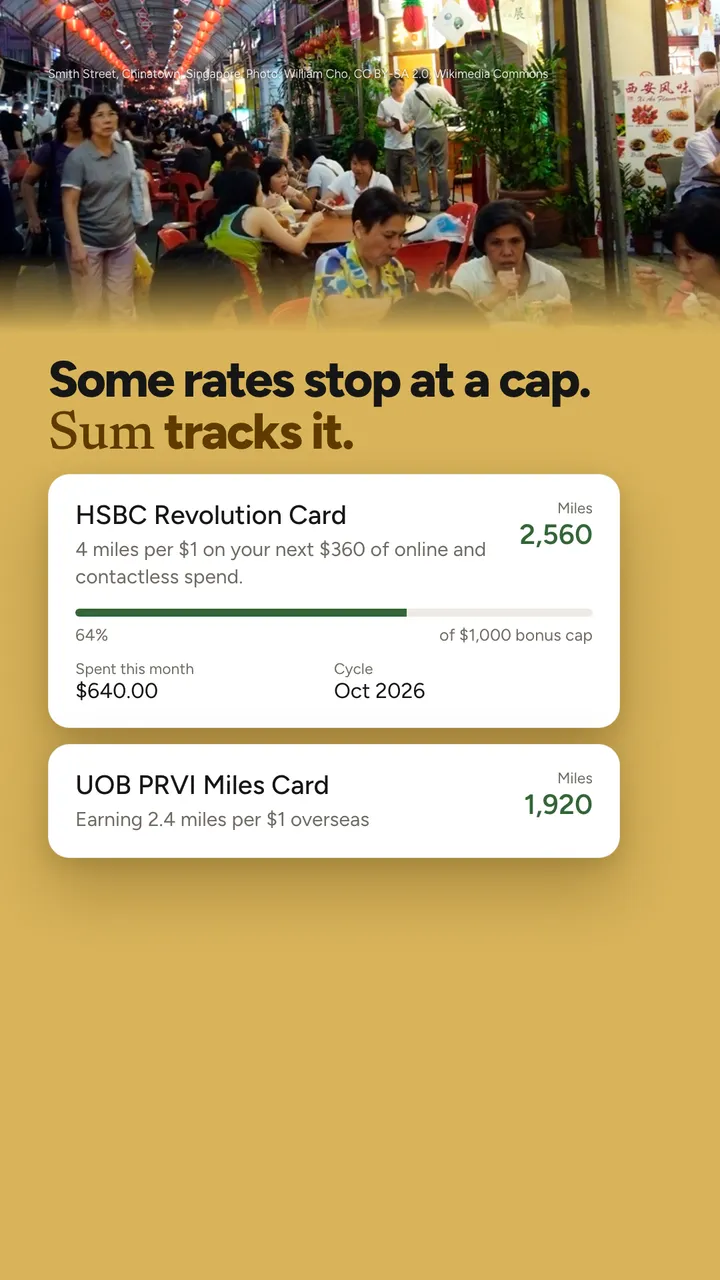
Here are the limits from the small type, in one place, with how much spending it takes to reach each one.
| Card | Cap | Reached after |
|---|---|---|
| POSB Everyday, ringgit | $20 of bonus a month | $20 ÷ 9.7% = about $206 |
| Maybank Family & Friends | $20 at the 6% level, $30 at 8% | $333.34 or $375 |
| Mari, overseas | $22.50 a month | $1,500 |
| UOB PRVI Miles | None | Never |
Nothing tells you when you've hit a cap. The card just starts earning the base rate, and you find out weeks later, if you look.
On the slide (sample data), $640 of a $1,000 bonus cap is 64%: $640 × 4 = 2,560 miles so far, with $1,000 − $640 = $360 left at 4 miles per $1.
What this means for you: on a trip, the card you started with may not be the one that earns the most by day four. It's worth checking where you stand before the big bill, not after it.
If you only remember three things
- The rate depends on the currency, not "overseas". The same card can pay 3 miles in baht and 2.4 in yen, or 10% in ringgit and its base rate elsewhere.
- Weigh the rate against the fee and the cap. Most cards add 3.25%, and most high percentages stop early.
- Pay in local currency. Every rate here depends on it.
How I keep track of this
Part of my job at Sum is reading these terms so the card optimiser matches them. I still don't trust my memory on a trip.
The card optimiser is on the free plan, and Sum is free to start. For each card in Sum's catalogue, it shows what you've spent this cycle, how far you are from the minimum or the cap, and what the card has earned. When I'm back, I import the card statement on the 1st of the month with my kopi, Sum sorts every line, and the trackers catch up. The catalogue covers most of the cards here, but honestly not all of them yet: Mari and GXS aren't in it.
If you'd rather compare cards on your own spending first, our cashback and miles calculator works out what each would earn on a typical month, with minimum spend and caps applied.
These rates move, by the way. Citi's ringgit offer ends on 28 February 2027, and GXS's first-year fee offer ends on 31 December 2026. If you spot one that has changed, tell me at [email protected] and I'll fix it.
My sister's envelope is still in the family chat. She's going to Da Nang next month, and I've been told that the rest of us are not to ask which card she took. My parents' JB weekend has been pencilled in. And the Tokyo column is the only one on that envelope with no dates beside it, which my mum has pointed out twice.
Talk soon, Brandon
Questions people ask
How much do Singapore credit cards charge on overseas spending?
DBS, OCBC, UOB, Citi and HSBC list a foreign currency fee of up to 3.25%, usually a 1% card network charge plus 2.25% from the bank. On a $100 dinner that is $3.25. The Mari and GXS credit cards list no foreign exchange fee.
Why does UOB PRVI Miles earn 3 miles in Bangkok but 2.4 in Tokyo?
Its terms pay 3 miles per $1 on spending in Indonesian rupiah, Malaysian ringgit, Thai baht and Vietnamese dong, and 2.4 miles per $1 on other foreign currencies. Yen and won fall in the second group.
Should I pay in SGD or the local currency overseas?
Every rate in this post is for paying in local currency. Charged in SGD, the purchase usually earns the card's local rate instead, the shop sets the exchange rate, and DBS and UOB list a 1% fee on SGD charges processed overseas.
Are GrabCoins the same as cashback?
No. GXS's page says GrabCoins are part of Grab's loyalty programme and have no cash value. Its own illustration values 500 GrabCoins at about S$1, spent within Grab.
Try the numbers yourself

Sum is launching in Singapore soon.
Your banks, cards, CPF and HDB flat, added up into one net worth. Statements sorted, card caps tracked, bills remembered.
Brandon · Finance team, Sum
Brandon is on Sum's finance team in Singapore. Brandon reads the CPF Board, IRAS and MAS updates so you don't have to, and turns our carousels into the longer version. Questions, corrections or something to share? Email Brandon at [email protected].
Got something interesting to share?
A money story, a question, something we got wrong, or a tip other Singaporeans should hear. Reach out to me at [email protected], or leave your email and I'll write to you.
Sources: MariBank: Mari Credit Card, read 7 Nov 2026; GXS Bank: GXS Credit Card, read 7 Nov 2026; UOB: PRVI Miles Card; UOB: Terms governing the UOB PRVI Miles Card (PDF); HSBC: TravelOne Credit Card; Citi: PremierMiles Card; Citi: Citi SMRT Card; POSB: Everyday Card; Maybank: Family & Friends Card; DBS: Overseas transaction fees.
Any app screens shown use sample data, not a real person's. Sum is free to start; some features need a paid plan.
Information only, not financial advice.