UOB One card review: how $600, $1,000 and $2,000 a month really pay
How the UOB One Card pays as at 1 Nov 2026: S$60, S$100 or S$200 a quarter, the 10-purchase rule, extra cashback on Grab and groceries, and the fee.
- Up to 3.33% at the bottom of each tier
- Extra cashback on Grab, Shopee and groceries
- Singapore Power bills earn
- One short month loses the quarter
- The rate falls between tiers
- Needs 10 purchases every month
Ethan's own opinion of the card as reviewed below. His full rating is at the end.
The UOB One doesn't pay a percentage of what you spend. It pays a fixed amount each quarter, earned by three months in a row of hitting a spend level and a purchase count. The catch is that one short month can cost the whole quarter.
Here's how the cashback works, the rules on quarters and the 10 purchases, the extra cashback, the fees, and a worked year you can redo with your own numbers.
The UOB One at a glance
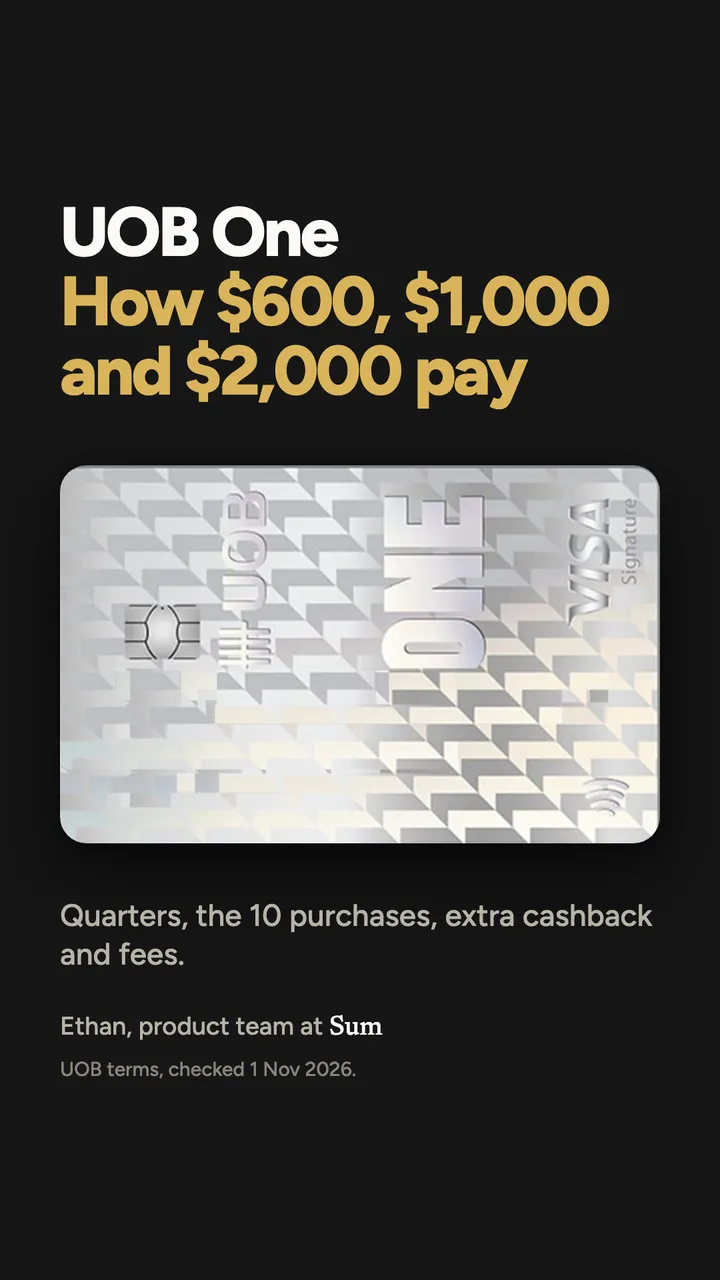
| UOB One Card | |
|---|---|
| Minimum income | $30,000 a year (Singaporeans and PRs aged 55 and under), $15,000 (56 and above), $40,000 (foreigners), as listed on the UOB product page |
| Annual fee | $196.20, first year waived |
| Supplementary cards | First card free; second onwards $98.10 |
| Quarterly cashback | $60, $100 or $200, for $600, $1,000 or $2,000 a statement month, with at least 10 purchases each month |
| Extra cashback | On selected merchants, capped at $120 a statement month |
| Quarter | 3 statement months from your card's opening month |
| Paid | In the statement after the quarter ends |
| Most a year | $2,240 ($800 quarterly plus $1,440 extra), per the product page |
| Foreign currency fee | 3.25% (UOB fee schedule, checked 15 Oct 2026) |
Figures from the UOB One terms (updated 22 Sep 2025, ver 2.1), the UOB One FAQ (updated 1 Nov 2026) and the product page, checked 1 Nov 2026. Promotions, including a time-limited overseas one on the product page, are left out here because they change often.
How does the UOB One cashback work?
Clause 3.1 of the terms sets three tiers. For each of the three statement months in a quarter, you need:
| Tier | Each statement month | Quarterly cashback |
|---|---|---|
| 1 | $600 to $999.99, at least 10 purchases | $60 |
| 2 | $1,000 to $1,999.99, at least 10 purchases | $100 |
| 3 | $2,000 or more, at least 10 purchases | $200 |
So it's per month and per quarter at once: the spend level is checked month by month, and the cashback is paid for the quarter.
The "up to 3.33%" in UOB's ads comes from the bottom of each tier: $600 × 3 = $1,800 of spending for $60, and $60 ÷ $1,800 = 3.33%. The same is true at $1,000 ($100 ÷ $3,000) and $2,000 ($200 ÷ $6,000).
Above the bottom of a tier, the cashback stays the same, so the rate falls:
| Each month | Quarter's spend | Cashback | Rate |
|---|---|---|---|
| $600 | $1,800 | $60 | 3.33% |
| $900 | $2,700 | $60 | 2.22% |
| $1,000 | $3,000 | $100 | 3.33% |
| $1,500 | $4,500 | $100 | 2.22% |
| $2,000 | $6,000 | $200 | 3.33% |
| $3,000 | $9,000 | $200 | 2.22% |
Spending counts by statement month, by the date a purchase posts, not the date you made it (FAQ questions 1 and 8). Supplementary cards' purchases count too, under the terms' definition of card transactions.
Bottom line: the card pays for steady spending just above a tier. A month of $1,400 earns the same as a month of $1,000.
The 10 purchases, and the month that costs a quarter
Each statement month needs at least 10 card transactions, as well as the spend. And the quarter pays at the tier you met in all three months.
Say someone spends $1,200, $1,150 and $980 across a quarter, with plenty of purchases each month. The third month is under $1,000, so the quarter pays at tier 1: $60, not $100. That $20 shortfall costs $40.
With only 9 purchases in a month, or under $600, the quarter pays nothing (clause 3.2). The exception is the first quarter after you get the card, which can be pro-rated: one-third of the cashback if you only qualify in the third month, two-thirds if in the second and third. After that, the minimum must be met in full.
There's also a base cashback of 0.03% for the year, but only if you earned no quarterly cashback at all in that calendar year (clause 3.6). On $12,000 of spending, that's $3.60.
Bottom line: know your statement date. That's when each month closes.
Quarters start from your card, not from January
The terms define a quarter as three consecutive statement months, starting from the card account's opening date (clause 2). UOB's FAQ gives an example: a card issued in February has quarters of Feb to Apr, May to Jul, Aug to Oct and Nov to Jan.
Two people with UOB One cards can be in different quarters in the same month. The FAQ says your statement shows your qualifying quarters.
Bottom line: a quiet month in the same quarter can undo a big one.
The extra cashback on Grab, Shopee and groceries
Once you've qualified for a quarter's cashback, you also earn additional cashback on "Selected Merchant Transactions" (clause 4.1), worked out on each month's total and capped at $120 per statement month (clause 4.3):
| Merchant | Tier 1 ($600) | Tier 2 ($1,000) | Tier 3 ($2,000) |
|---|---|---|---|
| Grab (not wallet top-ups) | 5% | 5% | 6.67% |
| McDonald's | 5% | 5% | 6.67% |
| Shopee Singapore (not ShopeePay) | 5% | 5% | 6.67% |
| SimplyGo bus and train rides | 5% | 5% | 6.67% |
| Supermarkets (merchant code 5411) | none | 2.67% | 4.67% |
| Shell | none | none | 1.67% |
| Singapore Power | 1% | 1% | 1% |
UOB's ads add the 3.33% to these, which is where the "up to 10%" comes from. The quarterly cashback is fixed, and these are on top.
Groceries count only at tier 2 and above, and only at merchants coded as grocery stores or supermarkets. A shop's code is set by its bank, not UOB.
Singapore Power bills earn the 1% when charged to the card directly. The product page notes that payments through AXS don't count.
Bottom line: at tier 1, a monthly supermarket run earns no extra. Tier 2 is where the card starts paying for groceries.
What doesn't earn cashback, or count to the minimum
The exclusions in clause 6 earn nothing and don't count towards the monthly spend. As at 1 Nov 2026 they include: GrabPay and ShopeePay wallet top-ups; insurance, rent, tax, school and university fees, hospitals, parking, gambling, charities and government services (by merchant category code); payments through AXS, EZ-Link, CardUp, iPayMy, SingPost SAM and a list of brokers and payment services; instalment plans, cash advances, fees and interest.
UOB's FAQ (question 6) confirms insurance under MCC 6300 neither earns nor counts towards the minimum. Utilities aren't on this card's list, which is why Singapore Power can earn.
Bottom line: a big insurance premium won't help you reach $600 in the month it's due.
The fees, and when cashback arrives
The annual fee is $196.20, waived for the first year (product page). The first supplementary card is free. The second onwards is $98.10.
Cashback is credited in the statement after the quarter ends (clause 3.5), and it can only be used against the main cardholder's spending in the following statement month (clause 3.7). Unused cashback is forfeited 2 calendar years after the quarter it was awarded for, or when the card is cancelled (clause 3.9).
Bottom line: cancel before the last quarter's cashback has been credited and used, and you lose it.
How it compares, at a stated spend
What each card pays on a month of ordinary spending, with none of it at bonus merchants, as at 24 Oct 2026, from Sum's reading of each bank's terms:
| Each month, ordinary spend | UOB One | UOB Absolute Cashback (1.7%) | Amex True Cashback (1.5%) |
|---|---|---|---|
| $600 | $20.00 | $10.20 | $9.00 |
| $900 | $20.00 | $15.30 | $13.50 |
| $1,000 | $33.33 | $17.00 | $15.00 |
| $1,500 | $33.33 | $25.50 | $22.50 |
| $2,000 | $66.67 | $34.00 | $30.00 |
UOB One's figures are the quarterly cashback divided by 3, and assume 10 purchases a month. The flat cards have no minimum or purchase count, so in a month you miss a tier, the UOB One column for that quarter can drop to the tier below, or to nothing. Each card has its own exclusions too.
A worked year
Say Kelvin is 30 and puts about $1,100 a month on the card, well over 10 purchases, including $120 on Grab, $300 at supermarkets and a $90 Singapore Power bill. Made-up example.
| Each quarter | Sum | Cashback |
|---|---|---|
| Quarterly cashback | Tier 2, all three months | $100.00 |
| Grab extra | $120 × 5% × 3 | $18.00 |
| Supermarket extra | $300 × 2.67% × 3 | $24.03 |
| Singapore Power extra | $90 × 1% × 3 | $2.70 |
| Quarter | $144.73 |
Over a year, that's $144.73 × 4 = $578.92 on $13,200 of spending, or about 4.4%. From the second year, the $196.20 fee brings it to $382.72.
Now say one month in one quarter dips to $980. That quarter pays at tier 1: $60, plus Grab $18 and Singapore Power $2.70, with no supermarket extra at tier 1: $80.70 instead of $144.73. A $20 dip costs about $64.
Bottom line: swap in your own months, and look at the lowest one, not the average. The calculator page does the same sums: UOB One on the card rewards calculator.
Three things to remember
- $600, $1,000 or $2,000 every statement month, with 10 purchases, for a fixed $60, $100 or $200 a quarter. The lowest month sets the quarter.
- Quarters start from your card's opening month. Your statement shows which months they are.
- Extra cashback on Grab, McDonald's, Shopee, SimplyGo, supermarkets, Shell and Singapore Power only comes once you qualify, capped at $120 a month.
Ethan's rating
Earn rate
- Very low
- Low
- Moderate
- High

- Very high
Effort to earn
- Effortless
- Easy
- Some effort
- Shiong
- Very shiong
Value for the fee
- Way overpriced
- Overpriced
- Fair
- Good value
- Great value
Against other cashback cards
- Bottom
- Below average
- Average
- Above average
- Top
Where it earns
- DiningGood
- GroceriesBonus rate
- TransportBonus rate
- OnlineBonus rate
- TravelGood
- OverseasLow
- Everything elseGood
One person's opinion, from the terms in this review. Your own spending decides what a card is worth to you.
Track it in Sum
Import your card statements. The card tracker shows each month of the quarter with what it spent and how many purchases it had, so you can see where the month stands. Sum uses calendar quarters until it knows a card's opening month, which matters if your quarter starts mid-year.
Ethan
Got something interesting to share?
Something here doesn't match your statement, or UOB changed the terms? Reach out to me at [email protected], or leave your email and I'll write to you.
Questions people ask
How does UOB One Card cashback work?
In each of the 3 statement months of a quarter, you need at least S$600, S$1,000 or S$2,000 of eligible spend and at least 10 purchases. That earns a fixed S$60, S$100 or S$200 for the quarter, which UOB describes as up to 3.33%.
What happens if I miss the UOB One minimum spend in one month?
The quarter pays at the highest tier you met in all three months. If one month falls below S$600 or 10 purchases, that quarter pays no quarterly cashback, apart from a pro-rated first quarter.
When does the UOB One quarter start?
Quarters run from your card's opening month, not the calendar. A card issued in February has quarters of Feb to Apr, May to Jul, Aug to Oct and Nov to Jan.
What is the extra cashback on Grab, Shopee and groceries?
Once you qualify for the quarter: 5% extra on Grab, McDonald's, Shopee and SimplyGo at the S$600 and S$1,000 tiers and 6.67% at S$2,000; 2.67% or 4.67% on supermarkets at S$1,000 or S$2,000; 1.67% on Shell at S$2,000; 1% on Singapore Power at every tier. It's capped at S$120 a statement month.
Does insurance count towards the UOB One minimum spend?
No. Insurance under MCC 6300 earns nothing and doesn't count towards the minimum, according to UOB's FAQ. Nor do GrabPay or ShopeePay top-ups.
What is the UOB One Card annual fee?
S$196.20, with the first year waived. The first supplementary card is free; the second onwards is S$98.10.
Try the numbers yourself

Sum is launching in Singapore soon.
Your banks, cards, CPF and HDB flat, added up into one net worth. Statements sorted, card caps tracked, bills remembered.
Ethan · Product team, Sum
Ethan is on Sum's product team in Singapore. Financial planning and investing took care of Ethan's own money long ago, so this isn't for the pay. The economy right now is rough on Singaporeans, and we are grateful Ethan is determined to alleviate some of this pain here at Sum.
If we listed a wrong number, or you caught a term that changed before we did, email Ethan at [email protected].
Sources: UOB: Terms and Conditions Governing UOB One Card, updated 22 Sep 2025, ver 2.1 (PDF); UOB: One Credit Card FAQs, updated 1 Nov 2026 (PDF); UOB: One Card.
Any app screens shown use sample data, not a real person's. Sum is free to start; some features need a paid plan.
Information only, not financial advice.