Maybank Family & Friends card review: picking 5 of 10 categories for up to 8% back
How the Maybank Family & Friends card pays: 6% or 8% on 5 categories you pick, the $800 minimum, $20 and $30 caps per category, fees and a worked year.
- You pick the bonus categories
- Groceries and commute are among them
- Fee waived for three years
- Under $800, everything earns 0.22%
- Each category stops at $20 or $30
- Minimum counted by posting date
Ethan's own opinion of the card as reviewed below. His full rating is at the end.
The Maybank Family & Friends card lets you pick 5 categories out of 10. Those five pay 6% or 8%, and everything else pays 0.22%. The catch: below $800 of eligible spend in a month your five pay 0.22% too, and each one stops at $20 or $30 of cashback.
Here's how the cashback works, the ten categories and what's inside them, the $800 minimum, the caps, the fees, and a worked year you can redo with your own numbers.
The Maybank Family & Friends card at a glance
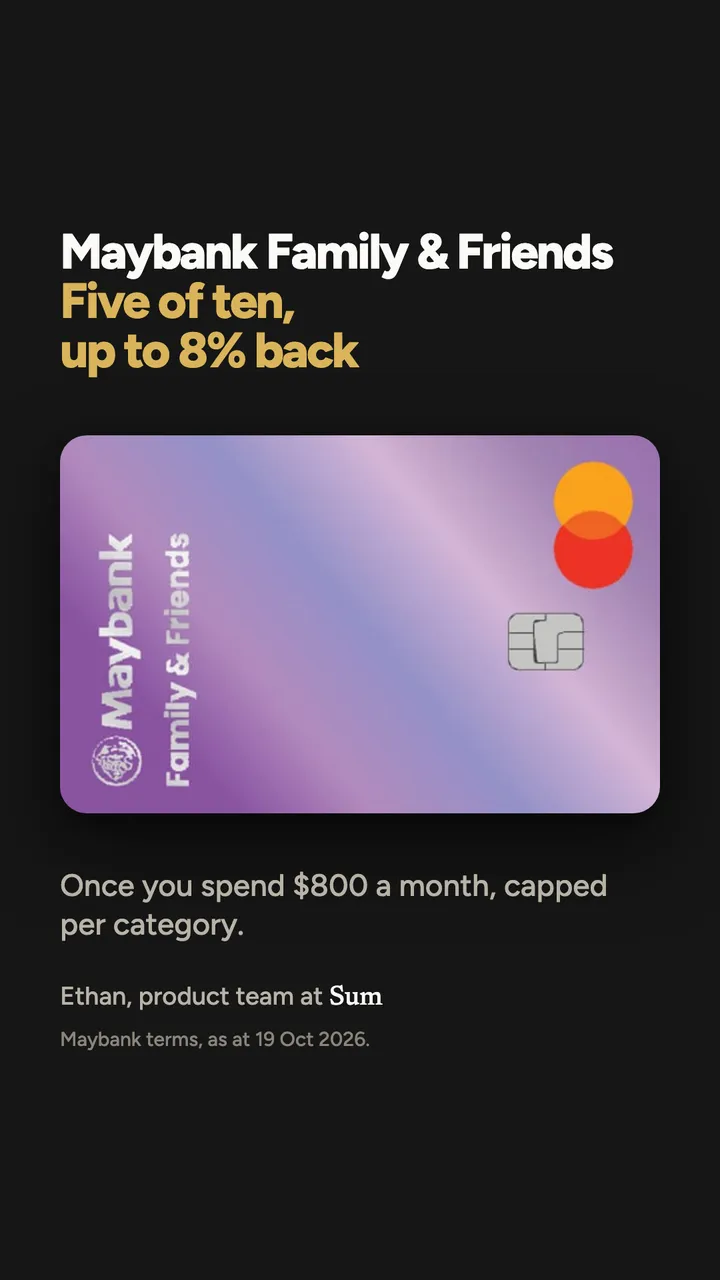
| Maybank Family & Friends Card | |
|---|---|
| Minimum income | $30,000 a year (Singaporeans and PRs), $45,000 (Malaysians, employed at least a year), $60,000 (other foreigners, employed at least a year) |
| Annual fee | $196.20 including GST, waived for 3 years, then waived with $12,000 of spend a year |
| Supplementary card | Free |
| Your categories | 5 of 10, plus Malaysian ringgit and Indonesian rupiah spend automatically |
| Under $800 a month | 0.22% on everything |
| $800 to under $1,600 | 6% in each of your categories, up to $20 each |
| $1,600 and above | 8% in each, up to $30 each (Groceries stays at 6%, up to $30) |
| Most cashback a month | $120 at $800, $180 at $1,600 |
| Minimum counted by | Posting date, calendar month |
| Changing categories | Every 3 months, in the Maybank TREATS SG app |
Figures from Maybank's Cashback Programme terms (effective from 1 January 2026) and the Maybank product page as published on 19 Oct 2026. Maybank's website didn't load for us on 1 Nov 2026, so check the product page for anything newer.
How does the cashback work?
The card has three levels, set by your eligible spend in a calendar month (clauses 4.1 to 4.6):
| Spend in the month | Your five categories | Everything else |
|---|---|---|
| Under $800 | 0.22% | 0.22% |
| $800 to under $1,600 | 6%, up to $20 per category | 0.22% |
| $1,600 and above | 8%, up to $30 per category | 0.22% |
Groceries is the exception: it earns 6% at both levels, capped at $20 at $800 and $30 at $1,600 (clause 4.3). Once a category hits its cap, the rest of your spending in it earns 0.22% for that month (clause 4.6).
Turn the caps into spending: - At 6%, $20 is reached after $20 ÷ 6% = $333.34 in a category. - At 8%, $30 is reached after $30 ÷ 8% = $375. - Groceries at the higher level: $30 ÷ 6% = $500.
So $300 of dining in a 6% month earns $300 × 6% = $18. But $400 earns $20 on the first $333.34, plus $66.66 × 0.22% = $0.15, which is $20.15 before rounding. Clause 5.2 works out cashback per category to two decimal places and rounds down, so that's $20.14.
The product page puts the maximum at $120 a month at the 6% level and $180 at 8%: $20 or $30 for each of your five categories, plus the ringgit and rupiah category.
Bottom line: the cap is per category, so the card pays most when your spending is spread across your five, not piled into one.
Which ten categories, and what's inside each?
Each category is defined by merchant category codes (MCCs), the four-digit codes a shop's bank gives it to say what kind of business it is (clauses 1.1 to 1.10):
| Category | What counts |
|---|---|
| Automotive | Petrol, EV charging, car servicing and repairs (5541, 5542, 5552, 5532, 5533, 5599, 7531, 7535, 7538) |
| Dining & Food Delivery | Restaurants and fast food (5812, 5814), Foodpanda and Deliveroo |
| Kids & Pets | POPULAR (not school bookshops), Toys 'R' Us, Yamaha Music (not course fees), Mothercare, Kiddy Palace, pet shops and vets |
| Online Shopping | Fashion, shoes, bags, luggage, department stores and marketplaces, online only |
| Telco & Streaming | Mobile, internet, pay TV and streaming (4812, 4814, 4899), including Netflix and Disney+ |
| Beauty & Wellness | Massage, spas, barbers and hair salons (7297, 7298, 7230) |
| Commute | Contactless bus and train rides, taxis, Grab and Gojek rides (4111, 4112, 4121, 4131, 4789) |
| Entertainment | Bars, cinemas, theatre and ticketing (5813, 7832, 7922, 7929) |
| Groceries | Supermarkets and grocery stores (5411), from FairPrice to Sheng Siong |
| Sports & Sports Apparels | Sports shops, bicycle shops, gyms and sports clubs (5655, 5940, 5941, 7032, 7941, 7992, 7997) |
A few details. Dining covers restaurants and fast food, but not every food business: a bakery or caterer may carry a different code. Online Shopping has to be online. The same shirt bought in the shop isn't in it. And Beauty & Wellness is salons and spas, not pharmacies.
Bottom line: some categories are smaller than their names. Match each one against your statement, not against what the name suggests.
How do you choose, and how often can you change?
If you never choose, you get the default five (clause 2.1): Automotive, Dining & Food Delivery, Kids & Pets, Online Shopping, and Telco & Streaming. Maybank's FAQ adds that cards held before 2026 with no choice made keep the older set: Groceries, Commute (once called Transport), Dining & Food Delivery, Kids & Pets, and Telco & Streaming.
To choose your own (clauses 2.3 to 2.6): - you choose in the Maybank TREATS SG app, after activating the card; - a choice takes effect on the 1st of the following month and is then locked for three months; - you choose the next set during the last month of those three, and once confirmed it can't be changed; - if you don't choose again, your current five carry on.
Bottom line: the default set includes Automotive. If you don't drive, that's one of your five slots earning 0.22%.
The $800 minimum, and why posting dates matter
The minimum is counted on eligible spending, by the date each purchase posts to your account (clause 4.7). A purchase on 30 November that posts on 2 December counts towards December. Spending on a supplementary card counts towards the principal card's minimum (clause 4.8). Excluded transactions, like insurance or utilities, don't count at all (clause 5.7).
The minimum is a cliff, not a slope. Take two months, each with $500 in your categories, spread so no cap is hit: - $790 in total: everything earns 0.22%, so $790 × 0.22% = about $1.73. - $810 in total: $500 × 6% = $30, plus $310 × 0.22% = $0.68, so about $30.68.
That's $20 more spending for about $28.95 more cashback.
Bottom line: in a month close to $800, check where you are a few days before it ends. The last few purchases may post into next month.
Malaysian ringgit and Indonesian rupiah spending
Clause 3 adds a sixth bonus category that everyone gets automatically: purchases in Malaysian ringgit or Indonesian rupiah. It works like this: - ringgit or rupiah spending outside your five categories earns 6% or 8% here, with its own $20 or $30 cap; - ringgit or rupiah spending inside one of your categories counts there first, and only the amount beyond that category's cap moves here.
It still needs the $800 or $1,600 minimum for the month.
Bottom line: a weekend in Johor Bahru or a trip to Bali can earn the bonus rate without using one of your five slots. A foreign currency fee applies to overseas spending, so check Maybank's fee schedule alongside.
What earns nothing
Clause 5.7 lists transactions that earn no cashback and don't count towards the minimum, including: - NETS, AXS and SAM payments, instalment plans and cash advances; - payments to government bodies, including tax and parking; - utilities and insurance premiums, charities, cleaning services, gambling and brokerage; - top-ups to prepaid accounts and wallets, with named examples such as EZ-Link, YouTrip, Singtel Dash and SimplyGo.
Separately, the product page lists 0.3% cashback on AXS bill payments, on bills up to $50 each, so at most $0.15 a bill.
The prepaid list naming SimplyGo sits a little oddly beside Commute, which includes contactless bus and train rides. Check how your fares appear on your first statement before relying on Commute for them.
Bottom line: your insurance and electricity bills won't help you reach $800 on this card. Count only the spending that qualifies.
The annual fee
The principal card's fee is $196.20 including GST. The product page says it's waived for the first three years, and after that waived automatically when you spend $12,000 in a year. Supplementary cards are free.
$12,000 a year is $1,000 a month, a little above the $800 the cashback needs.
Bottom line: spending $800 a month for the cashback leaves you $2,400 a year short of the waiver from the fourth year.
How it compares on cashback per $1
Category cashback cards with a monthly minimum, as at 24 Oct 2026, from each bank's terms:
| Card | Minimum spend | Bonus rate | Where | Bonus cap |
|---|---|---|---|---|
| Maybank Family & Friends | $800 or $1,600 a month | 6% or 8% | 5 categories you pick of 10, plus ringgit and rupiah | $20 or $30 per category a month |
| Citi Cash Back | $800 a statement month | 6% dining and groceries, 8% petrol and private commute | Set by Citi | $80 a month in total |
| HSBC Live+ | $600 in each month of the quarter | 5% dining, shopping, entertainment, petrol | Set by HSBC | $250 a quarter in total |
| Trust Freedom (bonus mode) | $500 or $2,000 in each month of the quarter | 5% or 15%, plus 1% base | 1 category you pick of 6 | $30 or $250 a quarter |
The rates look alike. The caps and the minimums are where they differ. The Family & Friends card's cap is per category, so it pays most when spending is spread across several.
A worked year
Say Hui Min is 38, has two children and a cat, and puts $1,200 a month of eligible spending on the card. Made-up example.
| Each month | Spend |
|---|---|
| Groceries | $400 |
| Dining & food delivery | $250 |
| Online shopping | $100 |
| Kids & pets | $120 |
| Telco & streaming | $90 |
| Commute | $60 |
| Everything else | $180 |
She's above $800, so her categories earn 6%. Here are the default five against her own five, where she swaps Automotive (she doesn't drive) for Groceries:
| Default five | Her five | |
|---|---|---|
| Groceries | $400 × 0.22% = $0.88 | $20 (capped) + $66.66 × 0.22% = $20.14 |
| Dining & food delivery | $250 × 6% = $15.00 | $15.00 |
| Online shopping | $100 × 6% = $6.00 | $6.00 |
| Kids & pets | $120 × 6% = $7.20 | $7.20 |
| Telco & streaming | $90 × 6% = $5.40 | $5.40 |
| Commute and everything else | $240 × 0.22% = $0.52 | $0.52 |
| Each month | about $35.00 | about $54.26 |
Over a year that's $35.00 × 12 = $420 against $54.26 × 12 = $651.12. One swap, made once, adds about $231 a year for her.
Her $1,200 a month is $14,400 a year, above the $12,000 the fee waiver needs from year four, on the page's terms.
Bottom line: swap in your own monthly spending by category, and see which five cover the most of it, up to each cap. The calculator page does the same sums for a few typical months: Maybank Family & Friends on the card rewards calculator.
Three things to remember
- 5 of 10 categories pay 6% at $800 a month, or 8% at $1,600, each capped at $20 or $30. Everything else earns 0.22%.
- Below $800 of eligible spend, everything earns 0.22%, counted by posting date. Insurance and utilities don't count.
- The defaults may not be your five. A choice is locked for three months, so start from your statement.
Ethan's rating
Earn rate
- Very low
- Low
- Moderate
- High

- Very high
Effort to earn
- Effortless
- Easy
- Some effort
- Shiong
- Very shiong
Value for the fee
- Way overpriced
- Overpriced
- Fair
- Good value
- Great value
Against other cashback cards
- Bottom
- Below average
- Average
- Above average
- Top
Where it earns
- DiningBonus rate
- GroceriesBonus rate
- TransportBonus rate
- OnlineGood
- TravelLow
- OverseasGood
- Everything elseNothing much
The bonus goes to the 5 of 10 categories you pick.
One person's opinion, from the terms in this review. Your own spending decides what a card is worth to you.
Track it in Sum
Import your card statements. For this card, you set your five categories in Sum to match the ones you chose with Maybank, and the card optimiser counts each one against its own cap. The tracker shows how close the month is to $800, the number the whole card depends on.
Ethan
Got something interesting to share?
Something here doesn't match your statement, or Maybank changed the terms? Reach out to me at [email protected], or leave your email and I'll write to you.
Questions people ask
How much cashback does the Maybank Family & Friends card give?
6% in your five chosen categories with $800 of eligible spend in a calendar month, or 8% with $1,600, capped at $20 or $30 per category. Below $800, everything earns 0.22%.
What is the maximum cashback on the Maybank Family & Friends card?
Up to $120 a month at $800 of spend and $180 at $1,600: $20 or $30 for each of your five categories plus the MYR and IDR bonus category.
How do I change my Maybank Family & Friends categories?
In the Maybank TREATS SG app. A choice takes effect on the 1st of the next month and is locked for three months; you choose the next set in the last month of that period.
What are the default Maybank Family & Friends categories?
For new cardmembers: Automotive, Dining & Food Delivery, Kids & Pets, Online Shopping, and Telco & Streaming.
Is the Maybank Family & Friends annual fee waived?
The $196.20 fee is waived for the first 3 years, and after that automatically with $12,000 of spend a year, according to Maybank's product page.
Does groceries earn 8% on the Maybank Family & Friends card?
No. Groceries earns 6% at both tiers, capped at $20 a month at $800 of spend and $30 at $1,600.
Try the numbers yourself

Sum is launching in Singapore soon.
Your banks, cards, CPF and HDB flat, added up into one net worth. Statements sorted, card caps tracked, bills remembered.
Ethan · Product team, Sum
Ethan is on Sum's product team in Singapore. Financial planning and investing took care of Ethan's own money long ago, so this isn't for the pay. The economy right now is rough on Singaporeans, and we are grateful Ethan is determined to alleviate some of this pain here at Sum.
If we listed a wrong number, or you caught a term that changed before we did, email Ethan at [email protected].
Sources: Maybank: Family & Friends Card Cashback Programme T&C, effective from 1 January 2026 (PDF); Maybank: Family & Friends Card; Maybank: Enhanced Family & Friends Card FAQ, accurate as at 1 December 2025 (PDF).
Any app screens shown use sample data, not a real person's. Sum is free to start; some features need a paid plan.
Information only, not financial advice.