The Dow's top 5 stocks, week of 16 to 20 Nov 2026
The Dow fell 8.0% and only McDonald's rose. Walmart, P&G, Disney and Coca-Cola fell least. What happened, why defensive stocks held up, and the maths.

On Saturday morning, while I was waiting for my kopi at the coffee shop under our block, Wei Jie messaged me. We shared a car to client sites in our audit days, and these days he mostly sends me receipts from Melbourne with a question mark. This time it was a screenshot of the week's Dow numbers, with one line underneath.
"Dow drop 8% and the only one that went up is McDonald's? So the whole of America went to eat McDonald's ah?"
I laughed, and then I realised it's a better question than it looks. In a week when nearly everything fell, the five that held up best were a burger chain, a supermarket, a maker of nappies and washing powder, a theme park company and a soft drink. That's not an accident, and it's also not the whole story.
Here's the long version of our Monday carousel: the five Dow stocks that did best between Friday 13 November and Friday 20 November 2026, what each company does, why it moved where a reason was reported, and what US$1,000 held for the week would have become. No predictions, no tips.
The Dow fell 8.0%, and only one of its 30 stocks rose
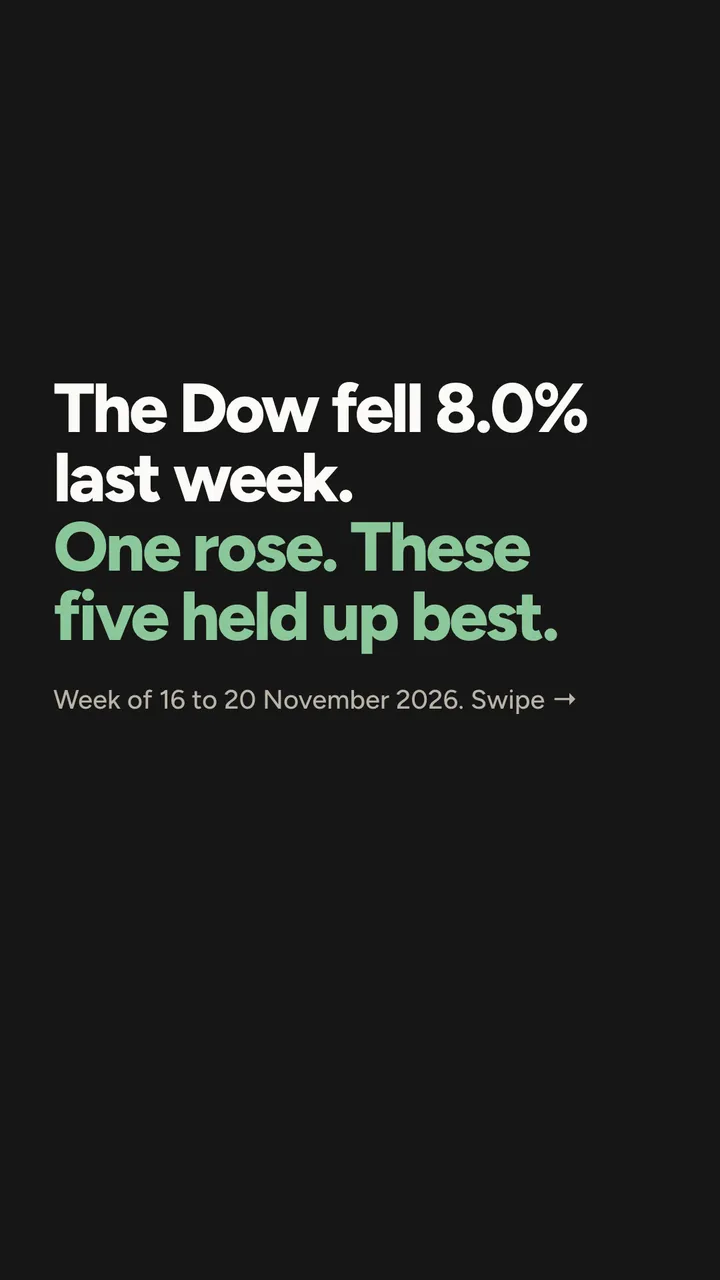
The Dow Jones Industrial Average tracks 30 large US companies. This week it went from 52,347.55 to 48,147.33, a fall of 4,200.22 points. US$1,000 spread like the index would have become about US$919.76, before fees and dividends. The broader S&P 500 fell 8.6% and the tech-heavy Nasdaq 10.0%.
To find the top five, we compare each stock's closing price on the two Fridays, using Yahoo Finance, and rank all 30 ourselves. This week only McDonald's rose, so four of the "top five" fell.
How the week went
The Dow fell on all five days: 1.4% on Monday, 1.6% on Tuesday, 1.1% on Wednesday, 2.2% on Thursday and 1.9% on Friday. AP and CNBC reported the selling was led by artificial intelligence and chip stocks, again. CNBC listed other pressures too: oil above US$83 a barrel, worries that the Federal Reserve could raise interest rates in December and January, and slowing growth in company earnings.
Nvidia, the chipmaker whose chief executive resigned the week before, fell 22.9%. On Friday alone it fell 14% after Reuters reported that the SEC, the US markets regulator, was looking into its accounting, CNBC reported. It was its seventh weekly fall in a row.
What a correction is
CNBC reported that the S&P 500 and the Dow closed the week in a correction. That's market shorthand for a fall of 10% or more from a recent high. It's a label, not a forecast. It doesn't tell you whether the next move is up or down. It just puts a name on how far prices have come down.
What this means for you: headlines will reach for words like correction and wipeout in a week like this. The number underneath, 8.0% this week, is the part worth keeping.
McDonald's rose 0.5%, the only Dow stock that did
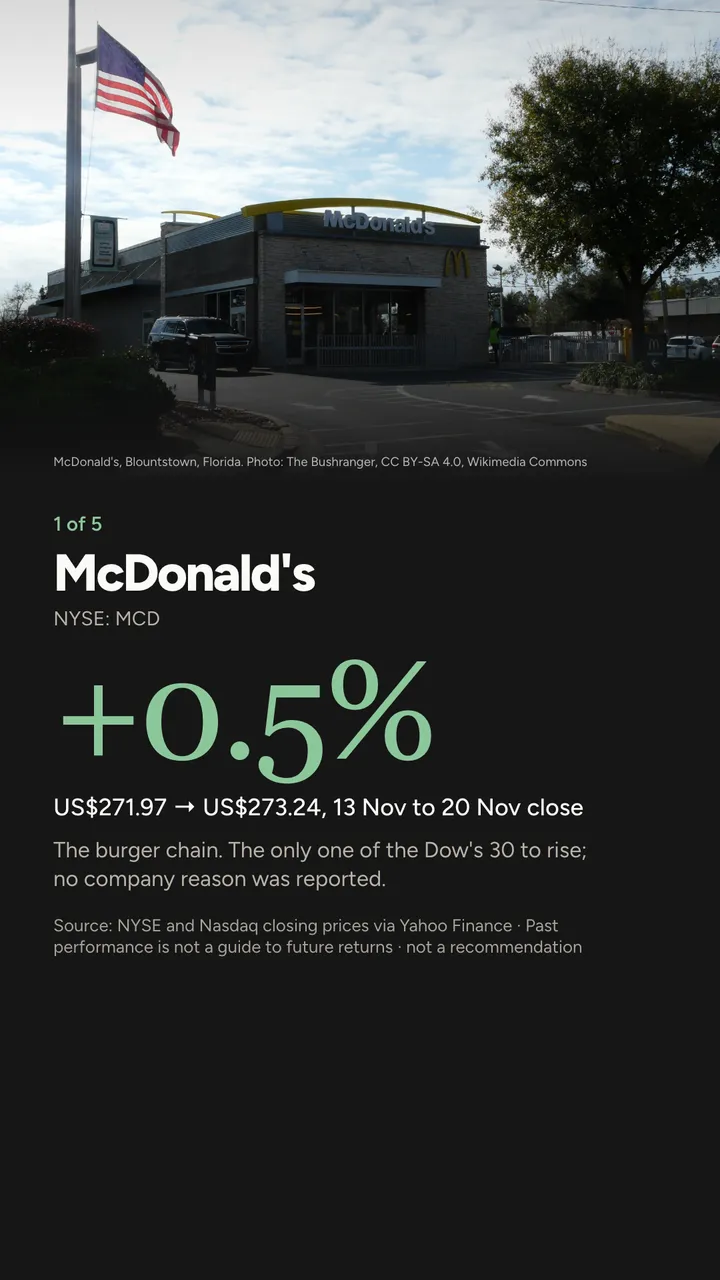
McDonald's runs and franchises burger restaurants in more than 100 countries. Most of its restaurants are owned and run by franchisees, who pay McDonald's rent and fees.
No company reason was reported for its rise. It was the only one of the 30 that finished the week higher, up US$1.27 a share.
The arithmetic
- US$1,000 of McDonald's shares would have become about US$1,004.67.
- One share, which is all you need to buy in the US: US$1.27 more.
What this means for you: being first in a ranking can mean very little in a week like this. A 0.5% rise is small; it just looks big next to everything else.
Walmart fell 0.1%, in the week of its results
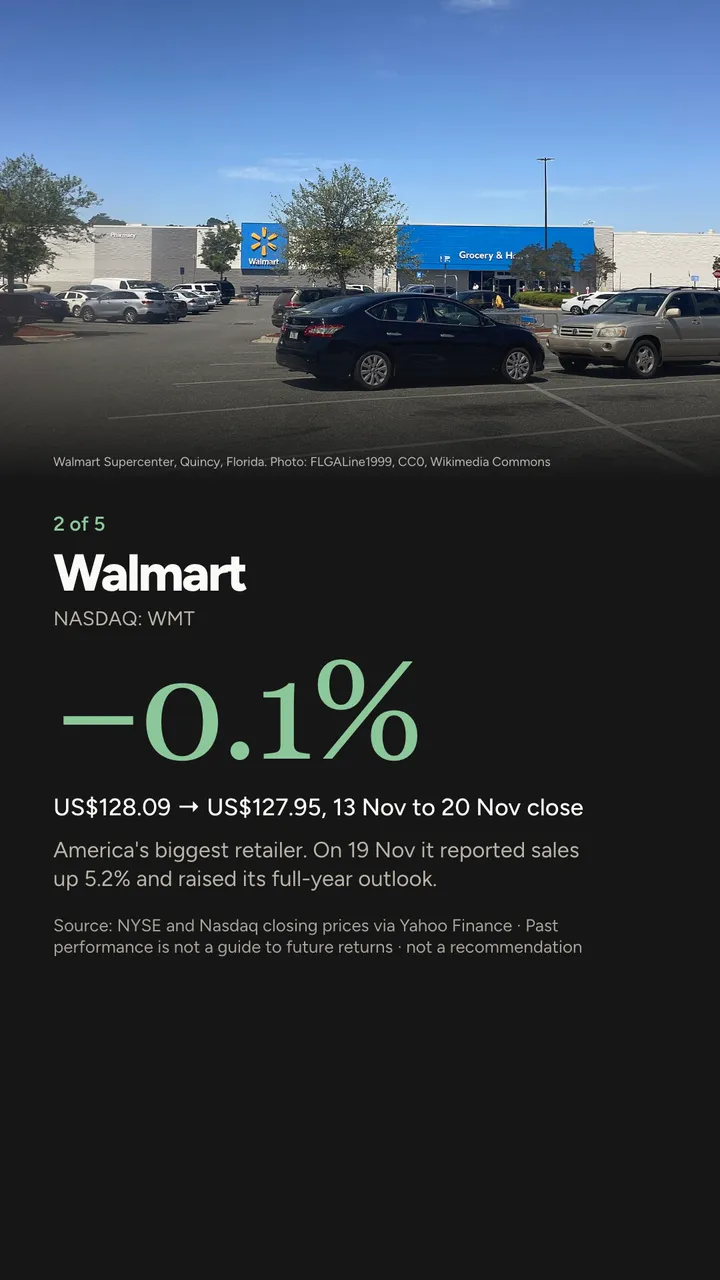
Walmart is America's biggest retailer, with supermarkets, discount stores and a large online business. Its shares now trade on the Nasdaq, not the New York Stock Exchange, though it's still in the Dow.
On Thursday it reported third-quarter revenue of US$188.84 billion, up 5.2% from a year earlier, and raised its full-year profit outlook to US$2.84 to US$2.89 a share, according to its release. Its chief executive told CNBC that fuel costs were higher than expected and that it aims to keep prices low. On Friday, when the market fell hardest, Walmart rose 1.5% as investors moved into consumer staples, CNBC reported.
What consumer staples are
Consumer staples are the things people keep buying in good times and bad: groceries, toothpaste, washing powder. Companies that sell them tend to have steadier sales than, say, a carmaker or a chip designer, because people can put off a new car but not dinner. That's why investors often move into them when markets are nervous.
The arithmetic
- US$1,000 of Walmart shares would have become about US$998.91.
- One share: US$0.14 less.
What this means for you: good results in a bad week can mean "fell less" rather than "rose". It's worth judging results against the week they landed in.
Procter & Gamble fell 0.3%, and rose on Friday
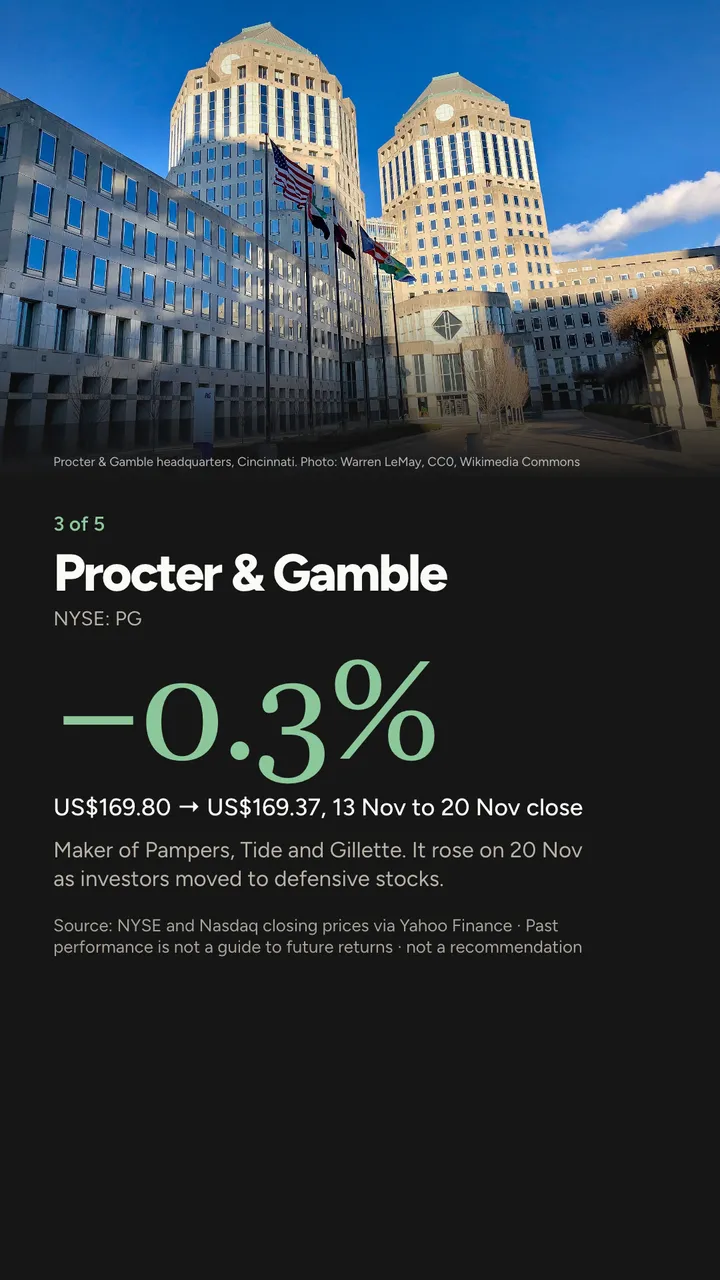
Procter & Gamble makes everyday household brands: Pampers nappies, Tide and Ariel washing powder, Gillette razors, Oral-B toothbrushes. If you've bought any of those at NTUC, you've bought from P&G.
It rose 1.9% on Monday, with no reason reported, then drifted lower until Friday, when it rose more than 1% as investors moved into defensive stocks, CNBC reported.
What a defensive stock is
A defensive stock is one whose business doesn't depend much on how the economy is doing, so its shares have historically fallen less than the market in bad weeks. Consumer staples are the classic example, along with utilities and healthcare. Note the word "less". Defensive doesn't mean the price can't fall. This week P&G still finished slightly lower.
The arithmetic
- US$1,000 of P&G shares would have become about US$997.47.
- One share: US$0.43 less.
What this means for you: a defensive stock is defensive relative to the market, not in absolute terms. It can still lose money in a week when everything falls.
Disney fell 0.8%, after beating forecasts
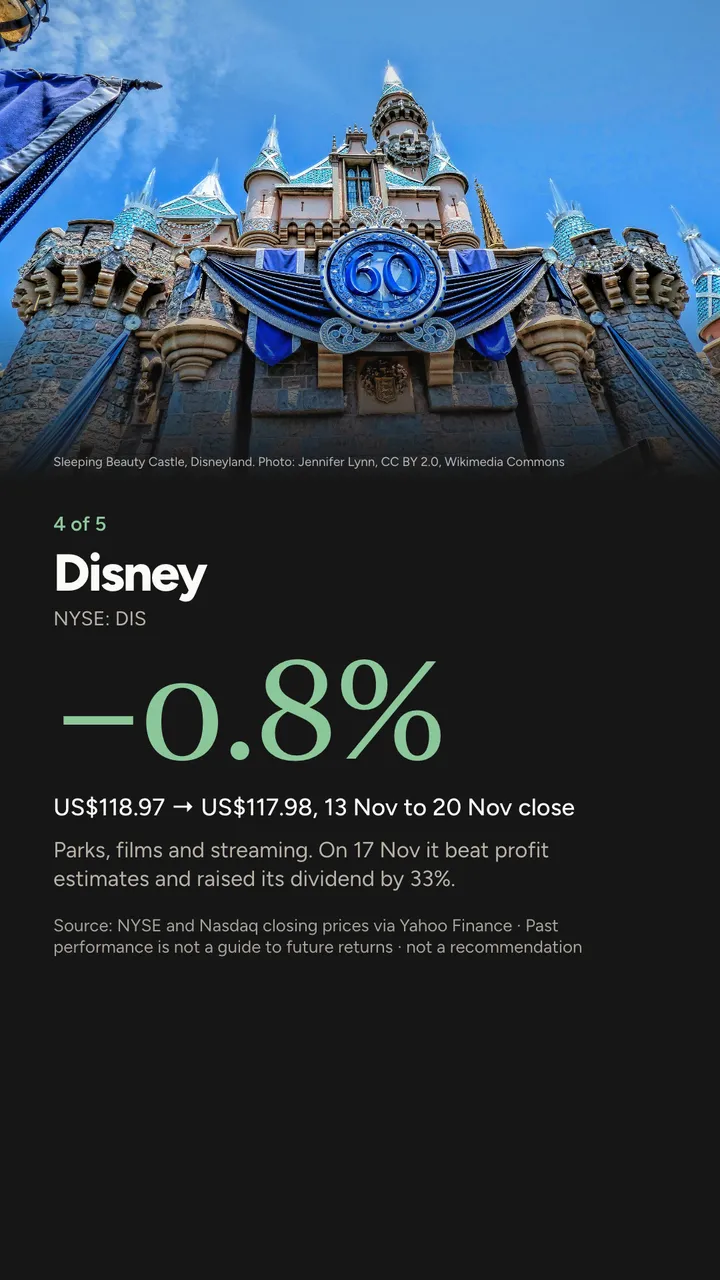
Disney runs theme parks and cruises, makes films (Marvel, Pixar, Star Wars) and owns streaming services such as Disney+.
On Tuesday morning it reported quarterly results above analysts' estimates: adjusted earnings of US$1.77 a share against the US$1.67 expected, and revenue of US$25.95 billion. It also set a target of US$3 billion in cost savings by its 2029 financial year and raised its dividend by 33% to US$2 a share, CNBC reported. The shares rose early that day, then closed 1.5% lower as the wider sell-off took over, AP reported. They rose 4.6% on Wednesday, with no reason reported from the sources we use.
Reading a dividend as a yield
A dividend on its own doesn't tell you much. What helps is comparing it with the share price, which is called the dividend yield. US$2 a share against Friday's close of US$117.98 is about 1.7% a year. That's my arithmetic, using the new figure. If the price changes, the yield changes with it.
The arithmetic
- US$1,000 of Disney shares would have become about US$991.68.
- One share: US$0.99 less.
What this means for you: a company can beat forecasts and its shares can still fall that day. On a bad day for markets, the market usually wins.
Coca-Cola fell 2.3%, with no single reason reported
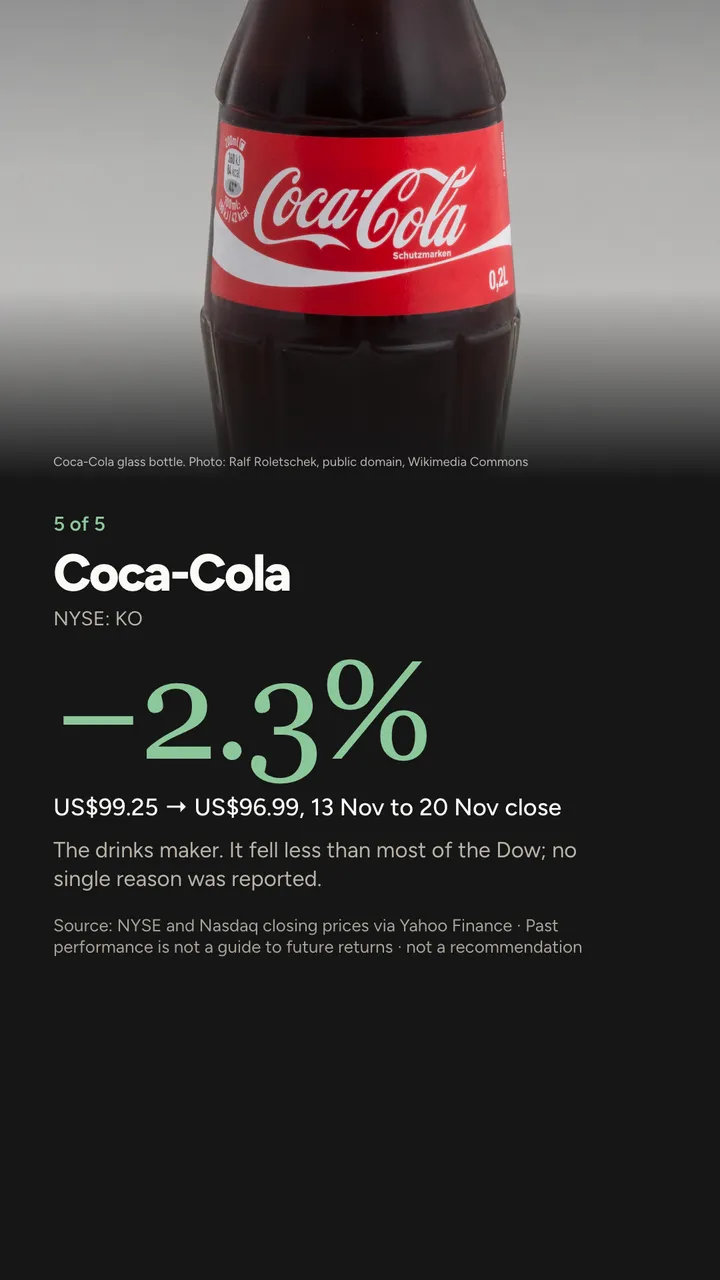
Coca-Cola makes the concentrate for Coke and owns brands such as Sprite and Minute Maid; bottling partners around the world turn it into the drinks on the shelf.
No single reason was reported for its fall. On Tuesday the broker TD Cowen named it a top pick for 2027, CNBC reported, and the shares still slipped slightly that day. It closed at a record the Friday before, so part of this week's move came from a high starting point.
What an analyst's "top pick" is
A broker's analysts publish views on companies, and a "top pick" is their favourite for a period. It's one firm's opinion about the future. This week is a small reminder that a share can fall on the day it's named one. That's not a comment on the view. It's just how markets work.
The arithmetic
- US$1,000 of Coca-Cola shares would have become about US$977.23.
- One share: US$2.26 less.
What this means for you: a defensive name falling 2.3% in a week when the index fell 8.0% still fell. Both numbers are true at once.
The week in one table
| Stock | Ticker | Close, 13 Nov to 20 Nov | Change | US$1,000 became |
|---|---|---|---|---|
| McDonald's | NYSE: MCD | US$271.97 to US$273.24 | +0.5% | US$1,004.67 |
| Walmart | NASDAQ: WMT | US$128.09 to US$127.95 | minus 0.1% | US$998.91 |
| Procter & Gamble | NYSE: PG | US$169.80 to US$169.37 | minus 0.3% | US$997.47 |
| Disney | NYSE: DIS | US$118.97 to US$117.98 | minus 0.8% | US$991.68 |
| Coca-Cola | NYSE: KO | US$99.25 to US$96.99 | minus 2.3% | US$977.23 |
| Dow Jones Industrial Average | DJI | 52,347.55 to 48,147.33 | minus 8.0% | about US$919.76 |
All before fees and dividends, and in US dollars. One week tells you what happened, and nothing about what comes next.
If you only remember three things
- In a week when 29 of 30 fell, the top five are the ones that fell least. That's a ranking, not a gain.
- Defensive stocks, the companies selling everyday things, held up best. They still mostly fell.
- Good results and a rising share price don't always arrive together. Walmart and Disney both beat expectations and both ended lower.
How I keep track of this
When I hold US shares, what I care about isn't the Dow's points. It's what my own holdings did in Singapore dollars, next to everything else I own. In a week like this one, that's the difference between a scary headline and a number I can sit with.
In Sum, stocks sit inside your net worth beside your bank accounts, CPF and property, so a red week sits in proportion. Stocks are on the Essential plan; live prices, profit and loss, and dividends are on Pro. For Singapore's side of the same week, when only three STI stocks rose, see the STI's top five for 16 to 20 November. Last week's Dow, when it rose 2.1%, is in the Dow's top five for 9 to 13 November.
I sent Wei Jie the section on defensive stocks on Sunday. He read it and replied with a photo of a McDonald's receipt, one burger meal, and a single question mark. I told him one meal doesn't move a share price. He said he knew, he was just hungry.
Talk soon, Brandon

Sum is launching in Singapore soon.
Your banks, cards, CPF and HDB flat, added up into one net worth. Statements sorted, card caps tracked, bills remembered.
Brandon · Finance team, Sum
Brandon is on Sum's finance team in Singapore. Brandon reads the CPF Board, IRAS and MAS updates so you don't have to, and turns our carousels into the longer version. Questions, corrections or something to share? Email Brandon at [email protected].
Got something interesting to share?
A money story, a question, something we got wrong, or a tip other Singaporeans should hear. Reach out to me at [email protected], or leave your email and I'll write to you.
Sources: Yahoo Finance, Dow Jones Industrial Average price history; CNBC, S&P 500 and Dow close in correction; Nasdaq erases 2026 gain as AI rout picks up steam, 20 Nov 2026; CNBC, S&P 500 correction: Five forces behind the market sell-off, 20 Nov 2026; CNBC, Nvidia stock plunges 14%, wraps up longest weekly losing streak since 2008 financial crisis, 20 Nov 2026; AP, Another wipeout hits Wall Street as Nvidia, other jittery AI stocks swing lower, 17 Nov 2026; Walmart, Walmart reports third quarter results (SEC filing), 19 Nov 2026; CNBC, Walmart hikes outlook as CEO tells CNBC retailer aims to keep prices low despite soaring fuel costs, 19 Nov 2026; CNBC, Stocks making the biggest moves Friday: Nvidia, Anthropic, Micron, General Mills, UnitedHealth, Strategy & more, 20 Nov 2026; CNBC, Disney beats fourth-quarter estimates, targets $3 billion in savings through cost-cutting efforts, 17 Nov 2026; CNBC, Stocks making the biggest moves Tuesday: Nvidia, CoreWeave, Nebius & more, 17 Nov 2026.
Any app screens shown use sample data, not a real person's. Sum is free to start; some features need a paid plan.
Information only, not financial advice.