The Dow's top 5 stocks, week of 9 to 13 Nov 2026
The Dow rose 2.1% even as Nvidia lost its chief executive and fell 12.7%. Caterpillar, Goldman Sachs, Apple, Alphabet and Coca-Cola led, with the maths.

On Friday morning I was in the office pantry, waiting for the kettle, when Arjun, one of our backend developers, came in holding his phone the way people hold a phone when they want you to read something. "Nvidia's CEO quit. Just like that. Effective immediately."
I said I'd seen it on the train. He scrolled. "And the Dow is only down a bit? Nvidia is one of the biggest companies in the world. How is the whole thing not falling?"
I started to answer, and realised the answer involved the word "price-weighted", which is not a word anyone wants before their first coffee. So I told him I'd write it down properly. By the time US markets closed that night, the Dow had finished the week up 2.1%.
Here's the long version of our Monday carousel: the five Dow stocks that rose the most between Friday 6 November and Friday 13 November 2026, what each company does, why it moved where a reason was reported, and what US$1,000 held for the week would have become. No predictions, no tips.
The Dow rose 2.1%, while Nvidia fell 12.7%
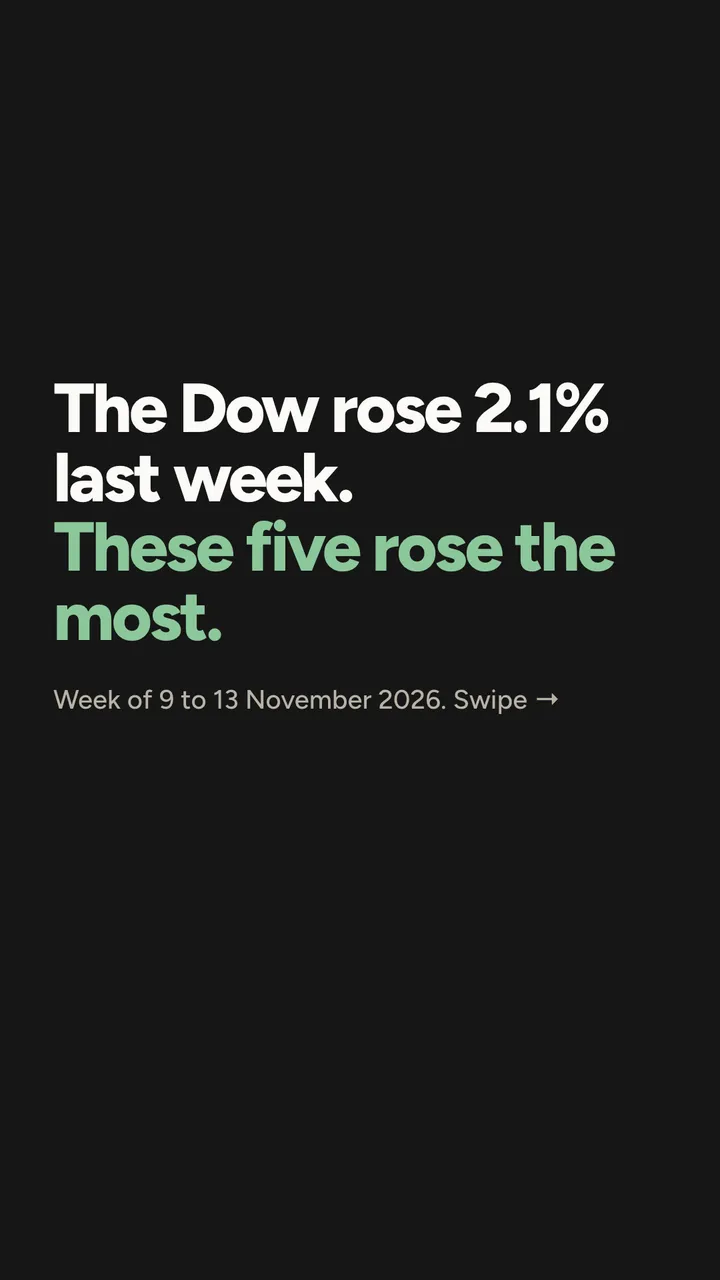
The Dow Jones Industrial Average tracks 30 large US companies. This week it went from 51,285.73 to 52,347.55, a rise of 1,061.82 points. US$1,000 spread like the index would have become about US$1,020.70, before fees and dividends. The broader S&P 500 rose 2.5% and the tech-heavy Nasdaq 2.3%, the best week for all three since early August, CNBC reported.
To find the top five, we compare each stock's closing price on the two Fridays, using Yahoo Finance, and rank all 30 ourselves.
How the week went
- Monday, up 2.2%. Tech stocks rebounded from the previous week's sell-off and oil fell, CNBC reported. This one day did most of the week's work.
- Tuesday, down 0.3%. US consumer prices for October rose 0.4%, more than the 0.3% expected, and the 10-year US government bond yield went back above 5%. A bond yield is the return a lender gets for lending to the government; when it rises, borrowing costs across the economy tend to follow.
- Wednesday, up 0.5%. US stock markets were open on Veterans Day; only the bond market closed.
- Thursday, down 0.4%. Nvidia announced that its chief executive had resigned with immediate effect, days after its board opened an investigation into him, CNBC reported. Its own announcement gave no reason.
- Friday, up 0.1%. Producer prices for October rose less than expected.
Why Nvidia's fall didn't sink the Dow
Here's the answer for Arjun. The Dow is price-weighted: a US$1 move in any of its 30 stocks moves the index by the same number of points, whatever the company's size. So what matters is how many dollars a share moves, not how big the company is.
Nvidia fell from US$186.64 to US$162.85, a drop of US$23.79 a share. Goldman Sachs rose US$50.74 and Caterpillar US$41.57. Those two rises add up to US$92.31, nearly four times Nvidia's fall in dollars, so in the Dow they outweighed it easily. In the S&P 500, which is weighted by company size, Nvidia counts for far more.
What this means for you: "the market" means different things depending on the index. The same week can look quite different in the Dow and the S&P 500.
Caterpillar rose 7.4%, almost all of it on Monday
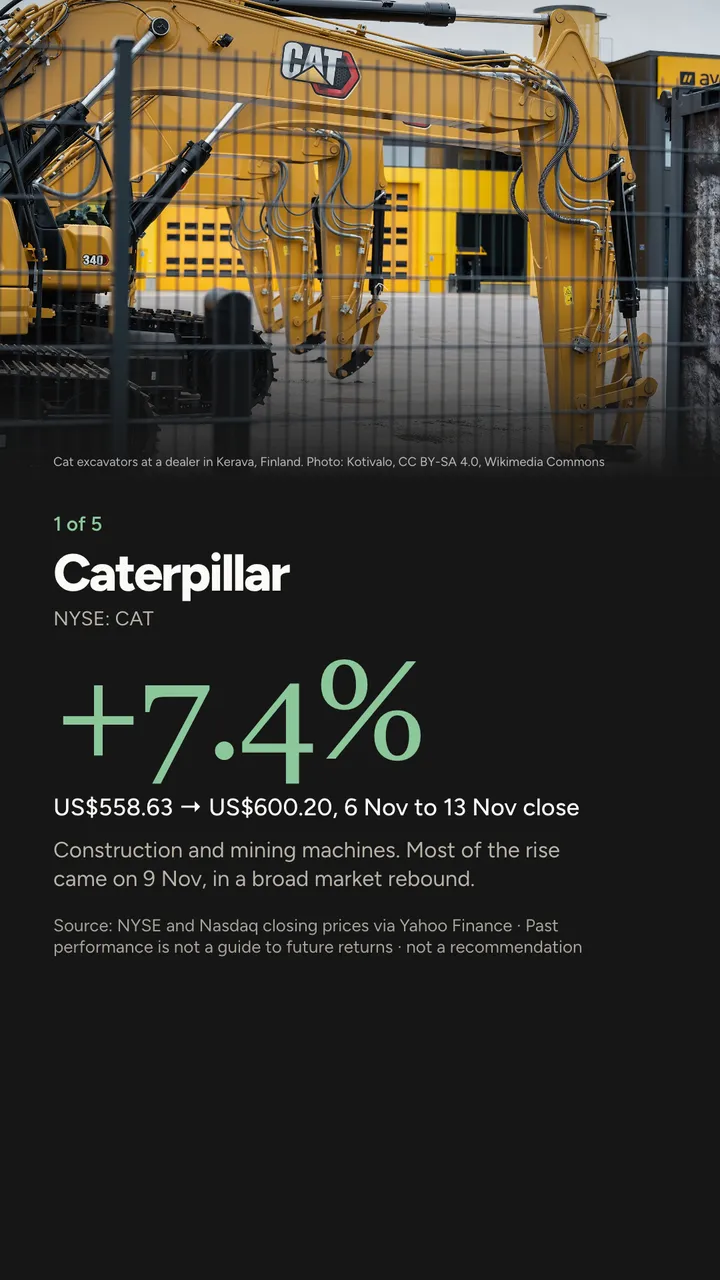
Caterpillar makes the yellow machines you see on construction sites and in mines, along with engines and power generators. It rose 7.2% on Monday. CNBC named Caterpillar and Goldman Sachs as the stocks holding the Dow up that day, and reported that industrial companies led the S&P 500's sectors with a 4.2% gain. Caterpillar made no announcement of its own that week.
What a sector move is
Stock markets group companies into sectors: industrials, technology, banks, energy and so on. On some days a whole sector moves together because investors change their view of that part of the economy. When that happens, a big company in the sector usually moves with it, whether or not it had news.
The arithmetic
- US$1,000 of Caterpillar shares would have become about US$1,074.41.
- One share, which is all you need to buy in the US: US$41.57 more.
What this means for you: a stock's best day can have nothing to do with the company itself. It's worth looking at what its sector did that day before looking for a company reason.
Goldman Sachs rose 5.9%, with no company reason reported
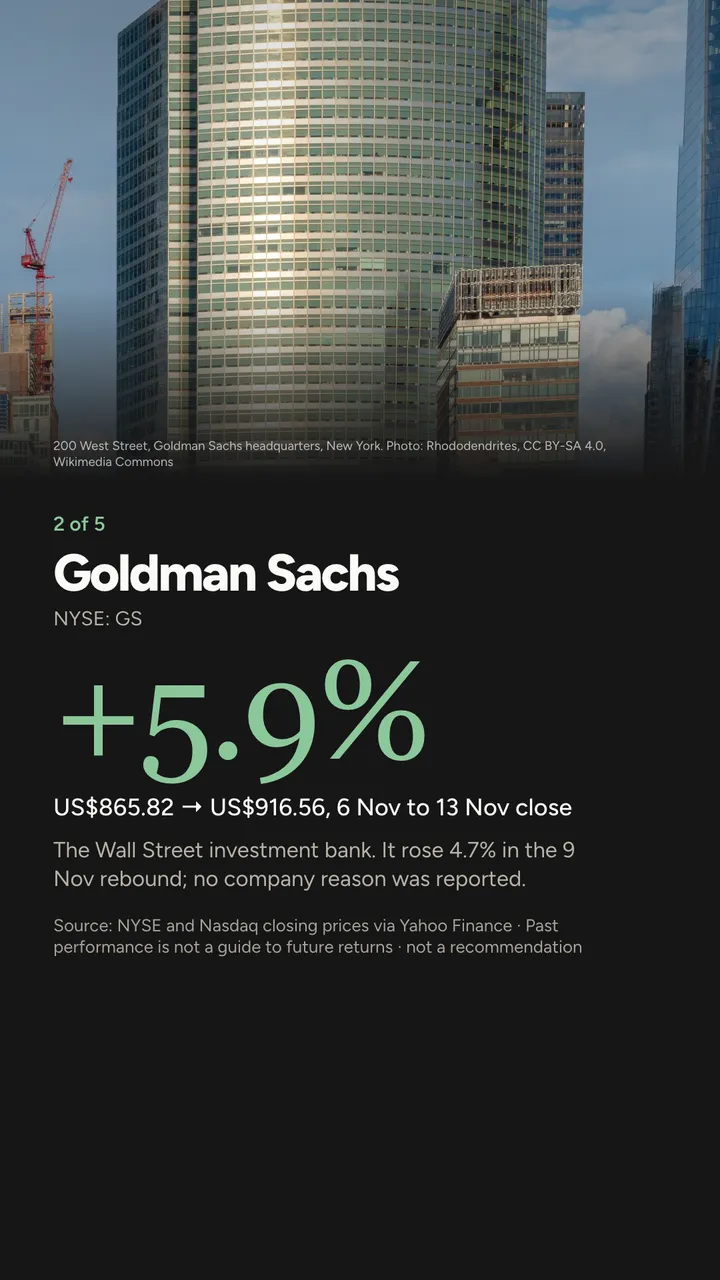
Goldman Sachs is an investment bank: it helps companies raise money and buy each other, trades shares and bonds, and manages money for wealthy clients and institutions. It's not a bank you'd open a savings account with in Singapore.
No company reason was reported for its rise. It rose 4.7% in Monday's rebound and 1.8% on Wednesday.
The heaviest stock in the Dow
At US$916.56 on Friday, Goldman had the highest share price of the 30, so under the Dow's price weighting it moves the index more than any other stock. Its US$50.74 rise this week was the largest dollar gain in the index.
The arithmetic
- US$1,000 of Goldman shares would have become about US$1,058.60.
- One share: US$50.74 more. One share also costs more than US$900, which is one reason fractional shares exist.
What this means for you: if you follow the Dow's daily moves in points, a handful of high-priced stocks are doing a lot of the moving.
Apple rose 4.1%, to record highs
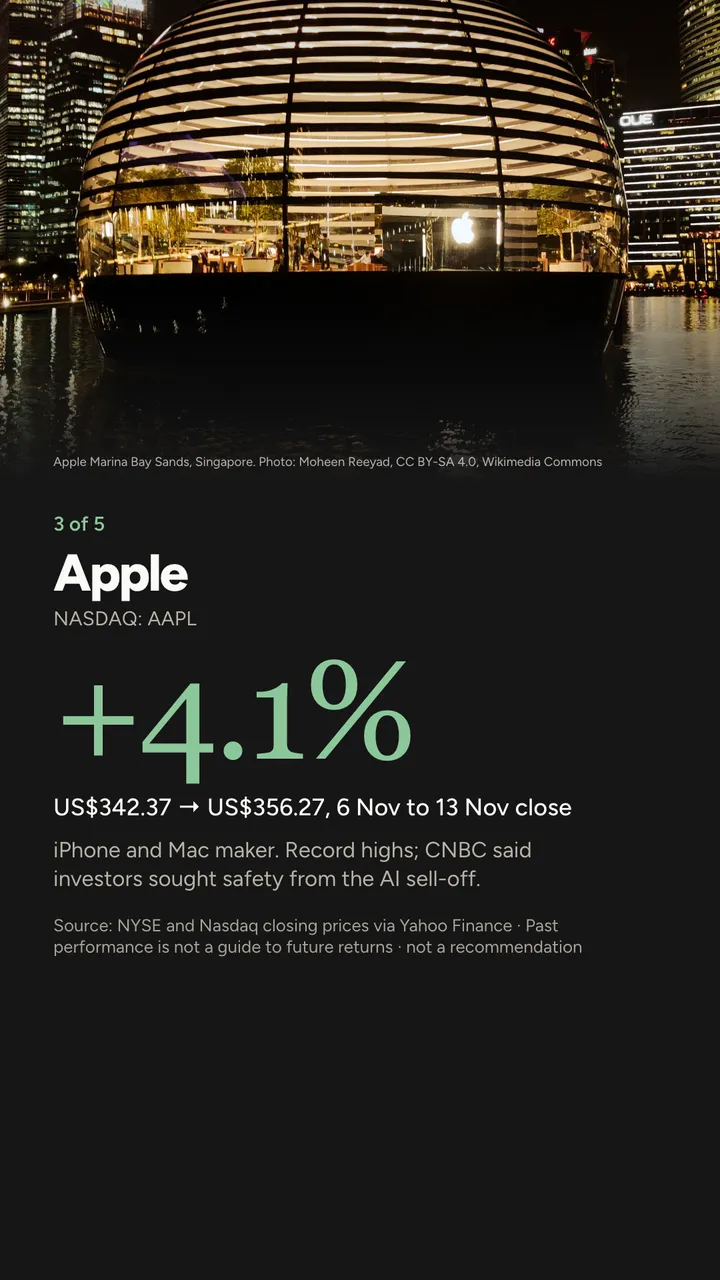
Apple makes the iPhone, Mac and iPad, and runs services like the App Store and iCloud. It closed at record highs on Monday and Wednesday, and on Friday reached US$360.80 during the day, taking its market value (the share price times the number of shares) above US$5.2 trillion, CNBC reported.
CNBC said investors were seeking safety from the selling in artificial intelligence stocks, and pointed out that Apple has stayed out of the expensive race to build artificial intelligence data centres. It quoted analysts at Bernstein calling Apple a "safe haven".
What "safe haven" means here
In a week when one group of stocks is being sold, money doesn't vanish. Some of it moves to companies investors see as steadier. That label is a description of how investors behaved that week, not a guarantee of anything. A stock described as a safe haven can still fall.
The arithmetic
- US$1,000 of Apple shares would have become about US$1,040.60.
- One share: US$13.90 more.
What this means for you: a record high tells you where a price has been, not where it's going. It's worth reading "record" as a fact about the past.
Alphabet rose 3.9%, with a record close on Thursday
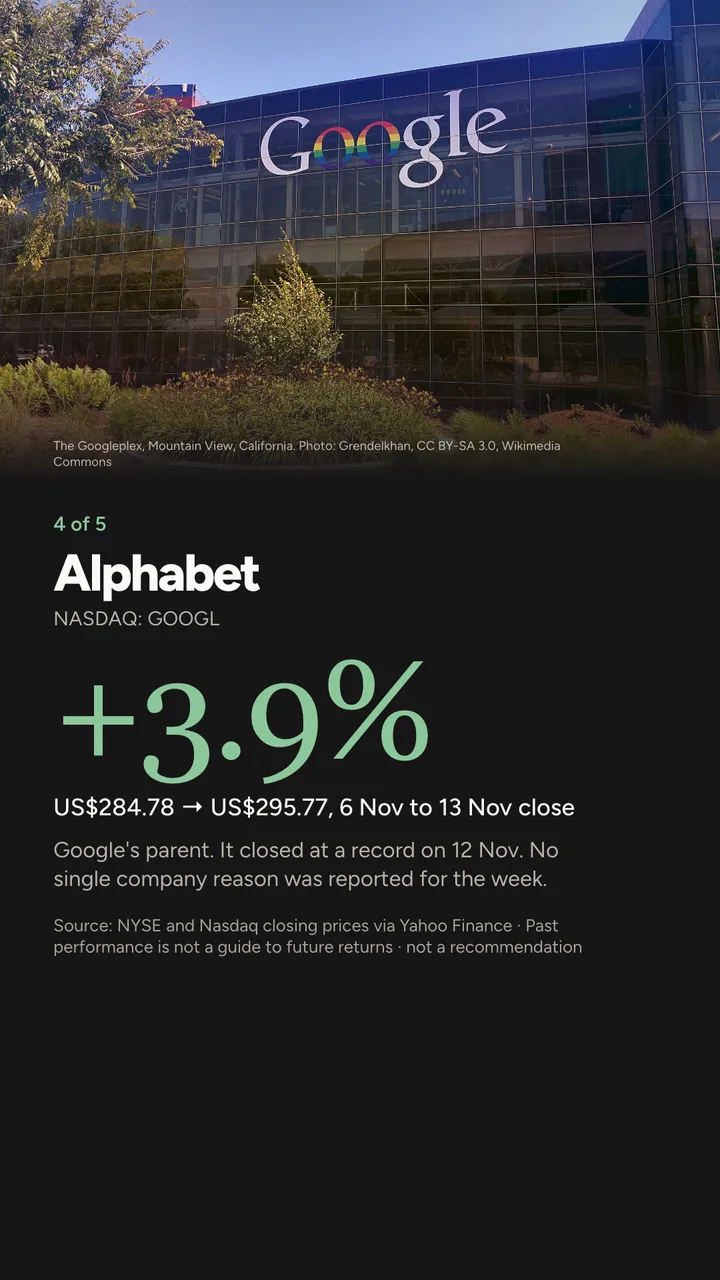
Alphabet is Google's parent company: search, YouTube, Android, and Google Cloud. No single company reason was reported for its rise.
On Thursday, the day Nvidia's chief executive resigned, Alphabet rose 1.8% to a record close of US$298.70. CNBC reported that Alphabet, Microsoft and Amazon offset part of Nvidia's drag on the market that day. Two weeks ago Alphabet was the one falling: it dropped 12.6% in the week to 30 October after its results, which I wrote about in the Dow's week of 26 to 30 October.
The arithmetic
- US$1,000 of Alphabet shares would have become about US$1,038.59.
- One share: US$10.99 more.
What this means for you: the same company can be the week's worst performer one fortnight and among the best the next. One week is a very small window.
Coca-Cola rose 3.7%, with no single reason reported
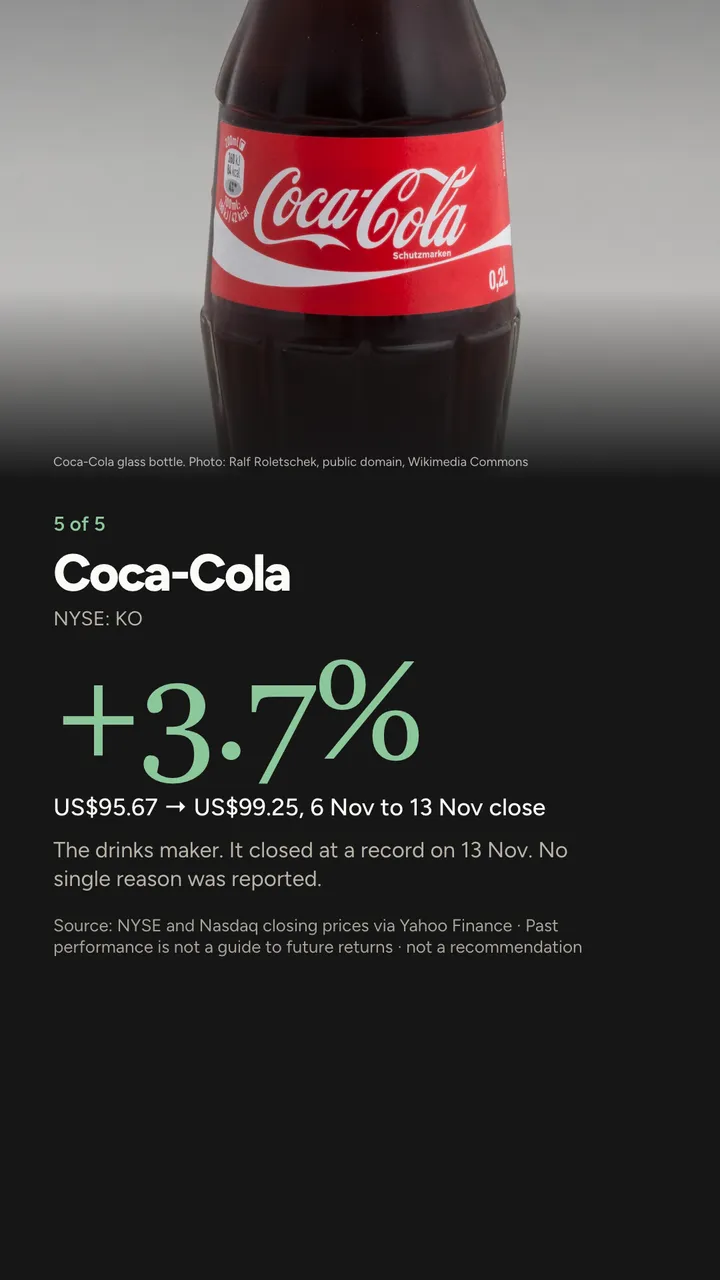
Coca-Cola sells drinks around the world, much of it by selling concentrate to bottling companies that make and distribute the drinks. No single reason was reported for its rise. About half of it came on Friday, up 1.9% to a record close.
What a defensive stock is
You'll often hear companies like Coca-Cola called defensive. The idea is that people keep buying soft drinks and toothpaste whether the economy is good or bad, so these companies' sales tend to swing less. It's a label for a type of business, and I'm using it to explain the word, not as the reason for this week's move, because no one reported one.
The arithmetic
- US$1,000 of Coca-Cola shares would have become about US$1,037.42.
- One share: US$3.58 more.
What this means for you: a familiar product doesn't make a stock simpler. It's worth knowing how the company actually earns its money, which here is largely selling concentrate, not cans.
The week in one table
| Stock | Ticker | Close, 6 Nov to 13 Nov | Change | US$1,000 became |
|---|---|---|---|---|
| Caterpillar | NYSE: CAT | US$558.63 to US$600.20 | +7.4% | US$1,074.41 |
| Goldman Sachs | NYSE: GS | US$865.82 to US$916.56 | +5.9% | US$1,058.60 |
| Apple | NASDAQ: AAPL | US$342.37 to US$356.27 | +4.1% | US$1,040.60 |
| Alphabet | NASDAQ: GOOGL | US$284.78 to US$295.77 | +3.9% | US$1,038.59 |
| Coca-Cola | NYSE: KO | US$95.67 to US$99.25 | +3.7% | US$1,037.42 |
| Dow Jones Industrial Average | DJIA | 51,285.73 to 52,347.55 | +2.1% | about US$1,020.70 |
All before fees, dividends and currency moves. If you're in Singapore, the US dollar's move against the Singapore dollar changes your result too. One week tells you what happened, and nothing about what comes next.
If you only remember three things
- The Dow is price-weighted, so dollar moves in high-priced shares like Goldman matter more than a big company's percentage fall.
- A sector can carry a stock. Caterpillar's best day came with no company news.
- "Record high" and "safe haven" describe what happened, not what comes next.
How I keep track of this
When I hold US shares, what I care about isn't the Dow's points. It's what my own holdings did in Singapore dollars, next to everything else I own.
In Sum, stocks sit inside your net worth beside your bank accounts, CPF and property, so a week like this sits in proportion. Stocks are on the Essential plan; live prices, profit and loss, and dividends are on Pro. For Singapore's side of the same week, when results lifted SATS and SIA, see the STI's top five for 10 to 13 November.
I sent Arjun the section on price weighting. He read it at his desk and came back to the pantry. "So in the Dow, Goldman is heavier than Nvidia because its share costs more?" Yes, I said. He thought about it. "That's a strange way to weigh things." It is, a bit. It's also more than a hundred years old.
Talk soon, Brandon

Sum is launching in Singapore soon.
Your banks, cards, CPF and HDB flat, added up into one net worth. Statements sorted, card caps tracked, bills remembered.
Brandon · Finance team, Sum
Brandon is on Sum's finance team in Singapore. Brandon reads the CPF Board, IRAS and MAS updates so you don't have to, and turns our carousels into the longer version. Questions, corrections or something to share? Email Brandon at [email protected].
Got something interesting to share?
A money story, a question, something we got wrong, or a tip other Singaporeans should hear. Reach out to me at [email protected], or leave your email and I'll write to you.
Sources: Yahoo Finance, Dow Jones Industrial Average price history; CNBC, Dow surges 1,100 points, Nasdaq climbs more than 2% as tech rebounds from last week's tumult: Live updates, 9 Nov 2026; CNBC, S&P 500 falls, dragged down by Nvidia sell-off and rate-hike fears after hot inflation data: Live updates, 10 Nov 2026; CNBC, Nasdaq gains more than 1% as CoreWeave spike revitalizes AI trade, 11 Nov 2026; CNBC, Nasdaq Composite slides as Nvidia shares tumble on Jensen Huang's exit; oil prices jump, 12 Nov 2026; CNBC, Nasdaq falls on Friday as Nvidia sells off, but index notches best week since August: Live updates, 13 Nov 2026; NVIDIA, NVIDIA Announces CEO Transition (SEC filing), 12 Nov 2026.
Any app screens shown use sample data, not a real person's. Sum is free to start; some features need a paid plan.
Information only, not financial advice.