Standard Chartered Journey card review: what counts for 3 miles per $1
How the Standard Chartered Journey card earns miles as at 1 Nov 2026: 3, 2 and 1.2 miles per $1, what counts as online, the cap, fees and a worked year.
- 3 miles per $1 on online rides, delivery and groceries
- Uncapped 1.2 miles per $1 elsewhere
- 10,000 miles with the paid fee, 2 lounge visits
- Phone wallets don't count as online
- Bonus stops at $1,000 a month
- $27.25 for every conversion
Ethan's own opinion of the card as reviewed below. His full rating is at the end.
The Standard Chartered Journey is a miles card: 3 miles per $1 on selected online rides, food delivery and groceries in Singapore dollars, and 1.2 on most other local spending. The catch is that "online" has a narrow meaning. The same ride can count or not depending on how it's paid, and the bonus stops after $1,000 a month.
Here's what it earns, what counts for the 3 miles, the cap, the fees and fine print, and a worked year you can redo with your own spending.
The Journey card at a glance
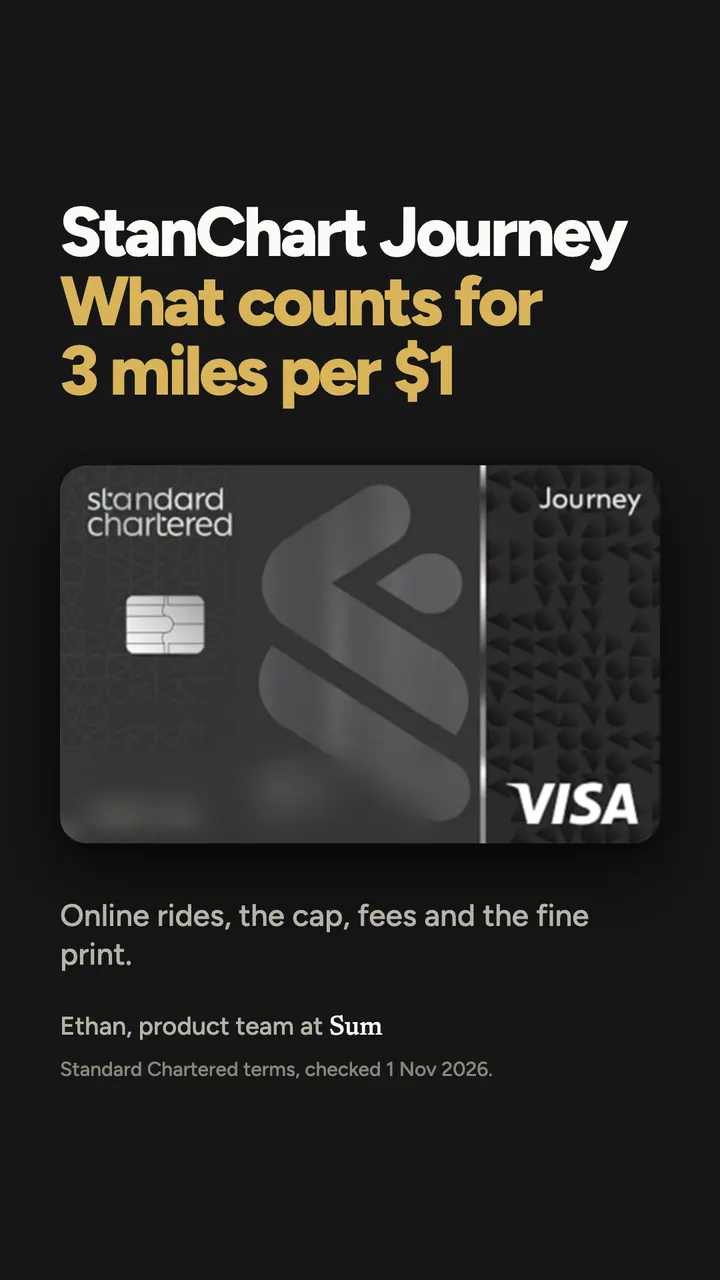
| Standard Chartered Journey (Visa) | |
|---|---|
| Minimum income | $30,000 a year, as listed on the product page |
| Annual fee | Waived the first year (see below), then $196.20 including GST |
| Renewal gift | 25,000 points (10,000 KrisFlyer miles) when the fee is paid |
| Supplementary card | No annual fee |
| Online transport, food delivery, groceries (SGD) | 7.5 points per $1, which is 3 miles per $1 |
| Cap on the bonus | First $1,000 of bonus spend per statement month |
| Foreign currency spend | 5 points per $1, which is 2 miles per $1 |
| Other spend in SGD | 3 points per $1, which is 1.2 miles per $1, no cap |
| Converting to miles | 25,000 points = 10,000 KrisFlyer miles, $27.25 per conversion |
| Foreign currency fee | 3.5% (1% Visa charge plus 2.5% bank fee) |
| Lounge access | 2 Priority Pass visits per year, principal cardholder only |
From the Journey terms (V.062025), the Credit Card Terms, the product page and the pricing guide, checked 1 Nov 2026.
How many miles does the Journey card earn?
The Journey pays 360° Rewards Points, and 2.5 points convert to 1 KrisFlyer mile (Singapore Airlines' programme).
Clauses 19 and 20 of the terms set three rates: - Singapore dollars: 3 points per $1, so 3 ÷ 2.5 = 1.2 miles per $1. - Foreign currency: 5 points per $1, so 2 miles per $1. - Bonus transactions in Singapore dollars: an extra 4.5 points per $1 on top of the 3, so 7.5 points, which is 3 miles per $1.
A qualifying $40 food delivery earns $40 × 7.5 = 300 points, or 120 miles. The same $40 paid in person at a restaurant earns 120 points, or 48 miles.
Bottom line: the 3 is the headline, but most spending sits at 1.2. The base rate matters as much.
What counts as "online transport" for 3 miles per $1?
Clauses 21 and 22 decide it. A bonus transaction has to pass three tests: 1. It's in Singapore dollars. 2. It's online, meaning card-not-present: the card details are saved in an app or typed into a website, and the card never touches a terminal. 3. The merchant's category code is on the list. Every merchant has a four-digit merchant category code (MCC). The list covers transport (4111, 4121, 4411, 4789), food delivery and restaurants (5811, 5812, 5814) and groceries and food stores (5411, 5462, 5499, 5921).
The terms name Grab, Gojek, Tada and Ryde as transport examples. Clause 22 adds that the bank goes by how Visa classifies the transaction, not by what the merchant sells.
Then the detail that trips people up: the product page FAQ says Apple Pay, Samsung Pay, Google Pay and Garmin Pay are not card-not-present transactions. If the ride app charges your phone wallet, it isn't online for this card, even though you booked on your phone.
Say a ride home from Changi is $32, a made-up fare for the arithmetic:
| How it's paid | Points | Miles |
|---|---|---|
| Booked on an app, card saved in the app | $32 × 7.5 = 240 | 96 |
| Booked on an app, paid with a phone wallet | $32 × 3 = 96 | 38.4 |
| Taxi from the queue, card tapped | $32 × 3 = 96 | 38.4 |
Same trip home, 57.6 miles apart. Not a lot per ride, but over a year of rides and deliveries it adds up. The difference has nothing to do with the car.
Topping up a ride app's own wallet counts as a top-up to a prepaid account, which earns nothing at all.
Bottom line: the 3 depends on which payment method each ride and delivery app has set.
Is there a cap on the 3 miles per $1?
Yes. Clause 23 caps the extra 4.5 points at 4,500 a statement month (one statement date to the day before the next), which is the first $1,000 of bonus spend. Above that, bonus spending still earns the uncapped base 3 points per $1. The terms' own example:
| Bonus spend in the month | Base points | Extra points | Total | Miles |
|---|---|---|---|---|
| $1,000 at an online grocer | 3,000 | 4,500 | 7,500 | 3,000 |
| $1,200 at an online grocer | 3,600 | 4,500 (capped) | 8,100 | 3,240 |
So the most the bonus adds in a month is 4,500 ÷ 2.5 = 1,800 extra miles. The extra points are added up over the month and credited on the statement date (clause 26).
Bottom line: $1,000 a month on rides, delivery and online groceries is a lot. For most people the cap rarely bites.
How do the points round?
There's no $5 block: points are worked out on the exact amount and rounded to a whole point. The Credit Card Terms say "nearest whole number" in clause 14.3.1 and "rounded down" in clause 24.5, so the table uses the less generous reading.
| Purchase | Points | Miles | Per $1 |
|---|---|---|---|
| Bubble tea, $4.60 | 13.8 → 13 | 5.2 | 1.13 |
| Lunch, $12.90 | 38.7 → 38 | 15.2 | 1.18 |
| Dinner, $100 | 300 | 120 | 1.2 |
Bottom line: each purchase loses less than half a mile, so small purchases barely suffer, unlike on cards that count in $5 blocks.
Paying overseas: 2 miles per $1, and the 3.5% fee
Foreign currency spending earns 2 miles per $1, with no cap, on the amount that posts to your card including the conversion and commission (clause 28). The pricing guide lists 1% for Visa and 2.5% for the bank, so 3.5% in all. On a $2,000 hotel stay paid in yen, the fee is $2,000 × 3.5% = $70, the card is charged $2,070, and the points are $2,070 × 5 = 10,350, or 4,140 miles.
If the terminal offers Singapore dollars instead (dynamic currency conversion), the purchase posts in SGD and earns 1.2 miles per $1, the pricing guide still adds a 1% charge, and the shop picks the rate. The miles cards post explains why that's rarely the better deal.
Bottom line: that's $70 for 4,140 miles, roughly 1.7 cents a mile. Worth it or not is your call.
The annual fee, and the 10,000 renewal miles
The product page lists the first year's fee as waived. The pricing guide adds "if FEE WAIVED is selected", which reads as a choice made when applying. After that it's $196.20 including GST. Clause 5 says that from 1 July 2024, when the fee is paid on your card anniversary, you get 25,000 points, which is 10,000 KrisFlyer miles. If the fee is waived afterwards, the bonus is reversed.
That's $196.20 ÷ 10,000 = about 2 cents a mile. Supplementary cards have no annual fee (clause 4).
Bottom line: if the fee is waived, the 10,000 miles go with it.
Turning points into miles, and whether they expire
The Credit Card Terms set the Journey's conversion at 25,000 points for 10,000 miles (clause 22.3), done in blocks of 25,000. Each conversion costs $27.25 including GST, "strictly not waivable" (clause 22.4), and takes about 5 working days (clause 22.5).
On expiry, the two documents don't line up. The product page says Journey points never expire. The general Credit Card Terms say 360° Rewards Points are valid for 3 years from the date the account opens, then a further 3 years (clause 24.7), and I couldn't find a carve-out for the Journey in them.
Bottom line: ask Standard Chartered to confirm in writing whether your Journey points expire. Either way, fewer, bigger conversions keep the $27.25 fee to a minimum.
Priority Pass lounge visits
The principal cardholder applies by SMS (clause 37) and gets 2 free visits a year (clause 41). A guest uses one of them (clause 42), and supplementary cardholders can't apply (clause 49). The product page also lists travel insurance of up to $500,000, with its own terms not covered here.
Bottom line: two visits is one round trip on your own. A nice extra, not a reason on its own.
What doesn't earn miles
Clause 27 points to Standard Chartered's Retail Transaction Exclusions. As at 1 Nov 2026 they include cash advances, insurance premiums, recurring payments, AXS and ATM payments, fees, prepaid top-ups (EZ-Link and SimplyGo top-ups are named) and merchant codes for utilities, parking, hospitals, schools, rent, tax and government.
Bottom line: leave tax, insurance and school fees out of any estimate.
How it compares on miles per $1
Ranked by miles per $1 on general spending with no minimum, as at 24 Oct 2026, from each bank's terms:
| Card | Local (SGD) | Foreign currency |
|---|---|---|
| UOB PRVI Miles | 1.4 | 2.4 |
| DBS Altitude | 1.3 | 2.2 |
| OCBC 90°N | 1.3 | 2.1 |
| Citi PremierMiles | 1.2 | 2.2 |
| StanChart Journey | 1.2 | 2 |
And the bonus side, among cards that pay extra for online spending, as at 24 Oct 2026:
| Card | Bonus | What counts | Rate on other spend |
|---|---|---|---|
| Citi Rewards | 4 | Online shopping, food delivery, rides (not travel), first $1,000 a month | 0.4 |
| DBS Woman's World | 4 | Online spending, first $1,000 a month | 0.4 |
| StanChart Journey | 3 | Online rides, food delivery, groceries, first $1,000 a month | 1.2 |
The Journey's bonus is lower than the 4-mile cards', but its base rate is three times theirs. Fees, renewal miles and rounding differ by card, so read each one's terms.
A worked year
Say Hui Min is 29. She spends $1,200 a month on the card in Singapore dollars: $300 of it on rides, delivery and online groceries with the card saved in each app, and $900 on everything else. She takes one $3,000 holiday a year paid in foreign currency, and it's her second year, so the fee is charged. Made-up example.
| Sum | Points | |
|---|---|---|
| Bonus spend | $300 × 12 = $3,600 × 7.5 | 27,000 |
| Other local spend | $900 × 12 = $10,800 × 3 | 32,400 |
| Holiday | $3,000 + 3.5% fee = $3,105 × 5 | 15,525 |
| Renewal gift | when the fee is paid | 25,000 |
| Total | 99,925 points, about 39,970 miles |
Three blocks of 25,000 points convert to 30,000 miles in one go, and the remaining 24,925 points wait for the next block.
What the card costs her in the year: the $196.20 fee, $105 in foreign currency fees and one $27.25 conversion, so $328.45.
Paid with a phone wallet instead, her $3,600 of rides and deliveries would earn 3 points per $1, not 7.5: 16,200 points (6,480 miles) fewer.
Bottom line: swap in your own split between bonus and other spending, and your own trip. The calculator page does the same sums: Standard Chartered Journey on the card rewards calculator.
Three things to remember
- 3 miles per $1 only for online payments in SGD at transport, food and grocery merchants, with the card itself, not a phone wallet. First $1,000 a month.
- Everything else in SGD earns 1.2 miles per $1, with no cap and gentle rounding, which is where most of the miles actually come from.
- 10,000 miles come with the paid annual fee, and each conversion costs $27.25. Confirm with the bank whether your points expire.
Ethan's rating
Earn rate
- Very low
- Low
- Moderate

- High
- Very high
Effort to earn
- Effortless
- Easy
- Some effort
- Shiong
- Very shiong
Value for the fee
- Way overpriced
- Overpriced
- Fair
- Good value
- Great value
Against other miles cards
- Bottom
- Below average
- Average
- Above average
- Top
Where it earns
- DiningGood
- GroceriesGood
- TransportGood
- OnlineFair
- TravelFair
- OverseasFair
- Everything elseFair
One person's opinion, from the terms in this review. Your own spending decides what a card is worth to you.
Track it in Sum
Import your card statements. The card optimiser reads each purchase the way the bank's terms do, and the trackers show how much of a monthly cap is used.
Ethan
Got something interesting to share?
Something here doesn't match your statement, or Standard Chartered changed the terms? Reach out to me at [email protected], or leave your email and I'll write to you.
Questions people ask
How many miles does the Standard Chartered Journey card earn?
3 miles per $1 on selected online transport, food delivery and grocery spend in Singapore dollars (first $1,000 a statement month), 2 miles per $1 in foreign currency and 1.2 miles per $1 on other spend in Singapore dollars. It pays 360° Rewards Points, 2.5 points to a mile.
Do Grab rides earn 3 miles per $1 on the Journey card?
Only when the ride is paid online in Singapore dollars with the card itself, under a transport merchant code. Apple Pay, Google Pay and Samsung Pay don't count as online, and topping up a wallet earns nothing.
What is the cap on the Journey card's 3 miles per $1?
The extra points stop after $1,000 of bonus spend in a statement month (4,500 extra points, or 1,800 extra miles). Spend above that still earns 1.2 miles per $1.
Is the Journey card annual fee waived?
The product page lists the first year as waived (the pricing guide says when the fee-waived option is chosen). After that the fee is $196.20 including GST, and paying it brings 25,000 points (10,000 KrisFlyer miles). The bonus is taken back if the fee is later waived.
How much does it cost to convert Journey points to KrisFlyer miles?
$27.25 including GST per conversion, in blocks of 25,000 points for 10,000 miles. It takes about 5 working days.
Do Standard Chartered Journey points expire?
The product page says they never expire. The general Credit Card Terms give 360° Rewards Points a 3-year validity, so it is worth asking Standard Chartered to confirm for your account.
Try the numbers yourself

Sum is launching in Singapore soon.
Your banks, cards, CPF and HDB flat, added up into one net worth. Statements sorted, card caps tracked, bills remembered.
Ethan · Product team, Sum
Ethan is on Sum's product team in Singapore. Financial planning and investing took care of Ethan's own money long ago, so this isn't for the pay. The economy right now is rough on Singaporeans, and we are grateful Ethan is determined to alleviate some of this pain here at Sum.
If we listed a wrong number, or you caught a term that changed before we did, email Ethan at [email protected].
Sources: Standard Chartered: Journey Credit Card Terms and Conditions, version V.062025 (PDF); Standard Chartered: Journey Credit Card (product page, fees and FAQ); Standard Chartered: Credit Card Terms (PDF); Standard Chartered: Credit Cards Retail Transaction Exclusions; Standard Chartered: Pricing Guide.
Any app screens shown use sample data, not a real person's. Sum is free to start; some features need a paid plan.
Information only, not financial advice.