12 more money facts for Singapore: vouchers, loans, CPF and the small print
CDC vouchers, card interest, tax on bank interest, SSBs, HDB grants and loans, car loans, moneylenders, free-look, CPF nomination and CPF LIFE: 12 facts.

Last year, a few weeks before we were due to collect the keys to our resale flat, the valuation came back. It was lower than the price we'd agreed with the seller. Not by a dramatic amount, but enough that I spent an evening at my parents' dining table with a calculator, a folder of HDB letters and my dad reading out the evening news in the background.
Here's what I learned that night. The loan is worked out on the lower of the price and the valuation, so the gap between the two had to come from us, in cash. I'd read the rules. I'd even nodded at them. I just hadn't done the sum with our own numbers until the sum was due.
That's what this second carousel is about. Part 1, which you can read at 12 money facts every Singaporean should know for 2026, covered tax, SRS, SDIC and a few more. This one has twelve facts it didn't use, each led by what it means in dollars: vouchers that expire, interest that starts on day one, how much a home or car loan really asks of you upfront, and two CPF rules that surprise people at the worst possible moment.
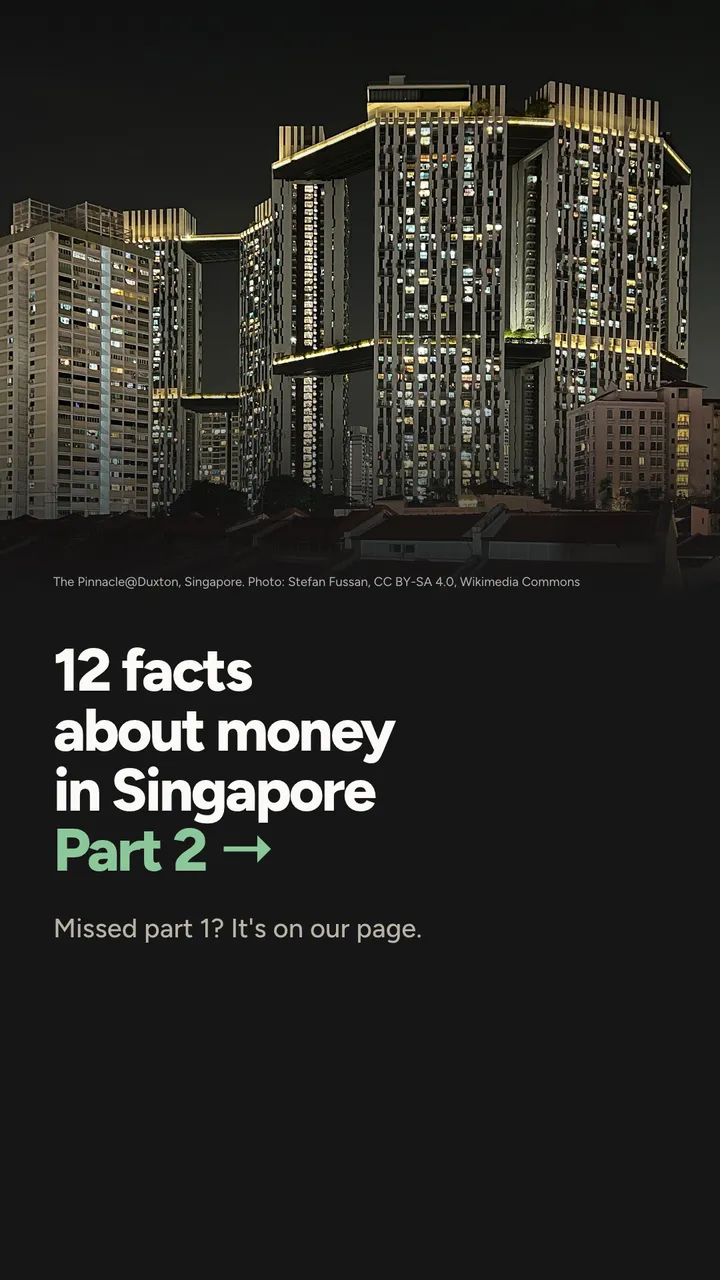
The figures are as at 26 October 2026. A few change monthly or quarterly, and I've flagged those as we go.
$300 of CDC vouchers disappear on 31 December
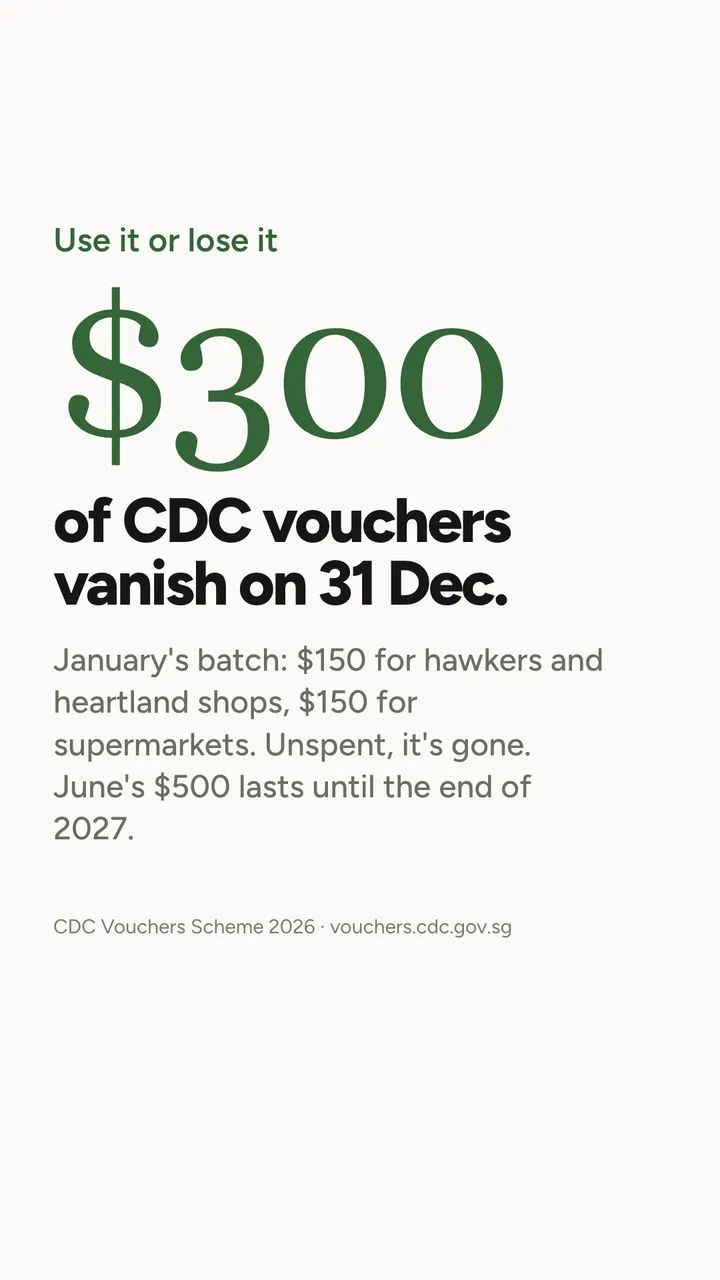
CDC vouchers come in batches, and each batch has its own expiry. January's $300 was split in two: $150 for hawkers and heartland merchants, and $150 for participating supermarkets. That batch ends on 31 December 2026. June's $500 batch runs until the end of 2027, so the two don't expire together.
What it looks like in a real household
Say the Tan household has spent $90 of January's hawker half and $60 of the supermarket half. That leaves $60 and $90, so $150 that will simply stop existing on 1 January. That's a couple of weeks of groceries for a small family, or a fair number of plates of chicken rice.
What this means for you: open the voucher link before December gets busy and check which batch your balance belongs to. A common mix-up is assuming everything expires at the end of 2027 because the newest batch does.
A card balance costs about $23 a month for every $1,000
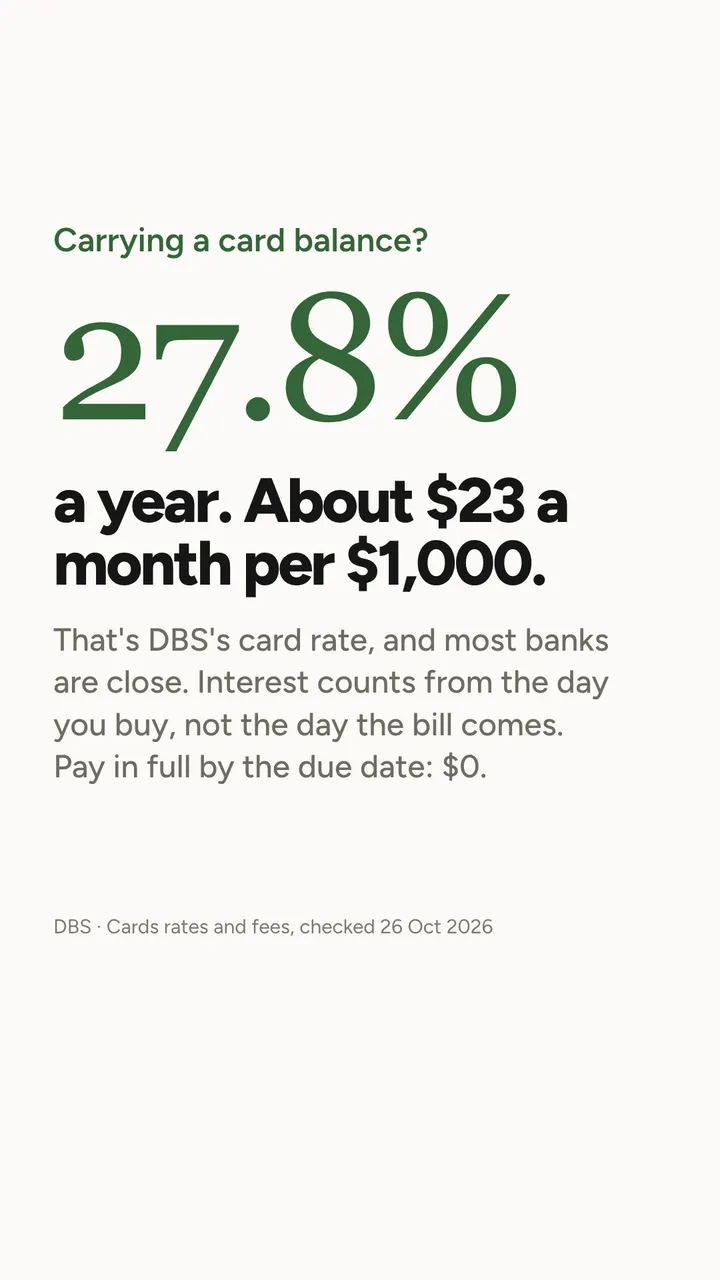
A credit card is free to use as long as you pay the full statement balance by the due date. The moment you pay less, two things happen. Interest starts at the card's rate, 27.8% a year at DBS when we checked (other banks are close), and it's counted from the day of each purchase, not from the day the statement arrives.
The arithmetic
- 27.8% a year, divided by 12 months: about 2.32% a month
- On a $1,000 balance: $1,000 × 2.32% = about $23 a month
- Leave $3,000 unpaid for three months: roughly $70 a month, so about $210, before any late fee
That's interest on money you've already spent. The same purchases, paid in full on time, cost $0 in interest.
What this means for you: if you can only pay part of a bill one month, it's worth knowing that the "minimum payment" on the statement avoids a late fee but not the interest. I used to think those were the same thing. They aren't.
The interest your bank pays you isn't taxed
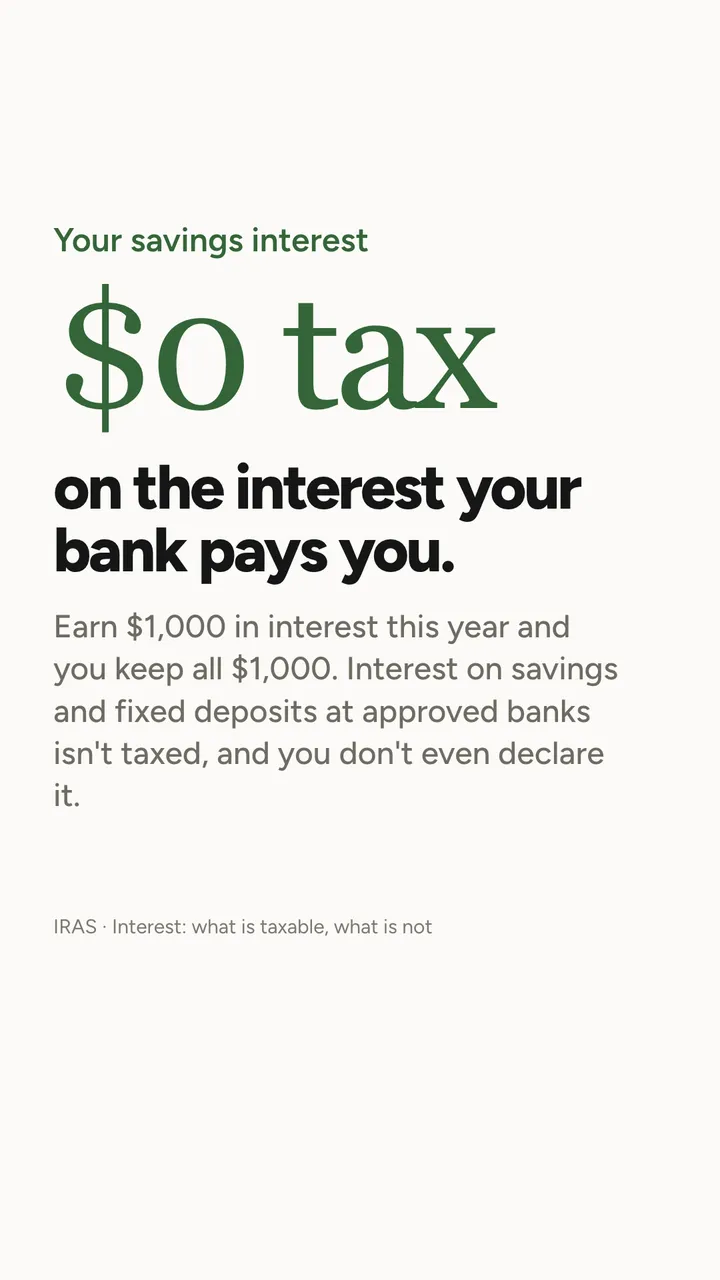
This one is good news, and a lot of people don't know it. In Singapore, interest an individual earns on savings accounts and fixed deposits with approved banks and finance companies isn't taxable, and you don't put it on your tax return at all.
An example
Say Wei Ling earns $1,000 in interest across her savings account and a fixed deposit this year. Her income tax bill doesn't change by a cent. She keeps all $1,000, and there's nothing to declare.
What this means for you: when you compare two places to keep savings, the interest rate on each is the number to compare, with no tax to take off. It also means the interest won't show up anywhere on your tax assessment, so don't go looking for it there (yes, I went looking).
Singapore Savings Bonds: 2.45% a year, and you can leave any month
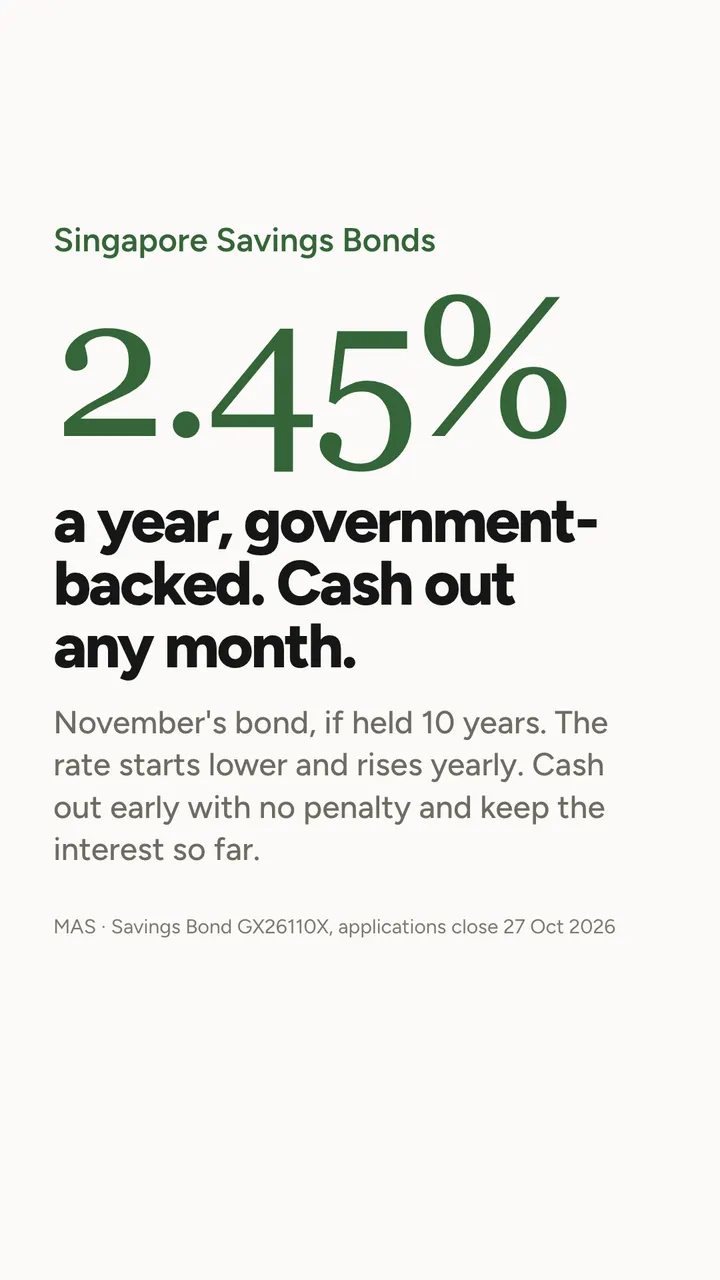
A Singapore Savings Bond (SSB) is a bond issued by the Singapore government and run by MAS. Each month there's a new one with its own rates, and November's, GX26110X, averages 2.45% a year if you hold it for the full 10 years. The rate steps up: it's lower in the first year and higher in later years, which is why the 10-year average is the number on the slide.
The part people miss is the exit. You can redeem in any month, with no penalty, and you keep the interest you've earned so far. You just don't get the higher later-year rates you didn't stay for.
Roughly how it adds up
Say Daniel puts $10,000 into one bond and holds it all ten years. At an average of 2.45% a year, that's roughly $245 a year on average, or about $2,450 over the decade, paid out to him along the way. If he redeems after year three, he keeps the interest from those three years, which is less than 2.45% a year because the early rates are the lower ones.
What this means for you: applications for November's bond closed on 27 October, and each month's bond has its own rate. If SSBs interest you, the MAS page shows the current one and its application window.
A first-time family can get up to $230,000 in grants for a resale flat
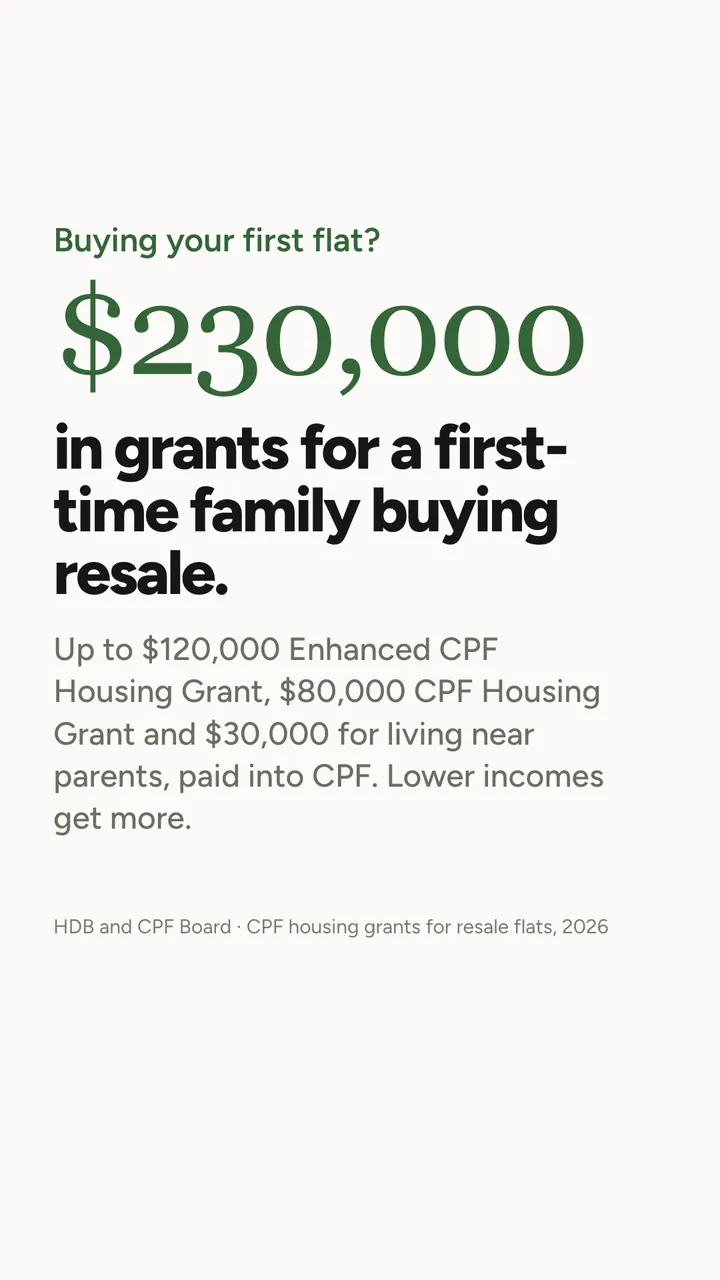
There are three grants stacked on this slide:
| Grant | Up to |
|---|---|
| Enhanced CPF Housing Grant (EHG) | $120,000 |
| CPF Housing Grant | $80,000 |
| Proximity Housing Grant, for living with or near parents | $30,000 |
| Total | $230,000 |
Two things are worth knowing. The money is paid into your CPF Ordinary Account (OA) and used for the flat, not handed over as cash. And the EHG is means-tested: lower household incomes get more, so "up to" really means up to.
What this means for you: before you set a budget for a resale flat, it's worth checking which grants your household actually qualifies for on HDB's page. It can move the price range you can look at by a lot.
An HDB loan still leaves a quarter of the price to you
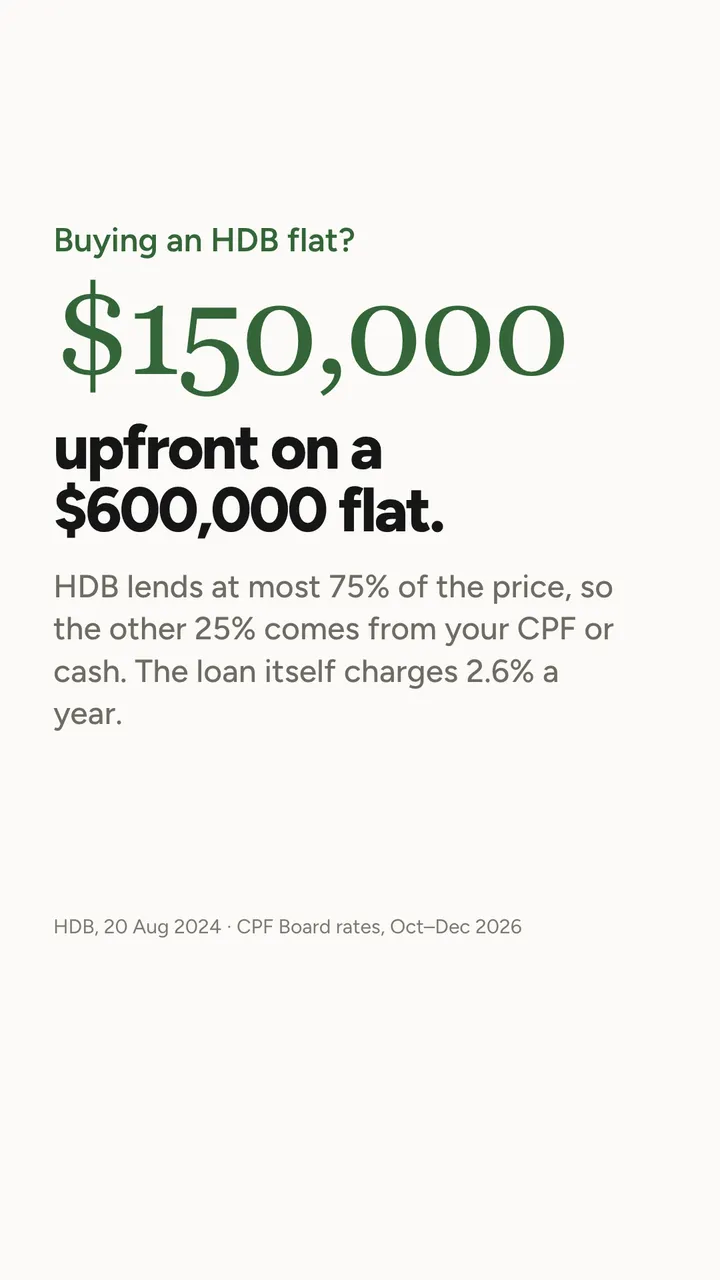
HDB lends at most 75% of the flat's price (and, as I found out, it works from the lower of the price and the valuation). The remaining 25% comes from your CPF OA, cash, or both. The HDB loan's interest rate is pegged at 0.1% above the CPF OA rate, which is why it's 2.6% while the OA earns 2.5%. The OA rate is reviewed every quarter, so this one can change.
The arithmetic
- Price: $600,000
- Largest HDB loan: $600,000 × 75% = $450,000
- Upfront: $600,000 − $450,000 = $150,000, from CPF, cash or both
And if the valuation comes in at, say, $590,000? The loan is worked out on $590,000, so the $10,000 gap is added to what you pay upfront, in cash. That was my evening with the calculator.
What this means for you: "upfront" is bigger than the deposit people talk about over kopi. It's worth adding stamp duty and legal fees to the list too, since those aren't paid from the loan either.
At most 30% of your income can go to an HDB or EC loan
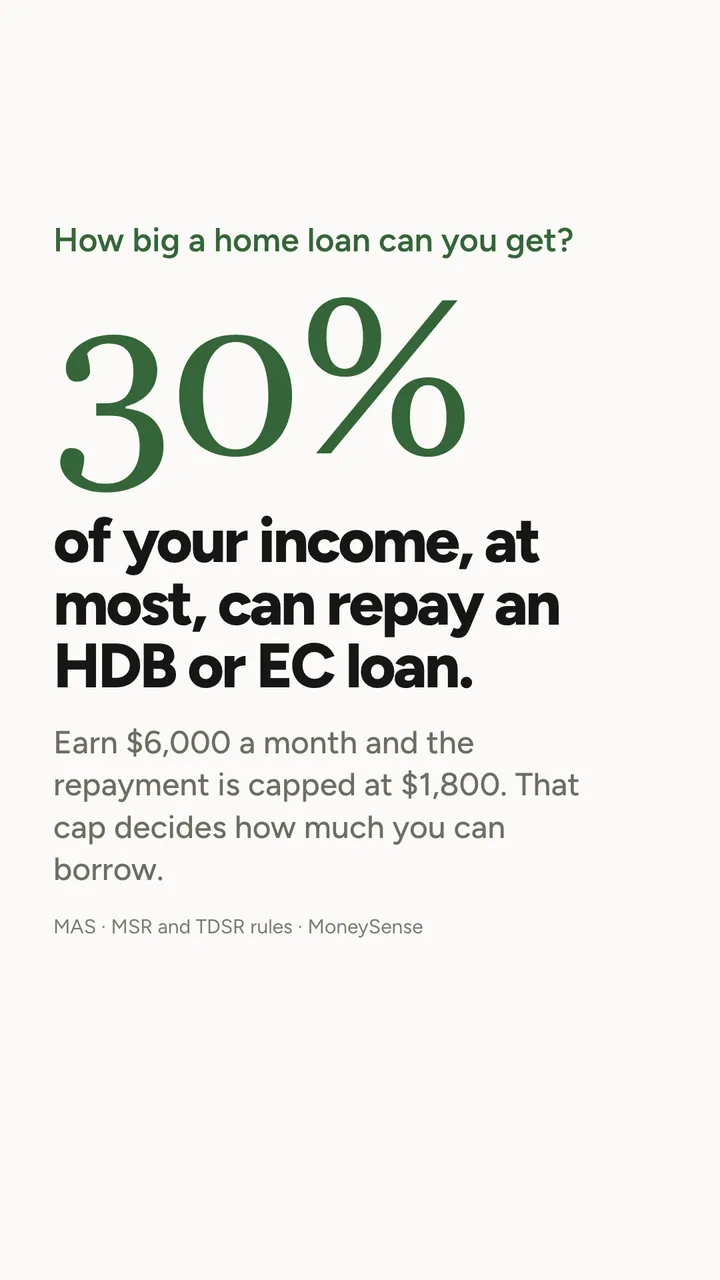
The Mortgage Servicing Ratio (MSR) is a rule that the monthly repayment on a loan for an HDB flat or an Executive Condominium (EC) can't be more than 30% of your gross monthly income. There's a separate, wider cap called the Total Debt Servicing Ratio (TDSR), which counts all your debts together, but the MSR is the one that usually decides how much an HDB buyer can borrow.
An example
Say Mei and Jun earn $6,000 a month together. Their repayment can be at most $6,000 × 30% = $1,800 a month. The bank or HDB then works backwards: at a given interest rate and loan length, what loan has a repayment of $1,800? That number, not the flat you like, sets the ceiling.
What this means for you: the cap is on the repayment, not the loan amount, so a longer loan or a lower rate can change what you can borrow. A raise changes it too. It's worth knowing your own 30% figure before viewing flats.
A car needs 40% of its price upfront
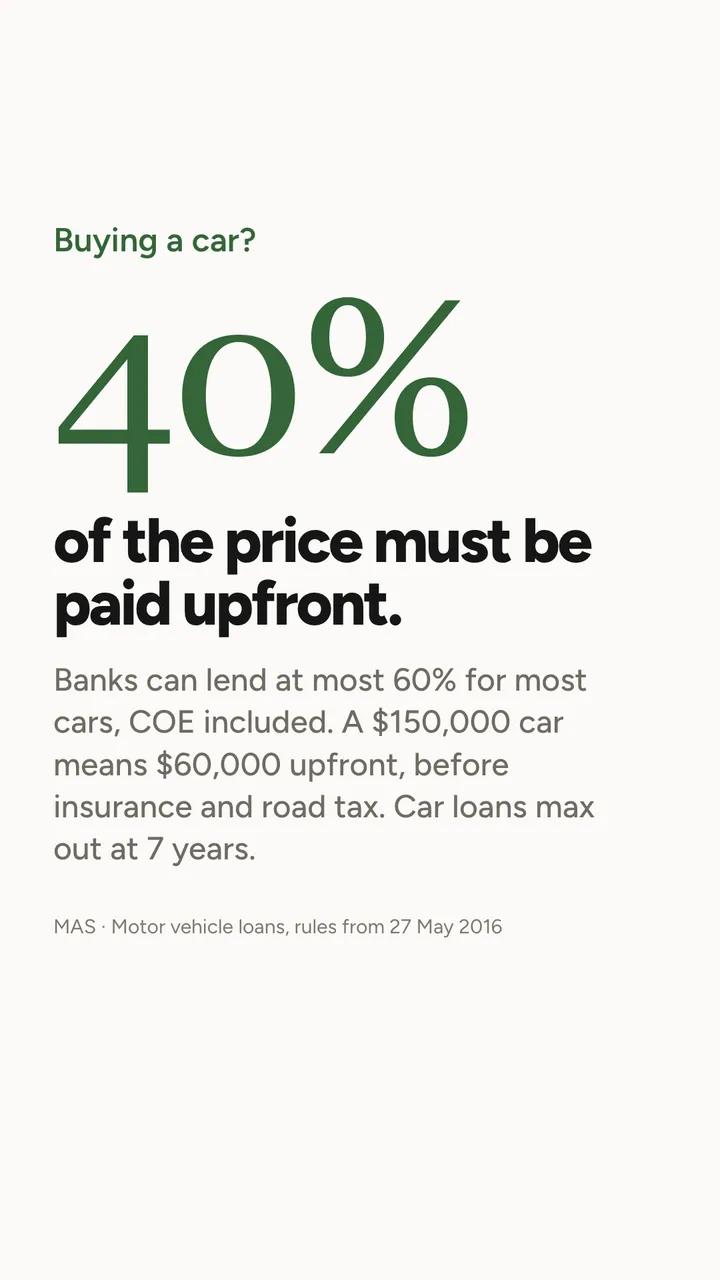
MAS limits car loans. For most cars, the loan can be at most 60% of the price, and the price includes the COE. The longest loan allowed is 7 years.
The arithmetic
- Car price, COE included: $150,000
- Largest loan: $150,000 × 60% = $90,000
- Upfront: $150,000 − $90,000 = $60,000
- Then insurance and road tax, on top
What this means for you: the number to save for is the upfront 40% plus the first year's running costs, not just a deposit. One misconception is that the COE is paid separately and the loan covers the car. The cap applies to the whole price.
A licensed moneylender can't charge more than the loan itself
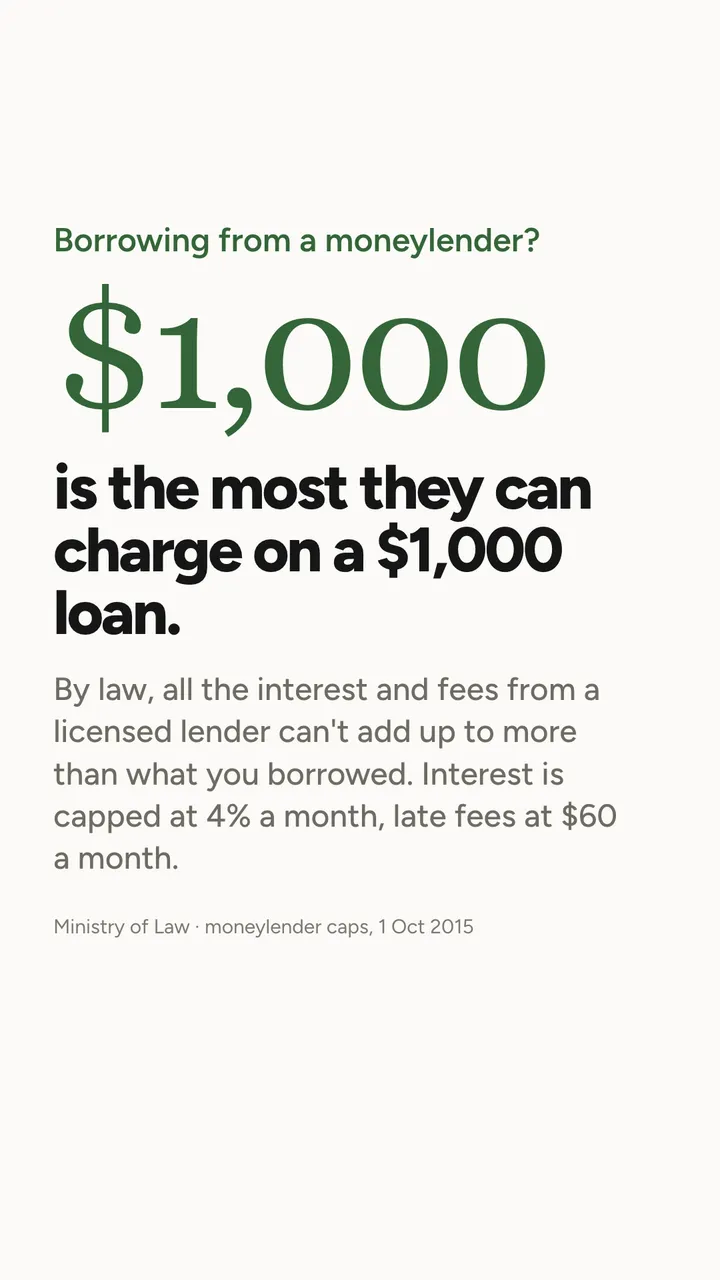
Licensed moneylenders in Singapore work under caps set by the Ministry of Law. Interest can be at most 4% a month. Late fees can be at most $60 for each month a repayment is late. And there's an overall ceiling: all the interest, late interest and fees together can't be more than the amount you borrowed.
What the caps mean on $1,000
- Interest at the 4% cap: $1,000 × 4% = $40 a month
- Over 12 months, if nothing is repaid: $40 × 12 = $480
- However long it runs, the total of interest and fees stops at $1,000, so the most you could ever owe is $2,000
4% a month sounds small next to the card rate. It isn't: 4% × 12 is 48% a year.
What this means for you: the caps only protect you with licensed lenders. The Ministry of Law keeps the list of licensed moneylenders, and it's worth checking a lender is on it before signing anything.
You have 14 days to change your mind on a life policy
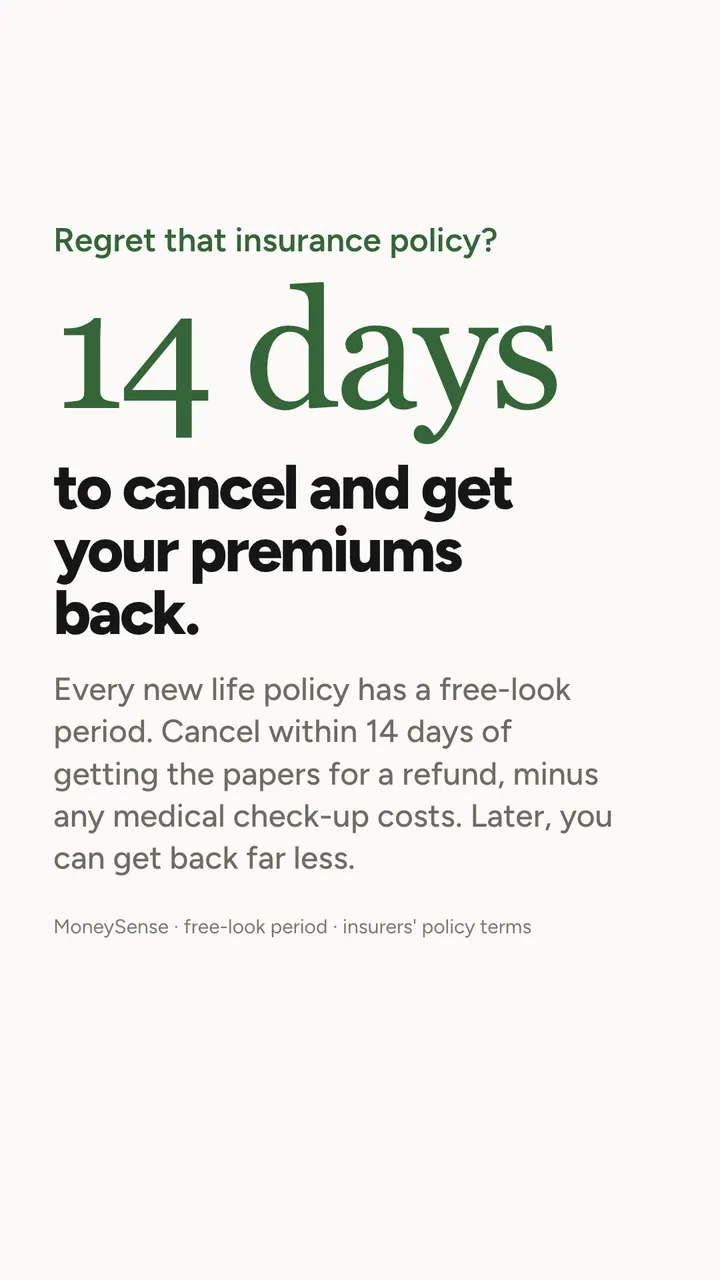
A new life insurance policy comes with a free-look period of 14 days from when you receive the policy documents. Cancel within that window and you get the premiums back, minus any costs the insurer paid for a medical check-up. After it, cancelling a policy can return far less than you paid in, especially in the early years.
What this means for you: when the papers arrive, the date on the envelope or email starts the clock. It's worth reading the cover, the exclusions and the premiums in that first fortnight, not the first year.
Your will doesn't cover your CPF
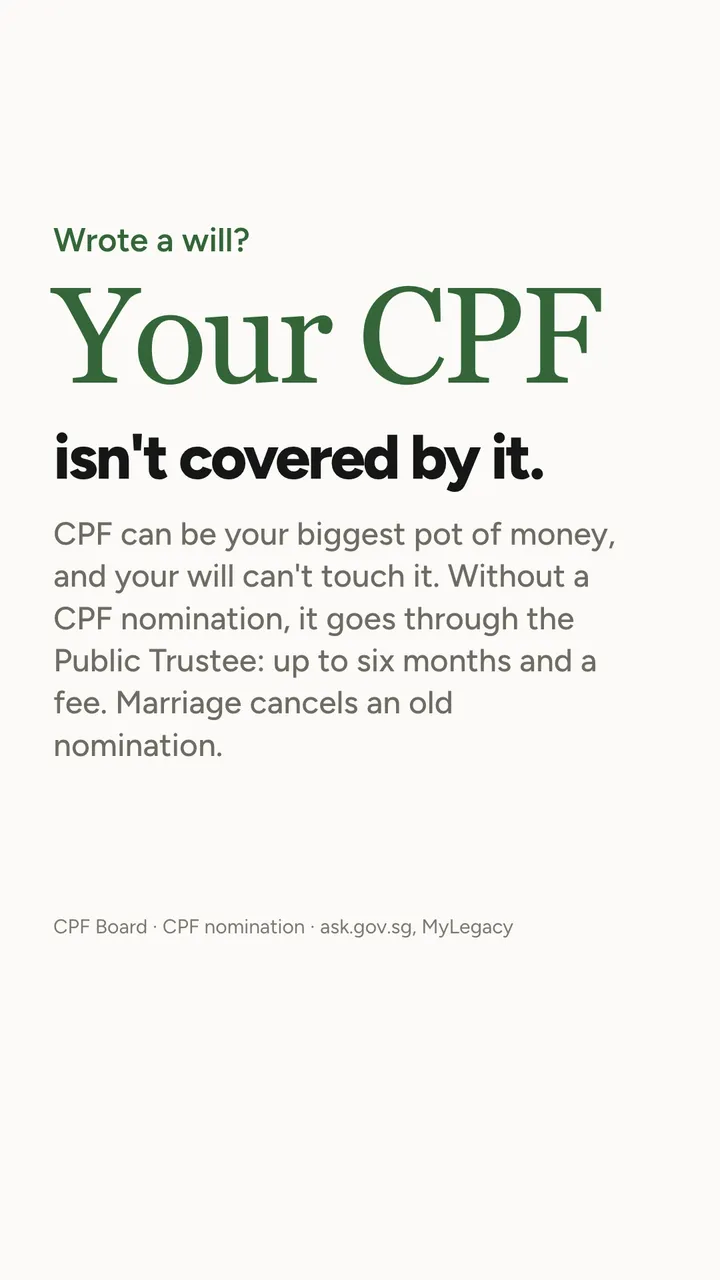
This is the one that surprises people most. CPF savings aren't distributed by your will. They go to the people named in a CPF nomination. With no nomination, they're passed to the Public Trustee, which distributes them under the law, a process that can take up to six months and comes with a fee. And getting married automatically cancels any nomination made before the marriage.
Why it matters in dollars
For a lot of people in their 30s and 40s, CPF is the biggest single pot of money they have. Say Aaron, 40, has $180,000 across his CPF accounts and a careful will. The will covers his bank accounts and shares. The $180,000 isn't covered by it at all, unless he's made a CPF nomination.
What this means for you: if you've married since you made a nomination, it's gone, so it's worth checking. A nomination can be made online through CPF, and MyLegacy has the guides.
Starting CPF LIFE at 70 pays up to 35% more a month
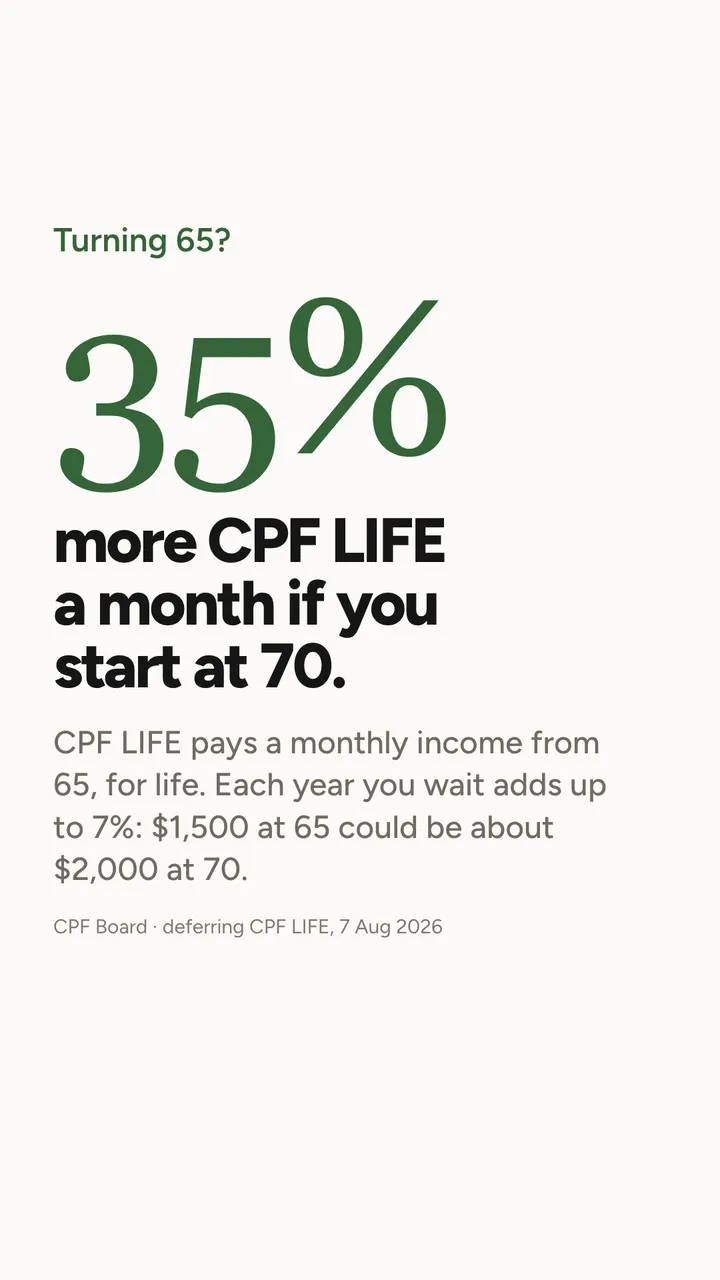
CPF LIFE is the scheme that turns your retirement savings into a monthly income for life, starting from 65. You can choose to start later, up to 70, and each year you defer raises your monthly payout by up to 7%.
The arithmetic
- Up to 7% a year × 5 years = up to 35%
- $1,500 a month at 65 × 1.35 = $2,025, which is the "about $2,000" on the slide
The trade-off is five years without the payout. Whether that makes sense depends on health, other income and what else the money needs to do, which is a personal call, not something a carousel can make for you.
What this means for you: the choice isn't fixed at 65. It's worth seeing your own estimated payouts on the CPF website at different start ages before that birthday arrives.
If you only remember three things
- A home or car loan never covers everything. 25% of an HDB flat (or more, if the valuation is lower) and 40% of a car are upfront.
- Your will doesn't cover your CPF. A nomination does, and marriage cancels an old one.
- $300 of CDC vouchers ends on 31 December. June's $500 runs to the end of 2027.
How I keep track of this
That evening with the valuation letter would have been shorter if I'd had everything in one place. These days I do. In Sum, my bank accounts, both credit cards, our HDB loan and my CPF accounts sit in one net worth, which is free to start, and bill reminders tell me before each card is due, so the 27.8% never gets a chance to start. CPF projections are on the Essential plan, and property valuation and Insights are on Pro.
None of that decides anything for me. It just means that when one of these twelve facts suddenly matters, the numbers I need are already in front of me, not in a folder at my parents' place.
Which of the twelve was new to you? Tell me at [email protected]. Part 3 is already forming.
Talk soon, Brandon
Try the numbers yourself

Sum is launching in Singapore soon.
Your banks, cards, CPF and HDB flat, added up into one net worth. Statements sorted, card caps tracked, bills remembered.
Brandon · Finance team, Sum
Brandon is on Sum's finance team in Singapore. Brandon reads the CPF Board, IRAS and MAS updates so you don't have to, and turns our carousels into the longer version. Questions, corrections or something to share? Email Brandon at [email protected].
Got something interesting to share?
A money story, a question, something we got wrong, or a tip other Singaporeans should hear. Reach out to me at [email protected], or leave your email and I'll write to you.
Sources: CDC Vouchers Scheme; DBS: Cards rates and fees (checked 26 Oct 2026); IRAS: Interest, what is taxable and what is not; MAS: Singapore Savings Bonds (GX26110X); HDB: CPF housing grants for resale flats, and HDB housing loans; CPF Board: Using your CPF to buy a home; MAS: Housing loan rules (MSR and TDSR); MAS: Motor vehicle loans; Ministry of Law: Borrowing from licensed moneylenders; MoneySense; MyLegacy: CPF nomination and estate planning; CPF Board: CPF LIFE.
Any app screens shown use sample data, not a real person's. Sum is free to start; some features need a paid plan.
Information only, not financial advice.