Wedding season: how much angbao, and how to plan for six of them
Cover your seat: what a S$1,988++ table works out to, what a plus-one costs, and how to plan a season of weddings without a shock in December.

A Saturday morning a few weeks ago, I came back from the market and found Rachel at the shoe cabinet (the one that sticks out two centimetres into the corridor) laying out invitation cards like a hand of poker. Four of them. Red, gold, one with pressed flowers, one that was mostly a QR code.
"November, November, December, December," she said, tapping each one. Then she picked up the gold one. "This one is a hotel. So how much?"
It's a question I've answered for friends a dozen times. "Cover your seat," I said, the way everyone says it.
And then I stopped, because this year I actually know what a seat costs. We got married in the middle of this year. I have a spreadsheet with a "deposit dates" column, and I can tell you exactly how it feels to sign for the banquet and do the division in your head. Last year we were the ones opening the angbao. This year, four cards on the shoe cabinet, and we're on the other side again.
"Cover your seat" sounds like a rule. It's really a bit of arithmetic that most of us never do, plus a few decisions that nobody likes to say out loud: which weddings to go to, what to do when money is tight, and how much a season of them adds up to.
This post goes through all of it, one slide at a time: the seat maths, the plus-one, the season total, the polite ways to do less, and how I'm planning our four. The venue ranges are from the 2026 MoneySmart, Blissful Brides and Lendela guides, for Chinese wedding dinners, as at 10 November 2026.
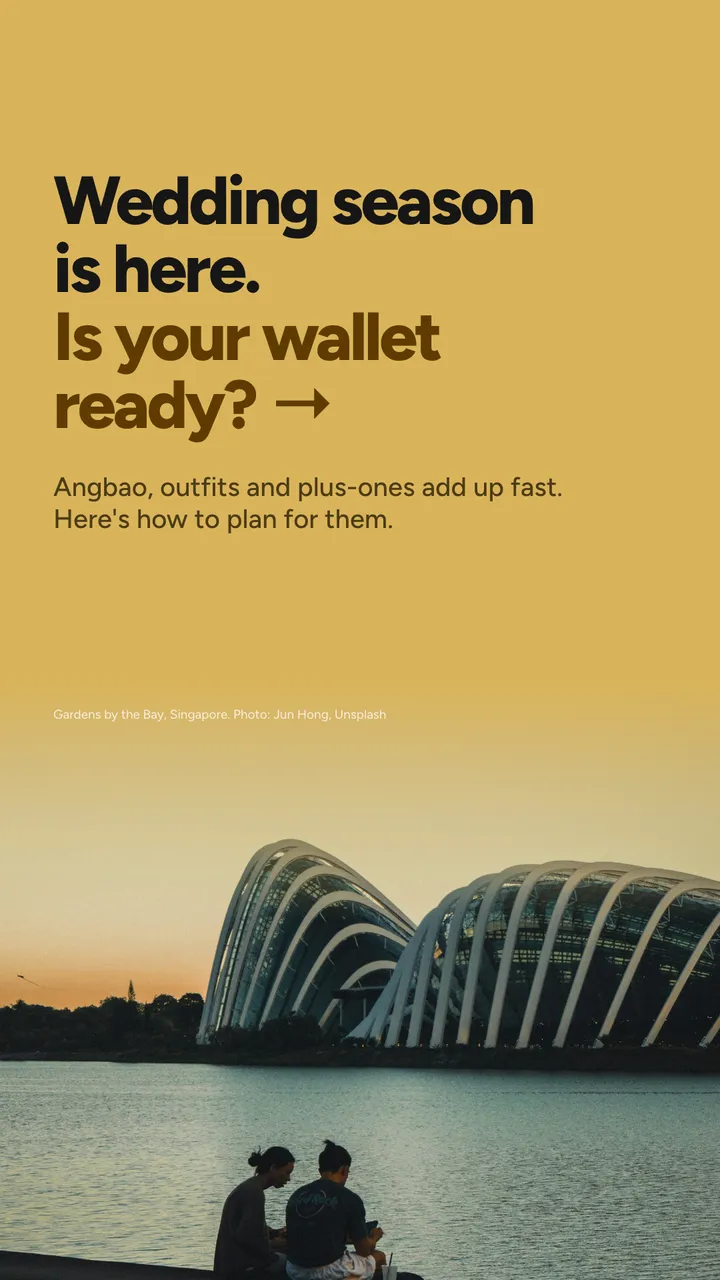
How much angbao? Start with what your seat costs
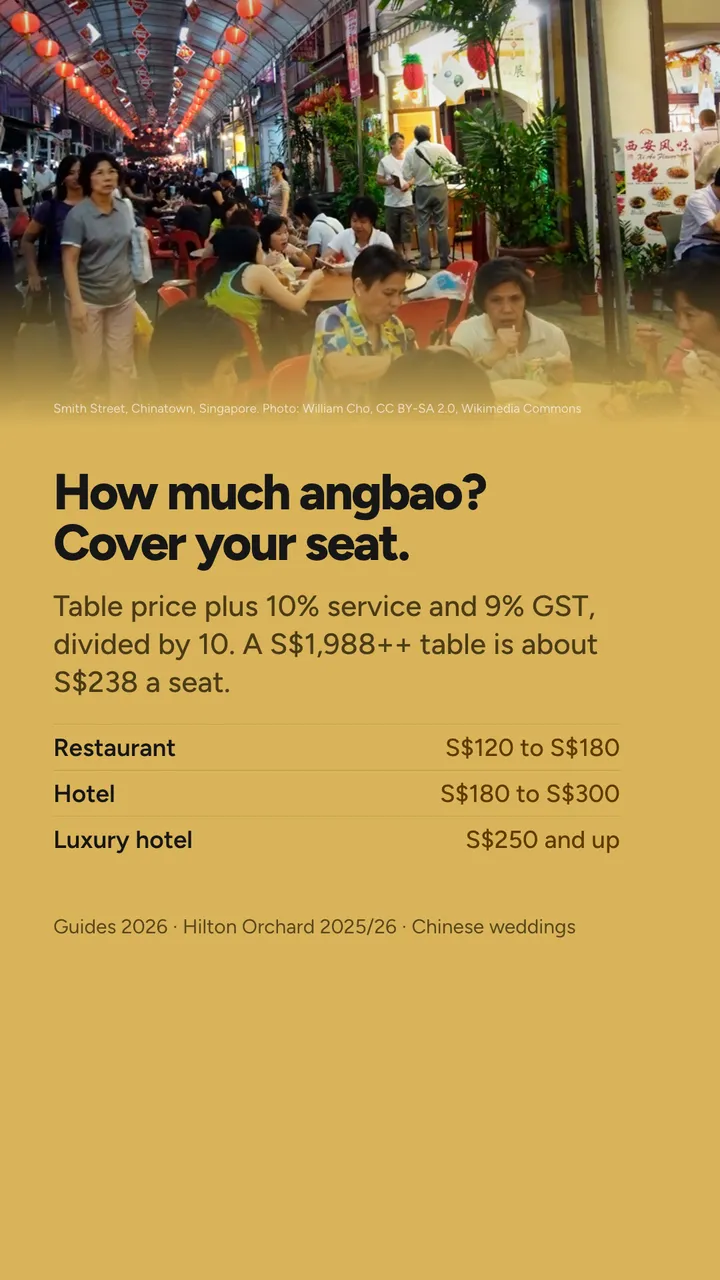
Wedding banquets in Singapore are priced per table, usually for 10 guests, and the price almost always has two plus signs after it. Those plus signs are the part people skip.
"++" means service charge and GST are added on top. The service charge is 10%. GST is 9%, and here's the bit that surprises people: GST is charged on the price including the service charge. So you don't add 19%. You multiply by 1.10, then by 1.09, which comes to about 1.199.
Here's the slide's example worked through. Hilton Singapore Orchard's 2025/26 package lists a table at $1,988++ for lunch, or for dinner Monday to Thursday.
| Step | Sum | Running total |
|---|---|---|
| Table price | $1,988.00 | |
| Add 10% service charge | $1,988 × 1.10 | $2,186.80 |
| Add 9% GST | $2,186.80 × 1.09 | $2,383.61 |
| Divide by 10 guests | $2,383.61 ÷ 10 | $238.36 a seat |
That's where "about $238" on the slide comes from.
The same hotel's price list shows how much the day matters. Friday and Sunday dinners are listed at $2,088++, which works out to $2,088 × 1.199 ÷ 10, about $250 a seat. A Saturday dinner is $2,288++, about $274 a seat. Same ballroom, same food, a different night of the week.
Most of the time, of course, you won't know the couple's package. That's what the guides' ranges are for:
- Restaurant: about $120 to $180
- Hotel: about $180 to $300
- Luxury hotel: $250 and up
They're wide because venues are. A weekday lunch at a restaurant and a Saturday dinner in a ballroom are both "a wedding".
What this means for you: look at three things on the invite: the venue, the day, and lunch or dinner. That tells you which end of the range you're in. And when you see "++", remember it's about 20% on top, not a rounding error.
A plus-one means two seats
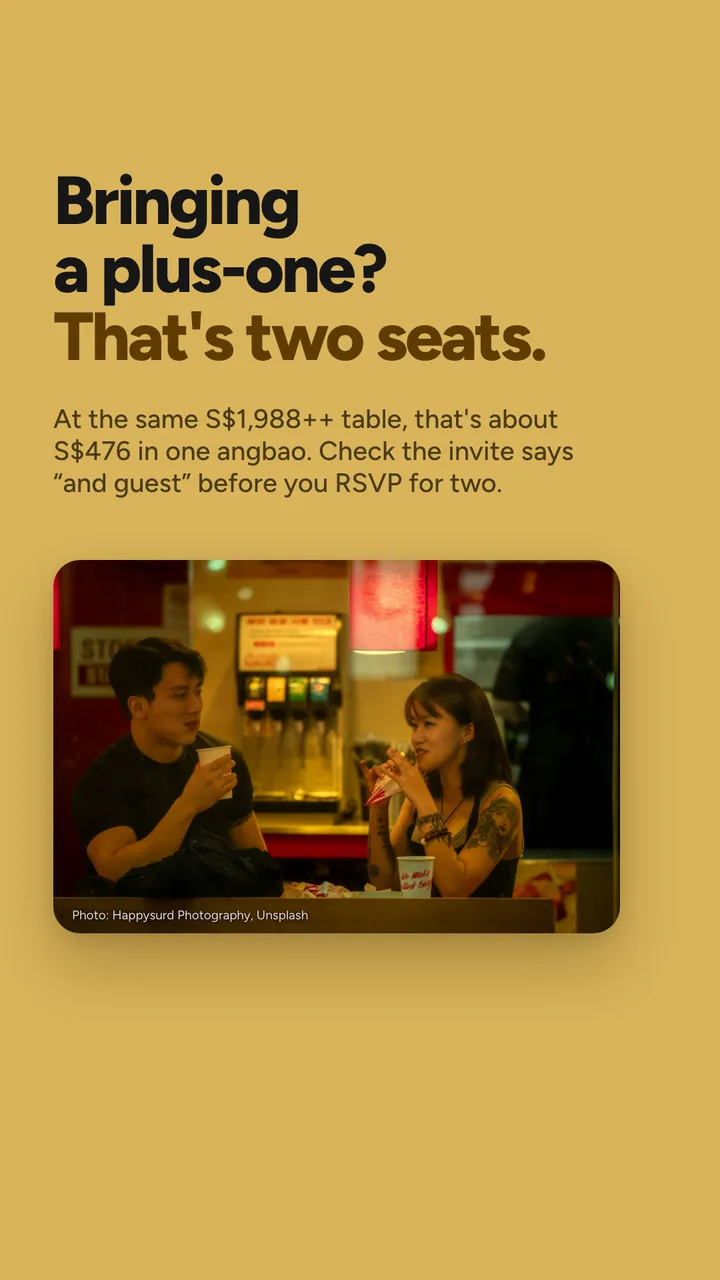
This one is simple arithmetic, and still the one people are most likely to get wrong. If you bring someone, the couple pays for a second seat. At the same table, that's 2 × $238 = about $476, usually in one angbao from the two of you.
The other half of the slide matters just as much. Check the invite says "and guest" (or has both your names) before you RSVP for two. Seating plans are worked out table by table, and a surprise extra person can mean the couple paying for a seat they hadn't planned, or a cousin squeezed onto the end of someone else's table.
Say Jia Min is invited to a former colleague's hotel dinner on a Saturday. This is made up, but it's ordinary. On her own, at about $274 a seat, she might give $280. If the invite says "and guest" and she brings her boyfriend, it's two seats: about $548, so she might put $550 in one angbao between them.
What this means for you: the plus-one decision is also a money decision. If the invite is for one, the kind answer is one. If it's for two, budget for two seats, not one and a bit.
Six weddings adds up to more than you'd think
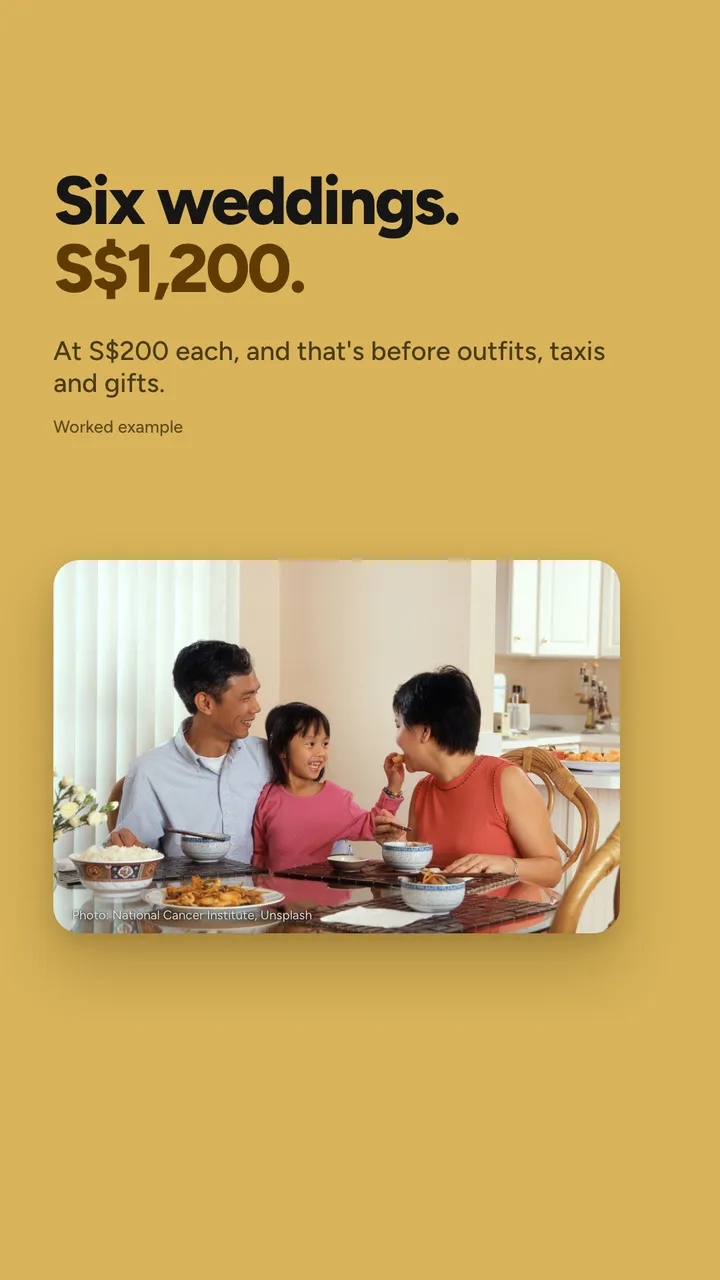
Every wedding on its own feels manageable. The trouble is that they don't come on their own. In Singapore, November and December are a season: school holidays, auspicious dates, year-end leave. Invites arrive one after another, and each angbao is paid out of the same month's money.
The slide's example is deliberately round: 6 weddings × $200 = $1,200. And that's only the angbao. Outfits, taxis home after a late dinner, and the occasional gift for a wedding you can't attend all sit on top.
Here's a more uneven season, worked out. Say Darren, 29, has six invites. Made up again.
| Wedding | Seats | Angbao |
|---|---|---|
| Restaurant lunch, friend | 1 | $150 |
| Restaurant dinner, cousin | 1 | $160 |
| Hotel weekday dinner, colleague | 1 | $240 |
| Hotel Saturday dinner, NS friend | 1 | $280 |
| Hotel Saturday dinner, close friend, with his girlfriend | 2 | $550 |
| Luxury hotel, school friend | 1 | $300 |
| Total | $1,680 |
Add $20 a wedding in taxis and one new shirt at $60, and Darren's season costs about $1,680 + $120 + $60 = $1,860. If he takes home $3,800 a month, that's almost half a month's pay over eight weeks, on top of the usual bills, and on top of December.
It's not that any single angbao is too much. It's that nobody adds them up in advance, so the total arrives the way a credit card bill does: all at once, in January.
What this means for you: before the season starts, write down every invite you have and a rough figure beside each. The total is the number to plan around, not the angbao in front of you.
You don't have to go to every one
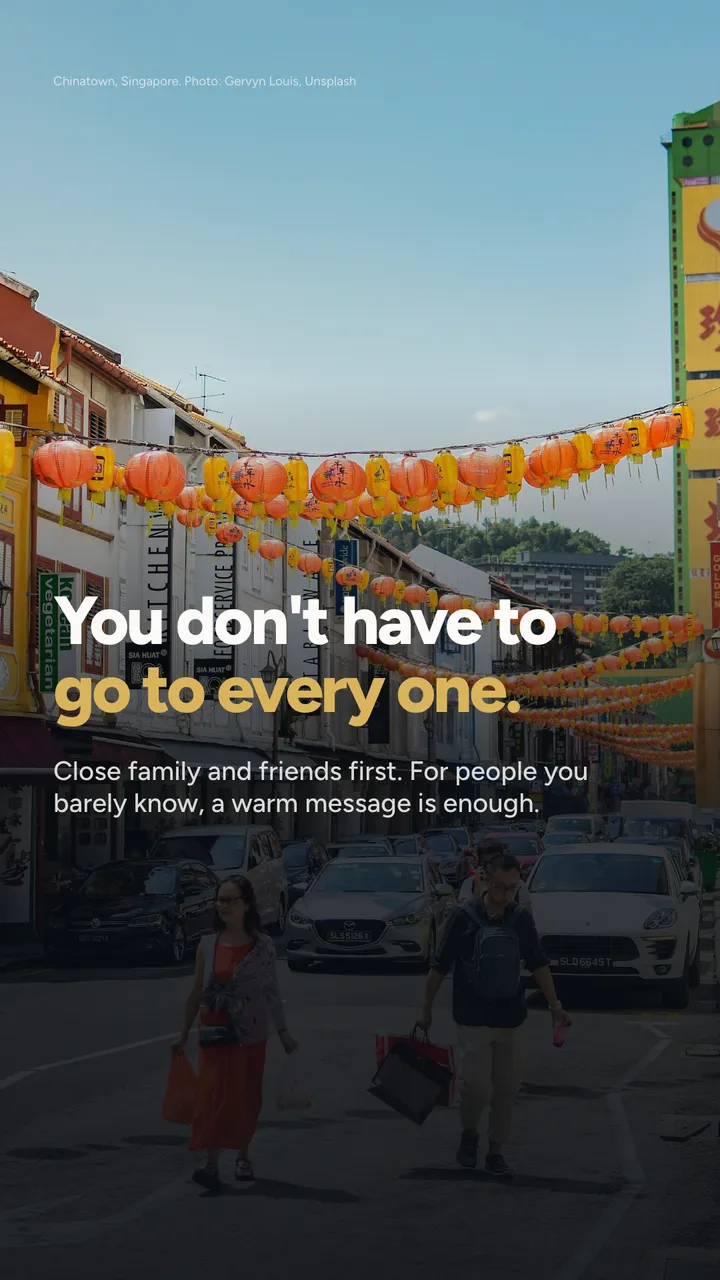
This is the slide I expect some people to disagree with, and I understand why. Turning down an invite can feel rude, and in a lot of families, attendance is noticed.
But here's the thing: an invite is an invitation, not an invoice. Couples invite widely because seating plans need filling and because they don't want anyone to feel left out. Most of them aren't keeping score.
A simple way to sort a season:
- Close family and close friends. Go, if you possibly can. These are the ones you'll remember too.
- Friends and colleagues you see often. Go if it fits the season's budget. If it doesn't, the next section is for you.
- People you barely know. A colleague from another department, a friend of a friend. A warm message, sent before the day, is enough. Something like: "Congratulations to you both. I can't make it, but I hope the day is everything you want."
What this means for you: sort the list before you RSVP, not after. Saying no early is kinder to the couple's seating plan than saying yes and changing your mind in week three.
Can't afford it? Tell them early, and visit after
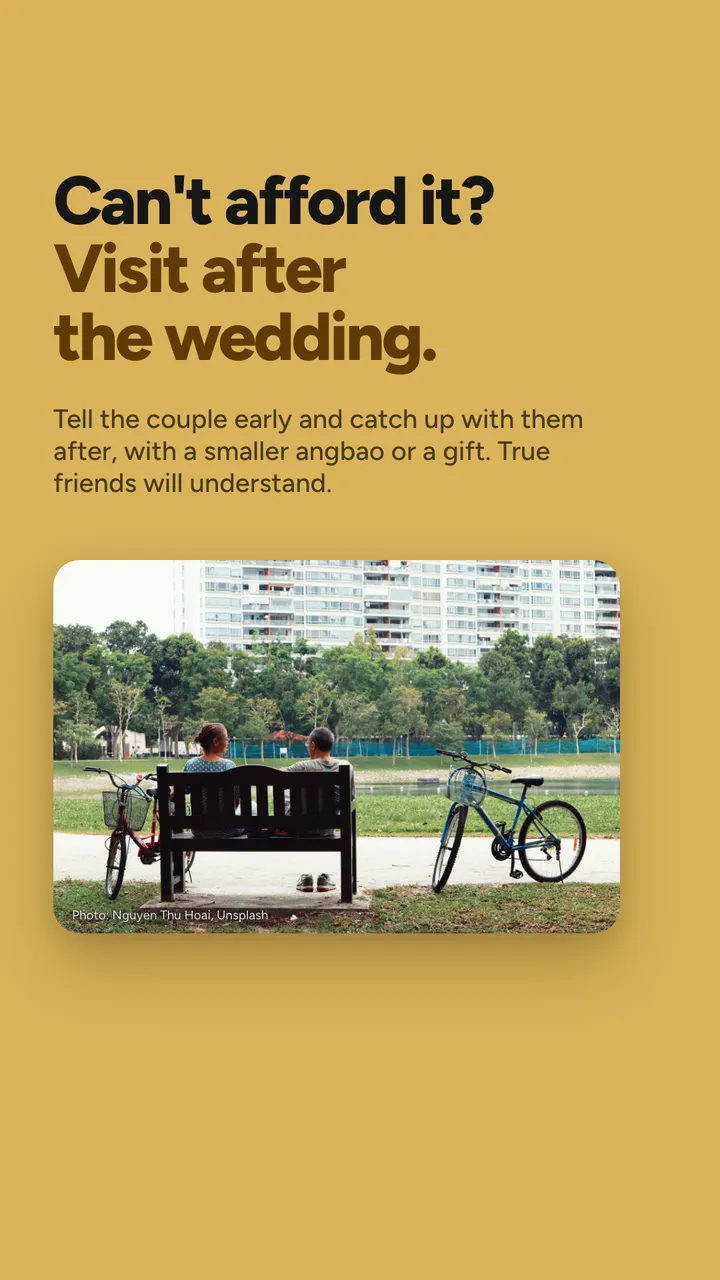
Sometimes a wedding matters to you, and the money isn't there. A new job, a flat, a month with a big bill. That's not a failure of friendship. It's a normal month.
The slide's suggestion is the one I'd give a friend: tell the couple early that you can't make it, then catch up with them after, with a smaller angbao or a gift. Early matters, because it lets them give the seat to someone else instead of paying for an empty chair.
Then the catch-up. A dinner a few weeks later, just the three of you, is often the conversation you'd never have had at the banquet anyway. At a banquet you get five minutes during the table round, shouting over the yam seng. Over a quiet dinner you get the story of the wedding.
Say Mei Xin is two months into a new role and has three December invites. Made up. She goes to her cousin's, sends a card and a message to a colleague, and tells her university friend in November that she can't make it but would love to take them out in January. She gives a smaller angbao then, and it's the dinner they both remember.
What this means for you: if you can't go, say so early and say what you'll do instead. True friends will understand. In my experience, the couple is mostly relieved to have an answer.
One good outfit for the whole season
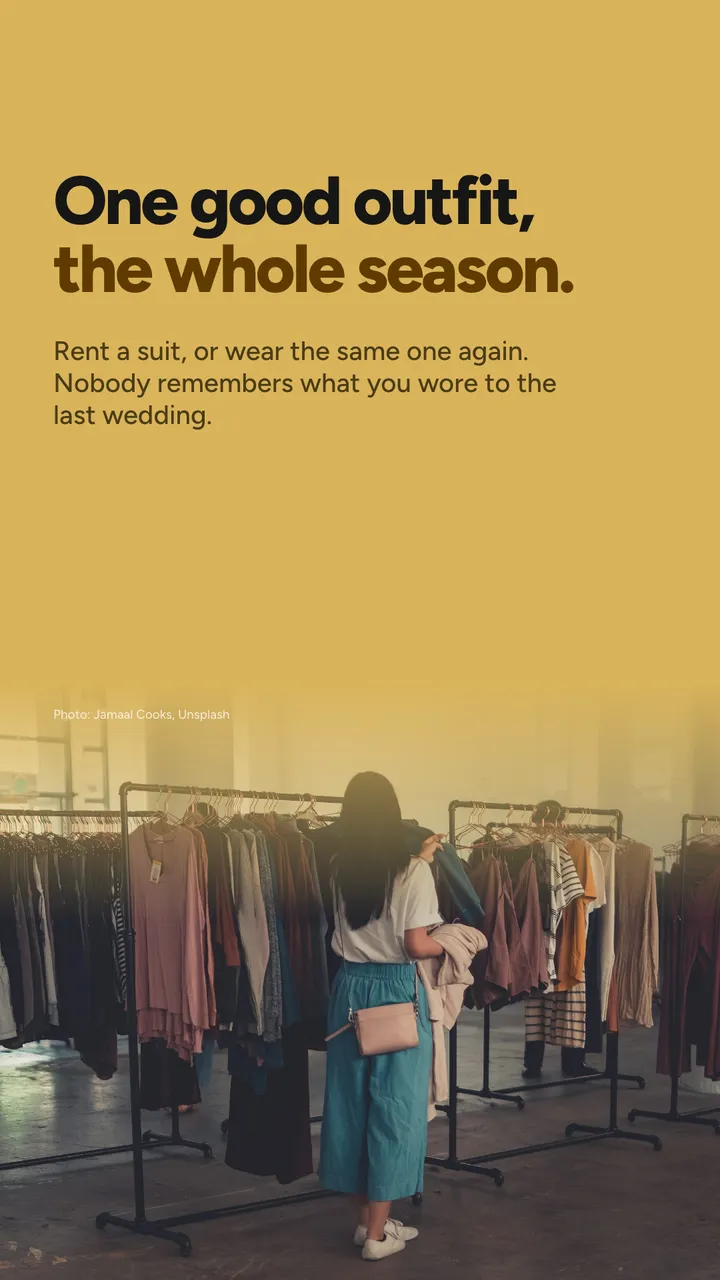
A wedding season can quietly become a shopping season. A new dress for one, a new shirt for the next, because the same friends will be at both.
They won't remember. People at a wedding are looking at the couple, the food and their phones, roughly in that order. Nobody is keeping a record of what you wore in November.
So the slide's suggestion is to pick one good outfit and wear it all season. Or rent one: suit and dress rental is common enough now for one evening. If an outfit costs $150 and you'd otherwise buy a new one for three of six weddings, wearing one outfit again saves $150 × 2 = $300, before shoes.
My own plan is the least glamorous one possible. I'm wearing my wedding suit. It fits, it was made to be worn, and having paid for it once, I'd like it to come out of the cupboard more than once.
What this means for you: decide on the outfit when you sort the invites, not the night before. "What am I wearing?" at 10pm is how a $150 shirt ends up in a basket.
If you only remember three things
- Cover your seat means the table price × 1.10 × 1.09 ÷ 10. A $1,988++ table is about $238 a seat, and the day of the week changes it.
- A plus-one is two seats, and only if the invite says "and guest".
- Add up the season before it starts. The total is the number to plan around, and it's fine to do less: a warm message, or a visit after.
How I keep track of this
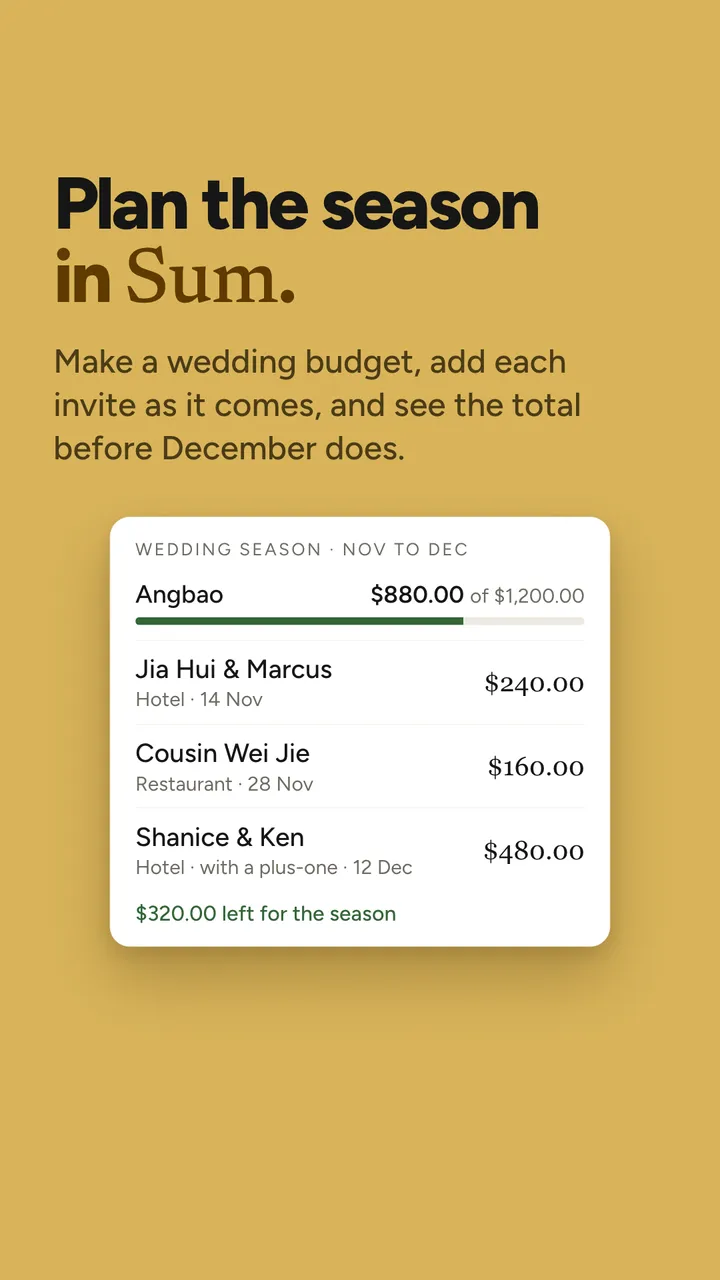
Sum is free to start, and budgets are on the free plan. The slide shows the way I'm doing our season this year: one budget for the whole wedding season, with a limit set before the first invite.
In the sample on the slide, the budget is $1,200. Three invites are in so far: a hotel on 14 November at $240, a restaurant on 28 November at $160, and a hotel with a plus-one on 12 December at $480. That's $240 + $160 + $480 = $880, so the bar is about 73% full, and $1,200 − $880 = $320 is what's left for the season. When the next invite comes, it goes straight in, and you see the new total before you RSVP, not after.
What I like about it is the order of things. The spreadsheet I used for our own wedding told me what we'd spent. This tells us what's left before we decide. If a fifth card arrives in December, I'll know whether it fits, or whether it's a warm message and a dinner in January.
The rest is my usual routine: on the 1st of the month I import last month's card statements with a kopi, Sum sorts every line, and I check the three biggest categories. In December, I already know one of them will be gifts.
The four cards are still on the shoe cabinet, now with sticky notes from Rachel on each one ("lunch", "dinner, Sat", "+1?", "hotel"). The "+1?" has been resolved. The suit has been to the dry cleaner. And all four are in one budget, with a little left over, which in December is the best kind of number.
If your season has a question this post didn't answer, tell me at [email protected].
Talk soon, Brandon
Questions people ask
How much angbao should I give at a Singapore wedding in 2026?
A common rule is to cover your seat: the table price plus 10% service charge and 9% GST, divided by the 10 guests at a table. The 2026 MoneySmart, Blissful Brides and Lendela guides put Chinese wedding dinners at roughly S$120 to S$180 at a restaurant, S$180 to S$300 at a hotel and S$250 and up at a luxury hotel.
What does ++ mean on a wedding table price?
It means service charge and GST are added on top. Service charge is 10%, and the 9% GST is charged on the price including service charge, so a S$1,988++ table costs S$1,988 x 1.10 x 1.09, about S$2,383.61, or about S$238 a seat at a table of 10.
How much angbao for a plus-one?
A plus-one takes a second seat, so the usual way to think about it is two seats in one angbao. At a S$1,988++ table that is about S$476.
What if I can't afford to attend a wedding?
You can tell the couple early that you can't make it and catch up with them after the wedding, with a smaller angbao or a gift. For people you barely know, a warm message is enough.

Sum is launching in Singapore soon.
Your banks, cards, CPF and HDB flat, added up into one net worth. Statements sorted, card caps tracked, bills remembered.
Brandon · Finance team, Sum
Brandon is on Sum's finance team in Singapore. Brandon reads the CPF Board, IRAS and MAS updates so you don't have to, and turns our carousels into the longer version. Questions, corrections or something to share? Email Brandon at [email protected].
Got something interesting to share?
A money story, a question, something we got wrong, or a tip other Singaporeans should hear. Reach out to me at [email protected], or leave your email and I'll write to you.
Sources: MoneySmart: Wedding ang bao rates; Blissful Brides: Wedding ang bao rates 2026; Lendela: Wedding angbao guide; Hilton Singapore Orchard: 2025/2026 wedding packages (PDF); IRAS: Current GST rates.
Any app screens shown use sample data, not a real person's. Sum is free to start; some features need a paid plan.
Information only, not financial advice.