5 hidden costs of being a woman in Singapore, and how to plan for each
The pink tax, upkeep, period products, caregiving and a longer retirement: what each one costs women in Singapore, and how to plan for it. By Jacqueline from Sum.

Why I made this deck

A while ago I was standing in the NTUC aisle on a weeknight, tired, with two razors in my hand. Same brand, same blades, same everything, as far as I could tell. One was pink, and the pink one cost more. I bought the other one and was annoyed the whole bus ride home.
That small moment is where this deck started. Once I'd noticed one cost like that, I kept noticing others, and most of them were much bigger than a razor. Some are charged to women at the checkout. Some are expected of us, every week or every month, without anyone calling them costs at all. And a couple only show up decades later, in a CPF statement.
I'm not on the finance team, so this isn't an explainer. It's what I've seen, in my own life and my mum's, with the numbers backing it up. Every cost comes with a way to plan for it, because noticing a cost is only useful if you can do something about it.
The deck runs small to big, like a timeline: the checkout, every week, every month, the career years, retirement, and then the one thing nobody has enough of.
The pink tax: same product, higher price

The pink tax isn't a tax in the government sense. It's the name for a pricing habit: a product made or packaged for women costs more than a near-identical one, for no reason you can see on the shelf. Razors are the classic example. The Straits Times explained it well back in 2018.
What annoys me most is that it's small. Ten or twenty cents here, a dollar there. Small enough that you'd feel silly complaining, and frequent enough that it adds up over years of shopping.
I think it's unfair, plainly. But I've also found it's one of the easiest costs on this list to dodge.
Worth checking: the price per unit on the shelf label, not just the price. And the plain or unisex version of the same thing, which is often sitting on the shelf next to it.
Presentable is mandatory
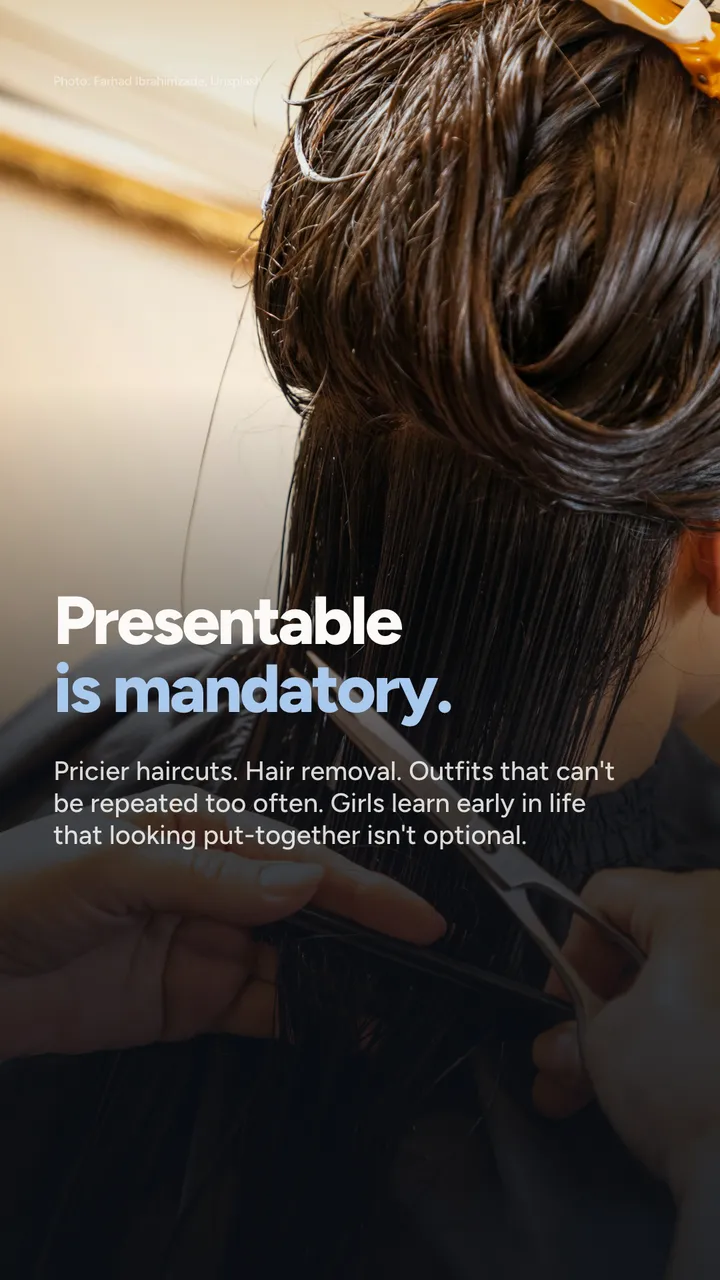
This one is less about prices and more about expectations. Nobody hands you a rule book, but somewhere around secondary school you learn it anyway: the haircut has to be kept up, the hair removal has to be done, and the same outfit can't show up at work three Mondays in a row.
I want to be careful here, because this isn't about whether women like looking nice. Plenty of us do, and that's fine. The point is that a lot of this isn't optional. It's part of being taken seriously at work, at a wedding, in a client meeting. And when something isn't optional, it's not a treat. It's a cost.
The trouble is that it rarely gets budgeted like one. It sits somewhere between "shopping" and "self-care", gets mentally filed as a splurge, and then comes with a side of guilt every time.
Worth checking: give it a proper line in your budget, under something like personal care, with a monthly amount you've decided on in advance. Then spending it isn't a lapse. It's the plan.
Pads every month, for decades

I nearly didn't put this slide in, because it feels so obvious. Then I asked a few friends whether period products had their own line in their budget, and not one of them did. They just came out of "groceries" or "miscellaneous", every month, for decades.
That's the thing about this cost: it's not big in any one month, but it never stops. It starts in your early teens and keeps going for something like forty years.
My view is simple. A cost you will pay every single month, with no choice, is a fixed cost, like your phone bill. It should be planned for like one.
Worth checking: look back at three months of spending and see what this actually comes to. Then set that amount aside each month so it stops being a surprise in the queue.
Caregiving is a full-time job, unpaid and with no CPF
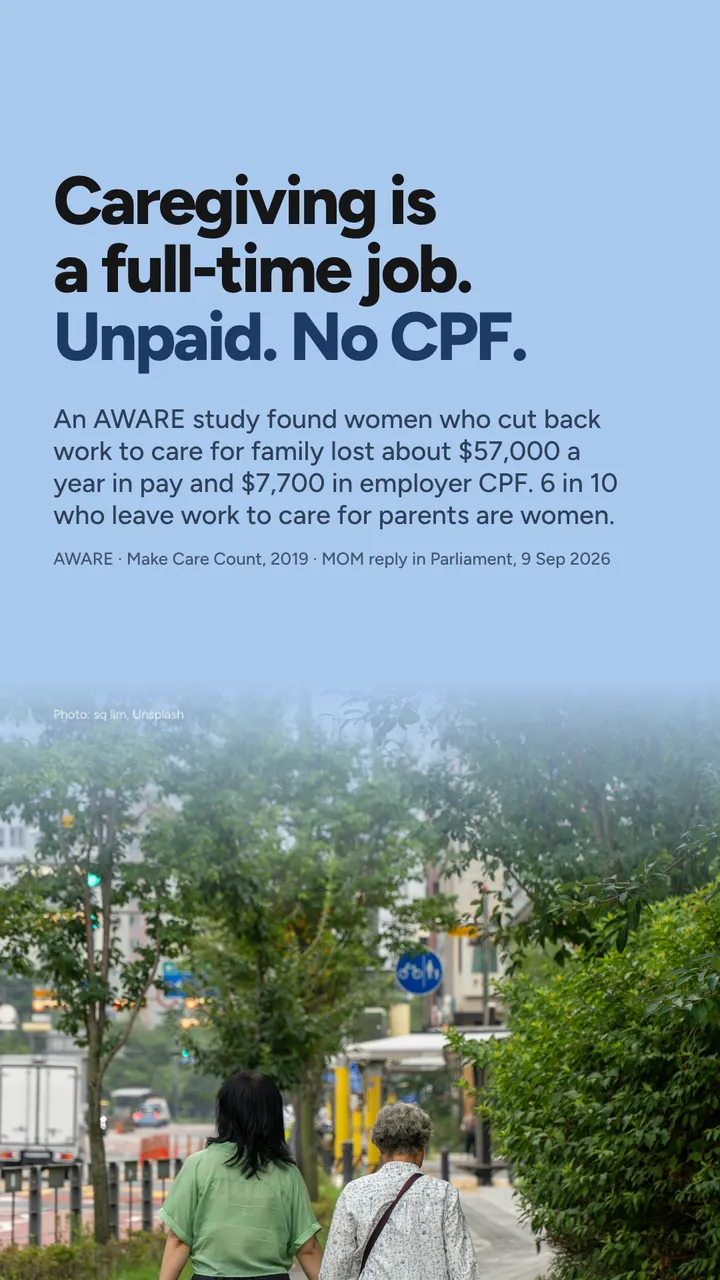
This is the slide I care about most, because it's my mum's story.
When my grandmother needed looking after, my mum stepped back from work to do it. She did it for years. Nobody thought of it as a financial decision at the time. She works part-time now, and I help with the bills.
What none of us understood then was what those years cost her. Not only the pay she didn't earn, but the CPF that didn't go in. When you're employed, your employer pays CPF contributions on top of your salary. When you stop working, those stop too, and so does the interest they would have earned over the decades until retirement.
AWARE looked at this in a 2019 study of 22 women caregivers, called Make Care Count. On average, the women had lost about $57,000 a year in pay and about $7,700 a year in employer CPF contributions. That's a small study, so treat it as a picture of what it can look like, not a national average. But even as a picture it's sobering:
| Years out of work | Employer CPF not paid in (at about $7,700 a year) |
|---|---|
| 1 | about $7,700 |
| 3 | about $23,100 |
| 5 | about $38,500 |
Before interest. And it isn't rare. In a written reply in Parliament on 9 September 2026, the Ministry of Manpower said that women made up 59.9% of residents in 2025 who were outside the labour force mainly to care for their parents. Six in 10.
I think caregiving should be talked about like any other big life expense, before it happens, not after.
Worth checking: if someone in your family has stepped back from work to care for someone, sit down together and look at her CPF statement. And if it might be you one day, it's worth talking it through as a family early, while there's time to plan. For anything about what to do with the money itself, a licensed financial adviser is the right person to ask.
Women live longer, so their savings must too
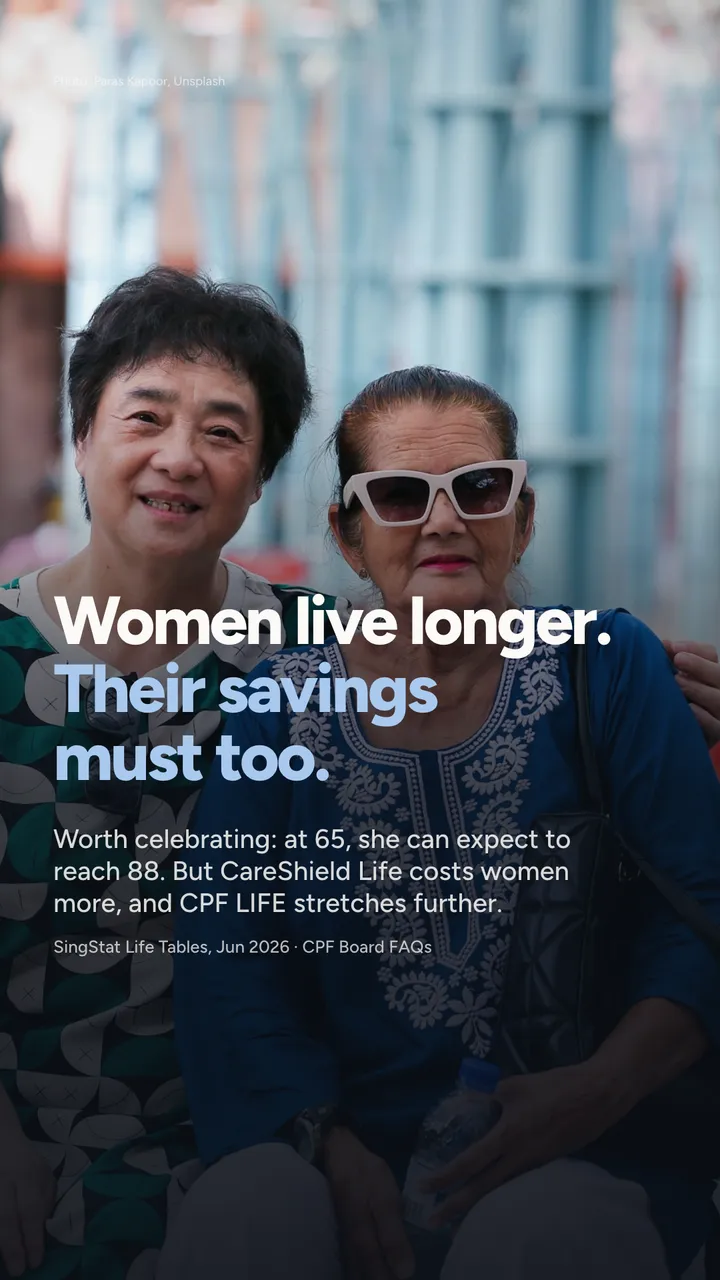
Let's start with the good news, because it really is good news. According to SingStat's latest life tables (published June 2026), a woman in Singapore who reaches 65 can expect to live to about 88. That's more than twenty years of retirement. I'd like mine to include a lot of travel.
The catch is that every one of those years needs paying for. Two schemes show it clearly:
- CareShield Life is the national long-term care insurance. It pays out a monthly amount if you become severely disabled and need long-term care. Its premiums are higher for women, which reflects that we tend to live, and need care, for longer.
- CPF LIFE is the scheme that turns your CPF savings into a monthly payout for as long as you live. The longer it's expected to pay, the further the same savings have to stretch, so the monthly payout for a woman from a given amount of savings is a little smaller.
Neither is unfair; it's arithmetic. But the same savings have more work to do, which is why the career gaps on the slide before matter so much.
Worth checking: your CareShield Life premium and your CPF LIFE payout estimate, both on the official CPF pages. Knowing the real numbers beats a vague worry.
Modern careers, traditional expectations

I didn't count this one in the five, because it's not something you pay for at the till. But it might be the cost that makes all the others worse.
Many of the women I know work full days and then come home to a second shift: dinner, laundry, homework, the parents' medical appointments. CNA wrote about exactly this in 2022, and the headline asked the question better than I can: why is it still a woman's job to run a household?
Here's where it touches money. Tracking your spending, setting a budget, checking your CPF, all of it takes time. If your evenings are already full, that's the first thing to go.
So who has the time to track her money? Honestly, often nobody. Which is why I think the answer has to be making it take less time, not asking women to find more.
If you only remember three things
- Some costs are charged to women and some are expected of them. Give each one a name and a line in your budget, so it stops being a surprise or a source of guilt.
- Caregiving and a longer life both reach your CPF. Talk about care as a family before it happens, and look up your real CareShield Life and CPF LIFE numbers.
- The hardest part is usually time, not discipline. Make tracking as close to automatic as you can.
How I keep track of this

A shameless plug, since I'm on the marketing team. But it's also genuinely how I do it.
Sum sorts my spending into categories on its own. I link a bank, or import a statement, and every line gets sorted. That's what makes the time problem smaller: I'm not typing anything in on a weeknight.
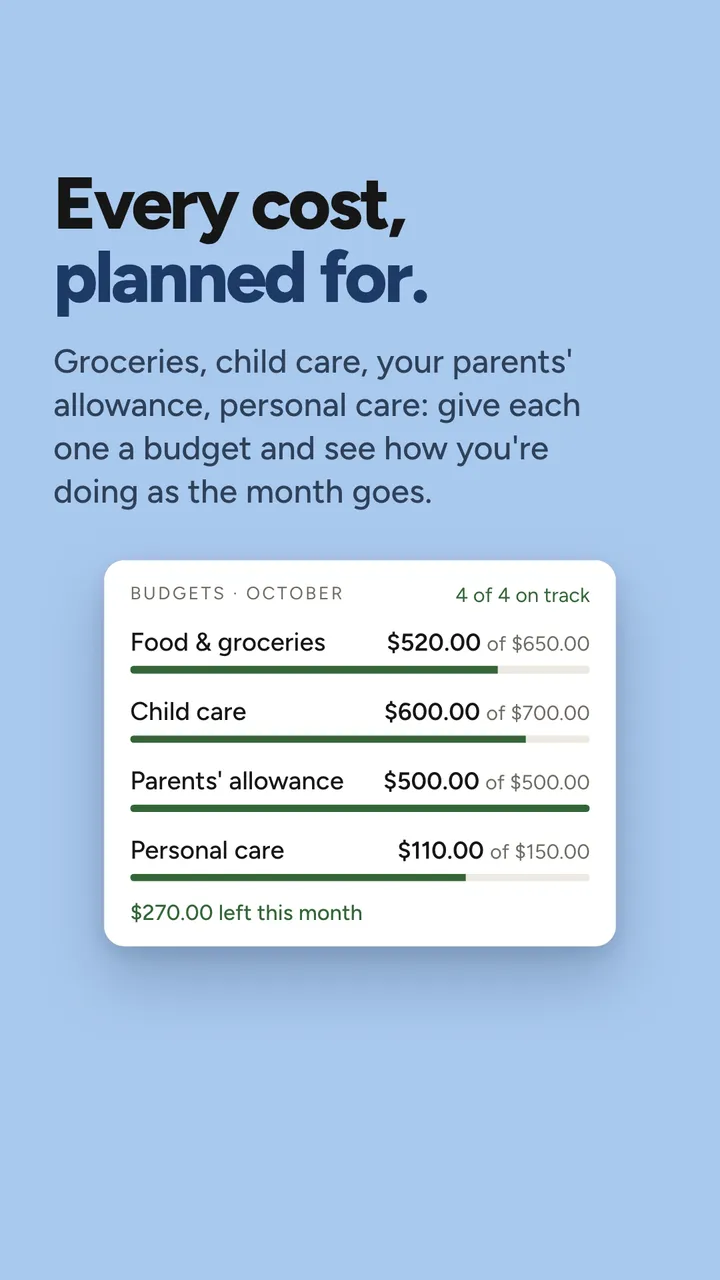
Then budgets. The example on the slide is a real-looking month, not a vanity one: food and groceries, child care, a parents' allowance and personal care, each with its own amount. Mine looks different, with rent in Toa Payoh and my share of Mum's bills, but the idea is the same. Every cost on this list gets a line, and I can see as the month goes whether I'm on track.
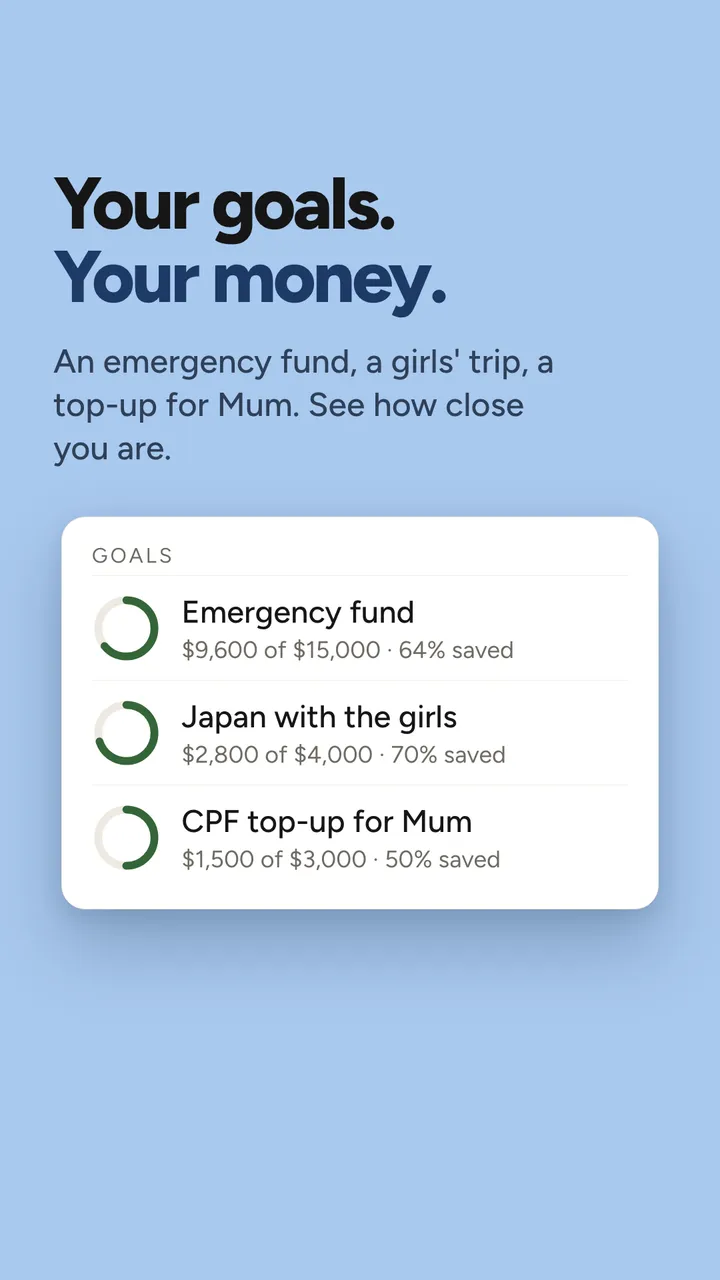
And goals, which are my favourite part. An emergency fund, a trip with friends, something for Mum. Seeing how close I am to each one is what keeps me going on the weeks I'd rather not look. Budgets and goals are part of Sum's free plan, so it's free to start.
Financial freedom is yours too. I hope this post helps you plan for the costs nobody warned you about.
Jacqueline

Sum is launching in Singapore soon.
Your banks, cards, CPF and HDB flat, added up into one net worth. Statements sorted, card caps tracked, bills remembered.
Jacqueline · Marketing team, Sum
Jacqueline runs content and social at Sum in Singapore. Jacqueline makes our TikTok and Instagram carousels and decides which one goes up on which day. Questions or something to share? Email Jacqueline at [email protected].

Got something interesting to share?
A money story, a question, something we got wrong, or a tip other Singaporeans should hear. Reach out to me at [email protected], or leave your email and I'll write to you.
Sources: AWARE, Make Care Count (2019), research on women caregivers; MOM, Parliament questions and replies (written reply, 9 Sep 2026); SingStat, Complete Life Tables for Singapore Resident Population, 2024–2025 (3 Jun 2026); CareShield Life, premiums and FAQs; CPF Board, CPF LIFE monthly payouts.
Any app screens shown use sample data, not a real person's. Sum is free to start; some features need a paid plan.
Information only, not financial advice.