Citi SMRT card review: 5% on rides, groceries and online, after $500
How the Citi SMRT card pays as at 1 Nov 2026: 5% on SimplyGo rides, groceries, online and taxis after S$500, the SMRT$600 yearly cap, expiry and the fee.
- Bus and MRT rides earn a bonus
- Low $500 minimum
- Fee waived for the first two years
- Capped at SMRT$600 a card year
- SMRT$ expire
- Under $500 a month, everything earns 0.3%
Ethan's own opinion of the card as reviewed below. His full rating is at the end.
The Citi SMRT card pays 5% on bus and MRT rides, taxis, groceries and online shopping. Fares show on a card statement as a line usually called BUS/MRT. On a lot of cards that line earns nothing at all, and this is one of the few where it's a bonus category. The catch: the 5% needs $500 of spending in the statement month, the total has a yearly cap, and SMRT$ expire.
Here's what it pays, the $500 minimum, the yearly cap, how SMRT$ are used and when they expire, and a worked year you can redo with your own numbers.
The Citi SMRT card at a glance
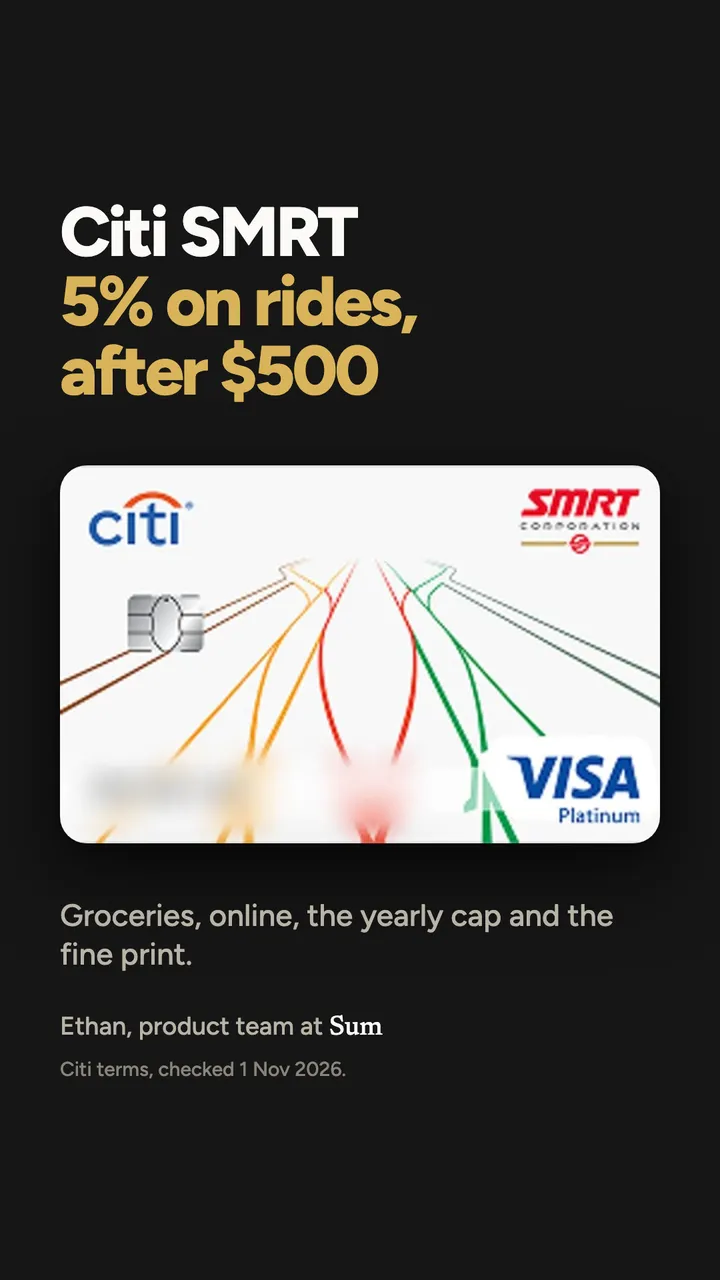
| Citi SMRT (Visa) | |
|---|---|
| Minimum income | $30,000 a year (Singaporeans and PRs), $42,000 (foreigners), as listed on the Citi product page |
| Annual fee | $196.20 including GST, first 2 years waived |
| Bonus categories | 5% on groceries, online, SimplyGo rides, taxis and private hire, with $500 qualifying spend in the statement month |
| Everything else, or under $500 | 0.3% |
| Cap | SMRT$600 per 12 months from issue or renewal; no monthly cap |
| How it's counted | On the month's qualifying spending, not purchase by purchase |
| Value | 1 SMRT$ = $1 |
| Getting it out | Cash rebate in the Citi Mobile app, or by SMS in $10, $50 or $100, from SMRT$10 |
| Expiry | 15 months from the start of each 12-month period |
Figures from the Citi SMRT$ Rewards Program terms (updated November 2024, in effect from 16 December 2024) and the Citi product page, checked 1 Nov 2026.
How much cash back does it pay?
The card pays in SMRT$, and clause 4(c) of the terms says each SMRT$ is worth $1. Clause 3 sets two rates: - 0.3% on all qualifying retail spend, with no minimum (clause 3(a)). - With $500 of qualifying spend in the statement month, an extra 4.7%, so 5% in total, on four categories (clause 3(b), Tables A and B): - groceries: supermarkets and grocery stores, merchant code 5411; - online: purchases on websites and in apps that the merchant's system flags as online, excluding mobile wallet and travel bookings; - SimplyGo (tap to pay): bus and MRT rides, code 4111 with the description BUS/MRT; - taxis: code 4121, including private hire such as Grab and Gojek.
A merchant code is the four-digit number the shop's bank gives it (MCC). It's what decides the category, not the name on the receipt.
A $120 supermarket shop in a qualifying month is $120 × 5% = SMRT$6.
Bottom line: "statement month" means the period between two statement dates, not the calendar month (clause 3(b) says so in as many words). Know your statement date.
Bus and MRT rides: what counts
The bonus is on SimplyGo tap-to-pay fares: tapping your contactless card, phone or watch at the gantry or on the bus, which then shows as BUS/MRT on the statement. Citi's product page says plainly that public transport means SimplyGo tap-to-pay transactions only.
Two things don't count: - Topping up an EZ-Link card with the credit card. Citi's exclusion list names EZ-Link and TransitLink, and the terms exclude top-ups to prepaid cards (clause 1(i)(x)). - Rides on other Citi cards. Citi's exclusion list names BUS/MRT for every Citi card, with a footnote that the Citi SMRT card is the exception.
Fares are small, so how the bonus is counted matters. Clause 4(d) says SMRT$ are worked out on the month's qualifying spending, not purchase by purchase. Say Mei Ling, a made-up example, spends about $3 a day on fares, 22 working days a month: $3 × 22 = $66, and $66 × 5% = SMRT$3.30. No ride is too small to count.
Bottom line: a top-up earns nothing on this card. Tapping the card itself is what earns.
The $500 minimum, and whether rides count towards it
Here the terms are less tidy. The minimum is $500 of Qualifying Retail Spend in the statement month, and clause 3(b) says spending that isn't Qualifying Retail Spend doesn't count towards it. The definition of Qualifying Retail Spend (clause 1(i)(xi)) leaves out "transit-related transactions". Table A then lists SimplyGo as a bonus category anyway.
So rides clearly earn the 5%. Whether they also count towards the $500 isn't spelt out, and the product page doesn't say either.
Bottom line: if your month lands well above $500 without your fares, this doesn't matter. If it's close, ask Citi directly how your rides are counted.
The SMRT$600 a year cap
There's no monthly cap. Instead, clause 4(c) caps the total at SMRT$600 in any 12-month period, starting from the date the card is issued, or from the statement date in the month the card is renewed.
SMRT$600 at 5% is $600 ÷ 5% = $12,000 of bonus-category spending in the year, or $1,000 a month on average. A month of $1,000 in the bonus categories earns $1,000 × 5% = SMRT$50. Twelve of those is exactly SMRT$600.
Bottom line: a big month doesn't hit a ceiling on its own, but it uses up more of the year's SMRT$600. Above about $1,000 a month in these categories, the last months of your card year may earn nothing.
Grab, online shopping and mobile wallets
The terms add three conditions: - Grab: only rides charged directly to the card get the bonus. Rides paid from a GrabPay wallet linked to the card don't, and GrabPay top-ups are excluded too (clause 3, Table B). - Online: the online bonus leaves out mobile wallet payments, so paying in an app with Apple Pay or Google Pay doesn't get it. - Travel: airlines, hotels, car rental, railways, bus lines, cruises, travel agencies and similar codes are left out of the online bonus (clause 1(h)). Booking a flight online earns 0.3%.
Citi is also running a separate promotion of 5% on Malaysian ringgit spending until 28 February 2027, on the product page. It has its own terms.
Bottom line: for Grab, check whether your rides are charged to the card or to the wallet. The app shows it in the payment method.
Using SMRT$, and when they expire
SMRT$ can be redeemed once you have at least SMRT$10 (clause 4(e) and 5(a)): - as a cash rebate on the card through the Citi Mobile app (clause 5(m)); - by SMS, in amounts of $10, $50 or $100 (clause 5(b)); - or as SMRT$ Rewards Vouchers, in multiples of SMRT$10, valid for 3 months from issue (clause 4(f)).
SMRT$ expire. Clause 4(h) says SMRT$ earned in each 12-month period are valid for 15 months from the start of that period, and Citi puts a reminder on your statement for the three months before they expire.
Bottom line: SMRT$ earned early in a card year last about 15 months. SMRT$ earned in its last month last about 3. Redeeming once or twice a year keeps that from mattering.
What doesn't earn SMRT$
Clause 1(i) lists what isn't qualifying spend: bill payments, education, government payments (tax, postal services, parking), insurance, payments to banks and brokerages, non-profits, gambling, top-ups to payment apps and prepaid cards, transit-related transactions other than the SimplyGo bonus, and the codes and merchants on Citi's exclusion list (such as utilities, property rentals, hospitals, EZ-Link and YouTrip).
Bottom line: the annual insurance premium and the tax bill earn nothing here, and don't help you reach $500.
How it compares on public transport rides
Cashback cards that pay a higher rate on SimplyGo bus and MRT rides, as at 24 Oct 2026 (OCBC 365 as at 1 Nov 2026, when its new terms began), from each bank's terms, ranked by the rate on rides:
| Card | Rides | Minimum spend | Cap |
|---|---|---|---|
| POSB Everyday | 10% | $800 a calendar month | $20 of bonus a month on rides |
| OCBC 365 | 6% | $800 a calendar month | $160 a month in total |
| Maybank Family & Friends | 6% (8% from $1,600), if Commute is one of your categories | $800 a calendar month | $20 per category ($30 from $1,600) |
| Citi SMRT | 5% | $500 a statement month | SMRT$600 per card year |
Fares are a small share of most people's spending, so the other bonus categories and the minimum usually matter more than the rate on rides. On the Citi SMRT card, groceries and online earn the same 5% as rides, and its $500 minimum is the lowest here. The Citi Cash Back review covers Citi's card that pays more on dining, groceries and rides but nothing on the MRT.
A worked year
Say Siew Ling is 45. In a typical month her card shows $66 of bus and MRT fares, $350 at supermarkets, $200 of online shopping, $40 of taxi and Grab rides charged to the card, and $150 on other things. Made-up example.
| Monthly sum | SMRT$ | |
|---|---|---|
| Fares, groceries, online, rides | ($66 + $350 + $200 + $40) × 5% = $656 × 5% | 32.80 |
| Other | $150 × 0.3% | 0.45 |
| Month | 33.25 |
Over a year that's 33.25 × 12 = SMRT$399, under the SMRT$600 cap. Even without her fares, her qualifying spending is $806 − $66 = $740, so the $500 question doesn't affect her. The fee is waived for the first two years. From the third, $196.20 brings the year down to $202.80.
If one month she spent $450 in total, that month would earn $450 × 0.3% = SMRT$1.35.
Bottom line: swap in your own categories and check how many of your months clear $500. The calculator page does the same sums for a few typical months: Citi SMRT on the card rewards calculator.
Three things to remember
- 5% on SimplyGo rides, taxis, groceries and online, in statement months with $500 of spending. Under $500, everything is 0.3%.
- SMRT$600 a card year is the ceiling, about $1,000 a month in the bonus categories.
- SMRT$ expire after 15 months, and GrabPay, mobile wallets online and EZ-Link top-ups don't get the bonus.
Ethan's rating
Earn rate
- Very low
- Low
- Moderate

- High
- Very high
Effort to earn
- Effortless
- Easy
- Some effort
- Shiong
- Very shiong
Value for the fee
- Way overpriced
- Overpriced
- Fair
- Good value
- Great value
Against other rewards cards
- Bottom
- Below average
- Average
- Above average
- Top
Where it earns
- DiningLow
- GroceriesGood
- TransportBonus rate
- OnlineGood
- TravelLow
- OverseasLow
- Everything elseLow
One person's opinion, from the terms in this review. Your own spending decides what a card is worth to you.
Track it in Sum
Import your card statements. The card optimiser reads each line the way the bank's terms do, BUS/MRT included, so fares show as earning or not earning depending on the card. The trackers show how far you are from a card's minimum in the current statement month, which is the number that matters on a card like this.
Ethan
Got something interesting to share?
Something here doesn't match your statement, or Citi changed the terms? Reach out to me at [email protected], or leave your email and I'll write to you.
Questions people ask
How much cash back does the Citi SMRT card give?
5% in SMRT$ on groceries, online purchases, SimplyGo bus and MRT rides, and taxi and private-hire rides, in statement months with at least S$500 of qualifying spending. Everything else, and every month under S$500, earns 0.3%. 1 SMRT$ is worth S$1.
Does the Citi SMRT card give cash back on MRT rides?
Yes, on SimplyGo tap-to-pay rides, which show on the statement as BUS/MRT. EZ-Link top-ups earn nothing.
Is there a cap on Citi SMRT cash back?
Yes. You can earn at most SMRT$600 in each 12-month period, counted from when the card is issued or renewed. There's no separate monthly cap.
Do SMRT$ expire?
Yes. SMRT$ earned in each 12-month period are valid for 15 months from the start of that period.
How do I redeem SMRT$?
As a cash rebate on the card through the Citi Mobile app, or by SMS in amounts of S$10, S$50 or S$100. You need at least SMRT$10.
Does Grab earn 5% on the Citi SMRT card?
Grab rides charged directly to the card do. Rides paid from a GrabPay wallet, and GrabPay top-ups, don't get the bonus.
Try the numbers yourself

Sum is launching in Singapore soon.
Your banks, cards, CPF and HDB flat, added up into one net worth. Statements sorted, card caps tracked, bills remembered.
Ethan · Product team, Sum
Ethan is on Sum's product team in Singapore. Financial planning and investing took care of Ethan's own money long ago, so this isn't for the pay. The economy right now is rough on Singaporeans, and we are grateful Ethan is determined to alleviate some of this pain here at Sum.
If we listed a wrong number, or you caught a term that changed before we did, email Ethan at [email protected].
Sources: Citi: Citi SMRT$ Rewards Program T&C, updated November 2024, effective 16 Dec 2024 (PDF); Citi: Citi SMRT Card; Citi: Rewards exclusion list, effective 16 Dec 2024 (PDF).
Any app screens shown use sample data, not a real person's. Sum is free to start; some features need a paid plan.
Information only, not financial advice.